admin
admin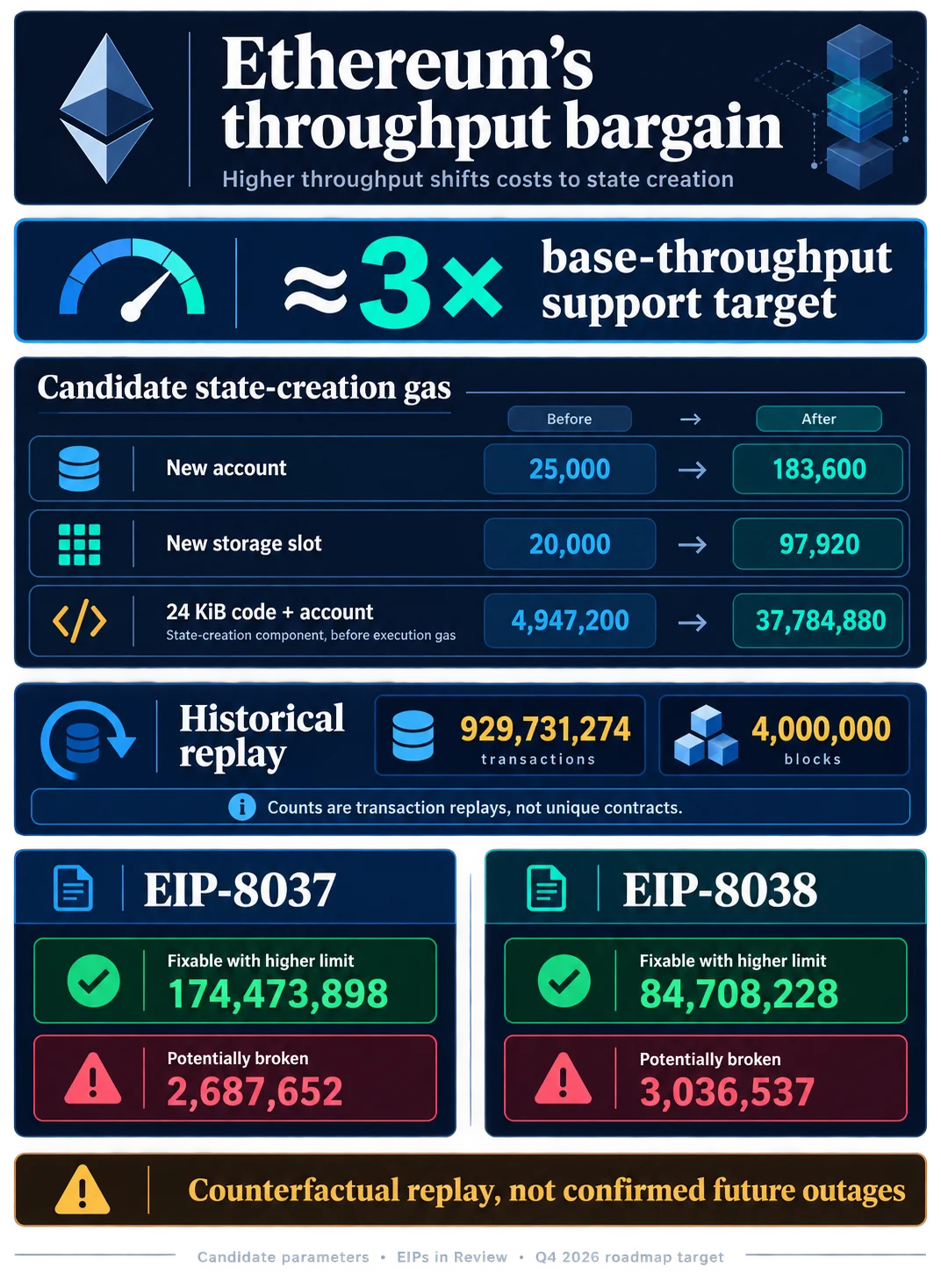
The Ethereum Foundation is preparing for a significant network upgrade, codenamed Glamsterdam, aimed at substantially increasing base-layer transaction throughput. This ambitious initiative centers on a fundamental repricing of gas costs, meticulously aligning charges with the actual network resources consumed by transactions, particularly those that create and modify persistent state. The proposed changes, encapsulated within Ethereum Improvement Proposals (EIPs) 8037 and 8038, are slated for testing and eventual deployment in the fourth quarter of 2026, with specific dates for testnet and mainnet forks yet to be finalized. This strategic adjustment is designed to enable roughly three times the current base throughput by making the cost of operations directly proportional to their impact on the Ethereum network’s state.
The core philosophy behind Glamsterdam is to ensure that every operation on the network is accurately costed based on its resource utilization. Historically, Ethereum’s gas mechanism has evolved, but this upgrade represents a more granular and impactful recalibration. By increasing the gas cost associated with creating new accounts, deploying smart contract bytecode, and allocating new storage slots, the network aims to manage the ever-growing demand on its persistent state. This approach acknowledges that storing data and code on the blockchain is a significant resource drain for nodes, and thus, these operations should bear a commensurate cost. The Ethereum Foundation has indicated that the candidate schedule for Glamsterdam is currently undergoing rigorous review, with EIP-8037 and EIP-8038 holding a formal "Review" status. This designation signifies that while the proposals are being seriously considered and tested, they have not yet reached the final stages of consensus for implementation.
Background Context: The Ever-Expanding State of Ethereum
Ethereum’s persistent state, often referred to as its "world state," comprises all the accounts, balances, contract code, and storage data that every node on the network must store and maintain. As the ecosystem has grown, so too has this state. In January 2026, the state portion of a Geth database, a widely used Ethereum client, was reported to be approximately 390 GiB. This ever-increasing state size presents a fundamental scalability challenge.
The network has previously seen adjustments to its gas limit, with a notable increase from 30 million to 60 million gas per block. Following this adjustment, the average daily increase in new state created on the network surged from roughly 105 MiB to 326 MiB, translating to an annual growth rate of about 116 GiB. The Glamsterdam proposals extrapolate this trend, simulating the impact of a significantly higher gas limit, specifically a hypothetical 200 million gas limit. Under such a scenario, the projected annual growth of new state could reach approximately 387 GiB. This projection highlights a critical concern: without recalibration, the network’s state could exceed performance thresholds within a year, impacting node efficiency and decentralization.
EIP-8037 addresses this by proposing a common cost of 1,530 gas for every byte of new state created. Coupled with a dedicated "state-gas dimension," this parameter aims to cap average annual state growth at around 120 GiB, assuming a reference block limit of 150 million gas. Even in a worst-case scenario with a 200 million gas limit after repricing, the proposal targets annual growth of no more than 160 GiB. This deliberate repricing strategy aims to make the creation of new state significantly more expensive, thereby encouraging more efficient use of blockchain resources.
The impact of these changes on specific state-creation operations is substantial, as illustrated by comparative gas charges:
| State-creation operation | Current Charge (Gas) | Candidate State-Gas Charge (Gas) |
|---|---|---|
| Create a new account | 25,000 | 183,600 |
| Create a new storage slot | 20,000 | 97,920 |
| Deploy 24 KiB of code + new account | 4,947,200 | 37,784,880 |
This table clearly demonstrates the dramatic increase in gas costs for fundamental state-altering operations. The repricing is structured to separate the cost of computational execution from the cost of permanent state additions. While computational work remains accommodated, the new gas dimension places a ceiling on the growth of persistent network state.
EIP-8038 complements EIP-8037 by focusing on the costs associated with accessing and writing to existing state. This proposal stems from client benchmarks conducted on a state snapshot comparable to the mainnet in March 2026, aiming to adjust account and storage costs for read and write operations on already established data.
Together, EIP-8037 and EIP-8038 are engineered to support a threefold increase in network throughput by creating greater headroom for higher block gas limits. It’s crucial to understand that this upgrade doesn’t guarantee an immediate tripling of mainnet capacity but rather creates the technical foundation and economic incentives to allow for it.
Testing and Replay Analysis: Quantifying the Impact
To gauge the potential effects of these repricing changes, a comprehensive analysis was conducted, replaying approximately 929.7 million transactions across 4 million blocks. This dataset, spanning from December 3, 2024, to June 15, 2026, was used to simulate transaction outcomes under both the current gas schedule and the proposed candidate schedule. Researchers meticulously replayed each transaction against its canonical pre-transaction state, first using its original gas limit and then allowing it to extend up to ten times that limit. The analysis tracked success rates, gas consumption, log generation, output, and execution traces.
Under EIP-8037, the replay analysis revealed that 174,473,898 transactions, which would have failed at their original gas limits, could succeed with increased gas under the new parameters. However, 2,687,652 transactions entered a "potentially broken" group, indicating issues that might not be resolved by simply increasing gas. For EIP-8038, the figures showed 84,708,228 transactions that were "fixable" with a higher gas limit, while 3,036,537 transactions were flagged as potentially broken.
It’s important to note that these figures represent transaction counts and not necessarily unique smart contracts at risk. Busy applications often generate a high volume of repeated transactions, which can skew these numbers. The "potentially broken" cohort is particularly significant as it identifies transactions that may revert for reasons beyond simple out-of-gas errors, even with increased gas allowances. These could include logical issues arising from the new gas costs altering execution behavior, or fundamental design assumptions that are no longer valid.
The vast majority of affected transactions fall into the "fixable" category. This implies that for many applications, the primary challenge will be adapting frontend interfaces, bundlers, and infrastructure providers to submit transactions with appropriate gas limits that reflect the new pricing structure. However, the "potentially broken" group highlights more complex issues. These include:
- Fixed 2,300-gas stipends: Certain operations have a fixed gas stipend that may no longer be sufficient.
- Hardcoded gas forwarded to internal calls: Contracts that hardcode gas amounts for internal calls might fail if these amounts are insufficient under the new pricing.
- Logic branching on
gasleft(): Smart contracts that dynamically adjust their behavior based on the remaining gas might encounter unexpected outcomes. - Presigned transactions with fixed limits: Transactions signed with pre-determined gas limits could fail if those limits are now inadequate.
An outreach report targeting specific implementations, such as the eth-infinitism ERC-4337 EntryPoint and related smart account stacks (including ZeroDev and Alchemy), has been published. This report identifies recurring counterfactual failures involving prominent protocols like Across, Socket/Bungee, CoW Protocol, and 0x. For applications with immutable contracts, adapting to the new gas economics could be operationally expensive, potentially requiring the deployment of new EntryPoint, account, factory, or validator implementations, followed by user migration. Other systems might find solutions through improved routing, batching mechanisms, or adjustments to gas accounting logic. ERC-4337 bundlers, in particular, will need to enhance their simulation capabilities and adjust submitted gas limits to accommodate the repricing, while also implementing validation guards for scenarios where internal gas assumptions might still cause reverts.
Timeline and Deployment Schedule
The Glamsterdam upgrade is a multi-stage process designed to ensure stability and allow for thorough testing before impacting the main Ethereum network. The Ethereum roadmap indicates a target deployment for the fourth quarter of 2026. This timeline includes several key phases:
- Candidate Schedule: The current phase involves the development and refinement of EIP-8037 and EIP-8038.
- Formal Review: Both EIPs are currently in the "Review" status, indicating they are undergoing technical scrutiny and community discussion.
- Testnet Deployment: The upgrade will first be deployed on Ethereum’s public testnets. The roadmap mentions fixed Sepolia and Hoodi testnet fork dates are still to be announced, providing developers with crucial environments to test their applications under the new gas economics.
- Mainnet Fork: Following successful testing on testnets, the Glamsterdam upgrade will be activated on the Ethereum mainnet.
The exact dates for the Sepolia, Hoodi, and mainnet forks are anticipated to be announced in the coming months, allowing builders a significant testing window to adapt their infrastructure and applications before the candidate parameters and deployment schedule become immutable. The previously reported Glamsterdam fork on August 20, 2026, with subsequent reporting of live repricing by August 24, suggests an accelerated development and testing cycle, though the official roadmap’s Q4 2026 target remains the definitive timeline. This staggered approach is a hallmark of Ethereum’s upgrade process, prioritizing network stability and user experience.
Implications for Developers and Users
The Glamsterdam upgrade will necessitate significant updates across the Ethereum ecosystem. Wallets, RPC providers, indexers, node tooling, and gas estimators must integrate the new gas pricing rules. Frontends and bundlers will need to cease reliance on cached constants or gas limits calibrated to the previous schedule.
Crucially, both EIP-8037 and EIP-8038 require updates to the eth_estimateGas RPC method and related estimation logic to accurately reflect the new costs. The announcement regarding the Platåberget testnet also highlighted that tools built around hardcoded maximum gas limits or a singular gas dimension will likely encounter issues and require revision.
For end-users, the impact should be largely transparent if the underlying infrastructure and wallets are updated correctly. A simple ETH transfer to an existing account will still cost the familiar 21,000 gas. However, sending value to an account that does not yet exist will incur the new, higher state-creation charge at runtime. This means any software that assumes all transfers can fit within the old constant gas limit will need to be revised.
The primary burden of adaptation falls on developers. They are tasked with resimulating their transactions, meticulously reviewing fixed gas stipends and internal call limits within their smart contracts, and rigorously testing all affected application paths against the candidate Glamsterdam schedule. This proactive approach is essential to ensure a smooth transition and prevent unexpected failures upon mainnet activation.
Analysis and Outlook
Ethereum’s strategy to enhance throughput through gas repricing is a testament to its iterative and adaptive approach to scalability. By directly addressing the cost of state bloat, the network aims to create a more sustainable and performant environment for decentralized applications. The Glamsterdam upgrade represents a significant economic recalibration, incentivizing developers to optimize their contract designs and state interactions.
The success of this upgrade hinges on the readiness of the ecosystem. The extensive testing and replay analysis provide valuable data, but the real-world impact will depend on the adoption and implementation of the necessary updates by developers, infrastructure providers, and tooling creators. While the move towards higher throughput is a positive development, the increased cost of state creation suggests a shift in how developers will need to approach blockchain resource management. Emphasis will likely grow on more efficient data storage, state minimization techniques, and potentially Layer-2 scaling solutions that abstract away some of these base-layer cost considerations.
Ethereum’s ability to "price its way" toward greater throughput demonstrates a sophisticated understanding of market dynamics and network resource allocation. However, the window of opportunity for builders to adapt their existing code and tooling to the new gas economics is limited. Proactive engagement with the proposed changes, thorough testing, and timely implementation of necessary revisions will be critical for a seamless transition and the continued growth and innovation of the Ethereum ecosystem. The Glamsterdam upgrade, therefore, is not just a technical enhancement but a strategic economic maneuver designed to ensure Ethereum’s long-term scalability and resilience.