admin
admin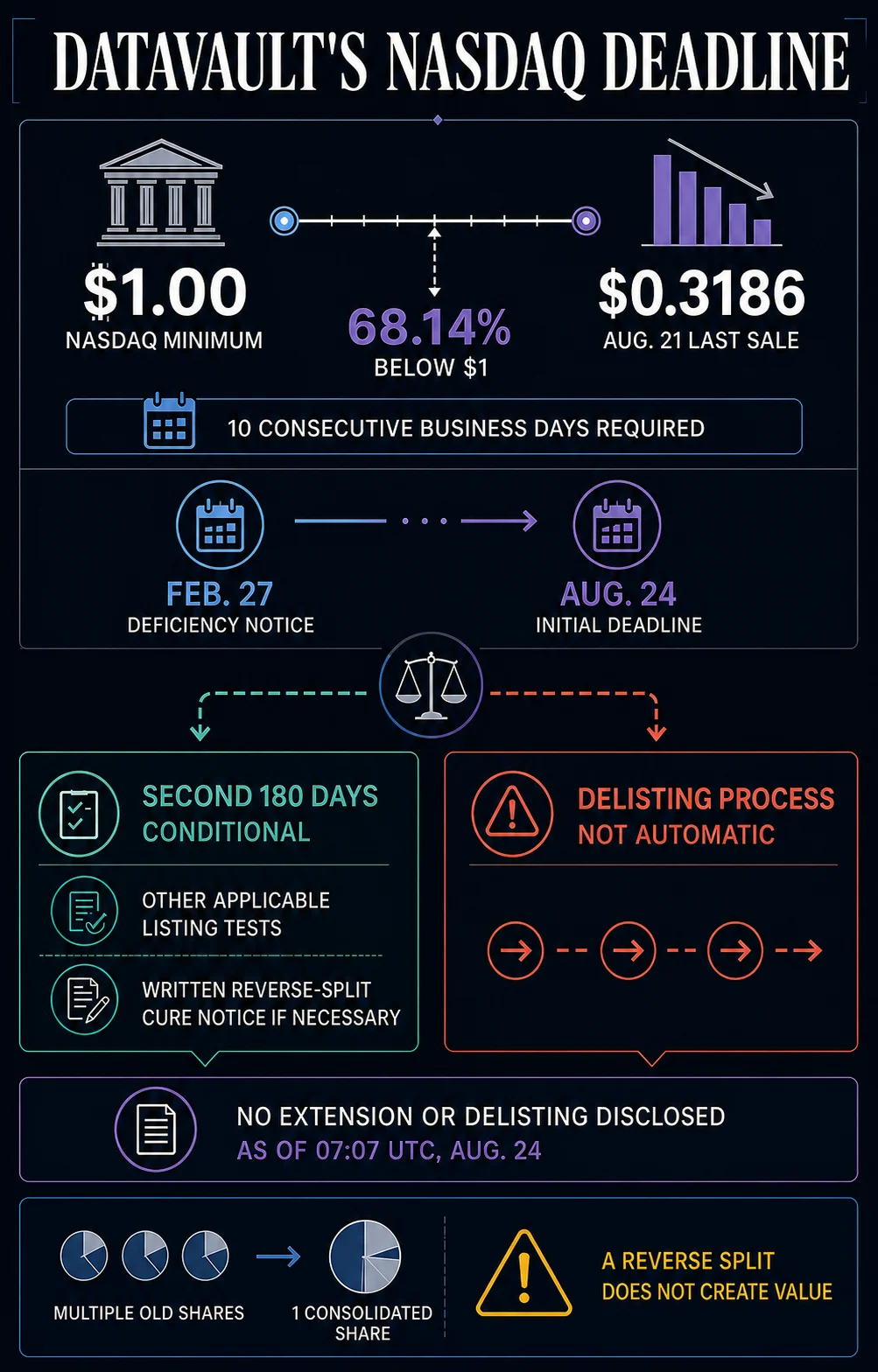
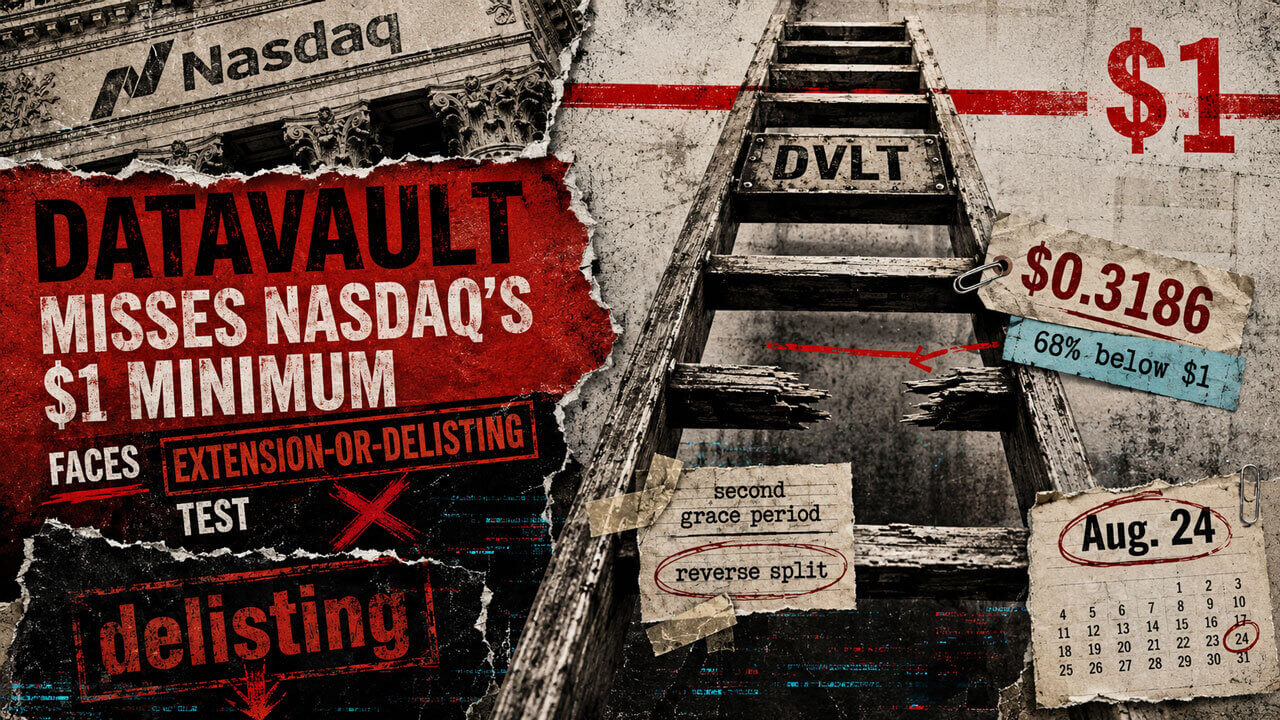
Datavault AI is facing a critical juncture as its mandated deadline to regain compliance with Nasdaq’s minimum bid price requirement arrives on August 24. The company’s stock, trading as DVLT, has been persistently below the exchange’s $1 threshold, currently standing at a mere $0.3186 as of August 21, representing a staggering 68% deficit. The outcome of this deadline is pivotal, with investors and stakeholders awaiting news on whether Nasdaq will grant an extension or initiate delisting procedures.
The gravity of the situation is underscored by the fact that Datavault AI’s stock has consistently closed below $1 for at least the past ten consecutive business days, as indicated by Nasdaq’s official quote feed and historical data. This prolonged period of underperformance has left the company with virtually no practical pathway to achieve the required 10-day closing bid price cure within the remaining window. The initial notification from Nasdaq regarding this deficiency was detailed in a February 27 filing, which stipulated that the company had until August 24 to rectify the situation.
The Nasdaq Minimum Bid Price Rule and Datavault’s Current Standing
Nasdaq’s continued listing standards are designed to ensure that companies traded on its exchange maintain a certain level of market capitalization and investor confidence. One of the most fundamental of these is the minimum bid price rule, which requires a stock to maintain a closing bid price of at least $1. This rule is crucial because a sustained low stock price can signal underlying financial distress, a lack of investor interest, or a general decline in the company’s perceived value. For investors, a stock trading below $1 is often viewed with caution, as it can also indicate a higher risk of delisting, which can significantly impact liquidity and investment value.
Datavault AI’s DVLT ticker has been languishing significantly below this critical $1 mark. On August 21, the last recorded sale price was $0.3186. Examining Nasdaq’s historical data for the period between August 7 and August 21 reveals a consistent pattern of closing or last sale prices below $1. This persistent underperformance directly contravenes Nasdaq’s requirement for a minimum closing bid price of $1 for at least 10 consecutive business days.
A Narrow Window for Compliance and Potential Next Steps
The February 27 filing from Datavault AI clearly outlined the terms of the deficiency notice from Nasdaq. The company was granted a grace period, culminating on August 24, to demonstrate compliance. Achieving compliance necessitates a closing bid price of $1 or higher for a minimum of 10 consecutive business days within this period. Given that August 21 was the last trading day before the deadline, and the stock remained significantly below $1, the mathematical possibility of fulfilling this requirement within the remaining trading days is effectively zero.
This situation leaves Nasdaq with two primary courses of action: either grant Datavault AI an extension to rectify the deficiency or issue a formal notice of delisting. The exchange’s rules provide a framework for such scenarios, allowing for a potential second chance under specific conditions.
Nasdaq’s Conditional Extension and Continued Listing Requirements
Under Nasdaq’s established compliance rules, specifically within its Capital Market issuer guidelines, a company that fails to meet the minimum bid price requirement may be granted an additional 180-day period to regain compliance. However, this extension is not automatic and is contingent upon the company meeting other critical continued-listing standards. These include satisfying the applicable continued-listing test for the market value of publicly held shares and adhering to all other initial listing requirements, with the exception of the bid price itself.
Crucially, for a company to be considered for this extended compliance period, it must formally notify Nasdaq in writing of its intent to cure the deficiency within the second period. This notification often includes a commitment to implementing measures such as a reverse stock split, if deemed necessary, to artificially boost the per-share price. This written notice serves as a commitment from the company to actively pursue a resolution and signals to the exchange that the company is taking the deficiency seriously.
Datavault AI’s Financial Position and Market Value
As of the close of its June quarter, Datavault AI reported stockholders’ equity totaling $245.9 million. As of August 19, the company had 949.7 million shares outstanding. Applying the August 21 last sale price of $0.3186 to this share count yields an approximate total equity market value of $302.6 million. While this figure represents the company’s overall market valuation, it’s important to note that Nasdaq’s public float requirement is a more specific measure and is not directly represented by this total equity market value. Public filings do not definitively establish the required counts of holders and market makers, which are also critical components of Nasdaq’s eligibility determination.
Timeline of Events and Lack of Formal Announcements
A review of the timestamped SEC submissions feed and Datavault AI’s press release index reveals no official announcements regarding an extension or a Staff Delisting Determination as of the August 24 refresh. This silence from both the company and the exchange adds to the uncertainty surrounding Datavault AI’s future on Nasdaq.
The company’s historical filings do provide some context regarding its ability to enact a reverse stock split. A 2025 authorization, documented in SEC filings, permitted a reverse stock split ratio ranging from 1-for-5 to 1-for-20. This authorization was slated to remain in effect until the company’s annual meeting that year. However, a review of subsequent SEC submissions has not indicated any renewed or replacement authority for such a split.
The Mechanics and Limitations of a Reverse Stock Split
A reverse stock split is a corporate action where a company reduces the number of its outstanding shares by consolidating them. For example, a 1-for-10 reverse split would mean that for every ten shares an investor currently holds, they would now possess one share. Mechanically, this action increases the per-share price, assuming the total market capitalization remains constant. However, it is crucial to understand that a reverse split does not, in itself, create any new economic value for the company or its shareholders. It is a financial maneuver to meet listing requirements, not a solution to underlying business challenges.
While a reverse split can temporarily lift DVLT’s share price above the $1 threshold, it does not guarantee that the stock will remain above $1 in the long term. Investor sentiment, company performance, and broader market conditions continue to influence a stock’s trajectory. Furthermore, a reverse split does not address Datavault AI’s broader capital needs, which appear to be significant.

Datavault AI’s Financial Pressures and Strategic Initiatives
Datavault AI has been navigating considerable financial pressures. In May, the company entered into an agreement to sell 109.1 million shares at a price of $0.55 per share. More recently, its financial reports for the first half of the year indicated a cash balance of $1.4 million alongside an operating cash burn of $79.96 million. These figures highlight a substantial need for capital to sustain its operations.
Adding to these financial considerations is Datavault AI’s publicly stated ambition to acquire a bank. Recent reports have detailed these financing pressures in conjunction with the company’s proposed bank acquisition, suggesting that securing adequate funding is a critical challenge that extends beyond simply meeting Nasdaq’s listing requirements. The proposed acquisition itself would likely require substantial capital infusion, further compounding the company’s financial demands.
Implications and the Path Forward
The immediate future for Datavault AI hinges on Nasdaq’s decision. The company is at a crossroads, with the possibility of an extended lifeline or a formal delisting process looming.
Scenario 1: Nasdaq Grants an Extension
If Nasdaq grants Datavault AI an additional 180-day compliance period, the company will have more time to attempt to raise its stock price. This would likely involve a reverse stock split, as previously authorized, to meet the $1 bid price requirement. However, this extension would only postpone the problem unless the company can demonstrate a clear path to sustainable profitability and investor confidence. The market will be watching closely to see if Datavault AI can leverage this extended period to fundamentally improve its financial standing and operational performance. The company would also need to ensure it meets all other listing requirements, including market value of publicly held shares, which is a separate but equally important metric.
Scenario 2: Nasdaq Issues a Staff Delisting Determination
If Nasdaq determines that Datavault AI does not qualify for an extension, or if the company fails to formally request one with a credible plan, a Staff Delisting Determination would be issued. This would initiate the formal delisting process. Companies typically have a period to appeal such a determination. If delisted from Nasdaq, DVLT would likely trade on over-the-counter (OTC) markets, such as the OTC Pink or OTCQB. Trading on OTC markets generally involves lower liquidity, less regulatory oversight, and a broader range of speculative investors, which can further depress the stock price and make it more difficult for the company to raise capital.
Broader Market Context and Investor Sentiment
The situation with Datavault AI is not unique in the current market environment. Many technology and growth-oriented companies have faced challenges in maintaining their stock valuations, particularly in periods of economic uncertainty or shifting investor sentiment. The high interest rate environment and concerns about inflation have led investors to become more risk-averse, favoring companies with strong profitability and stable cash flows over those with high growth potential but significant cash burn.
For Datavault AI, the combination of a persistent sub-$1 stock price, substantial operating cash use, and ambitious strategic goals like a bank acquisition presents a complex set of challenges. Investors will be scrutinizing any future announcements for clear indications of how the company plans to navigate its financial constraints and meet its operational and strategic objectives. The absence of a formal announcement by the August 24 deadline suggests that Nasdaq is likely in the process of reviewing the company’s situation, and a formal notification will be forthcoming. The decisive signal will be a formal notice from either Nasdaq or Datavault AI itself, clarifying the next steps in this critical period.