admin
admin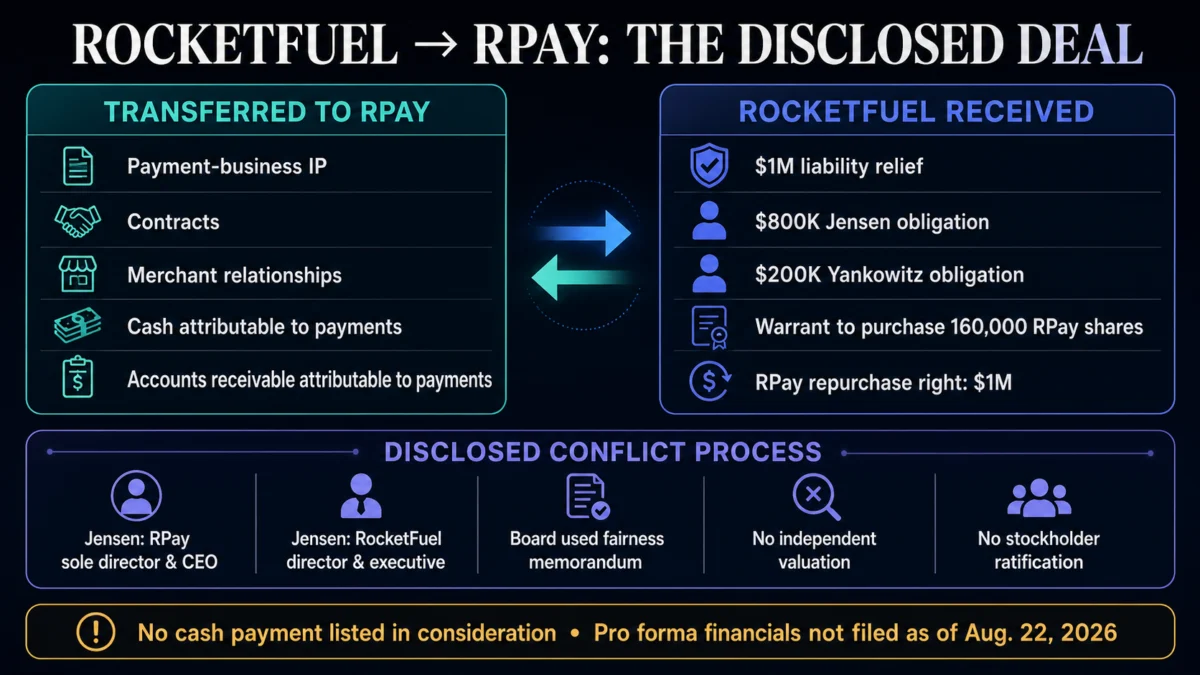
RocketFuel Blockchain has executed a significant internal transaction, transferring substantially all assets associated with its payments division to a newly formed entity, RPay. This move, disclosed in a recent regulatory filing, has raised questions due to the nature of the consideration exchanged and the absence of an independent valuation. The transaction, which closed on August 13, involves the assumption of substantial executive debt by RPay, with Peter M. Jensen, a director and executive officer of RocketFuel, now serving as the sole director and CEO of RPay.
Key Transaction Details Emerge in Regulatory Filing
The disclosure, filed with the Securities and Exchange Commission (SEC) on August 21, outlines a complex arrangement wherein RocketFuel offloaded its payments business assets, including intellectual property, merchant relationships, contracts, and associated cash and accounts receivable, to RPay. The primary consideration for this transfer was not a direct cash injection into RocketFuel but rather the assumption of $1 million in deferred compensation liabilities. Specifically, RPay agreed to take on an $800,000 obligation owed to Peter M. Jensen and a $200,000 obligation to Bennett J. Yankowitz, a former RocketFuel director and executive who remains an advisor to the company. This effectively released RocketFuel from these significant debts.
In addition to the debt relief, RocketFuel received a warrant to purchase 160,000 shares of RPay common stock. However, this warrant is encumbered by a $1 million repurchase right exercisable by RPay at any time. This clause means RocketFuel has not yet secured either the underlying shares or a cash equivalent of $1 million for this portion of the deal at the time of the filing. The filing explicitly noted that Jensen’s interests, given the assumption of his compensation claim and the warrant’s specific terms, diverged from those of RocketFuel’s general stockholders. Yankowitz’s obligation is structured to be paid at a rate of $0.25 for every $1 paid to Jensen, contingent on RPay’s board discretion, further highlighting the intricate nature of the arrangement.
A Shift from Previous Agreements and Lack of External Scrutiny
This recent transaction marks a departure from a preliminary, non-binding term sheet announced in March. That earlier proposal envisioned a multi-entity sale involving both RPay and RPoints, with a broader scope encompassing RocketFuel’s loyalty and rewards business. The March term sheet had contemplated approximately $1.5 million in deferred compensation assumptions, an earn-out based on payments revenue, and warrants representing 20% fully diluted stakes in both RPay and RPoints. The absence of a separate RPoints filing in RocketFuel’s subsequent SEC submissions suggests that the scope of the current RPay-only deal may differ significantly from the initial broader package, making a direct comparison of terms challenging.
Crucially, RocketFuel’s board of directors determined that a stockholder vote was not necessary for this transaction, citing Nevada Revised Statutes (NRS) 78.565. Instead of pursuing an independent valuation of the assets being transferred or seeking explicit ratification from its shareholders, the board approved the deal based on a fairness memorandum. This memorandum, according to the company, addressed the disclosed conflicts of interest inherent in the transaction. This approach, relying on internal assessments rather than external validation, could be a point of concern for investors seeking objective assurance regarding the fair value of the divested assets.
Unresolved Financial Implications and Disclosure Gaps
The full financial impact of the RPay transaction on RocketFuel remains to be definitively assessed. The company has classified the sale of its payments business as a "significant disposition" under SEC asset and income tests, necessitating the inclusion of unaudited pro forma financial statements. However, these crucial financial statements were conspicuously absent from the August 21 filing. RocketFuel has stated its intention to provide these in a subsequent amended Form 8-K/A filing. As of August 22, a review of RocketFuel’s SEC filing history did not indicate that this amendment had yet been submitted, leaving investors and analysts without a clear picture of the company’s post-transaction financial standing. The delay in providing this information further compounds the opacity surrounding the deal.
Background: RocketFuel’s Strategic Pivot
RocketFuel has been navigating a strategic realignment in recent years, aiming to streamline its operations and focus on core areas. The payments business, while a component of its historical operations, may have been identified as a non-core asset or one requiring significant capital investment to maintain competitive standing. The decision to divest these assets, particularly to an entity closely linked to its own executive team, suggests an effort to resolve liabilities and potentially unlock value that was perceived as stagnant within the existing corporate structure.
The deferred compensation obligations represent a long-standing financial commitment. By transferring these liabilities to RPay, RocketFuel effectively removes them from its balance sheet, simplifying its financial obligations and potentially improving its debt-to-equity ratios. The warrant issued to RocketFuel, while seemingly a form of equity participation in the new venture, is subject to significant uncertainty due to the repurchase clause, making its ultimate value contingent on RPay’s future performance and strategic decisions.
Analysis of Potential Implications
The structure of this transaction raises several points for consideration by stakeholders.
Insider Dealings and Corporate Governance: The fact that the buyer, RPay, is led by a RocketFuel director and executive, Peter M. Jensen, and the consideration involves assuming debts owed to him and another former executive, Bennett J. Yankowitz, points to a related-party transaction. While such transactions are not inherently problematic, they require a high degree of transparency and fairness to safeguard minority shareholder interests. The reliance on an internal fairness memorandum rather than an independent valuation is a departure from best practices often expected in significant asset disposals, especially those involving insider parties. This could lead to scrutiny from regulators or shareholder advocacy groups concerned about potential conflicts of interest.

Valuation and Fair Market Value: The absence of an independent valuation is a significant omission. Without an objective assessment, it is difficult for external parties to ascertain whether RocketFuel received fair value for its payments business assets. The $1 million liability relief is a tangible benefit, but the actual market value of the intellectual property, contracts, and merchant relationships could be substantially higher or lower. The warrant’s value is also highly speculative given the repurchase option.
Future of RocketFuel: The divestiture of the payments business signifies a strategic shift for RocketFuel. Investors will be keen to understand the company’s future strategic direction and how the proceeds or benefits from this transaction will be utilized. The focus may now shift to other operational segments or new growth initiatives. The ability of RocketFuel to generate future value for its shareholders will depend on the effectiveness of its revised strategy and the performance of its remaining business lines.
RPay’s Prospects: The success of RPay is now intrinsically linked to the future performance of the divested payments assets. As a standalone entity, RPay will need to demonstrate its ability to operate and grow this business independently. Its ability to manage the assumed liabilities and capitalize on the acquired assets will be crucial. The $1 million repurchase right held by RPay over RocketFuel’s warrant suggests a desire by RPay’s management to maintain significant control and potentially limit dilution in the early stages of its operation.
Disclosure and Transparency: The delay in filing the pro forma financials is a point of concern. Timely and complete financial disclosures are essential for market participants to make informed investment decisions. Investors and analysts will be closely monitoring for the amended filing and its contents to gain a clearer understanding of the transaction’s financial ramifications.
Conclusion
The transfer of RocketFuel’s payments business to RPay, while resolving immediate debt obligations for RocketFuel, is characterized by its insider nature and the absence of independent valuation. The transaction highlights a complex interplay of executive compensation, asset divestiture, and corporate restructuring. As RocketFuel moves forward, its commitment to transparency and the timely provision of detailed financial information will be critical in rebuilding investor confidence and demonstrating the long-term strategic advantages of this significant internal transaction. The market will be watching closely to see how both RocketFuel and the newly independent RPay navigate their respective futures.