Dwi Wanna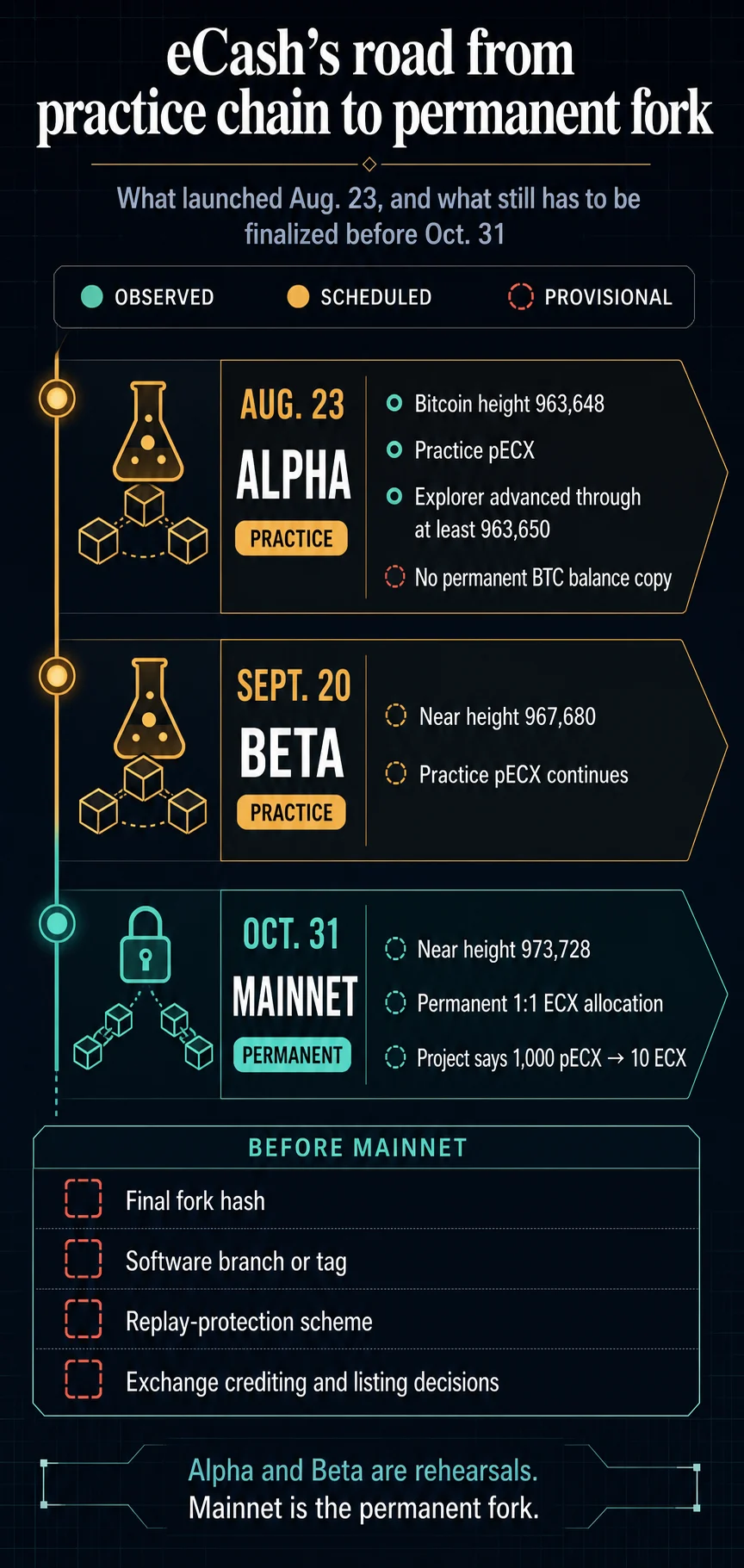
The Alpha Launch: A Technical Rehearsal
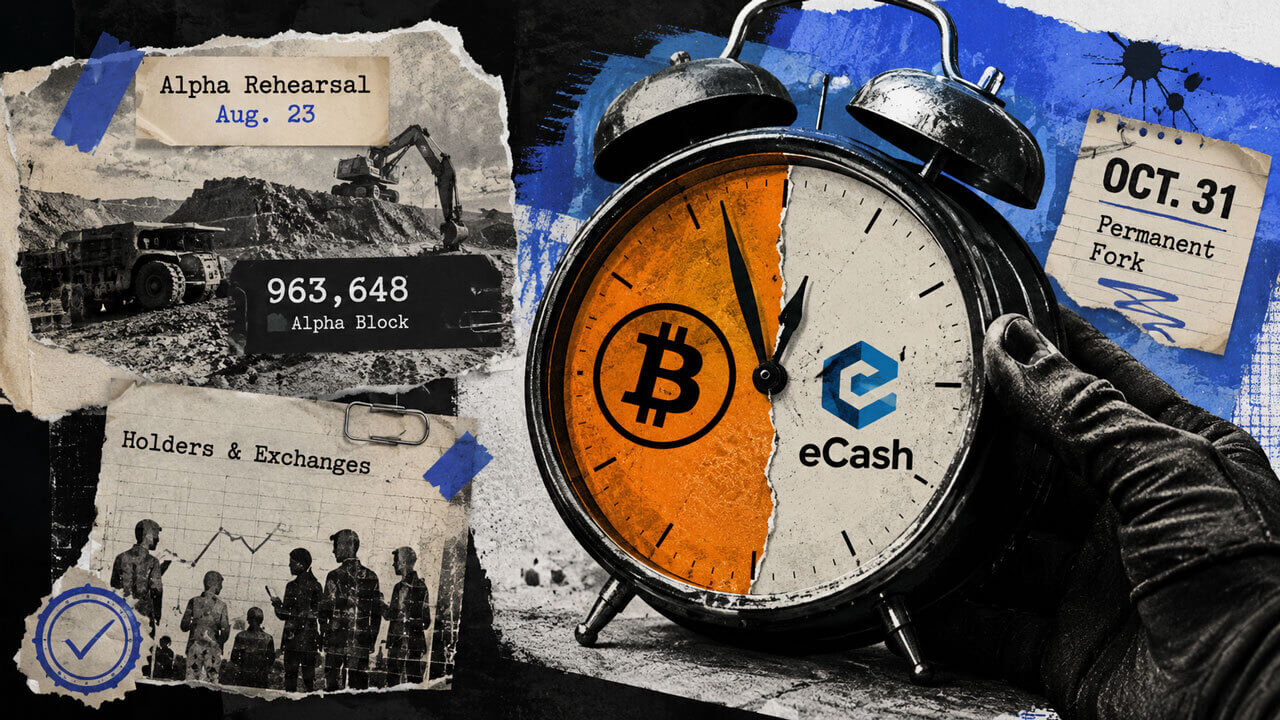
The activation of the eCash Alpha chain at Bitcoin block height 963,648 was designed as a "dry run" to test the network’s stability and the viability of the proposed sidechain or fork architecture. Data from the eCash Alpha explorer confirmed that the chain advanced through its initial blocks, though not without the typical friction associated with a nascent network. Specifically, the explorer flagged a stale competing block at the opening height, a common occurrence in young networks where consensus is still being established among a limited set of participating nodes.
In contrast, the Bitcoin mainnet continued its operation without interruption. Mempool.space recorded Bitcoin block 963,648 with a hash of 00000000000000000001769d9a327f5b455aa8a2dd407b1b63040d2a9f832d32 at approximately 01:48:47 UTC on August 23. The divergence between the two records underscores the current status of the eCash project: the Alpha chain is running as a parallel entity rather than a permanent split of the Bitcoin ledger. For the time being, Bitcoin ownership remains unchanged, and the units generated on the Alpha chain—referred to as "practice pECX"—possess no permanent value or standing on the eventual mainnet.
The Three-Stage Roadmap to Mainnet
The eCash development team has outlined a cautious, three-stage deployment strategy intended to mitigate the risks of a chaotic chain split. This roadmap is essential for stakeholders to understand the timeline of potential asset realization.
- Alpha Stage (Launched August 23): Initiated at block 963,648, this stage focuses on basic chain functionality and the issuance of pECX. These units are strictly for testing purposes.
- Beta Stage (Scheduled September 20): Expected to launch near block 967,680, the Beta stage will likely introduce more refined software and allow for broader stress testing by developers and early adopters.
- Permanent Mainnet (Scheduled October 31): The definitive fork is slated for Bitcoin block 973,728, coinciding with the anniversary of the Bitcoin Whitepaper. At this juncture, the permanent 1:1 allocation of ECX is expected to occur, creating a snapshot of the Bitcoin ledger.
Project founder Paul Sztorc has clarified the relationship between the practice units and the final asset. According to statements made by Sztorc, practice pECX units can be "burned" or redeemed for real ECX upon the mainnet launch, though the exchange rate is not 1:1. Instead, a redemption ratio of 1,000 pECX for 10 ECX has been proposed. This mechanism is intended to incentivize participation in the test phases without prematurely diluting the value of the final asset. However, technical documentation does not yet guarantee that transaction histories or balances from the Alpha and Beta stages will automatically migrate to the mainnet, leaving a gap in the continuity of the test environment.
Unresolved Technical Challenges and Replay Protection
Perhaps the most pressing concern for the broader Bitcoin community is the lack of finalized software and replay protection rules. Replay protection is a critical security feature in any blockchain fork; without it, a transaction intended for one chain (e.g., ECX) could be "replayed" on the other chain (e.g., BTC), leading to the accidental loss of funds.
The project’s current integration guide, which was last updated on August 11, continues to label many key parameters as "pre-launch" or "drynet4" values. Crucially, the final fork hash, the specific software branch or tag, and the definitive replay protection scheme have not been published. While the current guidance suggests an opt-in nLockTime of 499999999 for ECX transactions to differentiate them from Bitcoin transactions, integrators and wallet providers have been cautioned to verify the final scheme before the October deadline.
For developers, this lack of clarity creates a significant bottleneck. Without a stable codebase, third-party wallet providers and custodial services cannot safely build the infrastructure necessary to support the new asset. This technical debt increases the risk of a "messy" fork, where users might attempt to claim their ECX using unverified tools, potentially exposing their Bitcoin private keys to malicious actors or software bugs.
Exchange Responses and Market Readiness
The reaction from major cryptocurrency exchanges, particularly in the Japanese market—which has historically been proactive regarding Bitcoin forks—has been one of cautious observation. Several prominent platforms have issued notices to their users regarding the August 23 Alpha launch and the upcoming October deadline.
- GMO Coin: Stated that Bitcoin services would continue without interruption during the test phases. However, the exchange explicitly noted it would not handle pECX or the final ECX asset during the Alpha and Beta stages.
- Coincheck, SBI VC Trade, and Zaif: These exchanges published similar continuity plans, ensuring that Bitcoin trading and withdrawals would remain functional. However, they have left the decision regarding the eventual crediting, listing, or handling of ECX "undecided," pending further technical evaluations of the fork’s stability and market demand.
The hesitation of major exchanges to commit to supporting ECX reflects the broader uncertainty surrounding the project. Exchanges require rigorous security audits and clear communication from fork developers before they can commit to a snapshot and distribution of a new asset. If the eCash team does not resolve the outstanding technical issues by October, it is possible that many holders will be forced to move their Bitcoin to private wallets to claim their ECX, a move that carries its own set of operational risks for non-technical users.
Historical Context: Lessons from the Fork Wars
The eCash fork arrives in a different market environment than the "Fork Wars" of 2017, which produced Bitcoin Cash (BCH) and subsequently Bitcoin SV (BSV). During that era, forks were often the result of deep ideological divides over Bitcoin’s block size and scaling roadmap. These events were characterized by intense volatility and aggressive "hash wars," where miners shifted resources between chains to influence the outcome.
In 2026, the motivations behind forks have evolved. The eCash project appears to be more focused on technical experimentation—specifically regarding sidechains and the implementation of BIP-300 (Drivechains) concepts, which Paul Sztorc has championed for years. Unlike previous forks that sought to replace Bitcoin as the primary medium of exchange, this fork seems positioned as a complementary or experimental extension of the Bitcoin ecosystem.

However, the risks remain identical to those of 2017. Any event that involves a 1:1 asset allocation based on a Bitcoin snapshot creates a "honeypot" for scammers. Phishing attacks, fake wallet software, and "claim tools" that steal private keys are likely to proliferate as the October 31 deadline approaches. The success of the eCash fork will depend not only on its technical merits but also on the team’s ability to provide clear, secure, and user-friendly instructions for claiming the new asset.
Implications for Miners and the Network
For Bitcoin miners, the eCash fork represents a potential shift in profitability dynamics. While the Alpha and Beta stages do not offer significant financial incentives, the mainnet launch on October 31 could see a portion of Bitcoin’s hashrate migrate to the ECX chain if the new asset gains immediate market value.
Miners must weigh the opportunity cost of pointing their ASICs toward a new, potentially volatile chain versus the steady rewards of the Bitcoin mainnet. If the ECX chain uses the same SHA-256 mining algorithm as Bitcoin, it will be susceptible to 51% attacks if it fails to secure a sufficient percentage of the global hashrate. The "stale blocks" observed during the Alpha launch are a reminder that without robust miner support, a new chain can struggle with consistency and security.
Conclusion: A High-Stakes Countdown to October
The August 23 Alpha rehearsal was a successful proof of concept, but it solved few of the underlying anxieties facing the Bitcoin community. As it stands, the eCash fork is a work in progress with several "known unknowns." The period between the September 20 Beta launch and the October 31 Mainnet fork will be critical. During this window, the development team must finalize the replay protection rules and provide the industry with a stable, auditable software release.
For Bitcoin holders, the primary recommendation from security experts remains unchanged: maintain custody of private keys and exercise extreme caution. The promise of "free coins" from a fork is a powerful motivator, but it should never come at the expense of the security of one’s primary Bitcoin holdings. As the industry watches the October 31 deadline approach, the eCash fork serves as a reminder of the enduring complexity and evolving nature of the world’s largest decentralized network. The coming weeks will determine whether ECX becomes a valuable addition to the crypto-asset landscape or a cautionary tale of technical and operational hurdles.