admin
admin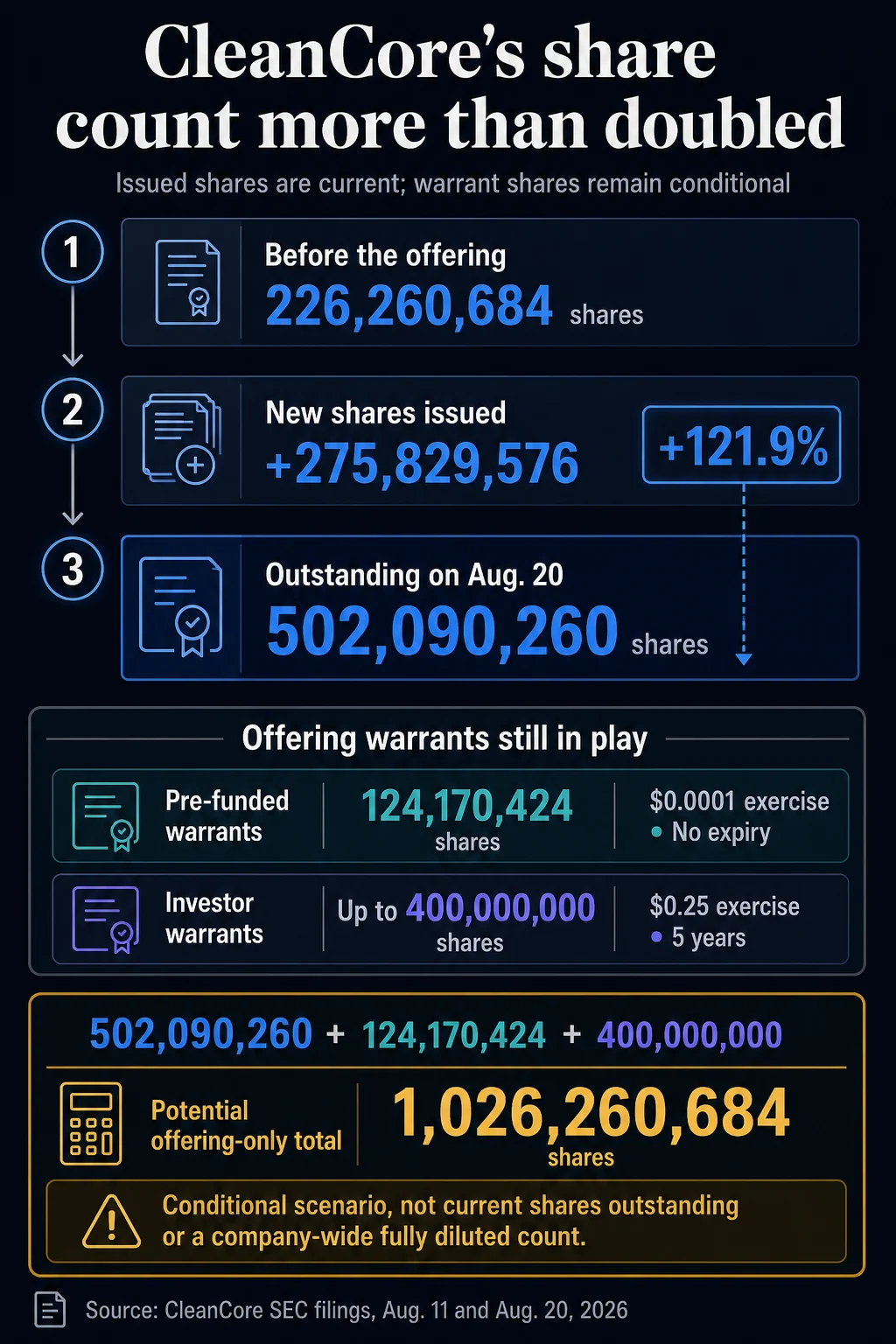
CleanCore’s recent $100 million stock offering has dramatically increased its common shares outstanding, a move tied to its strategic pivot from traditional cleaning products and Dogecoin treasury assets into the burgeoning field of Minnesota AI infrastructure. The offering, which closed on August 12, has seen the company’s shares outstanding surge from a pre-offering base of 226,260,684 to a reported 502,090,260 as of August 20. This substantial increase, representing a 121.9% rise, is a direct result of issuing 275,829,576 new shares, as detailed in an August 20 SEC filing. However, the financial implications for existing shareholders are compounded by the potential for significant further dilution, with conditional offering warrants representing rights to an additional 524.2 million shares.
The company’s strategic shift, outlined in its final prospectus, signifies a departure from its historical business operations. This pivot is underscored by the sale of a significant portion of its Dogecoin holdings, which generated approximately $33.4 million. These funds, alongside the capital raised from the stock offering, are earmarked for the development of AI infrastructure in Minnesota. This aggressive move into a new, capital-intensive sector raises questions about the company’s financial sustainability and the long-term value proposition for its investors.
Deep Dive into Share Dilution: A Growing Concern for Investors
The core of the concern for CleanCore’s investors lies in the sheer volume of potential new shares that could enter the market. The August 20 figures already reflect a substantial dilution event. However, this is just the beginning of the potential dilution. The company also issued pre-funded warrants covering 124,170,424 shares and investor warrants that could allow for the purchase of up to 400 million additional shares.
If all these offering warrants were exercised under their stated terms, the total number of shares outstanding, solely from this offering and its associated warrants, could reach an astonishing 1,026,260,684. This figure does not even account for other potential share issuances such as options, restricted stock units, pre-existing warrants, settlement shares, plan reserves, and project-covenant shares, which are listed separately in the prospectus.
The pre-funded warrants, which carry a nominal exercise cost of $0.0001 per share and have no expiration date, represent a near-certainty of future dilution. The investor warrants, priced at $0.25 per share and with a five-year expiration, offer the potential for CleanCore to raise an additional $100 million in gross proceeds if fully exercised for cash. While this could bolster the company’s cash reserves, the immediate impact on existing shareholders is a significant reduction in their ownership percentage and potential earnings per share.
This level of dilution, if fully realized, could severely depress the stock price and dilute the value of existing holdings. Investors who participated in the initial offering or held shares prior to this expansion will be closely watching how the company manages its capital and navigates this delicate balance between funding growth and protecting shareholder value.
Unresolved Funding Gaps Despite $100 Million Raise
While CleanCore announced the closing of its $100 million public offering, the net proceeds available for its ambitious AI venture appear to be significantly less than the headline figure. The company’s SEC filings detail an $8 million placement and advisory fee, and an estimated net proceeds of approximately $92 million. However, the exact cash received at the closing was not definitively stated in the closing disclosure.
This estimated $92 million in net proceeds faces substantial demand from the planned Minnesota joint venture. The initial budget for this venture is set at $479 million, with CleanCore committing to significant funding. The offering proceeds are intended to cover working capital, capital expenditures, general corporate purposes, and potential costs associated with divesting its cleaning business. This broad allocation means that not all of the net proceeds are exclusively reserved for the Minnesota AI infrastructure project.
The joint venture filing indicated an initial $40 million commitment, with $25 million due at the venture’s closing and an additional $15 million within four business days, contingent on budget needs. However, neither of these payments has been officially documented in the provided disclosures. This lack of clear documentation raises concerns about the project’s funding timeline and the company’s ability to meet its financial obligations.
CleanCore later issued a shareholder update stating it had "approximately $140 million of project equity – funded or committed," which included offering proceeds and completed Dogecoin sales. However, the disclosures do not reconcile this figure, distinguish between funded cash and commitments, or confirm that the venture’s contribution schedule has been met. This ambiguity surrounding the actual capital available and deployed for the Minnesota project adds another layer of uncertainty for investors.
The Role of Dogecoin in the AI Pivot
The company’s decision to sell a substantial portion of its Dogecoin holdings highlights a strategic financial maneuver to fund its pivot. CleanCore disclosed in its prospectus that it sold "substantially all" of its 463 million DOGE on July 20 for approximately $33.4 million. These proceeds were explicitly designated for its AI infrastructure segment.
This move is significant as it represents a tangible conversion of digital assets into capital for a new business venture. However, it also raises questions about the company’s previous strategy and the rationale behind holding such a significant amount of a volatile cryptocurrency. The prospectus does not quantify any remaining DOGE holdings or indicate if the tokens were pledged as collateral.
Prior to the Dogecoin sale and the recent stock offering, CleanCore’s financial position was already a point of concern. Its March 31 balance sheet reported only $4.1 million in cash and cash equivalents, with an additional $13 million in restricted cash. The absence of a clearly stated current cash balance following the Dogecoin sale and the stock offering leaves investors without a clear picture of the company’s immediate liquidity.

Background and Chronology of the Strategic Shift
CleanCore’s transformation from a cleaning products company to an AI infrastructure developer is a recent and rapid development. The company’s historical focus was on manufacturing and distributing cleaning supplies. However, a series of strategic decisions have led to its current trajectory.
- Pre-Offering Status: Prior to the recent stock offering, CleanCore had approximately 226,260,684 shares outstanding. Its financial position, as evidenced by its March 31 balance sheet, indicated limited liquid assets.
- Dogecoin Sale: On July 20, CleanCore sold approximately 463 million Dogecoin for about $33.4 million, with the proceeds earmarked for its AI infrastructure segment.
- Stock Offering Closing: The $100 million public stock offering officially closed on August 12. This offering involved the issuance of 275,829,576 new shares, increasing the outstanding common shares to 502,090,260 by August 20.
- SEC Filings and Prospectus: Detailed information regarding the offering, share numbers, and associated warrants was provided in subsequent SEC filings, including an August 20 filing and the final prospectus. These documents revealed the significant potential for further dilution through the exercise of various warrants.
- Joint Venture Commitments: The company entered into a joint venture for AI infrastructure in Minnesota, with an initial budget of $479 million. Documentation of the initial funding commitments for this venture remains unclear in the provided disclosures.
- Shareholder Update: A later shareholder update claimed approximately $140 million in project equity, funded or committed, but lacked specific reconciliation of these figures.
This timeline illustrates a company undergoing rapid and significant transformation, marked by ambitious capital-raising efforts and a bold pivot into a high-growth, high-risk sector.
Analysis of Implications and Future Outlook
The implications of CleanCore’s current situation are multifaceted. On one hand, the company is attempting to position itself in a rapidly expanding and potentially lucrative market: artificial intelligence and data infrastructure. The significant capital raised, coupled with the strategic sale of Dogecoin, demonstrates a clear commitment to this new direction. The Minnesota AI data center campus project, if successfully executed, could represent a substantial growth opportunity.
However, the overwhelming concern remains the substantial dilution of existing shareholder equity. The sheer volume of potential new shares, if all warrants are exercised, could lead to a severe devaluation of current holdings. This aggressive dilution strategy, while often employed to fund growth, carries inherent risks. Investors must weigh the potential for future gains against the immediate and significant reduction in their ownership stake.
Furthermore, the lack of clarity surrounding the precise funding status of the Minnesota venture raises red flags. The discrepancy between announced figures and documented transactions, along with the broad allocation of offering proceeds, suggests potential financial challenges or at least a lack of transparent financial management.
CleanCore’s pivot represents a high-stakes gamble. The company is betting on its ability to execute a complex AI infrastructure project while simultaneously navigating the financial complexities of a massive stock offering and potential warrant exercises. The success of this strategy will depend on its ability to attract and retain talent, secure necessary approvals and resources for the AI project, and ultimately generate sustainable revenue streams in a competitive market. For existing investors, the current landscape is characterized by significant uncertainty, with the promise of future growth heavily overshadowed by the immediate threat of dilution and unresolved funding questions. The company’s ability to provide clear and transparent financial reporting moving forward will be crucial in rebuilding investor confidence.