admin
admin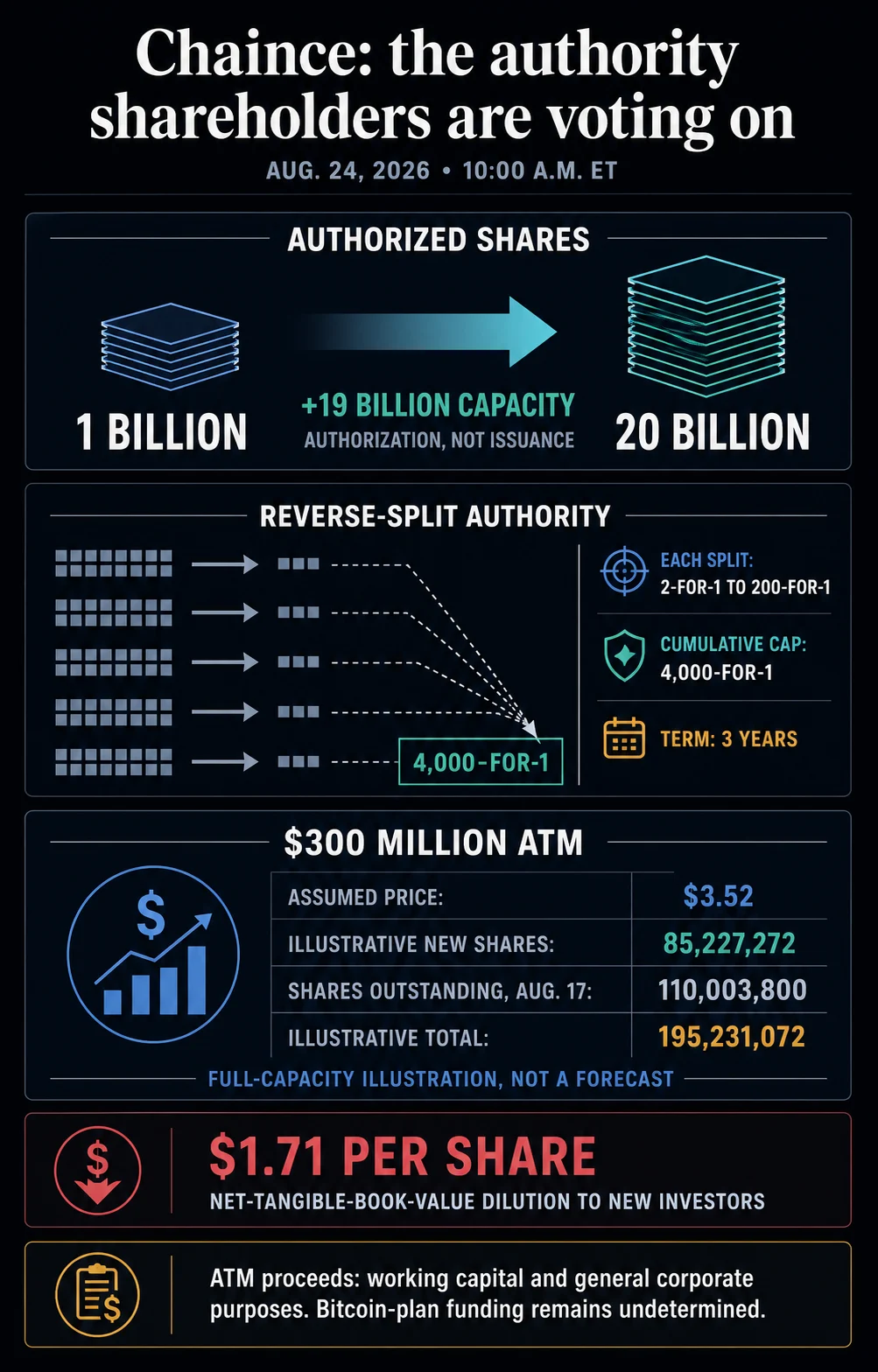
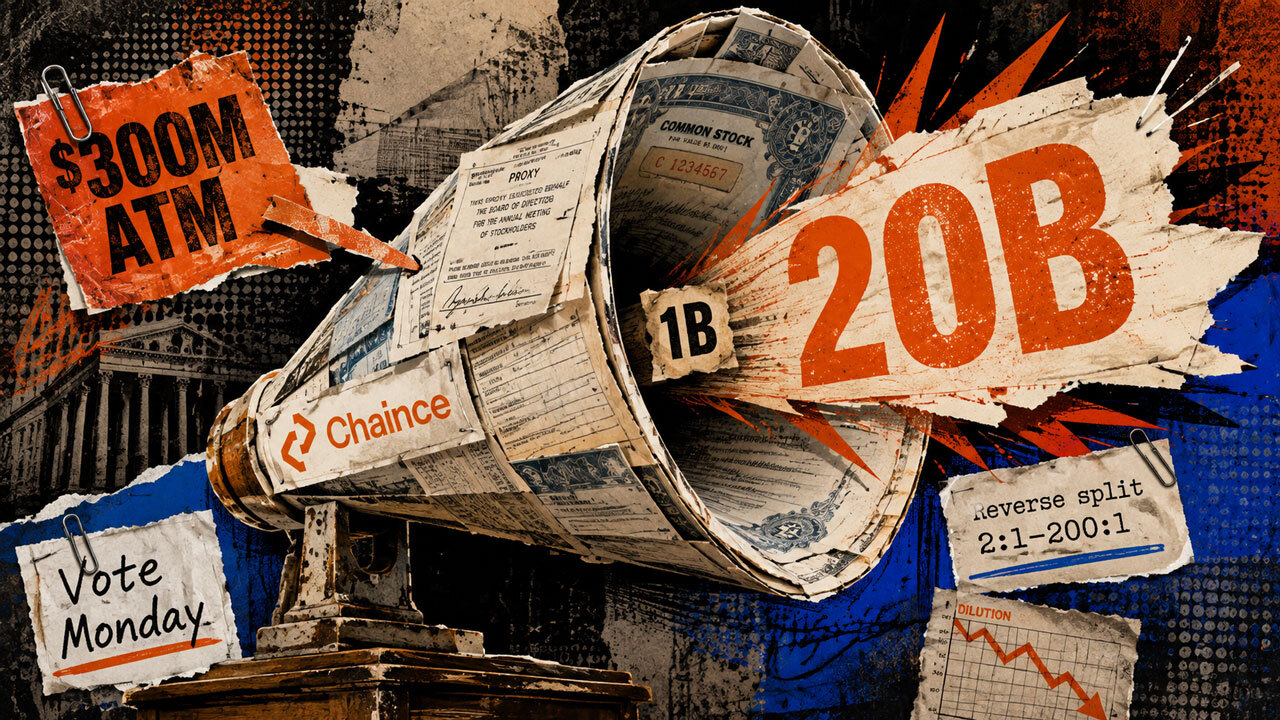
Shareholders of Chaince Digital Holdings, a prominent crypto treasury firm, are poised to cast a critical vote on Monday that could significantly reshape the company’s financial architecture. The proposals on the table aim to dramatically increase the authorized ordinary shares from the current 1 billion to a substantial 20 billion, while also granting the board of directors broad authority to enact reverse stock splits for a period of three years. This pivotal decision comes just days after Chaince announced the establishment of an at-the-market (ATM) program, enabling the potential sale of up to $300 million in company stock. If approved, these measures would provide Chaince with considerably expanded flexibility for future capital raising endeavors and strategic financial management. It is crucial to note that the actual issuance of shares and any subsequent reverse splits would remain contingent on subsequent corporate decisions, making Monday’s vote a referendum on the potential scale of the board’s future powers.
Understanding the Scope of Shareholder Authority
The core of the upcoming shareholder deliberation revolves around two key proposals. Proposal Three, as detailed in the company’s annual-meeting proxy filing with the U.S. Securities and Exchange Commission (SEC), seeks to authorize an additional 19 billion shares, thereby raising the total authorized share ceiling to an impressive 20 billion. It is important to distinguish between authorized shares and outstanding shares. Authorized shares represent the maximum number of shares a company is legally permitted to issue according to its corporate charter, while outstanding shares are those that have been issued and are currently held by investors. This increase in authorized shares is a foundational step for any future expansion or capital infusion.
Concurrently, Proposal Four addresses the company’s ability to manage its share structure through reverse stock splits. This proposal would empower the board of directors to execute one or more reverse stock splits anytime within the third anniversary of the Aug. 24 shareholder meeting. The flexibility offered is significant: each individual reverse split could range from a 2-for-1 consolidation to a more substantial 200-for-1 consolidation. Cumulatively, the total ratio across all authorized reverse splits under this provision would be capped at an astounding 4,000-for-1. The board would retain the discretion to determine the timing and necessity of implementing these reverse splits, providing them with a powerful tool for share price management and market perception.
Both of these crucial proposals require a simple majority of the votes cast by eligible ordinary shares. These votes must be cast either in person at the meeting or by proxy. Importantly, abstentions and broker non-votes, where a broker holding shares on behalf of a client does not have voting instructions for a non-routine matter, are excluded from the tally of votes cast. This means that brokers are unable to vote uninstructed street-name shares on these particular non-routine proposals, placing direct shareholder influence at the forefront.
The shareholder meeting is scheduled to commence at 10:00 a.m. Eastern Time in New York, with provisions for online participation, allowing for broad accessibility. A significant procedural update was filed with the SEC on July 28, amending the proxy materials and correcting the deadline for proxy submission. The proxy deadline was moved to Aug. 20 at 11:59 p.m. Eastern Time, a correction from the initially stated Aug. 21 date in the original filings. While registered shareholders have the option to cast their votes directly at the meeting, individuals whose shares are held through a brokerage firm needed to have obtained a legal proxy and completed their voting documentation in advance of the proxy deadline.
The Strategic Context: ATM Offering and Dilution Concerns
The timing of this shareholder vote is particularly noteworthy, as it coincides with Chaince’s launch of a significant at-the-market (ATM) stock offering. This offering, detailed in a prospectus supplement filed with the SEC, allows for the sale of up to $300 million worth of ordinary shares. The ATM program is structured with H.C. Wainwright acting as either an agent or principal, and the agreement is dated Aug. 19. A key aspect of ATM programs is their flexibility; H.C. Wainwright is not obligated to sell any specific number or dollar amount of shares. The actual volume of shares issued will be determined by market conditions and Chaince’s strategic decisions regarding the program’s utilization.
To illustrate the potential scale of this offering, the prospectus provides an example assuming the sale of 85,227,272 shares at a price of $3.52 per share. This hypothetical scenario is contrasted with the company’s outstanding share count of 110,003,800 as of Aug. 17. If this full-capacity example were realized, the total number of outstanding shares could rise to as many as 195,231,072. However, the actual final share count will inevitably fluctuate based on the prevailing sale prices and the extent to which Chaince chooses to utilize the ATM facility.
The potential impact on existing shareholders is further elaborated by an estimated dilution to the net tangible book value per share. The same example projects a dilution of $1.71 per share for new investors entering the market at that price point. This calculation notably excludes shares that remain available under Chaince’s 2025 equity plan, which currently stands at 6,164,000 shares, as well as up to an additional 42,755,344 shares that could be issued upon the exercise of outstanding warrants. These additional potential issuances underscore the broader dilutive considerations that shareholders must weigh.
Chaince has stated that the proceeds generated from the ATM offering may be allocated towards working capital and general corporate purposes. In a separate but related development, the company has also described a preliminary plan to establish an $800 million Bitcoin reserve. However, the specific funding sources and the financial instruments to be employed for this ambitious reserve plan remain undetermined at this juncture. Therefore, shareholders are being asked to grant significant future financial flexibility through the proposed share ceiling and reverse-split authority, while the company simultaneously has a substantial stock-sale facility available and is exploring major asset acquisition strategies. The ultimate execution of these powers will be subject to future management decisions, creating a dynamic and complex financial landscape for Chaince.
Historical Context and Industry Precedents
The move by Chaince Digital Holdings to seek such a substantial increase in authorized shares and reverse-split authority is not entirely unprecedented within the broader financial markets, particularly for companies seeking to navigate growth phases or manage their stock valuations. In the cryptocurrency and blockchain industry, companies often face unique challenges related to market volatility, regulatory scrutiny, and the need for substantial capital to fund research, development, and expansion.
Historically, companies have utilized reverse stock splits for several strategic reasons. One primary driver is to increase the per-share trading price. A low share price can sometimes be perceived negatively by institutional investors or may fall below the minimum price requirements for listing on major stock exchanges. By consolidating shares, a company can artificially inflate its per-share price, potentially making it more attractive to a wider investor base and improving its market standing.
The expansion of authorized shares, as proposed by Chaince, is often a precursor to significant corporate actions. This can include future stock offerings, mergers and acquisitions, employee stock option plans, or the issuance of shares for strategic partnerships. A higher authorized share count provides a company with the necessary "room" to execute these plans without requiring immediate shareholder approval for each individual issuance, thereby streamlining corporate operations.
The concurrent ATM offering is a well-established financial instrument that allows companies to sell shares into the open market over time, at prevailing market prices. This approach offers flexibility and avoids the need for a large, single underwriting event. For companies like Chaince, which operate in a rapidly evolving sector, the ability to access capital opportunistically through an ATM program can be crucial for maintaining agility and responding to market developments.

The precedent for companies in emerging sectors to seek such broad financial powers is evident. As these industries mature, companies often transition from early-stage fundraising to more structured capital markets activities. This involves aligning their corporate governance and financial instruments with the expectations of a broader investor community. Chaince’s current proposals can be viewed as a proactive step in this direction, aiming to equip the company with the financial tools necessary for its projected future growth and strategic objectives.
Implications for Investors and Market Perception
The dual proposals – the massive increase in authorized shares and the broad reverse-split authority – carry significant implications for Chaince’s existing and potential investors. The dramatic expansion of authorized shares from 1 billion to 20 billion, while providing substantial future flexibility, could also be interpreted by some as a signal of potential future dilution. Shareholders will be closely watching how the company manages its share issuance moving forward, particularly in light of the $300 million ATM program. The actual impact on share value will depend on how effectively the company utilizes the raised capital and whether it can generate commensurate growth in its underlying business operations.
The reverse-split authority, if exercised, would directly alter the number of shares held by each investor, while theoretically maintaining the overall value of their investment (though market reactions can cause price adjustments). A 4,000-for-1 reverse split, for example, would mean that an investor holding 100 shares would end up with just 0.025 shares, a significant consolidation. The rationale behind such a move would likely be to boost the per-share price, potentially improving liquidity and attracting institutional investors who may have minimum price requirements for their investments. However, reverse splits can sometimes be viewed negatively by the market, as they can be associated with companies struggling to maintain their stock price. The board’s communication and strategic justification for any such split will be crucial in shaping investor perception.
The simultaneous ATM offering, while providing immediate access to capital, also presents dilutionary pressures. The prospectus supplement details potential dilution figures, and investors need to carefully assess these projections against the company’s growth prospects. The effective use of the ATM proceeds for strategic initiatives, such as the planned Bitcoin reserve or general corporate purposes, will be critical in justifying any dilution.
Chaince’s stated intention to establish an $800 million Bitcoin reserve is a significant undertaking. If successfully funded and managed, this could position Chaince as a major player in the digital asset treasury space. However, the ambiguity surrounding its funding source introduces another layer of uncertainty that investors will need to consider. The success of this reserve plan, alongside the effective management of its equity, will be key determinants of Chaince’s long-term valuation and market standing.
Ultimately, the shareholder vote on Monday represents a critical juncture for Chaince Digital Holdings. The decisions made will set the stage for the company’s financial strategy and its ability to execute its ambitious growth plans in the dynamic cryptocurrency treasury sector. Investors will be keenly observing the outcomes and the subsequent strategic maneuvers by the company’s management.