admin
admin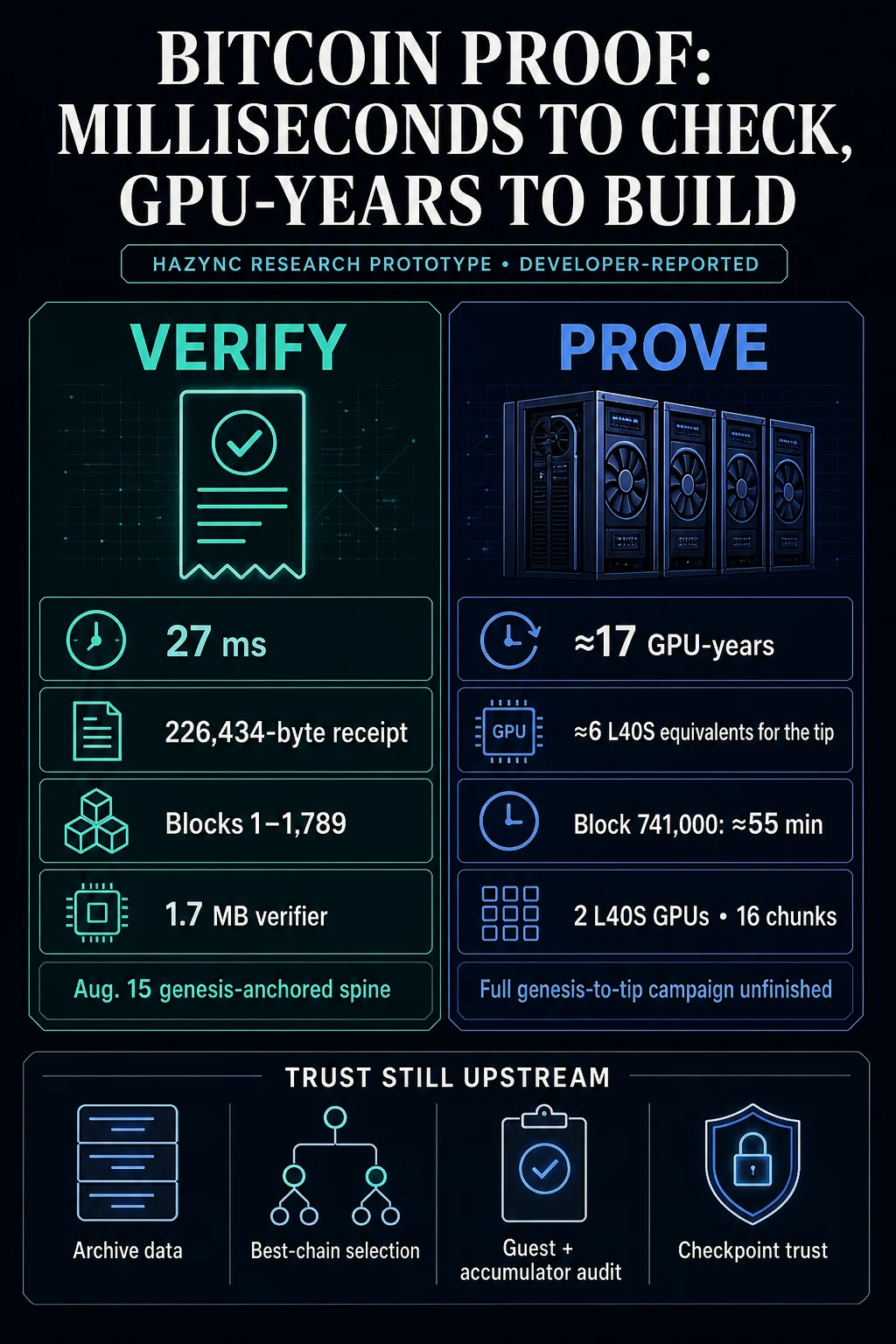
In a significant advancement for blockchain scalability and efficiency, Hazync, a research prototype, has demonstrated the potential for near-instantaneous Bitcoin block verification through the innovative application of zero-knowledge virtual machine (zkVM) technology. A recent disclosure by the developer of Hazync revealed that a compact, standalone verifier, weighing just 1.7 megabytes, successfully checked a cryptographic receipt encompassing the first 1,789 blocks of the Bitcoin blockchain. This monumental task, covering an initial 226,434 bytes of cryptographic data, was completed in an astonishing 27 milliseconds. While this achievement is groundbreaking, it is crucial to note that this result represents an early segment of Bitcoin’s extensive history, and a comprehensive proof campaign extending from the genesis block to the current tip of the blockchain remains an ongoing endeavor.
The Hazync project leverages the capabilities of RISC Zero’s zkVM to revolutionize how Bitcoin transactions are validated, aiming to make this critical process reusable and significantly more accessible. The core innovation lies in the zkVM’s ability to execute a sophisticated Bitcoin validation program. The output of this execution is a "receipt," a remarkably compact file that can then be efficiently verified by a much larger population of users. This design intentionally segregates the computationally intensive proof generation, concentrating it among specialized "provers," while distributing the less demanding receipt verification across a broader network. This division of labor is fundamental to the project’s efficiency gains.
The disparity in computational cost between these two tasks is profound. The developer estimates that the immense undertaking of backfilling Bitcoin’s entire history – from its inception to the present day – would require approximately 17 GPU-years of processing power. Following this initial historical computation, maintaining the validation of new blocks in real-time would necessitate computational capacity equivalent to roughly six high-performance Nvidia L40S GPUs. The promise of Hazync is that after this substantial upfront investment by provers, auditors, and archive operators, the subsequent verification of new blocks becomes exceedingly cheap and fast for the average user.
The Efficiency Divide: Proving vs. Verifying
Traditionally, a new Bitcoin node independently replays the entire blockchain to verify its integrity. This process is computationally demanding and time-consuming. Hazync offers a radical alternative by executing Bitcoin’s consensus rules within the zkVM. The zkVM then generates a proof that these rules were adhered to for each block within the specified range. Crucially, these individual block proofs are then recursively "folded" into a single, verifiable receipt. This "folding" technique is a hallmark of zero-knowledge proofs, allowing for the condensation of vast amounts of information into a small, easily verifiable package.
The technical underpinnings of Hazync are detailed in its public repository, showcasing a guest program meticulously constructed from substantial portions of Bitcoin Core v28’s consensus code and the libsecp256k1 cryptographic library. This guest program is compiled for the 32-bit RISC-V architecture. The strategic reuse of Bitcoin Core’s existing code significantly minimizes the need to reimplement consensus logic in a separate, custom cryptographic circuit, thereby reducing the potential for errors and accelerating development.
A key benchmark conducted by the developer measured the proof-generation cost for a recent Bitcoin block, specifically block 741,000. This block, a representative sample of recent network activity, contained 670 transaction inputs and involved 394 unspent transaction output (UTXO) leaves. The process of generating a proof for this block, divided into 16 chunks and processed across two Nvidia L40S GPUs, took approximately 55 minutes. This duration includes a significant 27 minutes dedicated to the aggregation of these individual proofs.
This specific measurement serves as a critical data point for the developer’s projection of roughly 17 GPU-years required for a complete genesis-to-tip historical backfill. It is important to acknowledge that the current benchmarks are derived from representative project data rather than a meticulously audited measurement across every distinct era of Bitcoin’s operational history. Consequently, the ultimate full-chain performance of Hazync remains an estimate, subject to refinement as the comprehensive proof generation campaign progresses.
The dynamic nature of software development also presents a challenge, as changes to the Hazync system can necessitate the re-creation of completed work. Each Hazync receipt is cryptographically bound to a unique METHOD_ID, which acts as a fingerprint of the compiled guest program. If the guest program is rebuilt or updated, it receives a new METHOD_ID, rendering all previous receipts associated with the prior version invalid. This mechanism ensures integrity but requires careful management of the build process.
The project recently restarted its genesis block proof generation on August 4th. This restart was prompted by an internal audit that identified the need for a new baseline for the system’s integrity. A subsequent "soundness fix" – a modification to ensure the correctness of the proof system – could potentially trigger a similar reset, even after considerable GPU time has been accumulated for proof generation. Therefore, the allocated proving budget must account for stable code development, the substantial effort of the historical backfill, and the ongoing computational capacity required to keep pace with new blocks added to the Bitcoin chain.

The speed of receipt verification is the aspect most directly experienced by the end-user, representing the tangible benefit of Hazync’s complex underlying infrastructure. The substantial 17 GPU-year estimate highlights the concentrated, industrial-scale effort required to achieve this streamlined user experience.
What the Receipt Does and Does Not Replace
A Hazync receipt fundamentally compresses the process of validity checking. However, it does not eliminate the need for other essential components of the Bitcoin network. Archive operators, for instance, continue to play a vital role in ensuring the availability of transactions and retaining the historical witness and signature data. These bytes are indispensable for future proof generation, as subsequent versions of the guest program will require them to re-prove the chain’s integrity. Thus, the efficiency of succinct verification is preserved by maintaining a long-term storage role for archive infrastructure.
The fundamental mechanism of best-chain selection, governed by Bitcoin’s "proof-of-work" consensus rule, remains unchanged. Hazync integrates the cumulative work value into the public output of its receipts. This allows a verifier to access the necessary data to compare competing chain tips. While the receipt attests to the rule compliance of its covered chain segment, the ultimate decision of which valid chain to follow still rests with the individual node.
Furthermore, an "archive bridge" – the interface through which archive data is accessed – retains the potential to be exploited to waste prover resources. The project’s defined composition rules establish a link between every state boundary and the genesis block. This design ensures that any forged state will fail validation when a receipt attempts to join the main chain’s "spine." However, a malicious bridge operator could intentionally serve unusable inputs, consuming valuable GPU time from provers and effectively creating an economic denial-of-service risk.
The developer describes a proof composed from the genesis block as "unconditional" within Hazync’s software and cryptographic assumptions. In contrast, any later checkpoint introduced into the system is treated as an explicit "trust input," meaning that a degree of trust is placed in the source of that checkpoint.
The guest program itself represents a critical review boundary. It incorporates substantial portions of Bitcoin Core’s consensus code, alongside project-maintained segments that manage the subsidy schedule and block height-based script activation rules. The project asserts that its script-flag schedule has undergone differential testing and is considered a sound superset of Bitcoin Core’s rules, allowing for additional rejections that are intended to preserve the overall soundness of the system.
To adapt Bitcoin Core’s C++ codebase for the zkVM environment, a portability layer has been developed. Additionally, a non-Core component, the Utreexo accumulator, is employed to manage changes to Bitcoin’s unspent transaction output (UTXO) set. The disclosed assumptions underpinning Hazync also extend to RISC Zero’s proof system, the SHA-256 hashing algorithm, and the secp256k1 elliptic curve digital signature algorithm. The project has identified the portability shims and the Utreexo accumulator as its highest-priority targets for residual review, acknowledging their critical role in the system’s integrity.
In August, the Hazync repository reported the findings of two AI-assisted external reviews. These reviews reportedly failed to uncover any pathways for the guest program to accept an invalid Bitcoin chain. However, a commissioned professional audit is still pending. The project’s commitment to public code is intended to facilitate external scrutiny, and ultimate production assurance will depend on rigorous adversarial examination of the exact guest program and all components within its proof boundary.
Hazync fundamentally reconfigures the concept of trustless synchronization by distributing it across several distinct roles, each with its own associated operator and budget. Receipt verification can indeed be reduced to milliseconds for a proven segment of the chain. However, the generation of these proofs consumes significant GPU capacity. Archive operators remain responsible for the underlying data, network nodes continue to compare chain tips based on proof-of-work, and independent auditors are tasked with assessing the integrity of the guest program.
The development of a stable implementation of Hazync, supported by sufficient computational resources and comprehensive external review, holds the potential to significantly reduce the overhead of repeated validation for new nodes joining the network. At the current stage of the project, the developer-reported 27-millisecond verification speed pertains to a limited historical segment. The more ambitious 17 GPU-year estimate underscores the considerable, yet unfinished, journey required to extend this efficient verification all the way to the current tip of the Bitcoin blockchain. This ongoing work represents a critical step towards making Bitcoin’s vast historical ledger more accessible and verifiable for a wider audience.