Dwi Wanna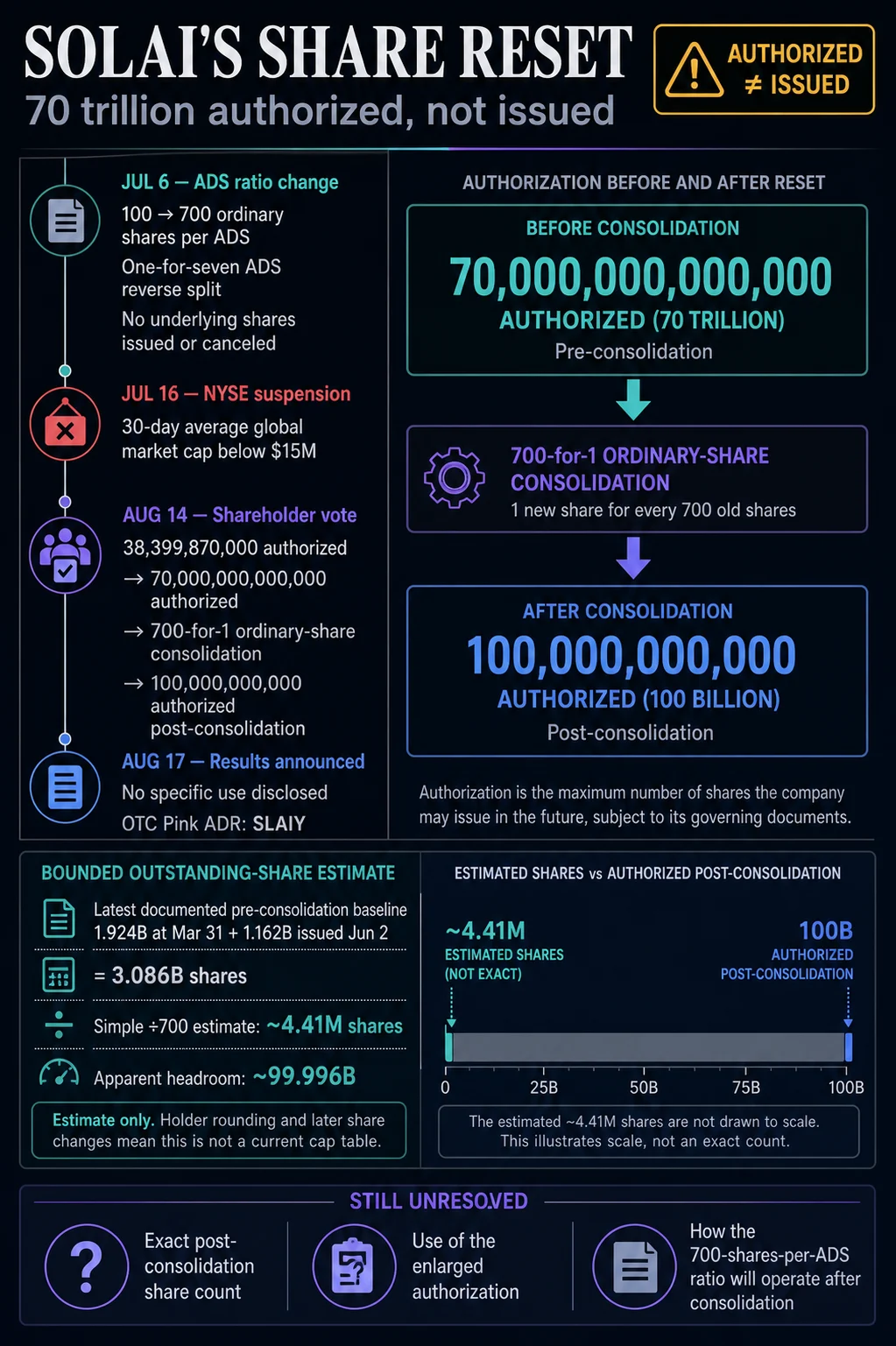
In a sweeping overhaul of its corporate capital structure, SOLAI Limited, the Solana-focused treasury firm formerly known as BIT Mining, has secured shareholder approval for a dramatic capital reset that positions the company for massive future share issuance. Following an extraordinary general meeting held on August 14, 2026, the company finalized a 700-for-1 share consolidation, a move that comes in the wake of its delisting from the New York Stock Exchange (NYSE) and its subsequent transition to the over-the-counter (OTC) markets. While the consolidation reduces the number of currently outstanding shares to a fraction of their former volume, the company simultaneously authorized a ceiling of 100 billion Class A ordinary shares, creating a vast "dilution reservoir" that far exceeds its current operational needs.
The restructuring follows a turbulent period for the firm, which rebranded from BIT Mining to SOLAI Limited to reflect its strategic pivot toward the Solana ecosystem. This transition has been marked by regulatory challenges and a declining market capitalization that ultimately triggered a suspension of its American depositary shares (ADS) by the NYSE in mid-July. The new capital structure provides the company with significant flexibility to raise capital or pursue acquisitions, though the sheer scale of the authorized share increase has raised questions among market analysts regarding potential long-term dilution for existing stakeholders.
The Mechanics of the Capital Reset
The capital restructuring approved by SOLAI shareholders was executed in a two-step process designed to reset the company’s equity base while drastically expanding its issuance capacity. During the August 14 meeting, investors first voted to increase the authorized Class A ordinary shares from a previous limit of 38.4 billion to a staggering 70 trillion shares. This figure represented the authorized capacity for pre-consolidation units, effectively clearing the path for the second phase of the plan.
Immediately following this increase, the company implemented a 700-for-1 consolidation. Under this "reverse split" mechanism, every 700 existing ordinary shares were merged into a single new ordinary share. This consolidation adjusted the 70 trillion authorized shares down to a post-split ceiling of 100 billion shares.
To put the magnitude of this reset into perspective, the previous authorization of 38.4 billion shares would have been equivalent to approximately 54.86 million shares in post-consolidation terms. By setting the new ceiling at 100 billion shares, SOLAI Limited has increased its authorized share capacity by a factor of roughly 1,823. Despite the scale of this change, the company’s official communications did not specify a particular immediate use for this newly created capacity, such as a pending acquisition, a specific financing round, or an employee compensation program.
NYSE Suspension and the Move to OTC Trading
The restructuring serves as a backdrop to SOLAI’s recent exit from major public exchanges. On July 16, 2026, the NYSE suspended trading in SOLAI’s American depositary shares after the company failed to maintain the exchange’s minimum listing requirements. Specifically, the firm’s average global market capitalization had fallen below the $15 million threshold over a consecutive 30-trading-day period, a metric the NYSE uses to ensure listed companies maintain a baseline of liquidity and investor interest.
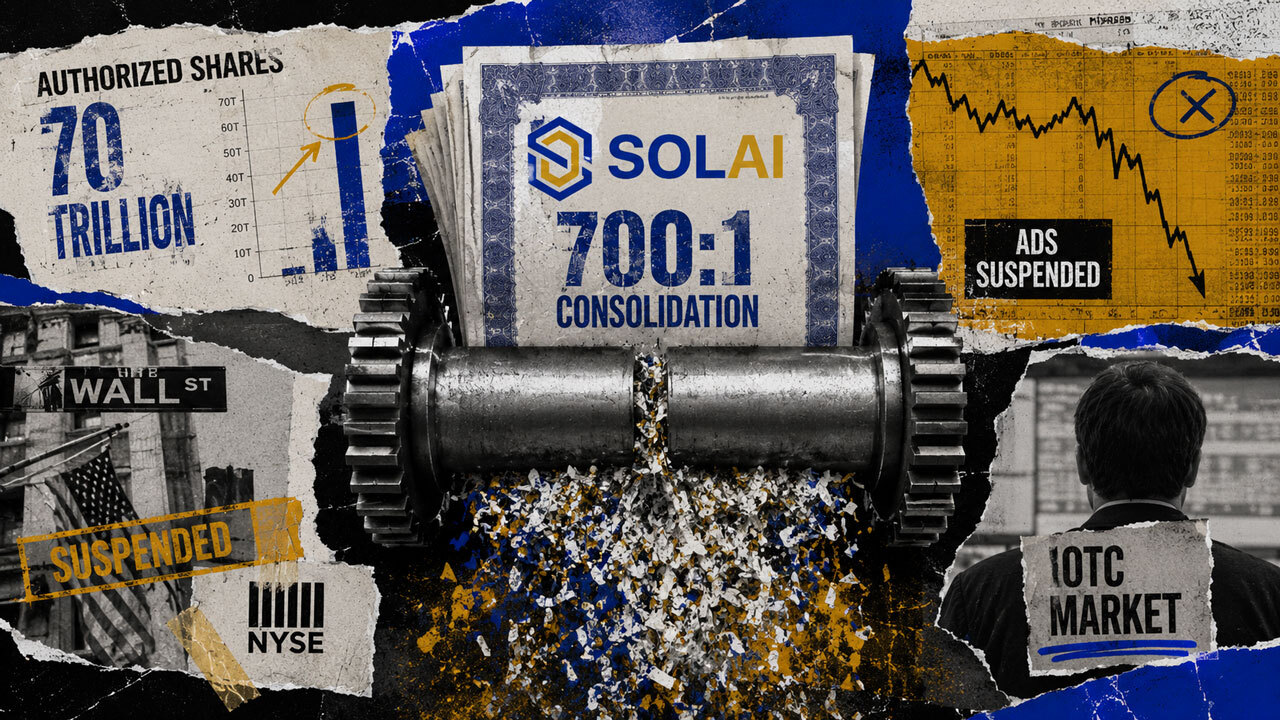
Following the suspension, the NYSE filed a Form 25 with the Securities and Exchange Commission (SEC), noting that the Solana treasury firm did not file an appeal within the mandatory 10-business-day window. Consequently, the formal removal from the NYSE was scheduled for August 17, 2026. Since the suspension, the company’s shares have been quoted on the OTC Pink market under the ticker symbol SLAIY.
The transition to the OTC market often results in reduced liquidity and increased volatility, as the reporting requirements and oversight are less stringent than those of the NYSE. However, for a company in the midst of a radical strategic pivot, the OTC market offers a venue to continue trading while it attempts to rebuild its balance sheet and execute its new business model centered on the Solana blockchain.
Analysis of Issued vs. Authorized Shares
A closer look at SOLAI’s share registry reveals the extent of the "unissued capacity" now available to the company. Based on the most recent filings, the firm reported 1.92 billion Class A shares outstanding as of March 31, 2026. This was followed by the issuance of an additional 1.16 billion shares on June 2, which were utilized as consideration for an undisclosed acquisition.
Combining these figures results in a pre-consolidation total of approximately 3.09 billion shares. When the 700-for-1 conversion is applied to this estimate, the current number of outstanding shares drops to roughly 4.41 million. Comparing this 4.41 million figure to the newly authorized limit of 100 billion shares reveals a massive gap. Effectively, SOLAI Limited now has the authority to issue approximately 99.996 billion additional shares without requiring further shareholder votes for authorization.
This discrepancy creates a "dilution reservoir," a term used by some financial analysts to describe a situation where a company holds a massive amount of authorized but unissued stock. While this provides the executive team with the agility to move quickly on strategic opportunities, it also serves as a cautionary signal to investors that their current percentage of ownership could be significantly diluted if the company chooses to tap into that reservoir for future funding or expansion.
Chronology of the Strategic Pivot
The recent capital reset is the latest chapter in a broader transformation of the company. Formerly known as BIT Mining, a prominent player in the Bitcoin mining sector, the firm underwent a rebranding to SOLAI Limited to align itself with the growing Solana ecosystem. This shift involved not only a name change but a fundamental alteration of its treasury management strategy, moving away from heavy hardware-based mining operations toward a model focused on holding and utilizing Solana (SOL) assets.
The timeline of recent corporate actions highlights the speed of this transition:

- Early 2026: Rebranding from BIT Mining to SOLAI Limited initiated.
- March 31, 2026: Company reports 1.92 billion shares outstanding.
- June 2, 2026: Issuance of 1.16 billion shares for acquisition purposes.
- July 16, 2026: NYSE suspends trading of SLAI ADSs due to low market capitalization.
- July 2026: Company implements a change in its ADS ratio from 100 to 700 ordinary shares per ADS via a one-for-seven reverse split.
- August 14, 2026: Shareholders approve the 70 trillion share authorization and subsequent 700-for-1 consolidation.
- August 17, 2026: Formal delisting from the NYSE takes effect; trading continues on OTC Pink.
The July action regarding the ADS ratio is particularly noteworthy. By changing the ratio from 100:1 to 700:1, the company effectively performed a reverse split of the depositary receipts without canceling the underlying ordinary shares. However, the subsequent August consolidation of the ordinary shares themselves adds a layer of complexity. As of the latest reports, Deutsche Bank, the depositary for the shares, has not yet issued updated instructions on how the ADS ratio will be adjusted to account for the consolidation of the underlying ordinary units.
Market Context and Solana Performance
The restructuring of SOLAI comes at a time of significant volatility and growth within the broader Solana ecosystem. According to recent market data, Solana (SOL) has shown resilience, trading up 19.80% over a seven-day period and maintaining a market capitalization of approximately $52.72 billion. Currently ranked as the seventh-largest cryptocurrency by market cap, Solana has seen a 21.78% increase in value over the last 60 days, driven by increased network activity and a surge in decentralized finance (DeFi) applications.
For a treasury firm like SOLAI, the performance of the underlying SOL asset is critical. The firm’s ability to leverage its treasury to generate value for shareholders depends heavily on the health of the Solana network. The decision to authorize 100 billion shares suggests that SOLAI may be preparing for a high-volume issuance strategy, perhaps to acquire SOL-based projects or to provide liquidity to nascent protocols within the ecosystem.
Broader Implications for Stakeholders
The massive expansion of authorized shares presents a dual-edged sword for SOLAI’s remaining investors. On one hand, the "reset" cleans up a penny-stock share structure that was likely a hindrance to institutional interest. By consolidating the shares, the company can achieve a higher nominal share price, which is often a prerequisite for more sophisticated trading platforms and investors.
On the other hand, the 100-billion-share ceiling is a stark reminder of the potential for future dilution. In many jurisdictions, authorized shares that are unissued do not have voting rights or dividend entitlements, but they represent a latent supply that can be activated at any time by the board of directors. For OTC holders, the primary concerns moving forward will be transparency and communication. Key disclosures that the market is awaiting include a finalized issued-share count, a clear strategic roadmap for the use of the authorized capital, and updated depositary instructions from Deutsche Bank.
As SOLAI Limited navigates its new life as an OTC-traded entity, its success will likely depend on whether it can convince the market that its vast "dilution reservoir" is a tool for strategic growth rather than a sign of impending equity devaluation. For now, the firm has the legal architecture in place to expand its footprint significantly, but the burden of proof remains on the leadership to demonstrate how this capital reset will translate into long-term value in the competitive landscape of digital asset treasuries.