admin
admin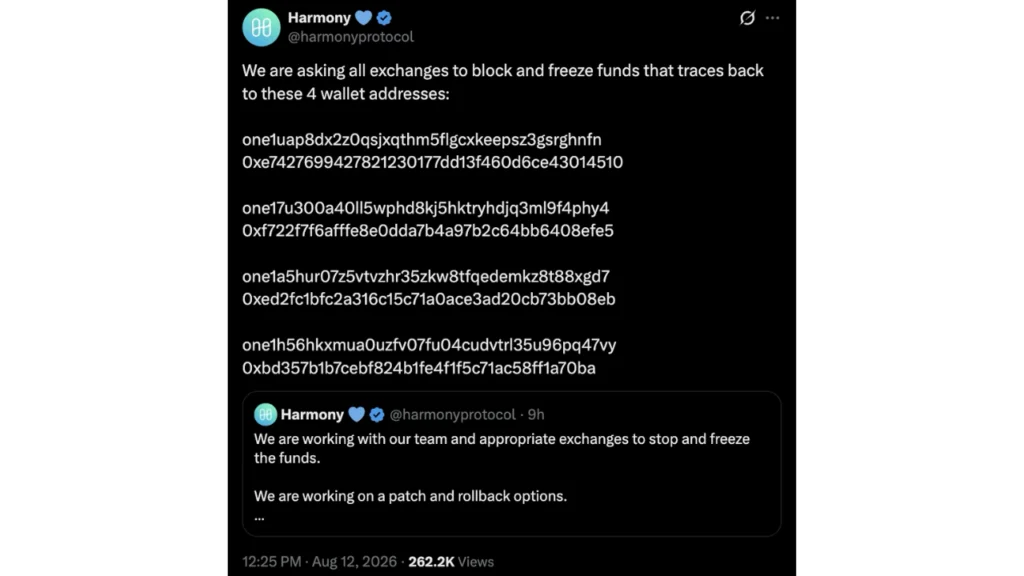
Harmony’s native ONE token experienced a precipitous decline on August 12, following a suspected exploit on the Layer-1 blockchain that reportedly led to the unauthorized creation of approximately 4 billion ONE tokens. This unprecedented issuance, which analysts estimate to represent about 26% of the token’s pre-incident circulating supply of roughly 15 billion ONE, has ignited widespread concerns regarding supply inflation and triggered intense selling pressure across cryptocurrency markets. Harmony swiftly acknowledged the security breach, confirming its efforts to deploy an emergency patch and actively evaluating various rollback options to mitigate the damage. The incident marks another significant challenge for the blockchain platform, which has previously contended with substantial security vulnerabilities and exploits.
Unraveling the Unauthorized Minting Incident
The crisis began unfolding when on-chain analytics firm Juiceberg brought to light the alleged creation of roughly 4 billion ONE tokens through what were described as "empty blocks" on the Harmony network. This figure, if officially corroborated by Harmony, signifies a massive dilution event, adding more than one-quarter to the token’s existing circulating supply in an instant. The implications of such a sudden and significant increase in supply are profound, typically leading to a sharp devaluation of the asset due to fundamental economic principles of supply and demand. The initial reports indicated that the newly minted tokens were not only created but also rapidly moved, with Juiceberg estimating that approximately 2.8 billion ONE were subsequently transferred to various cryptocurrency exchanges. A further 115 million ONE were reportedly available for sale on-chain at one point, indicating a rapid attempt by the exploiter to liquidate the ill-gotten gains. While Harmony has not yet independently confirmed these specific figures or detailed the precise vulnerability that facilitated the unauthorized minting, the project’s urgent response underscores the severity of the situation. Their immediate priority has been to prevent any further token creation and to establish a definitive strategy for handling the tokens already generated.
The unauthorized minting event contrasts sharply with traditional blockchain operations, where token creation is typically governed by predefined economic models, such as staking rewards, mining, or controlled release schedules. An exploit that allows for arbitrary token generation bypasses these mechanisms, undermining the scarcity and integrity of the digital asset. The term "empty blocks" in this context likely refers to blocks that, while validly added to the chain, contained transactions that incorrectly authorized the creation of new tokens without legitimate cause, or exploited a flaw in the network’s consensus or smart contract logic to mint tokens outside of the expected protocol. This type of vulnerability can be particularly damaging as it directly attacks the foundational economic model of the blockchain.
Harmony’s Swift Response and Containment Strategy
In the immediate aftermath of the suspected exploit, Harmony moved decisively to contain the breach and mitigate its impact. The development team identified four specific wallet addresses believed to be linked to the incident and promptly initiated contact with major cryptocurrency exchanges, urging them to block and freeze any funds originating from these suspicious addresses. This rapid coordination with centralized exchanges is a critical first step in such events, as it can prevent the further spread and liquidation of stolen or illicitly minted assets.

Beyond financial countermeasures, Harmony implemented technical interventions to secure the network. The project temporarily paused its token bridge, a crucial component that facilitates the transfer of assets between Harmony and other blockchain networks. Such bridges are often targets for attackers, as demonstrated by previous incidents, though in this case, the exploit appears to be native to the Layer-1 network itself rather than the bridge. Simultaneously, network operators were instructed to install an emergency software update designed to patch the underlying vulnerability and prevent any further unauthorized minting. The ongoing efforts include developing a more permanent patch and, significantly, evaluating the feasibility and implications of a blockchain rollback.
A blockchain rollback is a drastic measure that involves reverting the network to an earlier state, effectively erasing all transactions that occurred after a specific block number, including the unauthorized minting. While potentially effective in eliminating the illicitly created tokens and restoring the integrity of the supply, such an action carries substantial risks. It fundamentally challenges the principle of blockchain immutability, a cornerstone of decentralized networks, which dictates that once a transaction is recorded, it cannot be altered or reversed. Reversing transactions, even for legitimate reasons, can erode user trust, raise questions about transaction finality, and potentially reverse legitimate transactions made by innocent users during the affected period. Harmony’s careful consideration of this option highlights the severity of the exploit and the difficult choices facing the project team. The specific block range that might be affected by a rollback, and the full implications for the network’s users and decentralized applications (dApps), remain subjects of ongoing internal evaluation.
Market Turmoil and Investor Confidence Erosion
The news of the suspected exploit sent immediate shockwaves through the cryptocurrency market, with Harmony’s ONE token experiencing a dramatic downturn. According to market data, ONE’s price plummeted by over 39% at its lowest point, settling around $0.000747. This sharp decline underscores the market’s extreme sensitivity to supply shocks and security breaches, particularly when the reported scale of unauthorized token issuance is substantial relative to the existing supply. Before the incident, Harmony ONE had a circulating supply of approximately 15 billion tokens and a market capitalization that reflected its standing as a prominent Layer-1 blockchain. The sudden prospect of an additional 4 billion tokens, representing a quarter of the existing supply, created an immediate inflationary fear, leading to a sell-off as investors rushed to offload their holdings to mitigate potential losses.
The market’s reaction extends beyond the direct financial impact of the alleged attacker’s activities. Even if a significant portion of the newly minted ONE can be frozen or recovered, the lingering uncertainty surrounding the token’s definitive supply creates a climate of distrust. Investor confidence, once shaken, can be challenging to restore. The lack of an official and reconciled supply figure from Harmony leaves a critical question unanswered: what is the precise number of ONE tokens that were created? Until Harmony publishes a definitive and verified figure, the reported 4 billion remains an on-chain analyst’s estimate, contributing to market volatility and investor apprehension. This uncertainty creates a challenging environment for traders and long-term holders alike, as the true valuation of their assets becomes obscured by the potential for dilution. The incident also serves as a stark reminder of the inherent risks in the nascent and rapidly evolving blockchain ecosystem, where security vulnerabilities can have immediate and devastating financial consequences.
A Pattern of Security Challenges for Harmony
This latest security incident is not an isolated event for the Harmony blockchain. The platform has unfortunately faced a series of significant security breaches and vulnerabilities in its relatively short history, raising questions about its overall security architecture and resilience.

In 2023, Harmony encountered a vulnerability within its staking logic that resulted in the unintended creation of approximately 146.3 million ONE tokens. This issue affected 74 delegator addresses and was traced back to undelegation records that were not properly cleared after validator commission changes. Consequently, some matured undelegations erroneously received repeated payouts across multiple epochs, generating tokens outside the intended issuance process. Harmony addressed this specific flaw with an emergency hard fork, deploying a fix at block 51,118,080. While the scale of this previous incident was considerably smaller than the current one, it highlighted a prior instance of unauthorized token generation due to protocol-level vulnerabilities.
A more severe incident occurred in June 2022, when Harmony’s Horizon Bridge was compromised. Attackers exploited a vulnerability, gaining control of private keys, and subsequently stole approximately $100 million worth of various cryptocurrencies. The Federal Bureau of Investigation (FBI) later attributed this sophisticated attack to the Lazarus Group, a notorious cybercrime organization linked to North Korea. The Horizon Bridge hack was distinct from the current minting exploit in its nature; it involved the theft of existing assets held within the bridge rather than the creation of new tokens directly on the Layer-1 network. However, both incidents collectively paint a picture of persistent security challenges for the Harmony ecosystem, which can cumulatively erode trust among users, developers, and investors. The recurrence of such events underscores the critical need for continuous, rigorous security audits, robust incident response protocols, and a proactive approach to identifying and patching vulnerabilities.
Broader Implications and the Road Ahead for Harmony
The unauthorized minting exploit presents Harmony with a multi-faceted crisis that extends beyond immediate financial losses. The platform now faces several critical questions that demand urgent and transparent answers: What was the exact vulnerability that enabled the unauthorized minting? How many ONE tokens were definitively created? How many remain under the attacker’s control, and crucially, how many can cryptocurrency exchanges successfully freeze and prevent from entering the broader market?
The decision regarding a potential rollback is perhaps the most challenging. While reverting the chain could effectively neutralize the illicit tokens and restore the original supply integrity, it would inevitably impact legitimate users and potentially further undermine confidence in the network’s transaction finality. Such a move would require careful communication, community consensus (if possible), and a clear plan for compensating or addressing any legitimate transactions that might be inadvertently reversed. The philosophical implications for a blockchain that sacrifices immutability, even in extreme circumstances, could have long-term repercussions for its reputation and adoption.
For Harmony, the immediate priorities are clear: halt any potential further unauthorized issuance, conduct a thorough forensic investigation to identify the root cause of the vulnerability, and establish an accurate, officially verified accounting of all affected tokens. The cooperation of cryptocurrency exchanges will be paramount in tracing and freezing funds, especially if large quantities of the newly minted ONE have already found their way onto centralized trading platforms.

Beyond the immediate crisis management, Harmony must embark on a comprehensive strategy to rebuild trust and fortify its security infrastructure. This includes implementing more stringent security audits, potentially introducing bug bounty programs, and fostering a culture of security consciousness within its developer community. The incident also serves as a broader cautionary tale for the entire blockchain industry, emphasizing that even established Layer-1 protocols are susceptible to sophisticated exploits.
As of August 12, Harmony had confirmed the security incident but had not yet publicly confirmed the reported 4 billion ONE figure or disclosed the underlying vulnerability. The project has committed to providing further updates as its investigation and response efforts progress. The ongoing situation represents a profound test of Harmony’s technical resilience, its crisis management capabilities, and its ability to restore faith in its security protocols and the integrity of its token supply. The coming weeks will be crucial in determining the long-term viability and trajectory of the Harmony blockchain in the competitive Layer-1 landscape.