admin
admin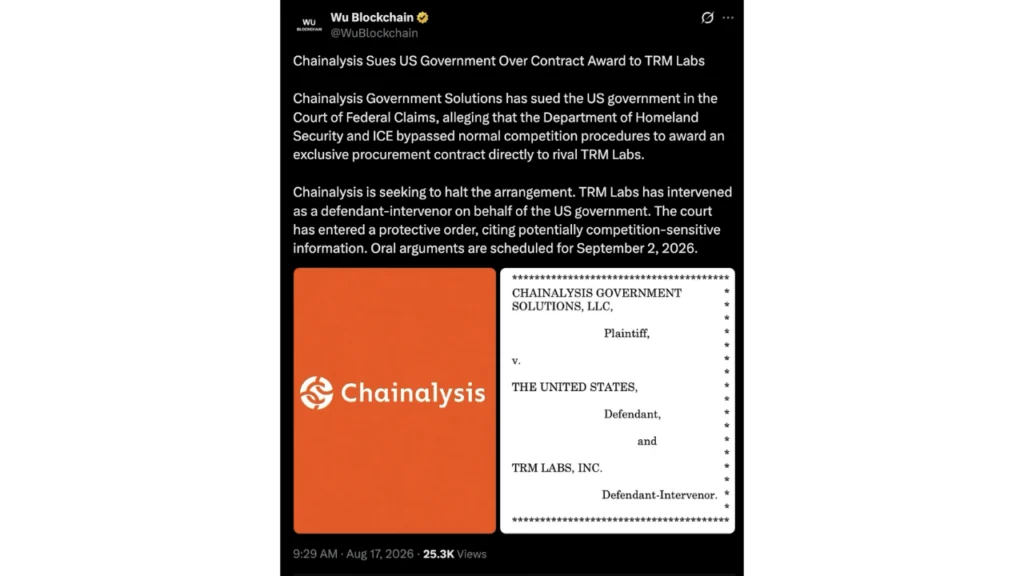
Blockchain analytics giant Chainalysis has filed a lawsuit against the U.S. government, challenging the award of a significant $94.7 million sole-source contract by U.S. Immigration and Customs Enforcement (ICE) to its competitor, TRM Labs. This legal action, initiated on July 27 in the U.S. Court of Federal Claims by Chainalysis Government Solutions, marks a significant escalation in the intense competition between two of the leading providers of investigative technology in the burgeoning crypto industry. The dispute centers on ICE’s decision to bypass a conventional competitive bidding process, prompting Chainalysis to allege that the government’s procurement decision was "arbitrary, capricious, and unreasonable."
The contested contract, valued at $94.655 million, is a one-year agreement that commenced on July 1. It is designed to provide forensic blockchain software and comprehensive support services for critical Homeland Security Task Force investigations. These investigations encompass a wide array of illicit activities, including cryptocurrency tracing, advanced blockchain analysis, open-source intelligence gathering, and the processing of investigative data related to fraud, cybercrime, and sextortion. The awarded system is also intended to enhance agencies’ capacity to scale their investigative operations efficiently during major incidents.
The Heart of the Dispute: Sole-Source Procurement
At the core of Chainalysis’s legal challenge is the principle of competitive bidding in government acquisitions. Federal procurement regulations generally mandate a competitive process to ensure fairness, transparency, and the best value for taxpayer money. However, these rules do allow for non-competitive, or sole-source, awards under specific, narrowly defined circumstances, primarily when an agency determines that only one provider can meet its unique requirements without detriment to mission objectives.
ICE, in its preliminary announcement in June of its intent to procure TRM Labs’ software and services through a sole-source mechanism, concluded that TRM Labs possessed the necessary capabilities for the assignment and that a competitive procurement was deemed unnecessary. Chainalysis, a long-standing and prominent player in the blockchain analytics space, vehemently disagreed with this assessment. Following ICE’s notice of intent, Chainalysis submitted a detailed capability statement, asserting its ability to provide the requisite technology and services. This submission underscored its belief that it was a viable and competitive alternative, thereby challenging ICE’s justification for a sole-source award.
The implications of such a large contract extend far beyond its immediate monetary value. For companies in the specialized field of blockchain analytics, securing federal agency contracts can be a strategic imperative. These agreements not only provide substantial revenue but also establish a technological foothold within critical government investigative workflows, potentially influencing future procurement decisions and setting industry standards for years to come. The current lawsuit highlights the strategic importance of these federal partnerships in shaping the competitive landscape of the crypto intelligence market.
A Detailed Chronology of Events
The timeline of events leading to this high-stakes legal battle unfolded rapidly:
- June 2023: U.S. Immigration and Customs Enforcement (ICE) issues a notice of intent to procure blockchain analytics software and support services from TRM Labs through a sole-source procurement process.
- Late June/Early July 2023: Chainalysis, upon learning of ICE’s intent, submits a capability statement to the agency, signaling its capacity to fulfill the contract requirements and contesting the sole-source justification.
- July 1, 2023: The disputed one-year contract, valued at $94.655 million, officially commences between ICE and TRM Labs.
- July 27, 2023: Chainalysis Government Solutions files a lawsuit against the U.S. government in the U.S. Court of Federal Claims, formally challenging the sole-source award to TRM Labs.
- July 28, 2023: TRM Labs enters the case as a defendant-intervenor, aligning itself with the U.S. government’s position and seeking to defend the validity of the contract award.
- July 31, 2023: The court approves the continued sealing of Chainalysis’s initial complaint, acknowledging that it contains confidential information, including trade secrets and commercially sensitive material, which remains inaccessible to the public.
- August 21, 2023 (Expected): The U.S. government and TRM Labs are anticipated to submit their formal responses to Chainalysis’s complaint.
- September 2, 2023 (Scheduled): Oral arguments in the case are slated to take place.
- September 10, 2023 (Requested): The government has formally requested that the court issue a final decision by this date, indicating a desire for an expedited resolution to the dispute.
This accelerated legal schedule underscores the urgency of the matter, particularly given that TRM Labs’ integration into federal investigative operations under the new contract has already begun. A swift judicial decision could either solidify TRM Labs’ position or halt its progress, potentially forcing a re-evaluation of the contract before deeper operational embedding occurs.
The Titans of Trace: Chainalysis and TRM Labs
The lawsuit pits two of the most prominent and technologically advanced firms in the blockchain intelligence market against each other. Both Chainalysis and TRM Labs specialize in developing sophisticated tools that enable law enforcement agencies, financial institutions, and regulatory bodies to trace cryptocurrency transactions, identify connections between various blockchain addresses, and investigate suspicious or illicit activities involving digital assets.
Chainalysis: Founded in 2014, Chainalysis is widely recognized as a pioneer and a market leader in blockchain forensics. The company has built an extensive client base that includes numerous federal agencies, such as the FBI, DEA, IRS, and, significantly, ICE itself. Its flagship platform, Reactor, is a sophisticated investigative tool used globally to visualize and analyze cryptocurrency flows, providing critical insights into criminal networks and money laundering operations. The company’s established relationship with ICE is evident; just two months prior to the disputed award, ICE issued Chainalysis an order worth approximately $262,149 for licenses to its Reactor platform. This existing engagement forms a crucial part of Chainalysis’s argument that it is a capable and experienced provider fully equipped to meet ICE’s needs. With significant funding rounds and a valuation in the billions, Chainalysis has long been the benchmark for the industry, boasting a comprehensive suite of products that address various aspects of crypto compliance and investigation.
TRM Labs: While a newer entrant compared to Chainalysis, TRM Labs has rapidly emerged as a formidable competitor, gaining significant traction, particularly within government and law enforcement sectors. Established in 2019, TRM Labs offers a suite of products, including its proprietary transaction monitoring software, which leverages advanced analytics and machine learning to detect fraud and financial crime in the crypto space. The company has aggressively expanded its market presence, securing contracts with various public and private entities. Evidence of this expansion can be seen in a Florida procurement document, which reportedly showed state law enforcement agencies spending $125,000 on TRM Labs’ cryptocurrency transaction monitoring software during the 2025-2026 fiscal year. The $94.7 million ICE contract represents a substantial leap for TRM Labs, promising to significantly bolster its footprint within the critical federal government blockchain investigation infrastructure and potentially challenging Chainalysis’s long-held dominance.

The rivalry between these two companies extends beyond contract bids; it encompasses a battle for technological superiority, market share, and strategic influence within an increasingly vital sector of national security and financial crime prevention.
Strategic Imperatives: Why Federal Contracts Are Crucial
The intense competition for this ICE contract underscores the growing commercial importance of blockchain analytics technology within the public sector. As cryptocurrencies become more mainstream and simultaneously exploited in a rising tide of cybercrime, fraud, sanctions violations, and other financial misconduct, government agencies are increasingly reliant on sophisticated tools to track and disrupt illicit activities. The global blockchain analytics market is projected to grow significantly, with reports often estimating its value in the hundreds of millions, expanding into billions over the next decade. Federal agencies represent a substantial and stable customer base within this market.
For both Chainalysis and TRM Labs, securing large federal contracts is not merely about immediate revenue. These contracts offer:
- Validation and Prestige: A major federal contract serves as a powerful endorsement of a company’s technology and capabilities, enhancing its credibility in both public and private sectors globally.
- Market Entrenchment: Embedding a company’s platform within a federal agency’s investigative workflow creates significant switching costs. Once integrated, agencies become accustomed to a particular system, making it harder for competitors to displace them in future procurements. This can lead to recurring revenue streams and a sustained competitive advantage.
- Strategic Influence: By becoming the primary provider to a key federal agency like ICE, a company gains insights into evolving government needs and priorities, allowing it to tailor future product development and stay ahead of market trends.
- Data and Network Effects: While specifics are sealed, the use of these tools can generate valuable data, which, within ethical and legal boundaries, can further refine algorithms and enhance the effectiveness of their platforms, creating a virtuous cycle.
- Competitive Edge: For Chainalysis, preventing TRM Labs from securing an exclusive, large-scale federal foothold is strategically as important as the $94.7 million contract itself. It protects its established market leadership. For TRM Labs, successfully defending this award would signify a major breakthrough, cementing its position as a top-tier provider and a direct challenger to Chainalysis’s long-standing dominance.
This battle reflects the broader trend of cryptocurrency intelligence evolving from a niche service to a critical component of national security and financial integrity infrastructure. Control over this market, especially within the U.S. federal government, is an increasingly valuable prize.
The Sealed Proceedings and Accelerated Timeline
A significant portion of the ongoing legal dispute remains obscured from public view. Chainalysis’s initial complaint, along with many subsequent filings, is currently under seal. This measure was approved by the court on July 31, due to the inclusion of confidential business information, trade secrets, and other commercially sensitive material that, if disclosed, could harm the competitive interests of the parties involved. As a result, the precise details of Chainalysis’s arguments and the specific remedies it is seeking — which could range from a re-evaluation of the contract to a full competitive re-procurement — are not publicly known.
TRM Labs’ decision to intervene as a defendant, rather than simply remaining an interested third party, highlights its vested interest in the outcome. By actively supporting the government’s position, TRM Labs aims to ensure the contract remains intact and its integration with ICE proceeds unimpeded.
The U.S. Court of Federal Claims operates with an expedited schedule for bid protest cases, reflecting the need to resolve procurement disputes swiftly to avoid prolonged delays in government operations. The tight deadlines for responses and the rapid scheduling of oral arguments and a potential decision underscore the court’s intention to bring clarity to this dispute quickly. This accelerated timeline means that the future of the $94.7 million contract could be determined before TRM Labs has the opportunity to become more deeply integrated into federal investigative operations, adding another layer of urgency and high stakes to the proceedings.
Broader Ramifications for Government Tech Procurement and the Crypto Analytics Market
The outcome of Chainalysis Government Solutions v. United States could establish significant precedents with far-reaching implications for both the U.S. government’s procurement practices and the broader cryptocurrency analytics industry.
-
Impact on Government Procurement:
- If the court sides with Chainalysis: A ruling in favor of Chainalysis could compel ICE to reconsider the award or even mandate a new, competitive procurement process. Such a decision would reinforce the stringent conditions under which federal agencies can justify sole-source contracts. It would likely lead to increased scrutiny of non-competitive awards across all government sectors, forcing agencies to provide more robust and transparent justifications when bypassing competitive bidding, particularly for sophisticated technological solutions where multiple capable providers exist. This could, in turn, make future federal blockchain analytics contracts significantly more competitive, potentially benefiting a wider array of innovative companies.
- If the government (and TRM Labs) prevails: A victory for the government and TRM Labs would reaffirm the discretion of federal agencies to make direct awards when they genuinely determine that a specialized provider uniquely satisfies their operational requirements. This outcome might be viewed by some as an affirmation of efficiency in specialized procurement but could be criticized by others for potentially limiting competition and innovation.
-
Impact on the Crypto Analytics Market:
- Competitive Landscape: Regardless of the immediate outcome, the lawsuit has already cast a spotlight on the intense rivalry within the blockchain analytics sector. It highlights that market leadership is not guaranteed and that companies must constantly innovate and compete vigorously for critical government contracts. The case could reshape market dynamics, potentially leading to more aggressive strategies from both established players and emerging challengers.
- Strategic Importance: The dispute underscores the evolving nature of blockchain intelligence. What was once considered a niche service for early adopters of cryptocurrency has now matured into a critical investigative infrastructure, essential for national security, law enforcement, and financial regulatory compliance. The value of this infrastructure, both in terms of technology and the strategic relationships with government entities, is clearly immense.
- Innovation and Specialization: The argument over "unique capabilities" might also spur further specialization and differentiation among analytics providers. Companies may invest more heavily in developing distinct features or specialized services that they can argue are truly unique and indispensable, thereby strengthening their claims in future sole-source justifications.
In conclusion, the lawsuit initiated by Chainalysis is more than just a dispute over a single contract; it is a battle for strategic positioning and market influence in the rapidly expanding and critical field of blockchain intelligence. The U.S. Court of Federal Claims’ forthcoming decision will not only determine the fate of the $94.7 million contract but also potentially set a precedent for how federal agencies acquire advanced technological solutions in the future, profoundly impacting the competitive dynamics of the crypto analytics market for years to come.