Dwi Wanna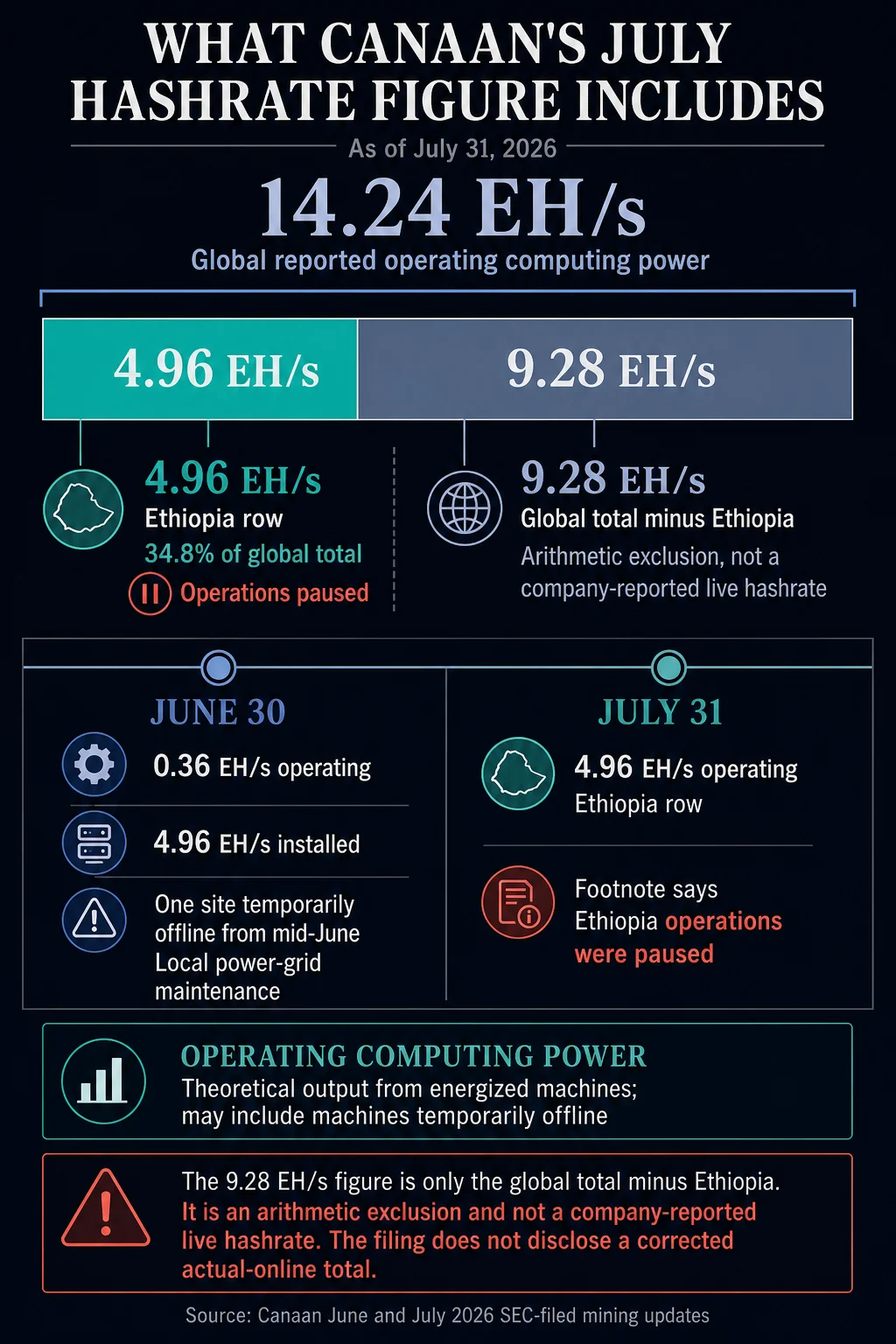
The reporting methodology employed by Canaan highlights a significant distinction between actual real-time hashing and "operating capacity" as defined by corporate accounting standards. By subtracting the Ethiopian contribution from the total, the arithmetic remainder for Canaan’s active global fleet stands at 9.28 EH/s. However, the company’s internal definitions suggest that even this figure may not represent a live, second-by-second measurement of machines currently solving blocks on the Bitcoin network.
Understanding Canaan’s Definition of Operating Computing Power
To interpret these figures accurately, one must look at Canaan’s specific definition of "operating computing power" as outlined in its SEC filings. The company defines this metric as the theoretical output of energized mining machines, assuming all such machines were operating at their full potential. Crucially, this metric is designed to include machines that may be temporarily offline for maintenance or other short-term interruptions, provided they remain part of the energized infrastructure.
This definition serves as a baseline for potential productivity rather than a reflection of realized output. For investors and industry analysts, this creates a layer of complexity when attempting to correlate a company’s hashrate with its actual Bitcoin production. In the case of the July update, the inclusion of 4.96 EH/s from Ethiopia—a country where Canaan did not confirm how much capacity was actually hashing at the end of the month—suggests that the company views "operating" status as a matter of site readiness and equipment installation rather than active data transmission to a mining pool.
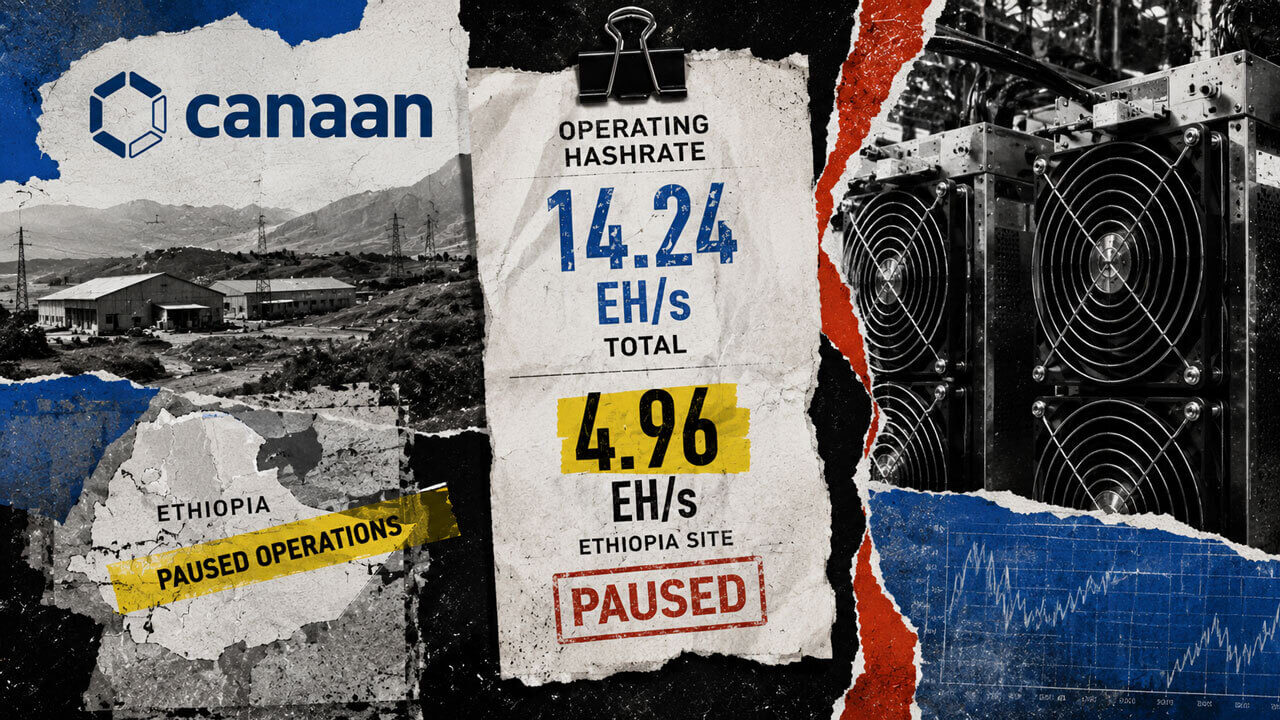
The July table assigned the full 4.96 EH/s to two specific projects in Ethiopia in both the "operating" and "installed" columns. Footnote 10 of the filing clarified that while mining operations in the country were paused, the hashrate remained categorized under installed capacity. The filing did not specify whether these paused machines remained energized or if they were completely powered down, leaving a grey area regarding the technical "energized" status required by the company’s own definition of operating power.
A Comparative Chronology: From June to July
The reporting for July represents a sharp pivot from the data provided in the previous month. As of June 30, Canaan’s disclosure listed its Ethiopian operations at only 0.36 EH/s of operating computing power, despite having the same 4.96 EH/s of installed capacity. At that time, the company explained that the significant gap between installed and operating power was due to a mining site going temporarily offline in mid-June. This disruption was attributed to local power-grid maintenance, a common challenge for miners operating in developing energy markets.
However, by the end of July, the reporting underwent a notable shift. Despite the new footnote describing the Ethiopian operations as "paused," the full 4.96 EH/s was moved back into the "operating" column. The documentation provided by the company does not establish whether the July pause was a continuation of the June grid maintenance or if a new set of circumstances had led to the suspension of activities. Furthermore, the filings do not clarify if Canaan considers this pause to be a temporary hurdle or a more prolonged operational adjustment.
This fluctuation in reporting underscores the volatility of mining operations in regions with developing infrastructure. It also highlights the flexibility companies have in how they categorize "operating" assets during periods of downtime.
The Ethiopian Context: Opportunities and Infrastructure Risks
Ethiopia has emerged as an attractive destination for global Bitcoin mining firms, including Canaan, primarily due to its massive hydroelectric power potential and competitive electricity costs. The Grand Ethiopian Renaissance Dam (GERD) has promised to provide a surplus of renewable energy, making the nation a hub for energy-intensive industries.
However, the reality of operating in Ethiopia involves navigating a complex landscape of grid stability and regulatory oversight. While the government has shown an openness to Bitcoin mining as a way to generate foreign currency and utilize excess energy, the domestic power grid often prioritizes residential and essential industrial needs. Maintenance schedules and unexpected outages are frequent, leading to the "temporary" offline periods mentioned in Canaan’s June report.
For Canaan, the 4.96 EH/s situated in Ethiopia represents a significant strategic investment. The decision to maintain this capacity in the "operating" column despite a pause suggests a corporate confidence that these assets will return to full productivity shortly. Alternatively, it may reflect a desire to demonstrate the scale of the company’s global footprint to shareholders, even when local conditions limit immediate output.
Analyzing Production vs. Theoretical Capacity
The discrepancy between reported operating hashrate and actual Bitcoin production provides further insight into Canaan’s operational reality. For the month of July, Canaan reported mining 46 BTC. To put this in perspective, a fleet consistently running at 14.24 EH/s—or even the 9.28 EH/s excluding Ethiopia—would typically be expected to yield a higher monthly total under standard network difficulty conditions.
This production figure of 46 BTC does not, however, cover every project listed in the company’s global capacity table. Canaan separately reports metrics for its joint ventures in West Texas, including the Alborz, Bear, and Chief Mountain projects. Canaan holds a 49% stake in these ventures. According to the company’s reporting standards, the output from these joint ventures is excluded from Canaan’s direct Bitcoin production totals and its average all-in power-cost calculations.
Even with these exclusions, the gap between the "theoretical" 14.24 EH/s and the 46 BTC produced suggests that a significant portion of the fleet was not hashing for a large duration of the month. This further reinforces the interpretation that "operating computing power" is a measure of potentiality and equipment status rather than a metric of monthly performance.
Financial and Asset Holdings
Beyond its operational hashrate, Canaan’s July update provided a snapshot of its digital asset treasury. At month-end, the company held 1,917 BTC. In addition to its Bitcoin holdings, Canaan reported a position of 3,952 ETH. These holdings represent a significant part of the company’s balance sheet and provide a buffer against the volatility of the mining hardware market.
Canaan’s dual role as both a manufacturer of ASIC (Application-Specific Integrated Circuit) mining rigs and a self-mining operator places it in a unique position within the industry. While it competes with other manufacturers like Bitmain and MicroBT, its self-mining operations allow it to deploy its own latest-generation hardware, such as the Avalon series, to secure the network and generate direct revenue.

Implications for Industry Transparency and Investor Relations
The nuance in Canaan’s July filing brings to light a broader conversation regarding transparency in the cryptocurrency mining sector. As more mining companies seek public listings and face rigorous SEC reporting requirements, the standardization of metrics like "hashrate" and "operating capacity" becomes critical.
In traditional industries, "capacity utilization" is a standard metric that tells investors how much of a factory’s or plant’s potential is being used. In Bitcoin mining, the industry has yet to adopt a single, universally accepted definition for "operating hashrate." Some companies report only what is actively hashing at the moment of the report, while others, like Canaan, include energized or "ready-to-run" machines.
For investors, the takeaway from the July report is the necessity of reading the fine print. While the headline figure of 14.24 EH/s suggests a massive operational scale, the footnotes reveal that nearly 35% of that power was not contributing to the company’s Bitcoin production during the period in question. This does not necessarily imply a lack of integrity in reporting, but rather a specific accounting methodology that prioritizes asset readiness over real-time performance.
Future Outlook for Canaan’s Global Fleet
Looking ahead, the reactivation of the Ethiopian sites will be a key performance indicator for Canaan. If the 4.96 EH/s returns to active hashing, the company’s Bitcoin production could see a significant month-over-month increase. Conversely, if the "pause" extends indefinitely, analysts may begin to discount the Ethiopian portion of the fleet when valuing the company’s operational efficiency.
The company’s strategy in West Texas through its joint ventures also remains a focal point. By diversifying its geographical footprint between the emerging market of Ethiopia and the established energy markets of the United States, Canaan is attempting to balance high-reward, high-risk energy opportunities with more stable, albeit potentially more expensive, regulatory environments.
As the Bitcoin network difficulty continues to adjust and the industry moves further away from the 2024 halving event, the efficiency of mining fleets will be the primary driver of profitability. Canaan’s ability to convert its "theoretical" operating power into actual mined Bitcoin will determine its standing in an increasingly competitive global market. For now, the July update serves as a reminder that in the world of crypto-mining, the numbers on the balance sheet often require a deeper look at the footnotes on the ground.