admin
admin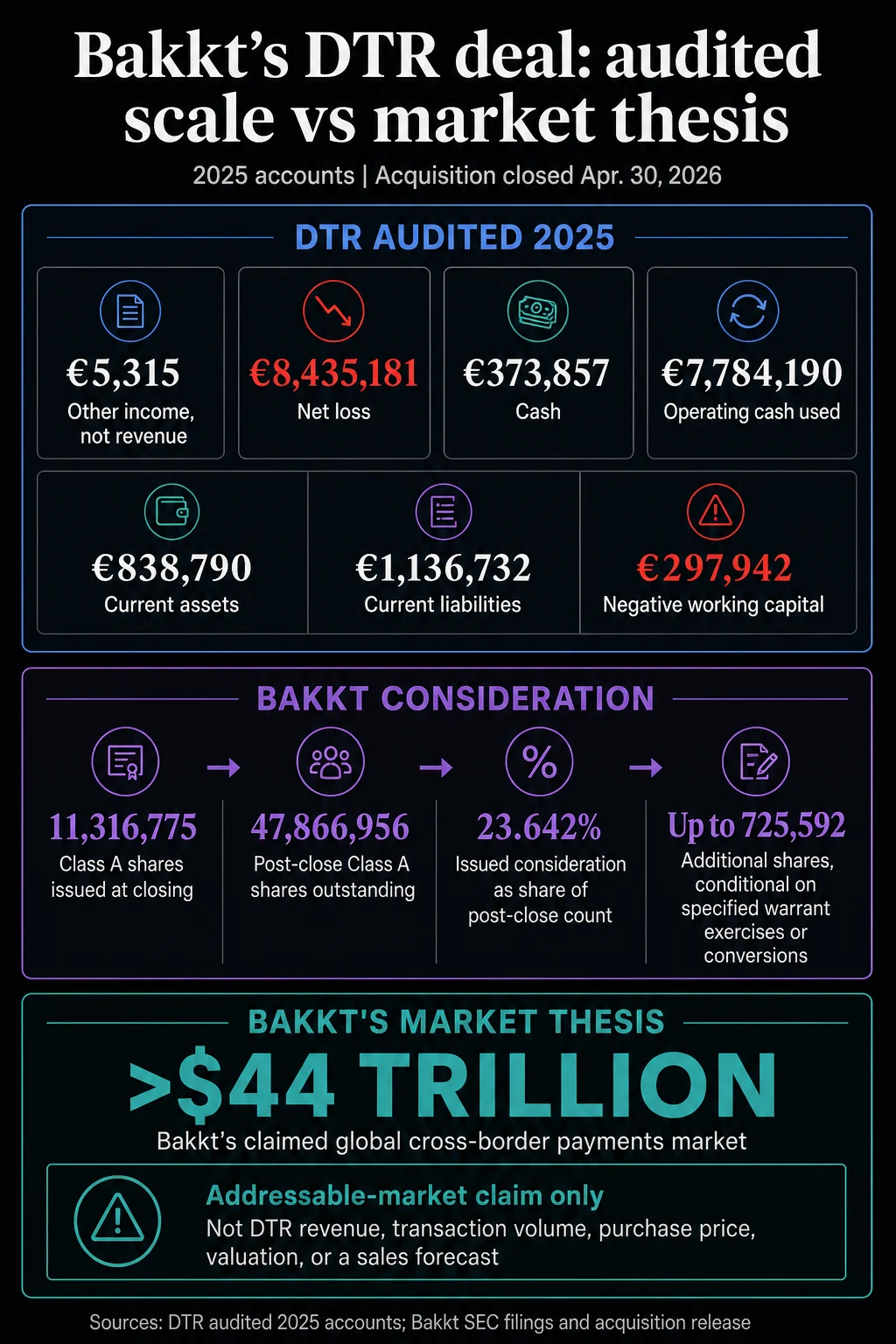
The audited financial statements for Distributed Technologies Research (DTR), a fintech software group acquired by Bakkt in April, reveal a company that generated a mere $5,315 in other income and incurred a substantial loss of $8.4 million during the 2025 fiscal year. These figures stand in stark contrast to Bakkt’s ambitious pronouncements surrounding the acquisition, which was positioned as a cornerstone of its strategy to revolutionize the $44 trillion global payments market through stablecoin infrastructure and agentic payment solutions.
The financial disclosures, covering DTR’s inaugural consolidated reporting year, predate the acquisition’s closing on April 30. They present a picture of a business grappling with significant operational challenges and a considerable cash burn, raising questions about the valuation and strategic rationale behind Bakkt’s investment.
A Deep Dive into DTR’s 2025 Financial Performance
According to the audited accounts, DTR’s financial performance in 2025 was characterized by minimal "other income" of $5,315, a classification that explicitly distinguishes it from revenue. More critically, the company reported a net loss of $8,435,181 for the year. These figures provide the first detailed look into the financial health of the acquired entity prior to its integration into Bakkt’s operations.
The reports further detail DTR’s balance sheet as of the end of 2025. The company held $373,857 in cash, a modest sum given its operational expenditures. A more concerning indicator of financial strain was DTR’s negative working capital position. Its current liabilities, totaling $1,136,732, significantly exceeded its current assets, which amounted to $838,790, resulting in a deficit of $297,942. This liquidity gap suggests potential challenges in meeting short-term obligations without external funding.
Operational Cash Flow and Funding Mechanisms
DTR’s operational activities in 2025 consumed a substantial $7,784,190 in cash. To sustain its operations and manage its deficits, DTR relied heavily on equity financing, raising $11,718,611 through the issuance of share capital. This reliance on capital injections highlights the company’s inability to generate sufficient operational cash flow to cover its expenses.
The acquisition itself was structured as a significant equity transaction. Bakkt acquired all of DTR’s outstanding equity, a move that saw DTR contribute its payments technology, application programming interfaces (APIs), intellectual property, and personnel to Bakkt. In return, Bakkt provided access to its systems and leveraged its regulatory licenses, as outlined in an earlier cooperation agreement.
The Acquisition Deal: Share Consideration and Ownership Structure
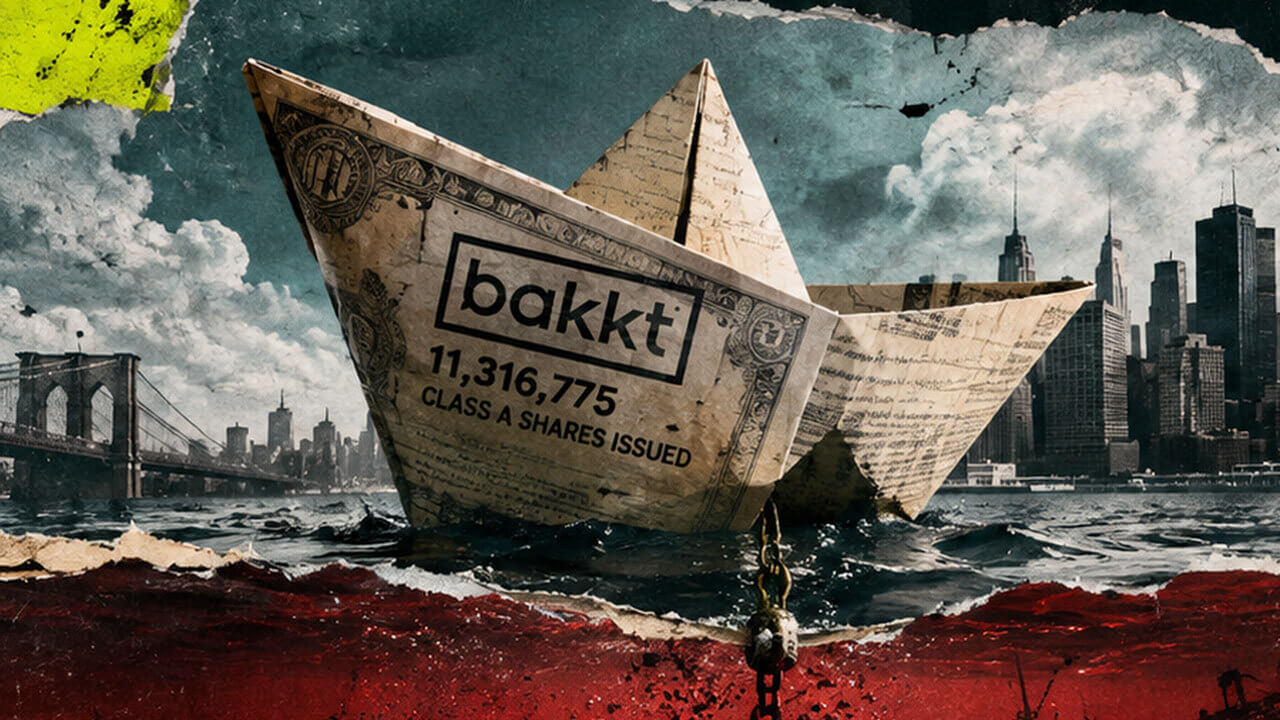
Bakkt finalized the acquisition by issuing 11,316,775 shares of its Class A common stock. The final share consideration was slightly reduced from an initial figure due to adjustments for specified shareholder loans and excess transaction expenses, resulting in a reduction of 196,532 shares.
A subsequent registration statement filed by Bakkt revealed that as of April 30, the company had 47,866,956 Class A shares outstanding. The shares issued to DTR shareholders represented approximately 23.642% of this post-close share count. It is important to note that this percentage differs from the initially stated deal term of 31.5%, which was based on a defined pre-close, as-converted share base. Bakkt also retains the option to issue up to an additional 725,592 consideration shares, contingent on the exercise or conversion of specific warrants, which would further adjust the overall ownership structure.
Related-Party Transactions and Impairment Charges
The acquisition of DTR was not a straightforward arm’s-length transaction. Akshay Naheta, who held the positions of CEO, president, and director at Bakkt, was also the CEO and principal owner of DTR. As part of the deal, Naheta received 8,322,949 Bakkt shares. Bakkt’s disclosures indicate that an independent special committee oversaw the negotiation and approval of the transaction, with Naheta recusing himself from the process. Stockholders subsequently approved the share issuance before the acquisition’s completion.
The audited accounts also flagged a significant impairment expense of $3,205,828. This charge was specifically described as a write-off of a related-party balance, suggesting that a financial obligation or asset related to a party connected to Bakkt or DTR was deemed unrecoverable. Furthermore, the cash-flow reconciliation revealed a movement of $3,614,868 related to an amount due from a related party. This figure represents the net change during the year, distinct from the year-end receivable balance of $409,040. These related-party disclosures add a layer of complexity and potential conflict of interest to the transaction.
Bakkt’s Vision vs. DTR’s Reality: The $44 Trillion Market Claim

In its official announcement regarding the acquisition’s completion, Bakkt framed the deal as a strategic entry into the global cross-border payments market, a market it asserted was valued at over $44 trillion. This figure, however, represents the total addressable market for cross-border payments, not DTR’s revenue, transaction volume, purchase price, or valuation. It also does not represent a forecast of Bakkt’s achievable sales within this market. The broad market claim, while indicative of Bakkt’s aspirations, serves to underscore the significant gap between the company’s overarching market ambitions and the demonstrated financial performance of the acquired entity.
Pre-Acquisition Concerns and Commercial Challenges
Even before the full financial details emerged, Bakkt’s own disclosures hinted at potential challenges with DTR. In its transaction proxy filing, Bakkt acknowledged that DTR had fallen behind its own forecasts. The filing detailed delays in three prospective customer integrations and a failure to secure expected large merchant partnerships. These pre-acquisition concerns, now juxtaposed with the audited 2025 financials, further highlight the disparity between the promised potential of DTR and its actual operational and financial achievements prior to becoming part of Bakkt.
The acquisition of DTR was intended to bolster Bakkt’s stablecoin infrastructure and agentic payments capabilities. The company envisioned leveraging DTR’s technology to facilitate seamless and efficient payment solutions, particularly in the cross-border realm. However, the limited "other income" and substantial losses reported by DTR in 2025 raise critical questions about the immediate commercial viability and the expected return on investment for Bakkt.
Analysis of Implications: A Challenging Path Forward
The financial revelations concerning DTR present Bakkt with a significant challenge. The company has invested a considerable amount of equity in an entity that, prior to the acquisition, demonstrated weak financial performance and faced commercial headwinds. The integration of DTR’s technology and personnel into Bakkt’s broader strategy now faces the crucial test of execution.
For Bakkt to realize its ambitions in the $44 trillion payments market, it must not only overcome DTR’s pre-existing financial and commercial limitations but also effectively leverage its assets to drive adoption and revenue. The company’s ability to convert DTR’s technology into tangible payment solutions and attract a substantial customer base will be paramount. The significant impairment charge and related-party disclosures also necessitate continued scrutiny and transparency from Bakkt regarding its financial dealings and governance practices.
The coming quarters will be critical in determining whether Bakkt can successfully integrate DTR and navigate the complexities of the payments industry, transforming the acquired technology into a profitable and market-leading enterprise. The stark contrast between Bakkt’s grand market pronouncements and DTR’s modest financial output in 2025 sets a high bar for the company’s future performance and its ability to deliver on its ambitious promises. The market will be closely watching how Bakkt addresses these financial realities and translates its strategic vision into measurable commercial success.