Dwi Wanna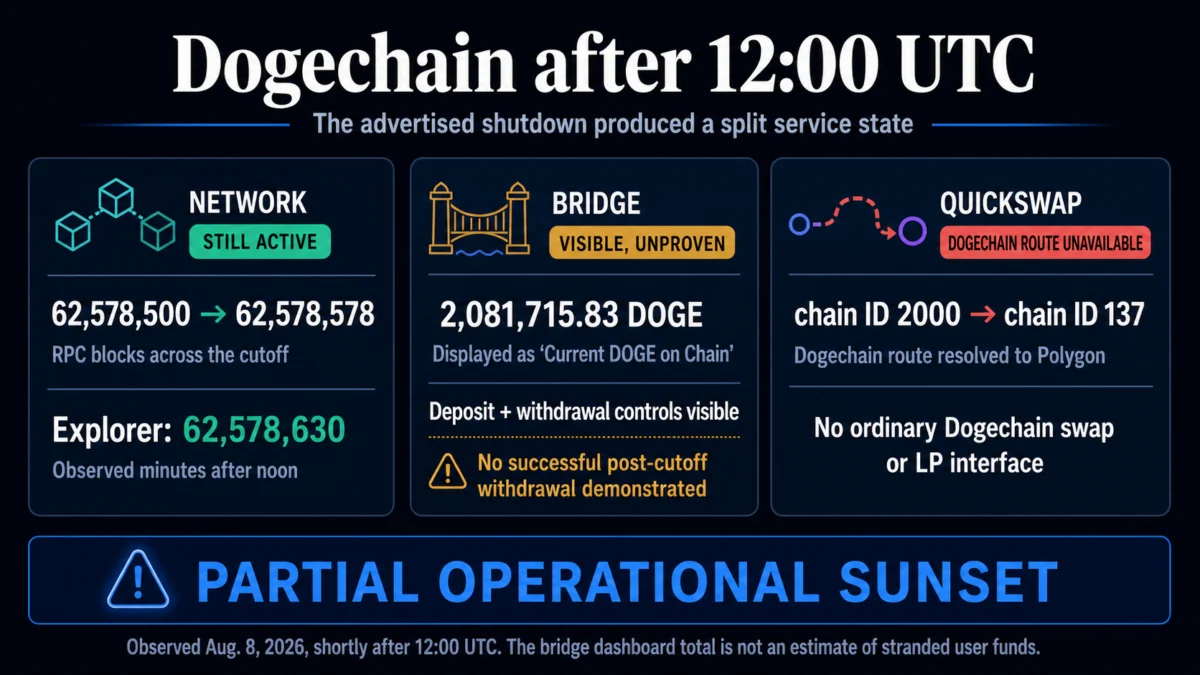
The Discrepancy Between Policy and Technical Reality
The official shutdown of Dogechain was not a sudden event but the culmination of a month-long warning period. In July 2024, the Dogechain team announced a definitive cutoff date, urging all users to migrate their assets back to the main Dogecoin blockchain or other compatible networks. The core of the warning was a stark technical reality: once the project-operated bridge services were terminated, any assets remaining on the Dogechain network would become inaccessible.
However, as the 12:00 UTC deadline passed on August 8, on-chain data revealed a "ghost" network that refused to go dark. The official Remote Procedure Call (RPC) endpoint, which serves as the primary gateway for decentralized applications (dApps) and wallets to communicate with the blockchain, continued to process requests. Observations of the network state immediately before the deadline showed block production at height 62,578,500. Less than two minutes after the supposed termination, the RPC returned block 62,578,578, bearing a timestamp of 12:01:52 UTC.
This continued activity indicates that a subset of validators remained active, continuing to secure the chain and process transactions despite the official cessation of support. For users, this created a confusing environment where the network appeared "alive," yet the essential gateways for exiting the ecosystem were being systematically dismantled or redirected.
The Bridge to Nowhere: 2 Million DOGE at Risk
The most critical component of the Dogechain ecosystem is its bridge interface. Because Dogechain is an EVM-compatible (Ethereum Virtual Machine) layer and not the native Dogecoin blockchain, DOGE must be "wrapped" to enter the network and "unwrapped" to leave it. This process relies on a bridge that locks native DOGE in a vault and mints an equivalent amount of wDOGE on Dogechain.
Post-deadline, the official bridge interface remained visible to the public, displaying a dashboard that listed exactly 2,081,715.83 DOGE as "Current DOGE on Chain." At current market valuations, this represents a significant sum of capital belonging to users who either missed the announcement or were unable to execute withdrawals in time.
The presence of the bridge UI, however, is not indicative of its functionality. The Dogechain bridge documentation specifies that the withdrawal process is administrator-mediated. It requires specific cryptographic signatures and the operation of a backend service to execute the transfer of native DOGE back to the user’s wallet on the Dogecoin mainnet. While the "front-end" website remained accessible, there was no evidence that the "back-end" infrastructure required to sign and finalize these transactions remained operational. Consequently, the 2 million DOGE displayed on the dashboard exist in a state of "limbo"—visible on the ledger but potentially locked behind a deactivated administrative gate.
QuickSwap and the Collapse of Liquidity
As the network’s primary decentralized exchange (DEX), QuickSwap played a vital role in the Dogechain ecosystem, providing the liquidity necessary for users to trade tokens and exit positions. In anticipation of the shutdown, QuickSwap issued multiple warnings throughout late July and early August, advising users to withdraw their liquidity provider (LP) tokens and move their assets to Polygon or other chains.
By the afternoon of August 8, QuickSwap had taken decisive action to prevent further user entrapment. The Dogechain-specific route on the QuickSwap interface, which previously allowed for swaps and liquidity management on the chain (ID 2000), began redirecting all traffic to the Polygon network (ID 137). This redirection effectively severed the link between the average user and the remaining liquidity on Dogechain.
For those who still held assets on the chain, this meant that even if they could connect their wallets to the Dogechain RPC, they no longer had a user-friendly interface to trade their tokens for wDOGE or other more liquid assets. The removal of the UI represents a "soft" shutdown of the ecosystem’s economic engine, leaving only those with the technical proficiency to interact directly with smart contracts able to attempt any final maneuvers.
A Chronology of the Dogechain Sunset
The path to the current state of limbo was marked by several key milestones:
- July 2024: The Dogechain team issues its first formal announcement regarding the network’s decommissioning. The notice cites a strategic shift and warns that the bridge will be closed permanently on August 8.
- August 1-7, 2024: QuickSwap and other ecosystem partners amplify the warning, urging users to close yield farming positions and bridge out.
- August 8, 11:50 UTC: Network activity remains high as users attempt last-minute withdrawals. The RPC is fully responsive.
- August 8, 12:00 UTC: The official deadline passes. Contrary to expectations, the network continues to produce blocks.
- August 8, 12:05 UTC: The official block explorer (explorer.dogechain.dog) remains online, showing multiple miner addresses still active.
- August 8, 12:15 UTC: QuickSwap redirects its Dogechain portal to Polygon. The bridge dashboard still shows over 2 million DOGE remaining on-chain.
- August 8, Late Afternoon: Reports emerge that the official block explorer has begun to fail, returning 404 errors or failing to load, signaling the beginning of the infrastructure’s final collapse.
Market Context and Token Performance
The native utility token of the network, Dogechain (DC), reflected the volatility and terminal nature of the project’s status. Despite the impending shutdown, the token showed a 0.26% increase in the 24 hours surrounding the deadline, though this follows a catastrophic 30-day decline of nearly 40%.
As of the time of the shutdown, the DC token held a market capitalization of approximately $1.25 million, with a circulating supply of over 96 billion tokens. However, the 24-hour trading volume plummeted to near zero, as major exchanges and DEXs delisted or restricted trading pairs associated with the chain. The Fully Diluted Valuation (FDV) stood at $2.58 million, a figure that has become largely academic as the network’s utility has ceased to exist.
In the broader context, the global cryptocurrency market cap remained stable at $2.22 trillion, with Bitcoin dominance at 58.89%. The sunsetting of Dogechain, while significant for its community, represents a localized event in the broader DeFi landscape, highlighting the risks associated with "meme-utility" layers that struggle to maintain long-term developer and validator incentives.

Technical Analysis: Why the Chain Kept Moving
The continuation of block production past the deadline is a phenomenon often seen in decentralized networks. Because a blockchain is maintained by a distributed set of validators, a project "shutting down" usually refers to the cessation of official development, the turning off of project-funded nodes, and the removal of front-end websites.
In the case of Dogechain, it is likely that several independent validators—possibly unaware of the exact timing or hoping for a last-minute reversal—kept their hardware running. Since the network’s consensus mechanism does not have a "kill switch" programmed into the protocol, the chain will theoretically continue to exist as long as at least one validator is mining blocks.
However, a blockchain without an RPC, an explorer, or a bridge is functionally a "dark chain." Users cannot see their balances, wallets cannot broadcast transactions, and value cannot be moved to other ecosystems. The 2 million DOGE "trapped" on the chain are not lost because the ledger disappeared, but because the tools required to interact with that ledger have been withdrawn by the project’s maintainers.
Implications for the DeFi Industry
The Dogechain shutdown serves as a cautionary tale for the burgeoning "Layer 2" and "sidechain" industry. It underscores the "bridge risk" that is inherent in all cross-chain protocols. When users move assets from a primary chain (like Dogecoin or Ethereum) to a secondary chain, they are essentially trading their native assets for an IOU issued by the bridge. If the bridge’s operators decide to stop honoring those IOUs, the assets on the secondary chain lose their peg and their value.
Furthermore, this event highlights the importance of "social consensus" versus "technical consensus." Technically, Dogechain is still "up," but socially and economically, it is "dead." For investors, the lesson is clear: the longevity of a network depends not just on its code, but on the sustained commitment of its core developers and the availability of exit liquidity.
As the explorer remains inaccessible and the bridge remains an unproven gateway, the fate of the 2 million DOGE remains the most pressing unanswered question. For now, the "permanent loss" warned of by the Dogechain team appears to be transitioning from a threat to a reality for those who remained on the chain past the noon deadline.