Dwi Wanna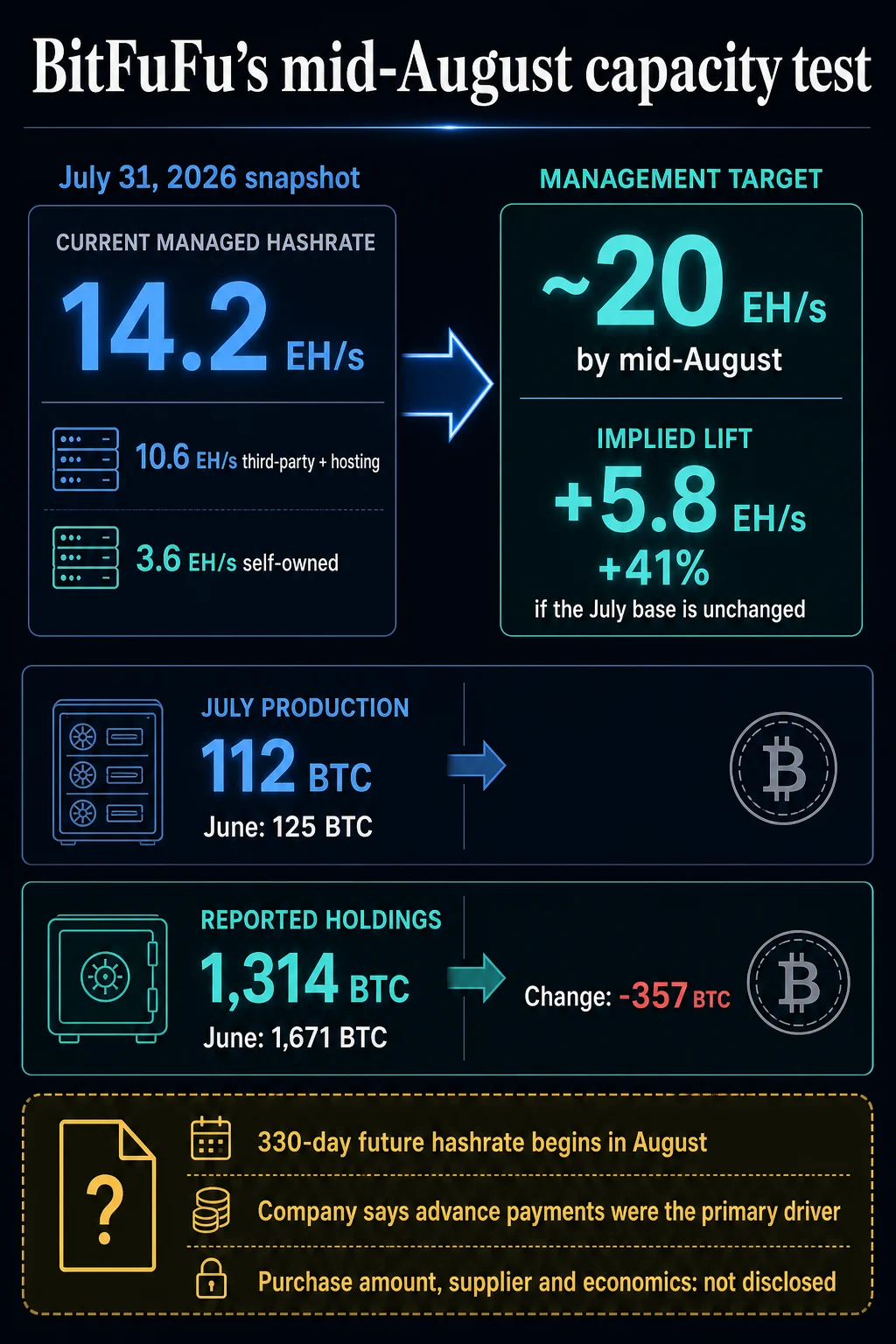
The strategic decision to utilize a significant portion of its liquid reserves to secure 330 days of future hashrate underscores a broader trend in the mining industry where firms are increasingly prioritizing long-term capacity locks over short-term liquidity. However, the lack of transparency surrounding the terms of these "prepaid capacity" deals has left analysts and investors attempting to bridge the gap between the company’s current production slump and its ambitious growth projections.
Operational Downturn and Hashrate Contraction
The July operating update revealed a multi-faceted decline in BitFuFu’s performance metrics. Total Bitcoin production for the month fell to 112 BTC, a noticeable drop from the 125 BTC generated in June. This downward trend was further reflected in the average daily output, which slipped from 4.2 BTC in June to 3.6 BTC in July. These figures specifically refer to the Bitcoin produced for the company’s own account and do not include the rewards generated for its vast network of cloud-mining customers.
The decline in production is closely correlated with a reduction in the company’s total managed hashrate. In July, managed hashrate—which includes both self-owned hardware and capacity managed for third-party suppliers and hosting customers—dropped to 14.2 exahashes per second (EH/s), down from 15.3 EH/s in June. A closer inspection of the data shows that the primary driver of this contraction was a decrease in third-party contributions. Capacity from suppliers and hosting clients fell to 10.6 EH/s from a previous 11.8 EH/s. In contrast, BitFuFu’s self-owned hashrate saw a marginal increase, rising from 3.5 EH/s to 3.6 EH/s.
This shift suggests a period of transition for the company, as it potentially rotates out older third-party contracts or experiences churn among its hosting clientele. The reliance on external suppliers has historically allowed BitFuFu to scale rapidly without the capital intensity of purchasing every rig, but the July data highlights the inherent volatility of such an asset-light model when contracts expire or are not immediately replaced.
The 20 EH/s Target and Capacity Commissioning
Despite the dip in July performance, BitFuFu management remains optimistic, pointing toward a significant capacity influx expected by the middle of August 2026. The company’s guidance suggests that the capacity secured through advance payments in June and July will restore the total managed hashrate to approximately 20 EH/s.
Achieving this target would require a 5.8 EH/s increase from the July month-end level, representing a roughly 41% surge in operational capacity within a two-week window. While the company’s June update had previously disclosed the acquisition of 5.3 EH/s from suppliers for a 270-day term beginning in August, the July filing introduced new complexity by mentioning a separate 330-day capacity block. Crucially, the July filing did not specify the exact exahash contribution of this new 330-day block, making it difficult to determine if the 20 EH/s target relies on a combination of these two agreements or if one supersedes the other.

This lack of a precise commissioning schedule creates an "operational checkpoint" for the firm. If BitFuFu successfully hits the 20 EH/s mark by mid-August, it will validate management’s ability to execute on its procurement strategy. However, failure to reach this milestone could signal logistical bottlenecks or delays in the deployment of the newly secured compute power.
Financial Ambiguity and the Cost of Growth
The most striking aspect of the July report is the 357 BTC reduction in the company’s treasury. Based on prevailing market conditions where Bitcoin’s market capitalization sits near $1.31 trillion and its circulating supply at approximately 20.07 million coins, the value of the "burned" Bitcoin is substantial. At an estimated price of approximately $65,000 per BTC, the 357 BTC decline represents a capital outlay of roughly $23.2 million.
However, BitFuFu has not provided a comprehensive financial "bridge" to explain the movement of these assets. The 357 BTC decline cannot be definitively categorized as a direct payment for hashrate, as the filing does not disclose the specific amount of Bitcoin or fiat currency committed to the new deals. Furthermore, the company has not identified the suppliers involved or provided details on the underlying economics of the arrangements, such as energy costs per kilowatt-hour, uptime guarantees, or cancellation protections.
This opacity is particularly relevant given BitFuFu’s previous statements regarding margin preservation. In an April 2026 update, management explicitly stated that it had declined to renew certain third-party contracts that would have placed undue pressure on profit margins. At that time, the company emphasized that it would not pursue hashrate growth at the expense of unit economics. Without disclosure of the pricing for the current 330-day deals, it remains impossible to verify if the company is adhering to its earlier standard of fiscal discipline or if it is aggressively overpaying for hashrate to maintain its market position.
Collateralized Assets and Debt Obligations
Adding another layer of complexity to BitFuFu’s balance sheet is the existence of encumbered Bitcoin. The July update noted that 44 BTC of the reported 1,314 BTC balance were pledged as collateral for loans and miner-procurement payables. This is a slight decrease from the 54 BTC pledged in June.
While the 10 BTC reduction in pledged assets might suggest a partial repayment of debt or a release of collateral, the company did not provide the specific reasons for the change or the terms of the underlying loans. BitFuFu’s 2025 annual report detailed historical collateral arrangements, but those figures are now outdated and cannot be accurately mapped onto the July 2026 figures. The use of Bitcoin as collateral is a common practice among miners to fund operations without selling their primary asset, but it introduces liquidation risk during periods of high market volatility.
Broader Industry Context and Implications
The situation facing BitFuFu is reflective of the broader challenges within the Bitcoin mining sector in 2026. As the network difficulty continues to adjust and the global hashrate remains competitive, miners are forced to find a balance between treasury management and aggressive infrastructure expansion.

The shift toward "compute deals" and "prepaid capacity" indicates a maturing market where hashrate is increasingly treated as a tradable commodity rather than just a byproduct of hardware ownership. By prepaying for 330 days of capacity, BitFuFu is essentially locking in its "cost of goods sold" for a significant period. If the price of Bitcoin rises or the network hashprice improves, these deals could prove to be highly lucrative. Conversely, if the network difficulty spikes or energy costs rise beyond the (undisclosed) contract rates, the company could find itself locked into underwater agreements.
Furthermore, BitFuFu’s role as a cloud-mining provider adds a layer of reputational risk. Cloud-mining customers rely on the company’s ability to maintain a stable and growing managed hashrate to fulfill their own mining contracts. The dip to 14.2 EH/s in July, while temporary according to management, highlights the sensitivity of the cloud-mining model to supplier fluctuations.
Conclusion and Future Outlook
BitFuFu stands at a critical juncture. The transition from 14.2 EH/s to a targeted 20 EH/s represents a bold attempt to scale in a competitive environment, but the cost of this growth—both in terms of treasury depletion and operational transparency—remains a point of contention.
The upcoming mid-August milestone will be the first major test of this strategy. Investors will be looking for confirmation that the 5.8 EH/s of new capacity has been successfully energized and is contributing to a recovery in daily Bitcoin production. Beyond the raw hashrate numbers, the market will require more detailed disclosures regarding the unit economics of the new capacity deals to determine if BitFuFu is building a sustainable, high-margin business or simply chasing growth at any cost.
For now, the "secret" nature of the compute deals and the plummeting output in July serve as a reminder of the operational hurdles inherent in the high-stakes world of industrial-scale Bitcoin mining. As the industry continues to professionalize, the demand for clear, granular data regarding energy contracts and procurement costs will likely only increase, placing more pressure on companies like BitFuFu to pull back the curtain on their strategic maneuvers.