admin
admin
Ethereum, the world’s most economically significant smart-contract blockchain, is currently navigating the final stages of a monumental shift in its underlying architecture. By the middle of this year, the network is scheduled to undergo "The Merge," a transition from its current Proof-of-Work (PoW) consensus mechanism to a more energy-efficient Proof-of-Stake (PoS) system. This event represents a watershed moment for the cryptocurrency industry, as assets worth hundreds of billions of dollars rely on the uninterrupted operation of the Ethereum Virtual Machine (EVM). Industry experts and core developers frequently compare this procedure to "changing the engine of an airplane while it is still in flight," emphasizing that Ethereum cannot, under any circumstances, cease producing valid blocks during the migration.

Unlike the Bitcoin network, which relies on a relatively singular software implementation (Bitcoin Core), the Ethereum community has deliberately fostered a multi-client ecosystem. Encouraged by the Ethereum Foundation (EF), various independent teams have developed several versions of client software to implement the PoS protocol, commonly referred to as Ethereum 2.0. These clients are written in different programming languages and managed by separate organizations to ensure that a single software bug cannot bring down the entire network. However, as the deadline for The Merge approaches, a critical challenge has emerged: the lack of diversity in client usage among validators could potentially undermine the very security the system was designed to provide.
The Architecture of the Merge: A Separation of Duties
The transition is technically defined as a merger between the existing Ethereum execution layer—the network we use today—and the Beacon Chain, a PoS coordination layer that has been running in parallel since December 2020. Post-merge, the functions of an Ethereum node will be bifurcated into two distinct logical layers.

The first is the Execution Layer, which manages the Ethereum Virtual Machine (EVM). This layer is responsible for processing smart contracts, executing transactions, and maintaining the state of account balances. The second is the Consensus Layer, which utilizes the Beacon Chain to reach agreement on the order of transactions and the validity of blocks.
Currently, a single Ethereum node performs both tasks. After The Merge, a node operator will need to run both an execution client and a consensus client. The execution client will process transactions and pass them to the consensus client, which then communicates with the broader network to validate the data. This separation is intended to enhance the robustness of the network by isolating the "business logic" of transactions from the "security logic" of network agreement.
The Mathematical Risks of Client Dominance
The primary motivation for maintaining multiple client codebases is to prevent a "single point of failure." If a critical vulnerability is discovered in one client, nodes running alternative software will continue to operate, keeping the network alive. However, the efficacy of this defense is entirely dependent on the distribution of these clients across the network’s total staking power.
The security of Ethereum’s PoS consensus relies on specific mathematical thresholds. If a buggy client controls less than 33% of the total staked Ether (ETH), the network can continue to finalize blocks without interruption while the bug is addressed. If a client with a market share between 33% and 50% suffers a failure, the network will stop finalization—a state where transactions are processed but not yet considered permanent—triggering automatic recovery mechanisms.
The situation becomes dire if a single client controls more than 66% of the network. This "supermajority" gives the buggy software the power to finalize an incorrect or corrupted version of the blockchain. In such a scenario, the non-buggy clients are forced into a lose-lose situation: they must either follow the "buggy" chain, effectively legitimizing the error, or split the network into two separate blockchains. This outcome is often described as "game over" for the network’s immediate stability and reputation, as it could lead to massive financial losses and a permanent loss of trust.
The Chronology of Ethereum’s Transition
The path to The Merge has been a multi-year journey characterized by rigorous testing and incremental upgrades:
- December 2020: The Launch of the Beacon Chain. This marked "Phase 0," introducing the PoS consensus layer without yet integrating the execution of transactions.
- October 2021: The Altair Upgrade. The first scheduled upgrade to the Beacon Chain, which refined the rules for validator rewards and penalties.
- August 2021: The London Hard Fork. This introduced EIP-1559, changing the fee market structure and preparing the execution layer for its future integration with PoS.
- Early 2022: Testnet Merges. Successful merges on testnets like Kintsugi and Kiln provided the "proof of concept" required to move toward the mainnet transition.
- Mid-2022 (Projected): The Mainnet Merge. The final step where the PoW mining algorithm is permanently replaced by the PoS consensus of the Beacon Chain.
Data Analysis: The Prysm Dominance Issue
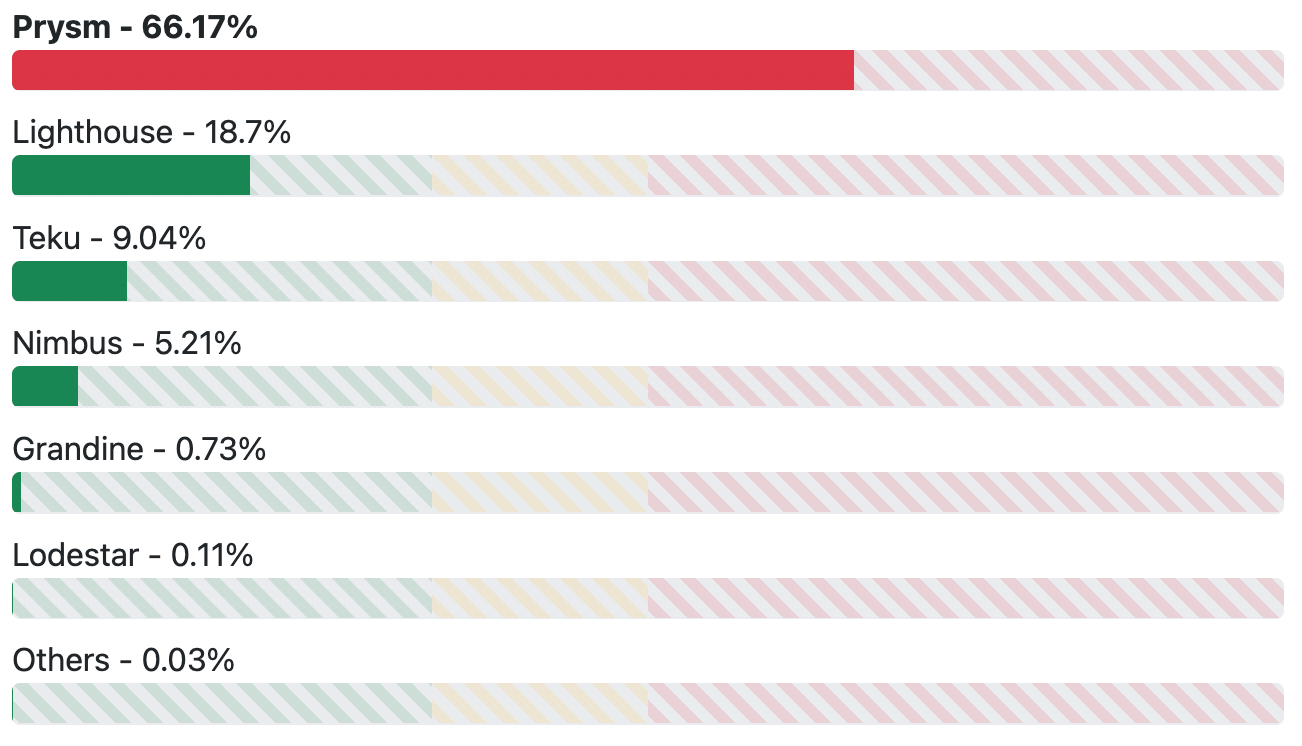
As of the current press time, the distribution of consensus clients is heavily skewed. The Prysm client, developed by Prysmatic Labs, is utilized by approximately 66% of the network’s staking power. While this is just below the critical supermajority threshold, it remains dangerously high. Other available clients include Lighthouse, Teku, Nimbus, Grandine, and Lodestar. Of these, Lighthouse and Teku hold significant but smaller shares, while Grandine and Lodestar account for less than 1% of the market.
To understand why Prysm has achieved such dominance, CryptoSlate spoke with Marius van der Wijden, an Ethereum core developer. He attributes Prysm’s success to a "first-mover advantage." Prysm was the first functional prototype for a beacon client, allowing the team to develop superior documentation, tooling, and a user-friendly Web UI long before their competitors. Furthermore, Prysm is written in Golang, a language known for its performance and readability, making it accessible to developers already familiar with Geth (Go-Ethereum), the dominant execution client.
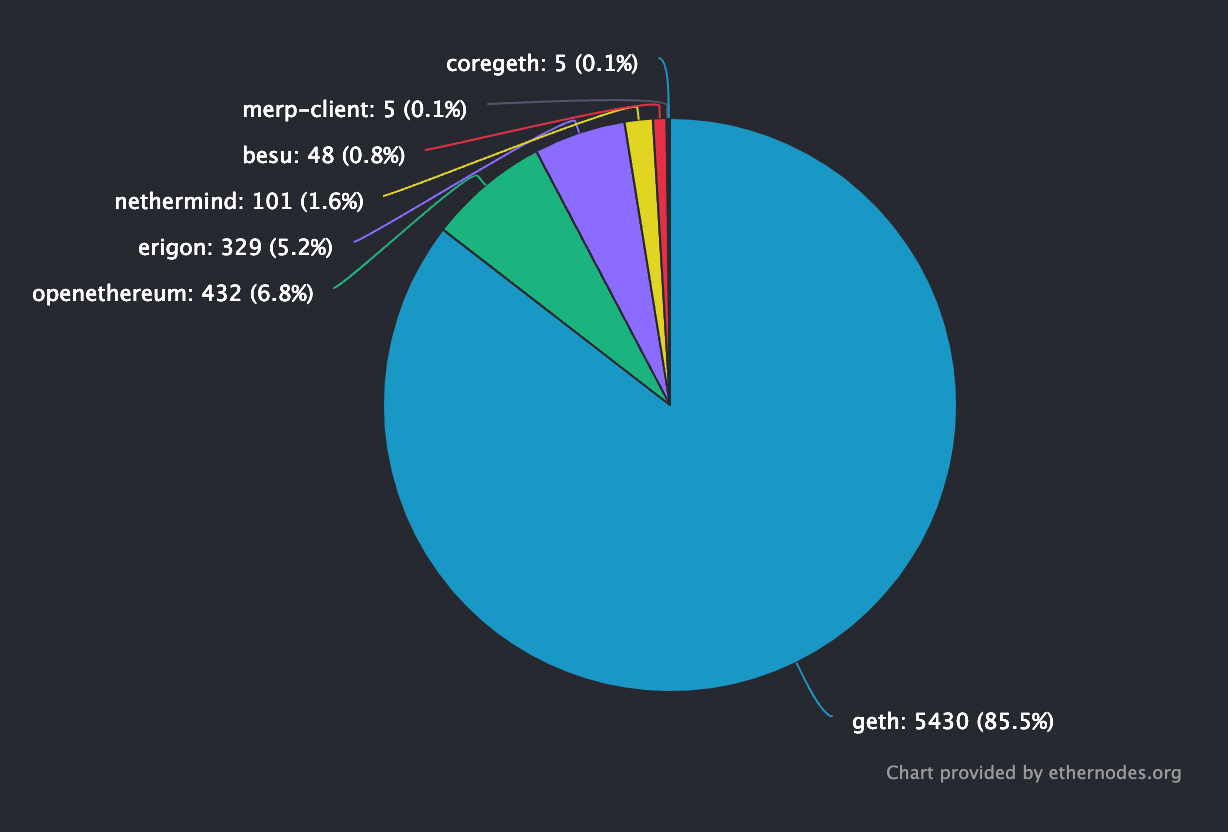
On the execution layer, the situation is even more concentrated, with Geth maintaining an 85% market share. However, developers are less concerned about this figure post-merge, as execution nodes do not provide the primary consensus security in the same way that validator nodes do.
Institutional Responses: Staking Providers and the Drive for Diversity
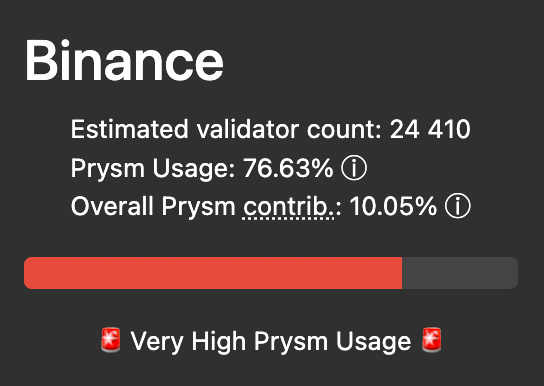
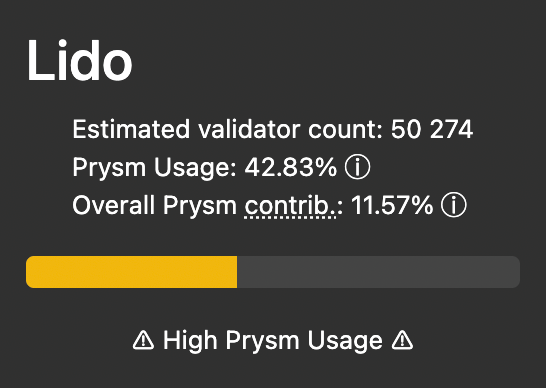
The concentration of client usage is largely driven by major centralized exchanges and staking-as-a-service providers. These entities manage thousands of validator nodes on behalf of their users. Coinbase, Kraken, and Binance are among the largest contributors to the Prysm dominance.
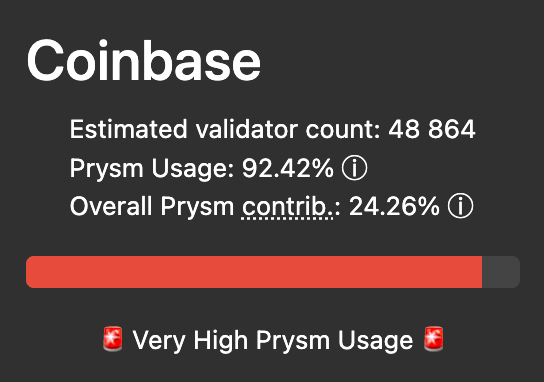
Coinbase, which manages roughly 17.5% of all validators, recently addressed the issue via social media. The company noted that when they launched their staking services, Prysm was the only viable client that supported "remote signers." This technology allows validators to store cryptographic keys in isolated, secure environments rather than on the validator server itself, a prerequisite for institutional-grade security. Coinbase has since begun working with the Lighthouse team to implement similar features, signaling a move toward greater diversity.
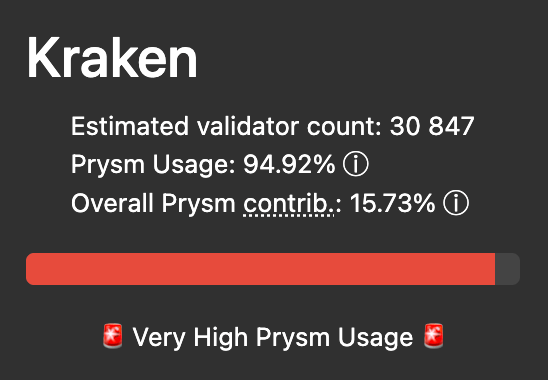
Kraken, managing approximately 11% of validators with a 94.9% reliance on Prysm, has also expressed a commitment to diversification. Brian Hoffman, Senior Product Manager at Kraken, confirmed that the exchange has begun rolling out new validators using the Teku client. "This way we can increase diversity in our validator client software and offer clients an even more resilient on-chain staking service," Hoffman stated.
In contrast, decentralized staking protocols like Rocket Pool have shown a much healthier distribution. Rocket Pool accounts for less than 1% of validators, but only 10.6% of its nodes run Prysm, demonstrating that decentralized, community-led initiatives are more aligned with the network’s goal of client diversity.
Broader Implications and the Path Forward
The risks associated with client dominance extend beyond technical failure; they involve the economic principle of "slashing." In Ethereum’s PoS system, validators can be penalized (slashed) for behavior that threatens the network. If a supermajority client fails and causes a consensus error, the protocol’s "Inactivity Leak" mechanism would eventually drain the ETH of the faulty validators to restore finality. Core developers have been clear: there will be no "bailouts" for stakers who choose to run a majority client if that client misbehaves.
Despite the current imbalance, the Ethereum core development team remains optimistic. Marius van der Wijden noted that while the community must accept a less-than-ideal distribution for the immediate future, the risks are mitigated by "fuzzing" infrastructure that constantly tests for differences between clients to catch bugs before they reach the mainnet.
The transition to Proof-of-Stake is expected to reduce Ethereum’s energy consumption by more than 99.9%, positioning the network as a more sustainable option for institutional investors and ESG-conscious corporations. However, the long-term health of the network will depend on the willingness of node operators—from home enthusiasts to multi-billion dollar exchanges—to prioritize network resilience over the convenience of a single dominant software provider. As The Merge nears, the push for client diversity remains the final, and perhaps most critical, hurdle in Ethereum’s evolution.