Dwi Wanna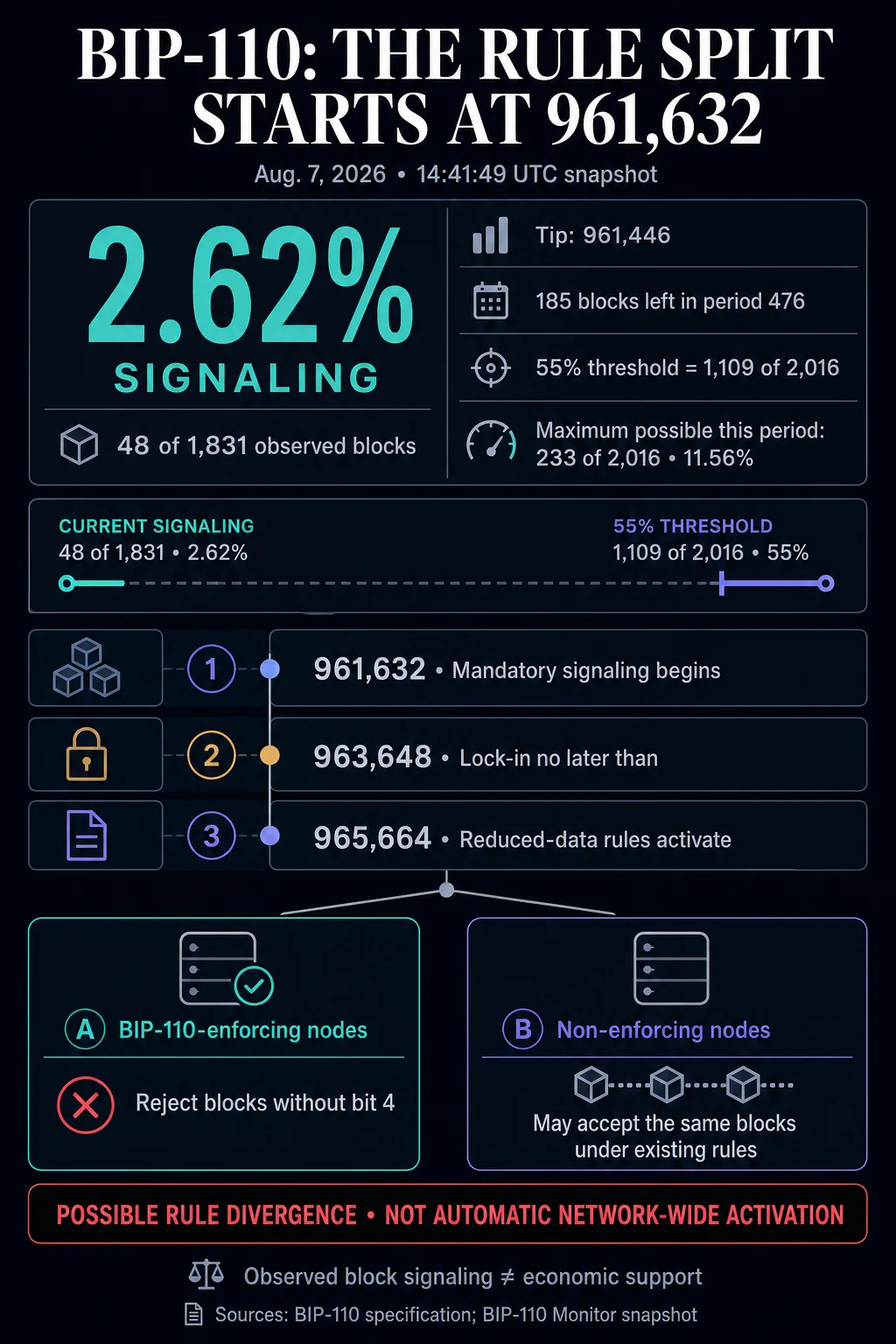
As of the afternoon of August 7, 2026, data from third-party monitors indicates a stark disparity between the proposal’s enforcement requirements and current network participation. Out of 1,831 blocks observed during the current signaling period, only 48 blocks—representing a mere 2.62% of the total—have signaled support for the change. With only 185 blocks remaining before the signaling window closes, the mathematical probability of BIP-110 meeting its activation threshold is non-existent. The proposal requires 1,109 signaling blocks within a 2,016-block period to reach its 55% threshold for lock-in. Even in a hypothetical scenario where every remaining block in the period signals support, the total would only reach 233 blocks, or approximately 11.56%.
Technical Background and the Objectives of BIP-110
BIP-110 was introduced as a technical measure to address concerns regarding block size and the long-term scalability of the Bitcoin ledger. The core objective of the proposal is to temporarily shrink the amount of data permitted within individual blocks. Proponents argue that by reducing data density, the network can maintain higher levels of decentralization by making it easier for individual users to run full nodes with limited hardware and bandwidth resources.
The proposal utilizes "bit 4" in the block version field as a signaling mechanism. In the Bitcoin protocol, miners use these version bits to indicate their readiness or support for specific soft forks. This method, established under the framework of BIP-9 (Version Bits), allows the network to coordinate upgrades without requiring a hard fork, which would split the network into two incompatible chains. However, BIP-110 is unique in its enforcement strategy, as it includes provisions for nodes to begin rejecting non-compliant blocks regardless of whether the broader network has reached a consensus threshold.
The Significance of Block Height 961,632
The transition at block height 961,632 represents a divergence in validation logic among different segments of the Bitcoin network. From this point forward, nodes running software that enforces BIP-110 will strictly reject any block that does not signal bit 4. Conversely, nodes running standard Bitcoin Core software—which currently constitutes the vast majority of the network—will continue to follow existing rules. These standard nodes will accept blocks regardless of bit 4 signaling, provided they satisfy all other protocol requirements.
This divergence creates a potential for a "chain split" if a subset of miners continues to produce blocks for the BIP-110 enforcing chain while the majority of hashpower continues on the legacy chain. The sustainability of a BIP-110-enforcing branch depends entirely on whether miners allocate sufficient hashpower to produce valid work on that specific chain after the boundary height is crossed. Without significant miner support, the enforcing chain could stall or remain a minority branch with limited security.

The activation schedule for BIP-110-enforcing nodes is structured across several key milestones. Mandatory signaling is scheduled to run through block 963,647. If the threshold is not met by block 963,648, the lock-in phase will not occur. If it were to lock in, the reduced-data rules would officially activate at block 965,664. However, because this schedule is only binding for nodes that have opted into BIP-110, it does not hold authority over the wider Bitcoin participant base.
Institutional and Developer Responses
The path toward BIP-110 implementation has been marked by a lack of consensus within the core development community. On March 26, 2026, a pull request for the BIP-110 implementation in the primary Bitcoin Core repository was closed without being merged. Bitcoin Core, the most widely used software client for the network, does not currently enforce the proposal. Antoine Poinsot, a prominent Bitcoin Core contributor, clarified in a personal capacity on June 4 that the mainstream client remains unaligned with the BIP-110 enforcement rules.
In contrast, alternative node implementations have taken a more proactive stance. Bitcoin Knots, a derivative of Bitcoin Core maintained by developer Luke Dashjr, has integrated BIP-110 support. In its August 7 release (v29.4), Bitcoin Knots issued a formal warning to users. The release notes stated that older, non-enforcing software—explicitly naming current versions of Bitcoin Core—could stop fully validating rules in certain scenarios, potentially leaving the chainstate in an "unsafe" or inconsistent condition if the network undergoes a split.
The mining sector has also seen fragmented adoption. OCEAN, a transparent and non-custodial mining pool, announced earlier this year that it would provide separate endpoints for miners who wish to signal for BIP-110 and those who do not. The pool stated that its default setting would switch to BIP-110 signaling on July 15. While this move provided a platform for proponents, it has not yet translated into the broad hashpower support necessary to influence the network’s overall trajectory.
Analysis of Risks and Potential Chain Divergence
The primary concern regarding the enforcement of BIP-110 is the risk of "divergent block acceptance." When two groups of nodes follow different validation rules, they may disagree on which chain is the "real" Bitcoin. If a miner produces a block that is valid under legacy rules but invalid under BIP-110 rules (due to a lack of bit 4 signaling), the network splits.
A technical write-up by BlockSlop on July 17 detailed a specific "late-upgrade" problem identified during testing on a regtest (regression test) environment. The researchers found that a node’s data directory could retain blocks accepted under old rules even after the operator switched to an enforcing build. This occurs because the standard startup process does not always reconnect or re-validate inherited history against the new rules. To mitigate this, Bitcoin Knots merged a safeguard that scans headers for mandatory-signaling violations and invalidates offending blocks to force a reorganization. However, more complex violations involving scripts or transactions still require a full reindexing of the blockchain, a time-consuming process for node operators.

The lack of economic support further complicates the situation. For a soft fork to be successful and safe, it typically requires "economic consensus"—support from exchanges, payment processors, and large holders. Without these entities recognizing the BIP-110 chain, any blocks produced on that chain would lack liquidity and market value, making it economically irrational for miners to sustain it.
Chronology of the BIP-110 Proposal
The timeline leading up to the current height 961,632 reflects a period of intense technical debate:
- March 2026: The Bitcoin Core development team closes the BIP-110 pull request, signaling that the proposal will not be included in the network’s primary software client for the time being.
- June 4, 2026: Core developers publicly reiterate that Bitcoin Core does not enforce BIP-110, setting the stage for a divergence between Core and Knots users.
- July 15, 2026: OCEAN mining pool switches its default to BIP-110 signaling, attempting to bootstrap miner support.
- July 17, 2026: Technical reports from the BlockSlop team highlight potential database and validation risks associated with late upgrades to BIP-110-compliant software.
- August 7, 2026: Bitcoin Knots releases version 29.4, including warnings about chainstate safety and mandatory signaling checks.
- August 7, 2026 (14:41 UTC): Network monitors confirm signaling remains at a negligible 2.62%.
- Block Height 961,632: The scheduled start of enforcement for BIP-110 nodes.
Broader Implications for the Bitcoin Ecosystem
The situation surrounding BIP-110 serves as a case study in the challenges of "User Activated Soft Forks" (UASF) and minority-led protocol changes. While Bitcoin’s decentralized nature allows any participant to run software with modified rules, the success of such modifications depends on the network effect. With Bitcoin currently holding a market capitalization of approximately $1.3 trillion and a dominant position in the global crypto market (59.01% dominance), the stakes for network stability are incredibly high.
The immediate impact of reaching height 961,632 is likely to be minimal for the average user, as the vast majority of miners and nodes are not enforcing the new rules. However, for the small percentage of users running Bitcoin Knots or other enforcing software, there is a tangible risk of being partitioned from the main network if they do not carefully manage their node configurations.
In the long term, the BIP-110 episode may prompt a re-evaluation of how signaling thresholds are set and how the community handles proposals that do not gain universal favor. While the goal of reducing block data remains a point of interest for those concerned with long-term decentralization, the current lack of hashpower and economic backing suggests that BIP-110, in its current form, is unlikely to become the standard for the Bitcoin network. The coming blocks will reveal the extent of the divergence, but without a significant shift in miner behavior, the legacy rules of Bitcoin Core are expected to remain the definitive protocol for the foreseeable future.