admin
admin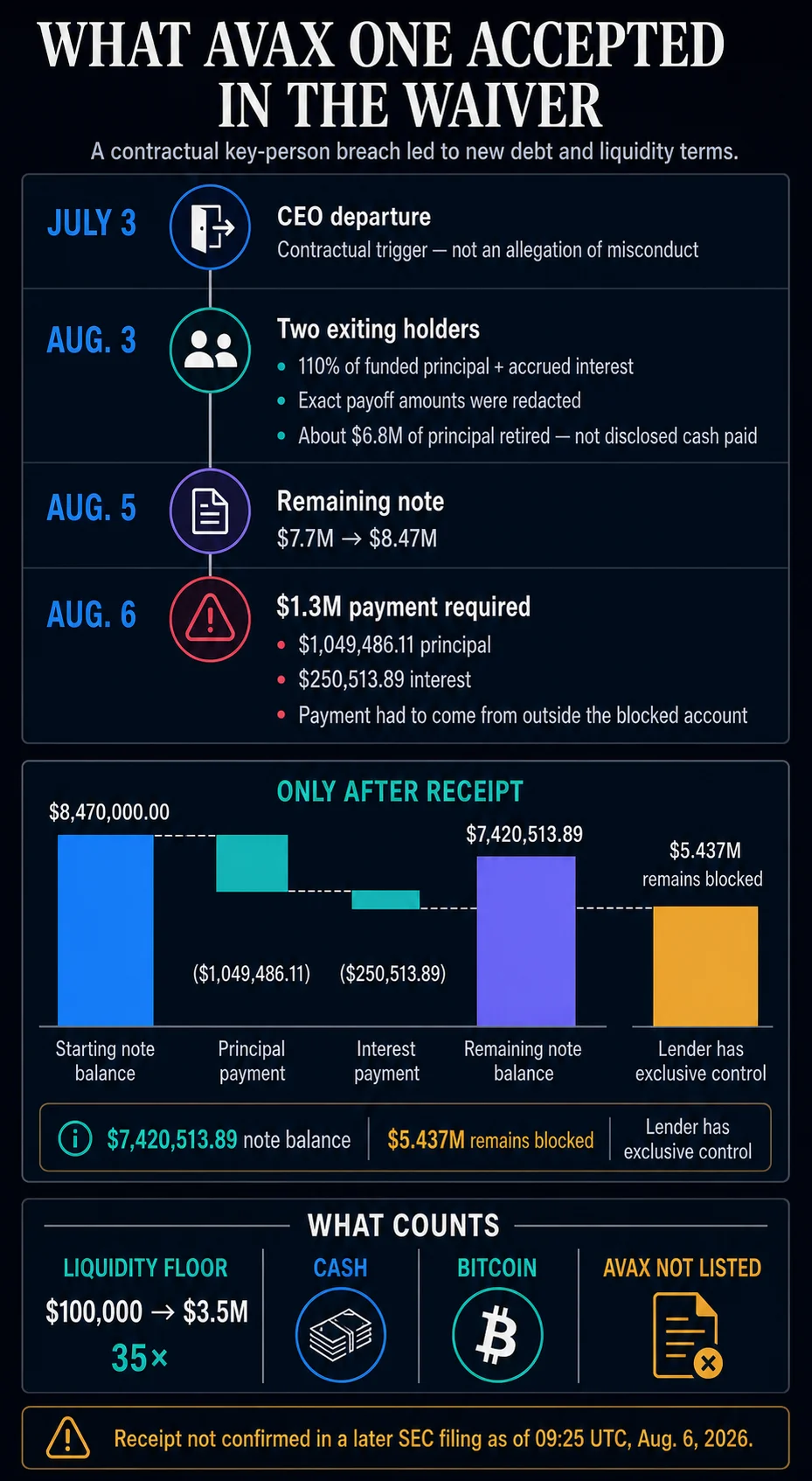
An unnamed institutional investor has significantly tightened its financial demands on AVAX One, a Nasdaq-listed firm specializing in digital asset treasury, imposing a drastic 35-fold increase in its minimum liquidity requirement and exclusively recognizing cash and Bitcoin as eligible assets. This stringent new condition, effective August 5, has created an immediate liquidity challenge for AVAX One, whose substantial holdings of the Avalanche (AVAX) token are now rendered ineligible for meeting the mandated threshold. The move follows a critical restructuring triggered by the recent departure of CEO Jolie Kahn, which initiated a default on a key-person covenant and necessitated a renegotiation of the company’s debt obligations.
The institutional lender’s new liquidity benchmark stands at $3.5 million, a sharp escalation from the previous $100,000 requirement. Crucially, the amended covenant explicitly excludes AVAX One’s primary treasury asset, nearly 14 million AVAX tokens valued at approximately $88 million according to CoinGecko data. This means the company must now amass $3.5 million in liquid fiat currency or Bitcoin held in custody to comply with the terms, a significant departure from its previous strategy of leveraging its considerable AVAX holdings.
The restructuring agreement, detailed in a recent Securities and Exchange Commission (SEC) filing, was precipitated by the July departure of Jolie Kahn. Kahn, instrumental in guiding the company, formerly known as AgriFORCE, from its agricultural roots into the digital asset space, triggered a default upon her exit. This default activated a key-person clause in the debt agreement, compelling AVAX One to enter into negotiations with its lender. The company’s stock has reflected the uncertainty surrounding these events, experiencing a decline of approximately 42% since Kahn’s departure, trading at $3.20.
A Drastic Shift in Debt Covenants
The institutional investor has agreed to waive the breach of the key-person covenant, provided AVAX One adheres to a substantially revised set of financial conditions. The most immediate and impactful change is the dramatic increase in the minimum liquidity requirement. The lender’s decision to recognize only bank cash and Bitcoin represents a clear preference for more traditional and universally accepted forms of collateral, potentially reflecting a heightened risk aversion or a strategic reevaluation of digital asset-backed liquidity.
This new stipulation creates a direct conflict with AVAX One’s existing balance sheet. While the company holds a significant digital asset treasury, the overwhelming majority of its value is tied up in AVAX tokens. The nearly 14 million AVAX tokens, representing a substantial portion of the Avalanche ecosystem’s circulating supply, are now effectively ring-fenced from fulfilling the immediate liquidity needs stipulated by the lender. This forces AVAX One into a position where it must rapidly generate liquid capital or liquidate a portion of its AVAX holdings, a move that could have significant implications for the token’s market price.

Timeline of Events and Restructuring Details
The events leading to the current liquidity crisis can be traced back to Jolie Kahn’s departure in July. Her exit as CEO activated a crucial covenant within the company’s debt agreement, placing AVAX One in technical default. This necessitated an urgent renegotiation with the unnamed institutional lender to avoid more severe consequences.
- July 2026: CEO Jolie Kahn departs AVAX One. This event triggers a default on a key-person covenant within the company’s debt agreement.
- August 5, 2026: AVAX One files an amended agreement with the SEC, detailing the restructuring terms with its institutional lender. The company announces the retirement of $6.8 million in outstanding principal debentures as part of a broader balance sheet strengthening initiative.
- August 5, 2026 (Effective Date): The new debt covenants come into effect, including a drastically increased liquidity requirement and the exclusion of AVAX tokens from meeting this requirement. AVAX One makes a $1.3 million payment to the lender to secure the waiver of the default.
The broader restructuring, as announced by AVAX One, also involved the retirement of $6.8 million in outstanding principal debentures. This move was presented as a measure to strengthen the company’s balance sheet. However, the specific terms of the debt renegotiation reveal a more complex picture, with an increase in the remaining debenture’s principal and accelerated redemption terms.
Implications for AVAX One’s Financial Health
The immediate challenge for AVAX One is to meet the $3.5 million liquidity requirement using only cash or Bitcoin. Given its current holdings, the company faces a significant hurdle. The nearly $88 million in AVAX tokens, while representing substantial underlying value, cannot be directly applied to satisfy the lender’s demand. This situation could force AVAX One into a difficult position: either it must quickly acquire a substantial amount of cash or Bitcoin, or it may be compelled to sell a portion of its AVAX holdings. A forced sale of such a large quantity of AVAX could exert downward pressure on the token’s price, potentially impacting the company’s overall asset valuation and future liquidity.
Beyond the liquidity covenant, the restructuring also imposes other stringent conditions. AVAX One has a 180-day deadline from Kahn’s departure to appoint a permanent CEO who is acceptable to the lender. Peter Wylie Jr. is currently serving as the interim chief executive, and the search for a permanent replacement is underway. This timeline adds another layer of pressure on the company’s leadership and strategic planning.
Furthermore, the agreement involved an increase in the principal amount of the remaining debentures. The original principal was $7.7 million, which was raised to $8.47 million before the $1.3 million payment was applied, leaving approximately $7.42 million outstanding. The filing does not provide a specific explanation for the $770,000 increase in the principal, although AVAX One has stated that repayment premiums were part of the broader restructuring. This increase in debt obligations means AVAX One now has a larger financial burden to manage.

The lender has also accelerated its capital recovery strategy. Monthly redemptions have been increased to one-tenth of the original principal, up from one-twenty-fifth. This means the lender will receive a larger portion of their investment back on a monthly basis, further straining AVAX One’s cash flow.
Adding to the financial pressures, the accelerated conversion price for the debt has been reduced from 85% to 82.5% of a benchmark tied to the three lowest trading prices over the previous 10 trading days. This lower conversion price, while potentially beneficial for the lender in acquiring more shares for the same debt amount, increases the risk of dilution for existing AVAX One shareholders. If the lender converts its debt into equity at this more favorable rate, it could significantly dilute the ownership stake of current investors.
Broader Market Context and Analysis
The restructuring at AVAX One occurs within a broader market environment where institutional investors are increasingly scrutinizing their digital asset exposures and debt arrangements. The volatility inherent in cryptocurrencies, coupled with regulatory uncertainties, has led some lenders to adopt more conservative lending practices. The demand for traditional, liquid assets like cash and Bitcoin as collateral reflects a desire for greater stability and predictability in financial agreements.
The situation also highlights the inherent risks associated with companies that heavily rely on a single or a few digital assets for their treasury and collateral. While the significant holdings of AVAX tokens represent a potential upside, they also create a vulnerability when market conditions or lender requirements shift. The exclusion of AVAX from meeting the liquidity test underscores the lender’s specific risk appetite and their confidence in the stability and liquidity of different digital assets.
For AVAX One, the path forward involves a delicate balancing act. The company must navigate the immediate liquidity demands, secure a permanent CEO, and manage its increased debt obligations, all while potentially facing dilution for its shareholders. Its ability to do so will likely depend on its capacity to generate new revenue streams, secure additional funding, or strategically manage its existing AVAX holdings without causing significant market disruption. The precedent set by this restructuring may also serve as a cautionary tale for other digital asset-focused companies, emphasizing the importance of diversified liquidity strategies and robust covenant management in their financial arrangements. The company’s performance in the coming months will be closely watched by investors and industry observers alike, as it grapples with these significant financial and operational challenges.