admin
admin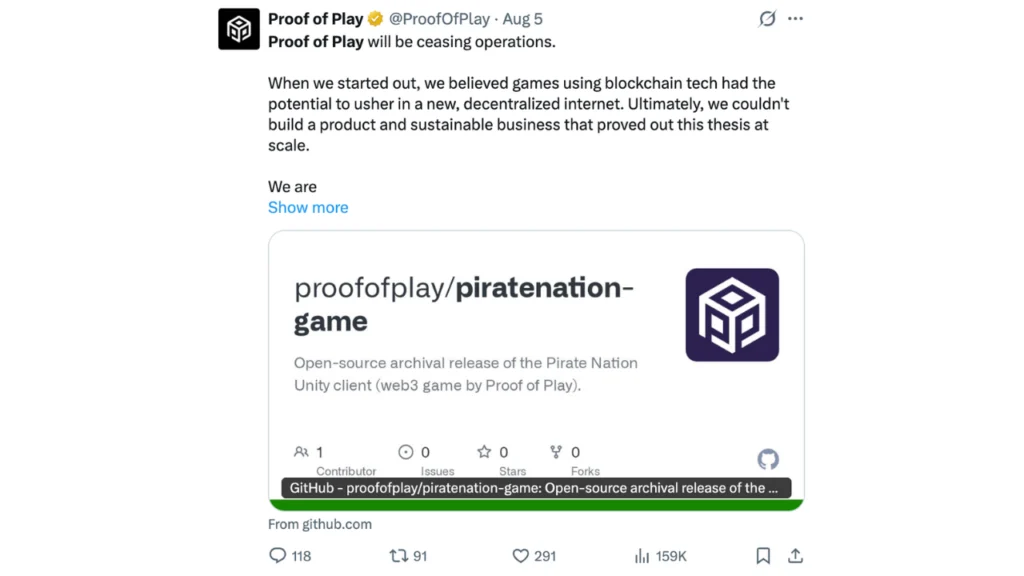
Proof of Play, the Andreessen Horowitz (a16z)-backed Web3 gaming studio celebrated for its ambitious fully on-chain RPG Pirate Nation, has announced its closure, signaling a significant setback for the nascent blockchain gaming industry and a potent reality check for its most pioneering visions. The company concluded on August 4 that it could not construct a scalable and sustainable blockchain gaming business, despite substantial venture capital investment and years of development aimed at revolutionizing game architecture. This closure underscores the persistent challenges in translating innovative blockchain technology into commercially viable and broadly appealing gaming experiences, particularly for models that prioritize decentralization at their core.
The Genesis of an Ambitious Vision: Fully On-Chain Gaming
Proof of Play emerged onto the Web3 gaming scene with considerable fanfare and a bold thesis: to build games where the core logic, assets, and player ownership resided entirely on the blockchain. This vision went beyond merely incorporating NFTs or cryptocurrency as rewards; it aimed for a paradigm shift where the game itself, in its fundamental operations, was decentralized and persistent. The company’s ambition was crystallized in its flagship title, Pirate Nation, a fully on-chain role-playing game designed to demonstrate how blockchain technology could foster persistent gaming worlds that could theoretically outlive any single development studio, with players retaining immutable ownership of their in-game assets.
The allure of "fully on-chain" gaming stemmed from a desire to address perceived shortcomings of traditional gaming, where developers hold ultimate control over game assets, servers, and even the game’s lifespan. Proponents argued that by decentralizing these elements, blockchain could empower players with true digital property rights, foster greater community participation in game evolution, and create interoperable assets across different virtual environments. This ethos resonated strongly with the core tenets of Web3, promising a future where digital scarcity and verifiable ownership would unlock new economic models and creative possibilities within gaming.
A Significant Backing Amidst Crypto’s Evolving Landscape
Proof of Play’s journey began with a substantial financial injection, highlighting the high expectations placed upon its pioneering approach. In 2023, the studio successfully raised a $33 million seed round, a notable figure even in the competitive venture capital landscape, especially during a period when the broader crypto market was navigating a recovery from a significant downturn. The round was co-led by a16z Crypto, the dedicated cryptocurrency fund of the influential venture capital firm Andreessen Horowitz, and Greenoaks, signaling strong institutional confidence in Proof of Play’s vision and the potential of fully on-chain gaming.
Andreessen Horowitz, through its a16z Crypto fund, has been one of the most vocal and significant investors in the Web3 space, consistently championing the transformative potential of blockchain technology across various sectors, including gaming. Their investment in Proof of Play was seen by many as a powerful validation of the "fully on-chain" concept, suggesting that if anyone could crack the code for scalable Web3 gaming, it would be a well-funded team with such prominent backing. This investment occurred at a time when the initial "play-to-earn" (P2E) boom of 2021-2022 had largely cooled, and investors were becoming more discerning, seeking projects with deeper technological innovation and sustainable economic models rather than speculative token plays. Proof of Play’s focus on foundational game architecture rather than just token incentives positioned it as a potentially more resilient and impactful venture.
Chronology of a Vision: From Hype to Halt
The timeline of Proof of Play encapsulates the rapid cycles of ambition, development, and eventual reckoning common in nascent technological sectors.

- 2021-2022: The Web3 Gaming Gold Rush: The period witnessed an explosion of interest and investment in blockchain gaming, fueled by the success of early play-to-earn titles like Axie Infinity. This era saw billions of dollars flow into projects promising novel economic models and player ownership, often with an emphasis on NFTs and token rewards.
- Late 2022 – Early 2023: Market Correction and Shifting Focus: Following a broader crypto market downturn and the collapse of several high-profile crypto entities, investor sentiment shifted. The focus moved from speculative P2E models to projects emphasizing genuine utility, robust technology, and sustainable game design. It was in this environment that Proof of Play’s "fully on-chain" thesis, with its emphasis on core infrastructure, gained traction as a more fundamental and potentially enduring approach.
- 2023: $33 Million Seed Round: Proof of Play secures its significant funding, allowing it to rapidly expand its team and accelerate development of Pirate Nation and its underlying technology. The company articulates its vision of a new paradigm for game development and ownership.
- Development and Iteration of Pirate Nation: Throughout 2023 and into 2024, Proof of Play works on Pirate Nation, building out its fully on-chain mechanics, smart contracts, and user interface. While specific public launch dates are not detailed, the game attracts attention within crypto circles for its technical ambition.
- August 4: The Closure Announcement: Proof of Play publicly declares its decision to cease operations. In its statement, the company explicitly acknowledges its failure to validate its core vision as a "commercially viable business," clarifying that the technical capability was often present, but the path to scalability and sustainability remained elusive. This announcement comes after "years of development and strong venture backing," highlighting the depth of the challenge. The company, however, did not provide specifics on its remaining financial position, employee impact, or a definitive shutdown date, leaving some details open.
The Commercial Viability Chasm: Beyond Technical Prowess
Proof of Play’s candid admission that commercial viability, rather than technical capability, ultimately drove its shutdown decision offers a crucial lesson for the Web3 gaming sector. Building a fully on-chain game presents formidable challenges that extend far beyond smart contract development and blockchain integration.
One significant hurdle is the cost of operation and scalability. Running game logic directly on a blockchain can incur substantial transaction fees (gas costs) and demand significant computational resources, especially as player numbers grow. While layer-2 solutions and more efficient blockchain architectures are emerging, they still add complexity and cost compared to traditional centralized server infrastructure. Maintaining token ecosystems, ensuring the security of smart contracts through rigorous audits, and continuously funding live-service game development within a decentralized framework proved considerably more expensive and complex than many developers anticipated. Unlike Web2 games that can leverage established cloud infrastructure and monetization models, Web3 games often have to build entirely new economic and technical stacks from the ground up.
Another critical factor is player adoption and user experience. Mainstream gamers, accustomed to seamless onboarding and intuitive interfaces, often find the requirements of Web3 gaming—such as setting up cryptocurrency wallets, managing private keys, and understanding gas fees—to be significant barriers to entry. The original article correctly points out that "most players prioritize engaging gameplay over tokenization." If the core game experience isn’t compelling enough to overcome these friction points, even the most innovative ownership mechanics will struggle to attract and retain a large, active player base. Proof of Play, despite its strong backing, did not release player statistics or revenue figures, but the implication is clear: the player base and associated revenue were insufficient to sustain the ambitious project.
The sustainability of tokenomics also presents a continuous challenge. Many Web3 games, particularly early play-to-earn models, struggled to maintain a stable in-game economy once speculative demand waned. While Pirate Nation aimed for a more integrated, gameplay-driven token utility, the underlying economic models still require a continuous influx of new players or sustained engagement to prevent inflation and maintain token value. Without a robust and expanding player ecosystem, the financial incentives can decline, making it harder to maintain an active community, as observed across the broader Web3 gaming landscape. The volatility of the crypto market itself further complicates the stability of in-game economies.
Open-Sourcing a Legacy: Pirate Nation‘s Post-Mortem Contribution
In a move that offers a silver lining to its closure, Proof of Play has opted to open-source a significant portion of Pirate Nation‘s development work. This decision ensures that years of innovative engineering and creative effort will not simply vanish but will remain accessible to the broader Web3 development community, potentially fostering future innovation.
The studio has released four public repositories, providing an unprecedented look into the inner workings of a high-profile fully on-chain game:
- Unity Client: Published under the permissive MIT license, this repository contains the game’s client-side code. While described as an "archival release" requiring developers to rebuild critical backend services, commercial Unity assets, SDKs, and authentication systems, it offers a foundational framework for understanding how the game was structured on the client side.
- Smart Contracts: This repository contains the core blockchain logic that powered Pirate Nation. Although intended as a reference rather than production-ready software, it provides invaluable insights into the design and implementation of fully on-chain game mechanics, asset ownership, and economic systems.
- Artwork: Perhaps the most immediately reusable contribution, Pirate Nation‘s entire art library—including Founder Pirate NFT artwork, logos, combat cards, and voxel assets—has been licensed under Creative Commons CC0. This highly permissive license allows for unrestricted public reuse, modification, and distribution without traditional copyright restrictions, enabling other creators to build upon or integrate these assets into their own projects freely.
- PopBot: Proof of Play also open-sourced its internal AI development tool, PopBot. This system was designed to coordinate multiple AI coding agents during game development, offering a glimpse into advanced, AI-assisted game production methodologies. Its release provides a valuable resource for developers exploring the integration of AI into their workflows.
This open-source initiative reflects a commitment to the decentralized ethos of Web3, turning a commercial failure into a substantial public good. By sharing its codebase and assets, Proof of Play contributes to the collective knowledge base, allowing future developers to learn from its successes and challenges, potentially accelerating the evolution of more sustainable and player-centric blockchain games. It also stands in contrast to many failed startups that simply disappear, taking their intellectual property with them.
The PIRATE Token’s Uncertain Future and Shiba Story Go‘s Acquisition

While Proof of Play the studio is shutting down, its ecosystem components face different fates. The PIRATE token, central to Pirate Nation‘s in-game economy, is slated to continue operating under the independent Pirate Nation Foundation. Proof of Play confirmed that this foundation remains active and will continue to support the token post-closure. However, the company issued a clear disclaimer that its internal reward points are not redeemable for tokens, products, or any other compensation, cautioning users against treating them as claims against either the foundation or the defunct company.
Investor reaction to the shutdown was swift and negative. Following the announcement, the PIRATE token experienced a nearly 14% drop in value over a 24-hour period, trading near $0.00112 with a market capitalization of approximately $803,000. The relatively low daily trading volume, around $209,000, indicated that even small trades could trigger significant price swings, reflecting fragile market confidence and liquidity concerns. The continuation of the token under a foundation, while offering a semblance of decentralization, faces the uphill battle of maintaining utility and value without the original development team driving game progression and innovation.
In a separate development, Proof of Play’s mobile title, Shiba Story Go, has found a new home. The company confirmed its acquisition by an undisclosed third party, ensuring its continued operation independently. The terms of the transaction and the identity of the buyer were not disclosed. This outcome for Shiba Story Go suggests that its business model, perhaps less reliant on the fully on-chain paradigm of Pirate Nation and potentially more aligned with traditional mobile gaming augmented by crypto elements, might have offered a clearer path to commercial viability or integration into an existing portfolio.
A Broader Reality Check for Web3 Gaming
Proof of Play’s closure is more than just the end of a single startup; it serves as a stark reality check for the broader Web3 gaming industry. It highlights the profound difficulties in converting technological innovation into profitable, scalable, and genuinely engaging businesses within the blockchain space. The optimism of the 2021-2022 crypto boom led to the launch of numerous projects centered on token incentives and speculative NFT trading. As market conditions normalized and the initial hype subsided, maintaining active player communities became increasingly challenging, especially as the financial incentives that often underpinned these early models declined.
The debate within the industry continues: do players truly value digital ownership and decentralized infrastructure over compelling gameplay? Critics argue that for the vast majority of gamers, the friction of blockchain integration and the emphasis on economic models often detract from the core gaming experience. They contend that while blockchain offers interesting possibilities, it must serve the gameplay, not dominate it. Supporters, on the other hand, maintain that the long-term benefits of true digital ownership, interoperability, and community-driven development are revolutionary and will eventually find their stride with better implementation and user experiences.
The failure of a project as well-funded and technically ambitious as Proof of Play, with the backing of a major VC like a16z, sends a powerful signal to investors and developers alike. It suggests that even with significant capital and a clear vision for pushing the boundaries of blockchain technology in gaming, the commercial realities—player adoption, sustainable economics, and operational costs—remain formidable obstacles. Venture capital firms may become more cautious about investing in highly experimental, fully on-chain models, potentially shifting focus towards more hybrid approaches that blend the benefits of blockchain with the established user experience of traditional gaming.
Despite the immediate disappointment of its closure, Proof of Play’s legacy may indeed extend beyond its own lifespan. By open-sourcing Pirate Nation‘s codebase, artwork, smart contracts, and even its AI development tools, the company has made a significant contribution to the collective knowledge of the Web3 development community. The lessons learned from this ambitious experiment—both in its technical achievements and its commercial challenges—will undoubtedly inform and shape the next generation of blockchain-powered games, perhaps guiding them toward more sustainable and player-centric models that can finally bridge the gap between technological innovation and mainstream appeal. The journey of Web3 gaming continues, now with a clearer understanding of the profound commercial chasm that must be crossed.