Dwi Wanna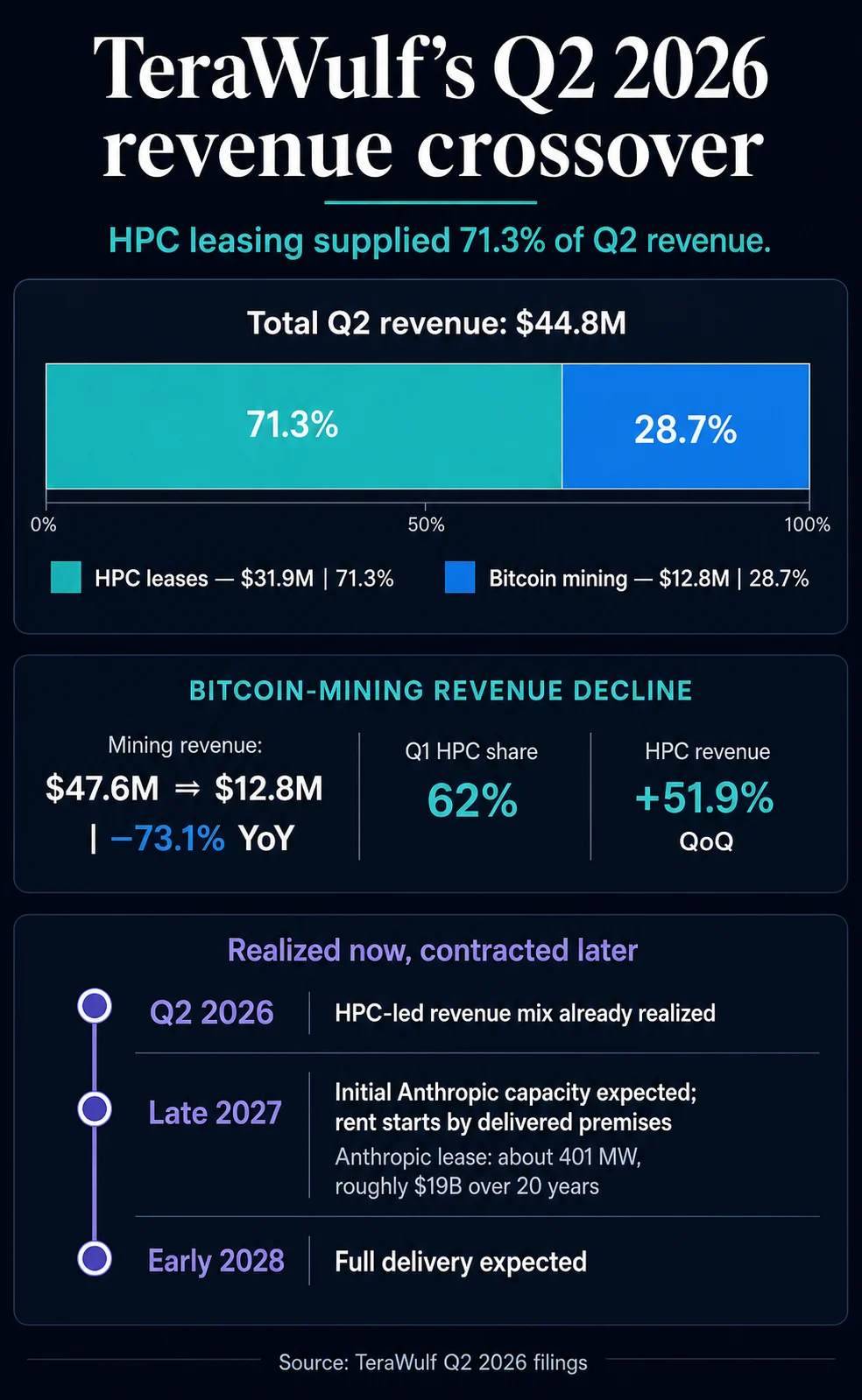
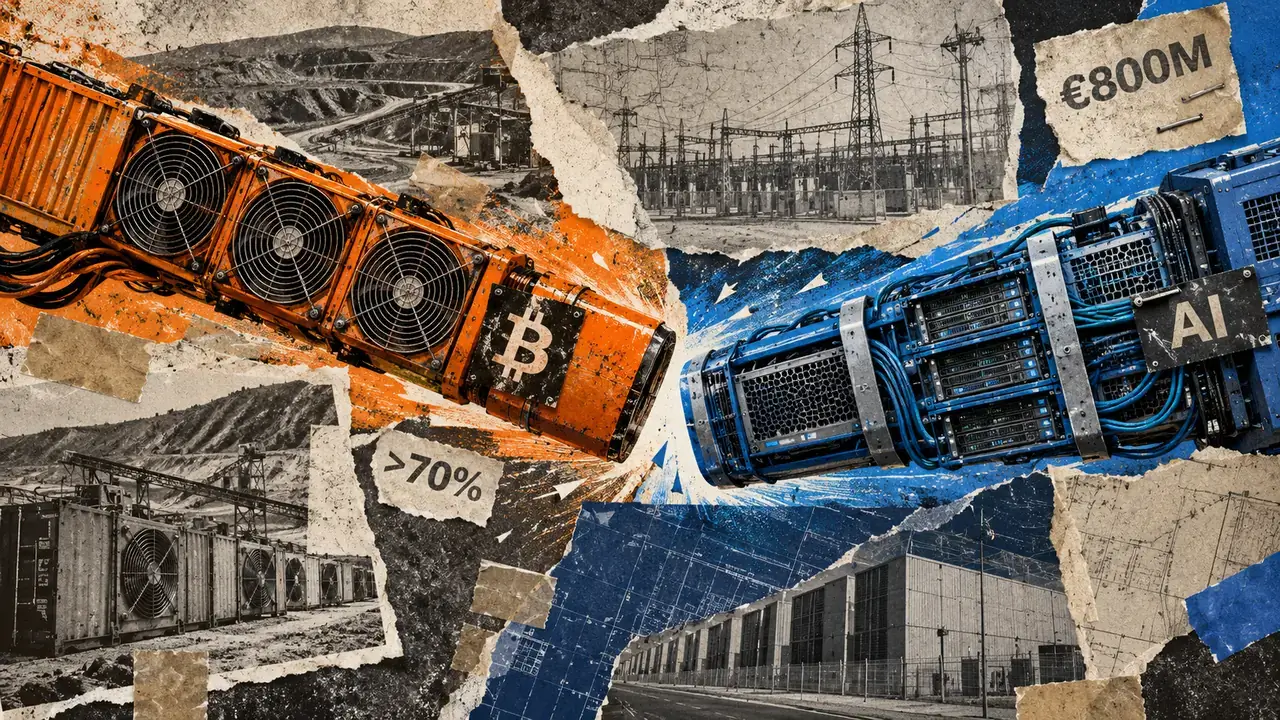
TeraWulf Inc., a leading developer and operator of vertically integrated digital infrastructure, has released its second-quarter 2026 financial results, signaling a definitive and aggressive pivot from its origins as a pure-play Bitcoin miner toward a future dominated by High-Performance Computing (HPC) and Artificial Intelligence (AI) hosting. The company’s latest earnings report reveals a stark transformation: while digital asset mining revenue plummeted by 73% year-over-year, its burgeoning HPC leasing business has rapidly ascended to account for 71% of total sales. This strategic realignment comes as the global demand for AI-ready data center capacity continues to outpace supply, providing energy-rich firms like TeraWulf with a lucrative alternative to the volatile economics of cryptocurrency mining.
According to the firm’s second-quarter 2026 report, digital asset revenue dropped to $12.8 million, a sharp decline from the $47.6 million reported during the same period a year earlier. This contraction in mining revenue was largely offset by the $31.9 million generated through HPC leasing, which successfully lifted the total quarterly revenue to $44.8 million. Although the new business segment softened the impact of the mining revenue collapse, it did not entirely bridge the gap, leaving overall sales approximately 6% lower than the previous year. However, the internal shift in revenue composition marks a fundamental change in the company’s financial identity and long-term trajectory.
The Financial Landscape: Navigating Losses and Capital Demands
The transition from cryptocurrency mining to AI infrastructure is a capital-intensive endeavor, reflected in the substantial net loss reported by the company. TeraWulf recorded a $940.8 million net loss during the second quarter of 2026. This figure was heavily influenced by a $755.7 million noncash charge associated with the remeasurement of warrant liabilities—a common accounting adjustment in high-growth firms with complex capital structures. When combined with previous quarters, TeraWulf’s total net loss for the year stands at approximately $1.4 billion.
Despite these headline-grabbing losses, the company’s leadership remains focused on the underlying growth of its revenue-generating assets. Chief Financial Officer Patrick Fleury characterized the quarter as a critical milestone in the "transformation of our financial profile." Fleury highlighted the significance of the 71% revenue share now attributed to HPC, noting that these long-term leases are often backed by stronger credit profiles than those seen in the speculative mining sector. This shift is intended to provide a more stable and predictable cash flow, insulating the company from the four-year "halving" cycles and price volatility inherent in the Bitcoin ecosystem.
Infrastructure Expansion: From Lake Mariner to Kentucky
TeraWulf’s primary operational hub remains the Lake Mariner campus in New York, a facility that has undergone significant repurposing. Originally designed for high-density Bitcoin mining, portions of the site are being retrofitted to meet the rigorous cooling and power requirements of HPC and AI workloads. As of the end of June 2026, the Lake Mariner site boasted 81 megawatts (MW) of revenue-generating critical IT capacity. Following an early-July delivery, this capacity increased to 102 MW.

The scale of the company’s construction pipeline suggests that this is only the beginning. An additional 336 MW of capacity is currently under construction at the New York site, with the first wave of this new capacity expected to begin generating rental income during the second half of 2026. This rapid expansion is supported by strategic alliances, including a lease obligation with Fluidstack that is backed by $600 million in Google credit support. Such partnerships provide TeraWulf with the institutional-grade credibility required to attract top-tier AI clients.
Beyond New York, the company’s most ambitious project to date is the development of the "Justified" campus in Kentucky. Following the close of the second quarter, TeraWulf signed a landmark 20-year lease agreement with Anthropic, a prominent AI safety and research company. Under the terms of the deal, TeraWulf will provide approximately 401 MW of capacity. This agreement is projected to generate roughly $19 billion in contracted revenue over its lifespan. Should Anthropic exercise its two five-year extension options, the total revenue from this single deal could escalate to approximately $33 billion. Initial capacity at the Kentucky site is slated for delivery in the second half of 2027, with full operational status expected by early 2028.
A Chronology of Strategic Realignment
The transition of TeraWulf from a Bitcoin-centric operation to an AI powerhouse has been a calculated response to shifting market dynamics.
- Early 2024: TeraWulf, like many miners, faced the reality of the Bitcoin halving, which slashed block rewards and increased the marginal cost of production. The company began exploring "dual-purpose" infrastructure.
- Late 2024 – Mid 2025: As the AI boom intensified, TeraWulf prioritized the acquisition of high-spec transformers and cooling systems suitable for GPUs rather than just ASICs (Application-Specific Integrated Circuits) used for mining.
- Q1 2026: The company officially reported that its HPC development pipeline had surpassed its mining expansion plans in terms of capital allocation.
- Q2 2026: HPC revenue officially overtook mining revenue, reaching 71% of total sales, marking the symbolic "death" of the company as a pure-play miner.
Chairman and CEO Paul Prager emphasized that the company is "moving from platform formation to scaled execution." Prager’s thesis rests on the scarcity of power infrastructure. As AI development faces bottlenecks due to electricity access and grid constraints, TeraWulf’s control over large-scale power interconnects becomes its most valuable asset. "We are prepared to realize value where appropriate and redeploy capital toward larger-scale opportunities where we have greater control over the infrastructure, customer relationship, and long-term economics," Prager stated.
Comparative Analysis: The Broader Mining Industry Pivot
TeraWulf is not alone in its pivot, but the scale of its transition is among the most aggressive in the industry. Other major players, such as Core Scientific and Iris Energy, have also announced significant allocations of power toward HPC. However, TeraWulf’s success in securing a massive, multi-decade contract with a high-profile tenant like Anthropic sets a new benchmark for the sector.
The decline in Bitcoin mining revenue is a trend seen across the industry, driven by increased global hash rates and the diminishing rewards of the network. For many miners, the infrastructure already in place—high-voltage power access, industrial cooling systems, and physical security—is 80% of what is needed for a Tier 3 or Tier 4 data center. The remaining 20%, which includes specialized networking and redundant power supplies, requires significant capital expenditure (CapEx) but offers much higher rent-per-kilowatt-hour compared to the speculative returns of mining.

Implications for the Future of Energy and AI
The implications of TeraWulf’s results extend beyond the balance sheet. This shift highlights a growing competition for energy between the "old" digital economy (crypto) and the "new" digital economy (AI). As miners move their capacity toward AI, the available hash rate for the Bitcoin network may see a period of slower growth or consolidation, potentially impacting network security and decentralization in the long run.
Conversely, for the AI sector, the entry of former Bitcoin miners into the hosting space provides a vital release valve for the current capacity crunch. TeraWulf’s commitment to contracting an additional 250 MW to 500 MW of critical IT capacity each year suggests a belief that the AI infrastructure super-cycle is in its early stages. The company has stated it will pursue new projects selectively, focusing on sites with secured power and confirmed customer demand to ensure high risk-adjusted returns.
Conclusion and Outlook
TeraWulf’s second-quarter 2026 performance serves as a blueprint for the "Miner 2.0" business model. By leveraging its existing energy assets and pivoting toward the high-margin, high-demand world of AI leasing, the company is attempting to outrun the diminishing returns of the Bitcoin mining industry.
While the $1.4 billion year-to-date loss and the 73% drop in mining revenue are significant hurdles, the $19 billion to $33 billion revenue potential from the Anthropic deal provides a massive light at the end of the tunnel. As the Lake Mariner expansion continues and the Kentucky campus breaks ground, TeraWulf is no longer just a participant in the digital asset space; it is positioning itself as a foundational pillar of the global AI infrastructure. The transition is fraught with capital risk and construction complexity, but for TeraWulf, the path forward is clear: the future is in the silicon of AI, not just the hash of the blockchain.