admin
admin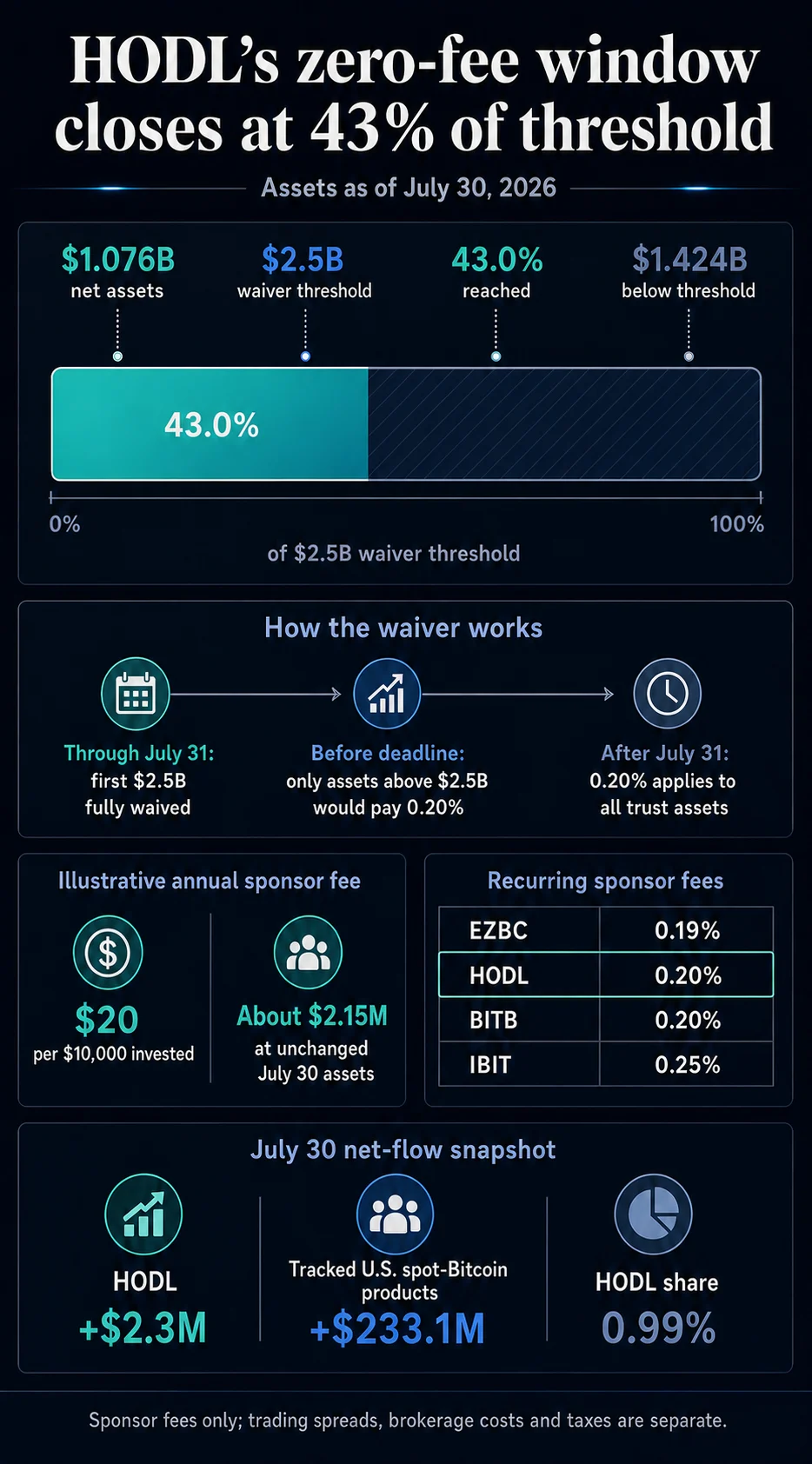
The zero-sponsor-fee period for VanEck’s Bitcoin ETF, trading under the ticker HODL, officially concluded on July 31, 2026. As the clock struck midnight, the fund reported net assets totaling $1.076 billion. This figure represents approximately 43.0% of the $2.5 billion asset threshold that was set to trigger the end of the sponsor fee waiver. Consequently, HODL did not meet the asset level required to extend the fee waiver beyond its predetermined expiration date.
The termination of the fee waiver marks a significant transition for HODL investors, as a 0.20% sponsor fee will now apply to all trust assets. This fee structure places HODL on par with the Bitwise Bitcoin ETF (BITB), which also charges a 0.20% sponsor fee. However, it positions HODL one basis point above the Franklin Bitcoin ETF (EZBC), which maintains a 0.19% sponsor fee, and below the iShares Bitcoin Trust ETF (IBIT), which has a 0.25% fee.
Background of the Fee Waiver and Its Mechanics
VanEck initially introduced the zero-sponsor-fee period as a strategic incentive to attract assets and gain market share in the highly competitive spot Bitcoin ETF landscape. The waiver was designed to offer investors a cost-free entry point, allowing them to experience the benefits of Bitcoin exposure through an exchange-traded fund without the immediate burden of management fees.
The mechanics of the waiver were more nuanced than a simple asset cap. VanEck committed to waiving the 0.20% sponsor fee on the first $2.5 billion of trust assets through July 31, 2026. Had the fund’s assets surpassed this threshold before the deadline, only the assets exceeding $2.5 billion would have incurred the 0.20% fee, resulting in a pro-rated or weighted sponsor fee for the total assets. This tiered approach aimed to provide a gradual transition into the full fee structure.
However, as of July 30, 2026, the day preceding the waiver’s expiration, HODL’s net assets stood at $1.076 billion. This was approximately $1.424 billion short of the $2.5 billion asset threshold. The fund’s performance, therefore, meant that the waiver remained in effect for its entire asset base until its scheduled end date.
Chronology of Fee Waiver Extensions

The fee waiver for HODL was not a static provision. VanEck had previously filed for extensions to the waiver period, demonstrating a commitment to supporting the fund’s growth. The most recent extension was filed on November 25, 2025, which superseded an earlier deadline of January 10, 2026. This extension pushed the fee waiver’s expiration to July 31, 2026, the date that ultimately marked its conclusion.
There was no announcement of a further extension by VanEck prior to the July 31 deadline. Regulatory filings with the U.S. Securities and Exchange Commission (SEC) also did not indicate any new waiver proposals, reinforcing the expectation that the 0.20% sponsor fee would commence on August 1, 2026.
Financial Implications for Investors
With the 0.20% sponsor fee now in effect, investors in HODL will experience an incremental increase in their investment costs. Based on the fund’s net asset level of $1.076 billion as of July 30, 2026, the annual sponsor fee would amount to approximately $2.15 million, assuming assets remain constant.
For individual investors, this translates to an annual cost of roughly $20 for every $10,000 invested, before accounting for any fluctuations in share price. It is crucial for investors to understand that this sponsor fee represents only one component of the total ownership cost. Other expenses, such as brokerage commissions, bid-ask spreads, potential premiums or discounts to net asset value (NAV), and applicable taxes, can further influence an investor’s overall return.
Asset Flows and Market Performance
Analyzing asset flows provides insight into investor sentiment and the fund’s traction in the market. According to data from Farside Investors, HODL experienced net outflows totaling $87.6 million across 169 trading sessions between November 25, 2025, and July 30, 2026. These outflows occurred during the period of the extended fee waiver.
It is important to note that net asset flows do not solely dictate changes in Assets Under Management (AUM). AUM is also influenced by the fluctuating market value of Bitcoin, as well as the processes of creation and redemption of ETF shares, and other fund expenses. Therefore, these outflows, while notable, do not definitively signal investor rejection or predetermine future performance post-waiver.

In the immediate period leading up to the waiver’s end, HODL saw a modest inflow of $2.3 million on July 30, 2026. This represented approximately 0.99% of the total net inflow of $233.1 million across all tracked U.S. spot-Bitcoin ETFs on that day. Farside Investors’ data indicates HODL’s cumulative net inflows at $1.146 billion, a figure distinct from its $1.076 billion in net assets.
Competitive Landscape and Fee Structure
The introduction of spot Bitcoin ETFs in the U.S. market has led to intense competition, with issuers vying for investor capital through various strategies, including fee structures. As the fee waiver for HODL concludes, its 0.20% sponsor fee places it in direct competition with its peers.
- Bitwise Bitcoin ETF (BITB): Also charges a 0.20% sponsor fee.
- iShares Bitcoin Trust ETF (IBIT): Has a higher sponsor fee of 0.25%.
- Franklin Bitcoin ETF (EZBC): Offers a slightly lower sponsor fee of 0.19%.
This fee positioning means HODL will be competitively priced against one peer, offer a more favorable fee than another, and be marginally more expensive than a third. The expiration of its zero-fee period means HODL will now compete on its ongoing expense ratio, alongside other factors such as liquidity, tracking accuracy, and brand reputation.
Broader Implications for the Bitcoin ETF Market
The conclusion of VanEck’s zero-fee period for HODL signifies a broader trend in the Bitcoin ETF market. As the initial hype and aggressive promotional tactics of the early entrants begin to subside, the focus is shifting towards sustained performance and competitive fee structures.
The fact that HODL did not reach its $2.5 billion asset threshold for fee waiver extension suggests that other Bitcoin ETFs may have captured a larger portion of investor interest or that the market has become more discerning in its allocation. This could indicate a maturation of the spot Bitcoin ETF market, where investors are increasingly evaluating products based on long-term value propositions rather than introductory incentives.
The ongoing competition among Bitcoin ETFs, characterized by varying fee percentages and the potential for future adjustments, will likely continue to shape investor decisions. As the market evolves, issuers will need to demonstrate not only their ability to track Bitcoin’s price effectively but also their capacity to manage costs and provide compelling value propositions to retain and attract capital. The performance of HODL in the coming months, particularly in light of its new fee structure, will be closely watched by market participants as an indicator of its competitive standing within the burgeoning spot Bitcoin ETF ecosystem.