Dwi Wanna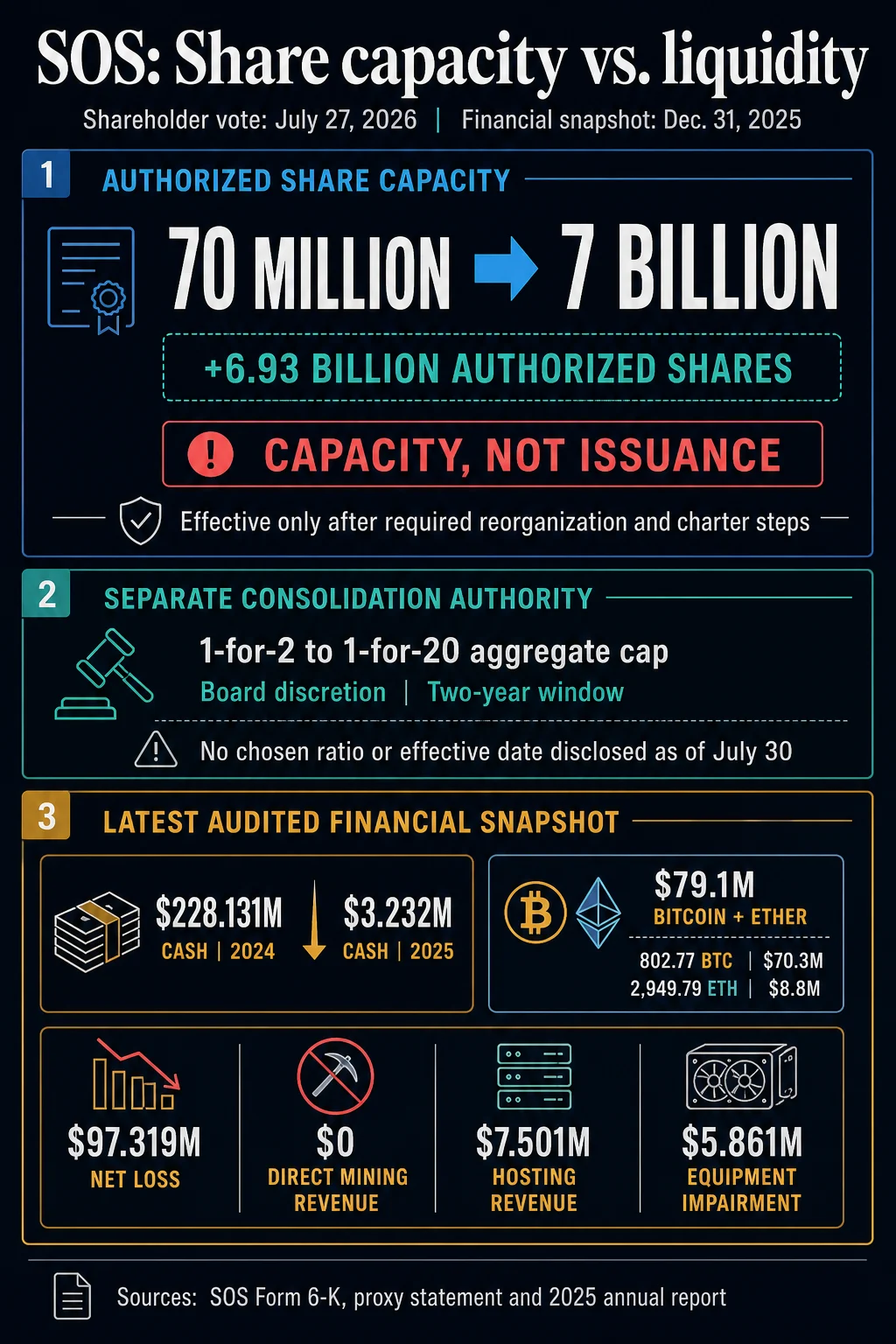
SOS Limited, a diversified technology company with significant exposure to the cryptocurrency mining and hosting sectors, has secured shareholder approval for a dramatic restructuring of its capital framework. The move, disclosed in a Securities and Exchange Commission (SEC) filing on July 30, 2026, following a July 27 shareholder vote, authorizes a 100-fold expansion of the company’s authorized share pool. This strategic maneuver comes at a critical juncture for the firm, which is grappling with a near-total depletion of its cash reserves, a suspension of its primary mining operations, and a mounting net loss that has raised questions about its long-term viability. By expanding its authorized share capacity from 70 million to 7 billion, SOS Limited is positioning itself for a massive equity-based survival play, providing the board with the necessary headroom to raise capital, facilitate acquisitions, or restructure debt in an increasingly volatile digital asset landscape.
The Financial Precipice: A 98% Liquidity Decline
The catalyst for this radical expansion of share capital is a stark deterioration in the company’s liquid assets. According to the most recent audited balance sheet, SOS Limited experienced a precipitous drop in cash and cash equivalents over a twelve-month period. At the close of the 2024 fiscal year, the company reported a robust cash position of $228.131 million. However, by December 31, 2025, this figure had collapsed to just $3.232 million—a 98.6% reduction.
This liquidity crisis was compounded by a net loss of $97.3 million from continuing operations throughout 2025. While the company maintained a significant portfolio of digital assets, including 802 Bitcoin (valued at approximately $70.3 million at year-end 2025) and 2,949 Ethereum (valued at roughly $8.8 million), these assets are subject to high market volatility and do not provide the same operational flexibility as fiat currency. The reliance on market-sensitive digital holdings as the primary pillar of its liquid balance sheet has left the company vulnerable to fluctuations in the broader crypto market, necessitating a move toward equity-based financing to stabilize operations.
Operational Pivot: From Direct Mining to Hosting
The shift in the company’s financial strategy mirrors a broader operational transition. During the 2025 fiscal year, SOS Limited’s direct cryptocurrency mining revenue plummeted from $9.2 million in the previous year to zero. This total cessation of mining revenue was the result of a temporary shutdown of direct mining activities, a move likely driven by increasing energy costs, heightening network difficulty, and the need to preserve capital.
In place of direct mining, SOS Limited pivoted toward hosting services. For the year ending December 31, 2025, the company reported $7.5 million in hosting-service revenue. While this provides a more predictable stream of income compared to the rewards of direct mining, it has thus far failed to offset the losses incurred from the idling of its own hardware. Furthermore, the company recorded a $5.8 million impairment charge on its mining equipment, reflecting the depreciating value of older-generation ASICs and the challenging economics of the sector. The transition to a "hosting-first" model suggests a defensive posture, aiming to utilize existing infrastructure to generate cash flow without the direct exposure to mining difficulty adjustments.
The 7 Billion Share Authorization: Mechanics and Implications
The July 27 shareholder vote granted the board the authority to increase the company’s authorized share capital to 7 billion shares. Specifically, the reorganization involves the creation of 5.94 billion additional Class A ordinary shares and 990 million additional Class B ordinary shares. It is important to note that this approval creates financing capacity rather than immediate dilution; the shares have been authorized but not yet issued.

The implementation of this expansion is conditional upon the completion of specific reorganization and charter steps. According to the company’s proxy statement, this enlarged pool is intended to support "future financings, acquisitions, equity compensation, and other corporate transactions." For a company with only $3.2 million in cash, the ability to issue shares is effectively its only remaining lever for raising the capital required to restart mining operations or settle outstanding obligations.
However, the potential for dilution is unprecedented. If the company were to utilize the entirety of its new 7 billion share capacity, existing shareholders would see their ownership stakes diluted to a fraction of their current value. This "survival play" suggests that the company is prioritizing the preservation of the corporate entity over the immediate protection of shareholder equity value.
The Mystery of the 2 Million Class B Shares
A significant point of contention and curiosity within the recent SEC filings is the unexplained increase in outstanding Class B shares. Between the filing of the company’s annual report on May 15 and the record date for the shareholder vote on July 13, the count of outstanding Class B shares rose by exactly 2 million. During this same period, the count of Class A shares remained unchanged.
The mechanics of the company’s share structure make this increase particularly noteworthy. Class A shares cannot be converted into Class B shares, and a simple transfer between existing shareholders would not alter the total number of outstanding shares. Consequently, the 2 million share increase points to a new allotment. SOS Limited has not filed any transaction-specific disclosures to identify the recipient of these shares, the consideration received by the company, or the underlying purpose of the issuance. This lack of transparency regarding a significant issuance of high-voting Class B shares has fueled speculation among market observers regarding potential private placements or insider compensation packages designed to shore up control ahead of the massive share expansion.
Chronology of the Restructuring Effort
The path to this 7 billion share authorization has been marked by several key regulatory and corporate milestones:
- December 31, 2024: SOS reports a strong cash position of $228.1 million.
- December 31, 2025: Fiscal year ends with cash reserves down to $3.2 million and a $97.3 million net loss.
- May 15, 2026: SOS files its annual report, revealing the extent of its liquidity crisis and the cessation of mining revenue.
- May–July 2026: The company quietly issues 2 million Class B shares without public explanation.
- July 13, 2026: The record date for the extraordinary general meeting is established.
- July 27, 2026: Shareholders convene and approve the increase in authorized share capital and the authority for a reverse stock split.
- July 30, 2026: The results of the vote are officially disclosed via a 6-K filing with the SEC.
Strategic Contingency: The Reverse Stock Split
In addition to the share increase, shareholders granted the board the authority to implement one or more share consolidations (reverse stock splits) over the next two years. The approved ratios range from a minimum of 1-for-2 to a maximum aggregate cumulative ratio of 1-for-20.
The board maintains full discretion over whether to execute these consolidations. Historically, companies in the crypto-mining sector have utilized reverse stock splits to maintain compliance with exchange listing requirements—specifically the minimum bid price rules of the NYSE or NASDAQ. By reducing the number of outstanding shares, the company can artificially increase the price per share, preventing a delisting that would further restrict its access to capital markets. Given the massive dilution potential of the 7 billion share authorization, a reverse split is widely viewed by analysts as an inevitable secondary step to keep the stock tradable on major exchanges.

Market Context and Industry Pressures
SOS Limited’s struggles are emblematic of a broader trend within the cryptocurrency mining industry. Following the most recent Bitcoin halving events and the increasing professionalization of the sector, smaller or less efficient miners have found themselves squeezed by rising hash rates and diminishing rewards.
Competitors such as Marathon Digital and Riot Platforms have similarly turned to the equity markets to fund expansion and balance sheet diversification. However, the scale of SOS Limited’s proposed share increase is outlier-level. While other firms have used "At-The-Market" (ATM) offerings to incrementally raise funds, SOS is seeking the capacity to expand its share count by 10,000%. This suggests that the company’s financial distress is significantly more acute than its peers, necessitating a "nuclear option" for recapitalization.
Analysis of Potential Outcomes
The success of SOS Limited’s survival play hinges on its ability to find buyers for its newly authorized shares. In a market that is increasingly wary of "penny stock" crypto miners, the company must demonstrate a clear path back to profitability.
If the company successfully completes its reorganization and begins issuing shares, it could theoretically raise hundreds of millions of dollars to pay off debts, upgrade its mining fleet, and pivot back to direct mining. However, if the market perceives the 7 billion share pool as a sign of terminal dilution, the share price could collapse further, making it impossible to raise meaningful capital regardless of the number of shares authorized.
Furthermore, the "mysterious" issuance of 2 million Class B shares remains a red flag for institutional investors who prioritize corporate governance. Without a clear explanation for who received those shares and why, the company may struggle to attract the high-quality capital needed for a genuine turnaround.
Conclusion and Future Outlook
The approval of the 7 billion share authorization marks the beginning of a high-stakes gamble for SOS Limited. The company has successfully built the legal "vessel" required to hold a massive influx of capital, but it remains to be seen if the market is willing to fill it. With a balance sheet dominated by volatile digital assets and a cash reserve that is insufficient to cover even a fraction of its annual losses, SOS is now entirely dependent on its ability to leverage its new share pool.
Investors and regulators will be closely watching for the company’s next series of filings. Updated disclosures regarding its mid-2026 cash and crypto positions will be vital in determining whether the company’s liquidity has improved or if the "cash collapse" has continued. For now, SOS Limited remains a cautionary tale of the volatility inherent in the crypto-mining sector, where even a $200 million cash cushion can evaporate in the face of operational shifts and market downturns. The 7 billion share play is, quite literally, the company’s last line of defense.