Dwi Wanna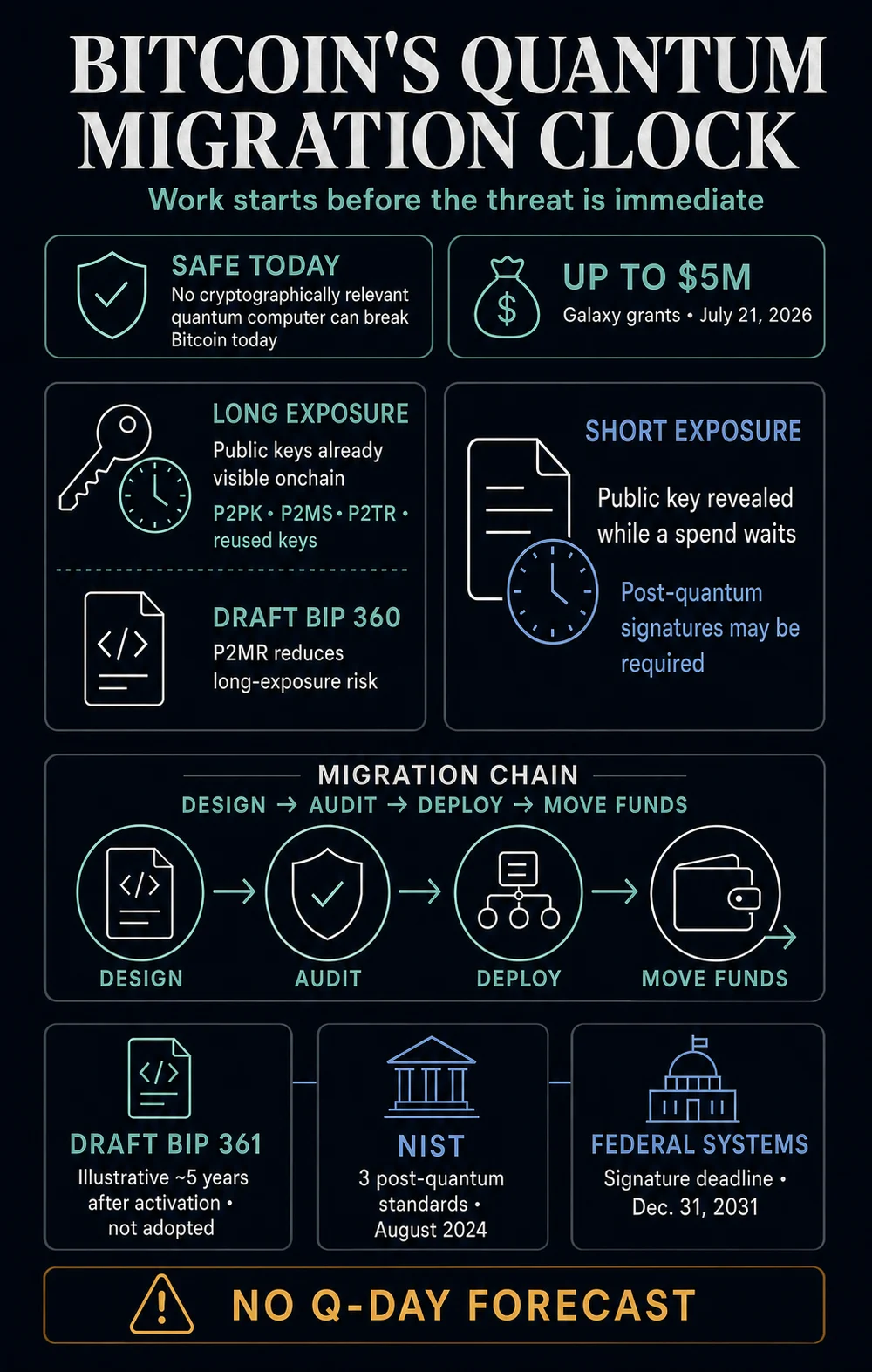
Galaxy Digital, the financial services and investment management firm led by Mike Novogratz, announced a strategic commitment of up to $5 million on July 21, 2026, to fortify the Bitcoin network against the emerging threat of quantum computing. The initiative represents one of the most significant private-sector investments into Bitcoin’s long-term cryptographic resilience, funding a multi-year roadmap that includes developer grants, rigorous security audits, and the establishment of a dedicated Quantum Advisory Council. While current quantum hardware lacks the processing power to compromise Bitcoin’s signature security, the program underscores a growing consensus among cryptographers and institutional stakeholders that the window for a proactive migration is narrowing.
The core of the initiative focuses on accelerating the research and development of post-quantum cryptography (PQC) within the Bitcoin ecosystem. Galaxy Digital’s funding is structured to support developers as they achieve specific milestones in the transition process, such as the refinement of quantum-resistant transaction proposals and the integration of new signature schemes. By providing financial incentives for this specialized work, Galaxy aims to catalyze a movement that has historically relied on volunteer contributions and academic research, ensuring that the necessary technical infrastructure is ready well before a "Q-Day"—the hypothetical point at which quantum computers can break modern encryption—arrives.
The Nature of the Quantum Threat to Bitcoin
To understand the urgency behind Galaxy’s $5 million pledge, it is necessary to examine the specific cryptographic vulnerabilities inherent in the Bitcoin protocol. Bitcoin currently relies on the Elliptic Curve Digital Signature Algorithm (ECDSA) to ensure that only the rightful owner of a private key can authorize a transaction. While ECDSA is virtually impenetrable by classical computers, it is susceptible to Shor’s algorithm, a quantum algorithm that can efficiently solve the discrete logarithm problem. If executed on a sufficiently powerful quantum computer, Shor’s algorithm could derive a private key from a publicly available public key, allowing an attacker to forge signatures and drain funds from any vulnerable address.
The technical risk is generally categorized into two distinct exposure windows. The first involves "long-term exposure," where public keys are already visible on the blockchain. This includes older addresses (Pay-to-Public-Key or P2PK), reused addresses, and certain types of multisignature scripts. In these cases, an attacker with a quantum computer would have an indefinite amount of time to compute the private key and move the funds. The second window is "short-term exposure" or "mempool exposure." Most modern Bitcoin transactions use a hash of the public key (Pay-to-Public-Key-Hash or P2PKH), which remains hidden until a user attempts to spend the funds. However, once the transaction is broadcast to the network, the public key is revealed in the mempool while waiting to be confirmed in a block. A fast enough quantum computer could theoretically intercept this key, compute the private key, and broadcast a competing transaction with a higher fee to steal the funds before the original transaction is processed.
Technical Proposals and BIP 360
The Galaxy initiative specifically targets the advancement of Draft Bitcoin Improvement Proposal (BIP) 360. This proposal identifies several critical areas of exposure, including Pay-to-Public-Key (P2PK), bare multisignature outputs, and certain Taproot outputs that expose public keys for extended periods. BIP 360 proposes a soft-fork upgrade to introduce a new output type known as Pay-to-Merkle-Root (P2MR).
P2MR is designed to minimize the footprint of a transaction and limit the exposure of cryptographic material. By removing the "key path" associated with Taproot, P2MR ensures that the public key remains hidden behind a Merkle root until the moment of spending. This approach provides a "hash-protected" shield that is significantly more resistant to quantum analysis than raw public keys. While P2MR does not solve the mempool exposure problem, it provides a vital first layer of defense for long-term storage, giving the network a "waiting room" where funds can be held safely while the community works on more complex post-quantum signature schemes.

The transition to P2MR would require a significant shift in how wallets and custodians handle transactions. Galaxy’s funding is intended to bridge the gap between theoretical BIPs and production-ready code, supporting the development of migration tools that institutional custodians and retail wallet providers can use to move assets into these more secure output types.
Coordination and the Decentralized Governance Challenge
The technical design of a quantum-resistant Bitcoin is only half the battle; the other half is the logistical challenge of network-wide coordination. Unlike a centralized financial system that can mandate an upgrade overnight, Bitcoin operates as a decentralized network of miners, node operators, developers, and users. Any major change to the consensus rules requires broad agreement to avoid a contentious chain split.
Galaxy Digital’s initiative acknowledges that the migration could take years, if not a decade, to fully implement. The process involves several sequential stages:
- Research and Design: Selecting a post-quantum signature scheme (such as those based on lattices or hashes) that is small enough to fit within Bitcoin’s block space constraints.
- Formal Audits: Ensuring that new code does not introduce classical vulnerabilities or "backdoors."
- Software Deployment: Updating Bitcoin Core and other node implementations.
- Institutional Integration: Custodians and exchanges must update their internal signing infrastructure and cold storage protocols.
- User Migration: Millions of individual holders must manually move their funds from old addresses to new, quantum-resistant addresses.
BIP 361, another informational proposal highlighted by the initiative, sketches a hypothetical five-year, two-phase transition plan. This roadmap suggests that once a post-quantum design is activated, there would be a multi-year period where both classical and quantum-resistant signatures are valid, allowing users ample time to migrate. However, the complexity of this task means that any delay in the research phase could leave the network vulnerable if quantum hardware advances faster than expected.
Chronology of Quantum Readiness and Global Standards
Galaxy’s move does not occur in a vacuum but is part of a broader global shift toward post-quantum security. The timeline for these developments has accelerated over the past few years:
- August 2024: The National Institute of Standards and Technology (NIST) finalized its first three post-quantum encryption standards. These include ML-KEM (for encryption) and ML-DSA and SLH-DSA (for digital signatures). NIST urged organizations to begin integration immediately, citing the long lead times required for systemic migration.
- June 2026: The White House issued Executive Order 14412, "Securing the Nation Against Advanced Cryptographic Attacks." This order directed the Office of Management and Budget (OMB) to require all federal agencies to transition specified systems to post-quantum signatures by December 31, 2031.
- July 2026: Galaxy Digital launches its $5 million Bitcoin Quantum Readiness Initiative, aligning the cryptocurrency sector’s timeline with federal and international standards.
These benchmarks indicate that the "quantum threat" is no longer viewed as science fiction by major governments and financial institutions. By starting in 2026, Galaxy and the Bitcoin development community are aiming to complete the transition before the 2031 deadline often cited by government agencies as a critical threshold.
Analysis of Implications for the Bitcoin Market
The implications of this initiative extend beyond technical security; they are deeply tied to Bitcoin’s value proposition as "digital gold." A primary component of Bitcoin’s $1 trillion-plus market capitalization is the belief in its absolute scarcity and the immutability of its ledger. If a quantum computer were to successfully "crack" a high-profile Bitcoin address—such as one of the early blocks attributed to Satoshi Nakamoto—the resulting loss of confidence could be catastrophic for the asset’s price and reputation.

By funding quantum readiness, Galaxy Digital is essentially purchasing an insurance policy for the entire ecosystem. For institutional investors, the existence of a clear, well-funded migration path reduces "tail risk"—the low-probability but high-impact event of a total cryptographic failure. This proactive stance is likely to be viewed favorably by regulators and institutional allocators who require rigorous risk management frameworks before committing capital to digital assets.
Furthermore, the initiative may spark a "arms race" for talent in the post-quantum space. There is currently a limited pool of cryptographers with expertise in both blockchain architecture and lattice-based or hash-based signatures. Galaxy’s grants could help anchor this talent within the Bitcoin ecosystem, preventing a "brain drain" to other sectors or competing blockchain projects that are also vying for quantum-resistant solutions.
Official Responses and Industry Outlook
While official statements from the Bitcoin Core development team are rare due to the project’s decentralized nature, prominent contributors have expressed cautious optimism regarding the funding. The general sentiment among the developer community is that while $5 million cannot "buy" a consensus-driven upgrade, it can significantly lower the barriers to entry for researchers who would otherwise be unable to dedicate years of their lives to such a complex problem.
Institutional custodians have also signaled support. Representatives from several major digital asset vaults noted that the development of standardized migration tools is a top priority. Without such tools, the manual migration of billions of dollars in cold storage would be an operational nightmare fraught with the risk of human error.
As the industry moves forward, the focus will likely shift from "if" Bitcoin will become quantum-resistant to "how" and "when." The Galaxy Digital initiative provides the necessary spark to move these discussions from theoretical white papers into the realm of executable code. While the threat of quantum computing remains on the horizon, the race to secure the world’s largest decentralized network has now officially entered a new, more urgent phase. The coming years will determine whether Bitcoin’s decentralized governance can move fast enough to outrun the rapid advancements in quantum physics.