Dwi Wanna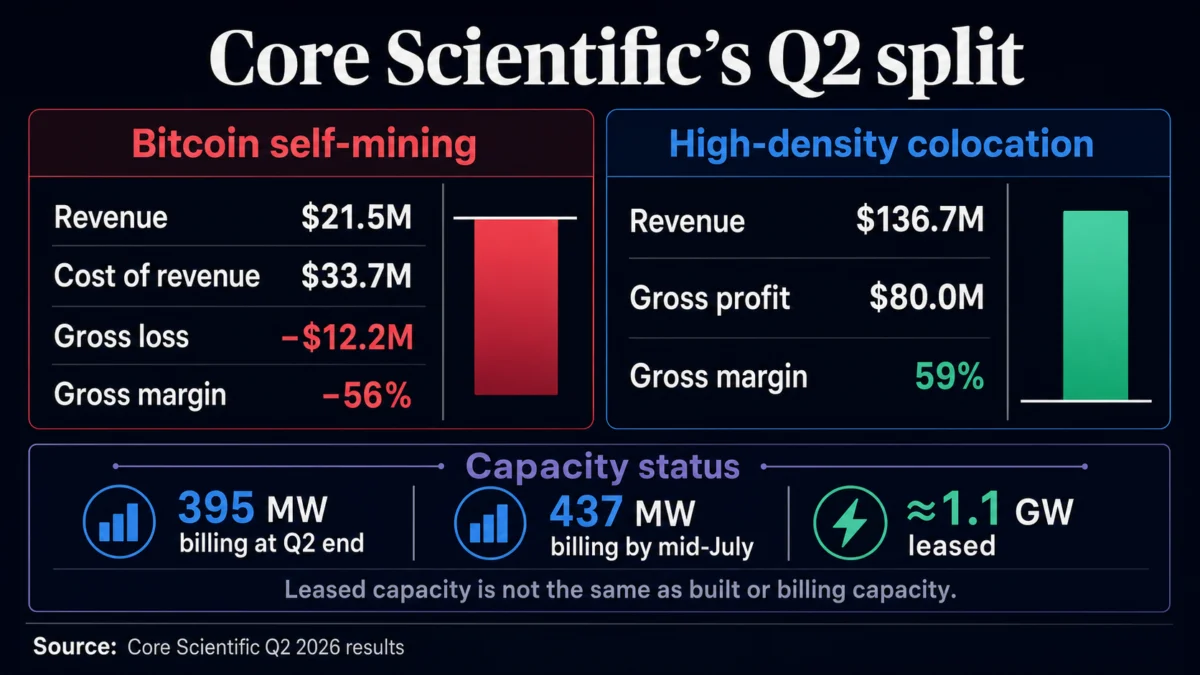
Financial Performance Breakdown: A Tale of Two Segments
The Q2 earnings report highlights a stark contrast between the economics of securing the Bitcoin network and the economics of powering the AI revolution. During the three months ended June 30, Core Scientific’s self-mining segment generated $21.5 million in revenue. However, the cost of revenue for this segment reached $33.7 million, leading to a segment gross loss of $12.2 million. This negative 56% margin reflects the increasing difficulty and diminishing returns associated with Bitcoin mining in a post-halving environment, where energy costs and hardware depreciation often outpace the value of the rewards earned.
Conversely, the high-density colocation segment—which provides the specialized power, cooling, and space required for AI data centers—demonstrated exceptional profitability. This segment produced $136.7 million in revenue and $80.0 million in gross profit, yielding a robust 59% margin. The success of this division was so significant that its gross profit exceeded Core Scientific’s consolidated total of $70.0 million, as the losses from the mining division and other smaller segments weighed down the overall company-wide performance.
It is important to note that the $12.2 million mining loss is not a simple reflection of Bitcoin’s price relative to electricity. The cost of revenue figure included $17.9 million in power fees, but also $9.9 million in depreciation and various other operating expenses. This indicates that while the company’s machines may still cover their immediate power costs, they are no longer generating enough value to offset the capital expenditures and infrastructure upkeep required to keep them operational.
The Strategic Pivot and Infrastructure Conversion
The disparity in profitability has accelerated Core Scientific’s plan to repurpose its existing mining facilities for high-density colocation. The company stated it is transitioning sites "as circumstances allow," signaling a pragmatic rather than abrupt exit from crypto mining. However, the Q2 results provide the strongest economic evidence to date for a total conversion of the company’s 1.1-gigawatt (GW) portfolio.
During an earnings call, Chief Financial Officer Jim Nygaard provided further clarity on the wind-down of mining operations. Nygaard noted that Core Scientific is currently operating its remaining miners primarily to offset contractual power costs while facilities are being prepared for AI clients. By the end of June, the company had nearly 30% fewer miners online than at the end of the first quarter, with self-mining activities localized to only two remaining sites.
This transition is not merely a change in business model but a massive engineering undertaking. Converting a Bitcoin mining facility into an AI-ready data center requires significant upgrades to power density, cooling systems, and physical security. Bitcoin mining can often tolerate power fluctuations and lower-tier infrastructure, whereas AI workloads, particularly large language model (LLM) training, require high-tier reliability and sophisticated liquid or advanced air-cooling solutions to manage the heat generated by high-end GPUs.
The Growing Pipeline of AI Contracts
The scale of Core Scientific’s AI ambitions is reflected in its massive contract pipeline. At the end of the second quarter, the company reported 395 megawatts (MW) of billing colocation capacity. By mid-July, this figure had grown to 437 MW, representing approximately $635 million in average annualized colocation revenue under Generally Accepted Accounting Principles (GAAP).
Despite this progress, a significant gap remains between current operational capacity and the company’s long-term commitments. Core Scientific currently holds roughly 1.1 GW of leased customer power capacity, tied to more than $24 billion in potential contracted revenue. A cornerstone of this pipeline is the company’s relationship with major semiconductor and AI firms, including a multi-year partnership with AMD. This relationship is anchored by 15-year agreements covering approximately 530 MW across five sites, representing over $14 billion in potential base contracted revenue.
The company has indicated that its broader relationship could eventually support up to 2.5 GW of capacity. However, management cautioned that this higher figure remains prospective and is not yet reflected in built or billing capacity. The primary challenge for Core Scientific over the coming 24 to 36 months will be the speed and efficiency with which it can convert its power-ready sites to meet the rigorous demands of these high-value AI contracts.
Accounting for the $1.16 Billion Net Loss
A headline figure in the Q2 report was a massive $1.16 billion net loss. However, market analysts have pointed out that this figure overstates the operational damage sustained during the quarter. The vast majority of this loss—approximately $1.05 billion—was attributed to a non-cash fair-value expense for warrants and contingent value rights (CVRs).
As Core Scientific’s stock price rose during the quarter, the valuation of these financial instruments, which were issued as part of the company’s restructuring and exit from bankruptcy, also increased. Under standard accounting rules, this increase in the value of the company’s liabilities must be recorded as an expense on the income statement. Therefore, while the net loss appears staggering, it does not represent a cash drain on the business; rather, it is a byproduct of the company’s rising market valuation and the complex capital structure established during its Chapter 11 reorganization.
Contextualizing the Industry Shift
Core Scientific is not alone in its pivot toward AI. Since the Bitcoin halving in April 2024, which slashed mining rewards by 50%, the entire crypto-mining industry has been forced to re-evaluate its reliance on digital asset production. Competitors such as Iris Energy, Terawulf, and HIVE Digital Technologies have all announced varying degrees of diversification into HPC and AI hosting.
The trend is driven by a unique market misalignment: while the demand for AI compute is skyrocketing, the lead time to build new data centers with gigawatt-scale power access is now five to seven years in many major markets due to electrical grid constraints. Bitcoin miners, who spent years securing massive power interconnections and building "behind-the-meter" infrastructure, now find themselves sitting on some of the most valuable real estate in the technology sector.

For Core Scientific, the pivot is a matter of survival and optimization. The company’s bankruptcy exit in early 2024 provided it with a cleaner balance sheet, but the underlying volatility of Bitcoin remained a risk. By locking in 15-year contracts with AI firms, the company is effectively trading the high-risk, high-reward nature of crypto mining for the stable, predictable, and high-margin cash flows of the enterprise data center market.
Chronology of Key Events
- January 2024: Core Scientific officially emerges from Chapter 11 bankruptcy after a year of restructuring, focusing on debt reduction and operational efficiency.
- March 2024: The company begins announcing initial pilot programs for HPC hosting, signaling a shift away from exclusive Bitcoin mining.
- April 2024: The Bitcoin Halving occurs, reducing mining rewards from 6.25 BTC to 3.125 BTC per block, significantly squeezing margins for all global miners.
- June 2024: Core Scientific announces a massive 200 MW deal with a leading AI provider, later identified as part of its broader relationship with firms like AMD and CoreWeave.
- July 2024: The Q2 earnings report confirms the economic reality of the pivot, showing mining losses outweighed by AI profits.
- July 15, 2024: Billing capacity reaches 437 MW, a milestone in the company’s infrastructure conversion timeline.
Implications and Future Outlook
The results for Q2 2026 suggest that Core Scientific is no longer a Bitcoin mining company in the traditional sense. Instead, it has become a specialized real estate and power infrastructure firm that happens to use Bitcoin mining as a "placeholder" for its unutilized energy capacity.
The successful generation of $80 million in profit from AI hosting proves that the company’s infrastructure is viable for the most demanding workloads in the tech industry. However, the $12.2 million loss in mining highlights the urgency of the conversion process. Every megawatt still dedicated to mining represents an opportunity cost—the difference between a 59% positive margin in AI and a 56% negative margin in crypto.
Looking forward, the market will closely monitor Core Scientific’s ability to execute its $24 billion contract backlog. The primary risks involve potential delays in the supply chain for electrical components (such as transformers and switchgear) and the technical challenges of managing ultra-high-density cooling at scale. Nevertheless, the second quarter of 2026 will likely be remembered as the tipping point where AI officially became the primary driver of Core Scientific’s economic value.
The company’s trajectory serves as a blueprint for the broader mining industry. As Bitcoin mining becomes increasingly institutionalized and low-margin, the repurposing of "stranded" or industrial power for AI represents the next frontier of digital infrastructure. For Core Scientific, the transition is well underway, moving from the volatile world of decentralized finance to the foundational infrastructure of the artificial intelligence era.