Dwi Wanna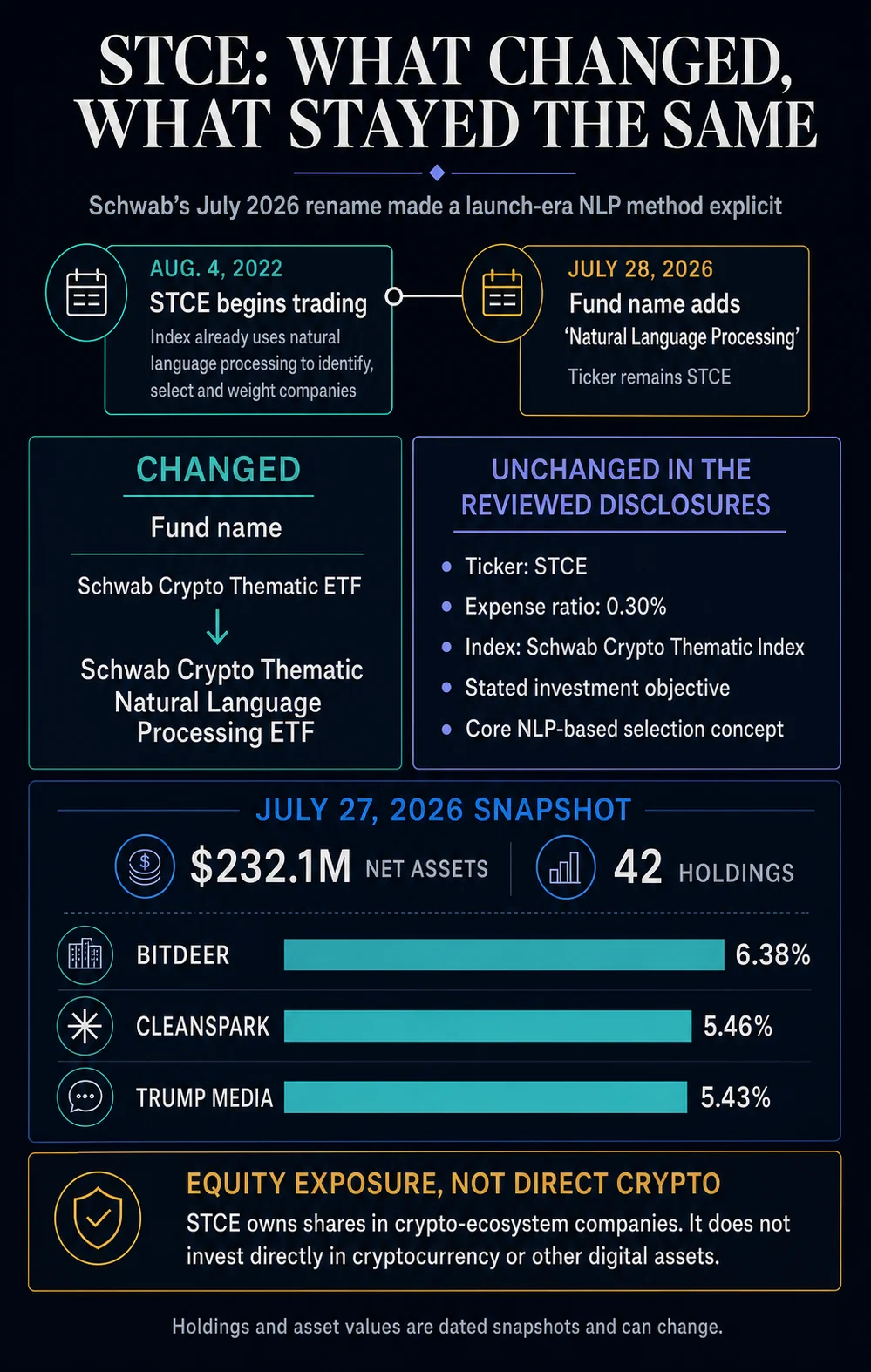
Schwab Asset Management has officially rebranded its flagship crypto-equity exchange-traded fund (ETF), the Schwab Crypto Thematic ETF, to the Schwab Crypto Thematic Natural Language Processing ETF. This change, which became effective on July 28, 2026, represents a significant shift in the marketing strategy for the $232.1 million fund, despite the underlying investment methodology, ticker symbol, and fee structure remaining virtually identical to those established at its inception four years ago. The move highlights an increasing trend among traditional financial institutions to emphasize the role of artificial intelligence and advanced data processing techniques in their investment vehicles, even when those techniques have been operational for years.
The fund, which trades under the ticker STCE, remains an equity-based ETF rather than a spot cryptocurrency fund. It provides investors with exposure to companies integrated into the broader digital asset ecosystem—ranging from bitcoin miners and hardware producers to financial services firms—rather than holding digital currencies like Bitcoin or Ethereum directly. While the name now prominently features "natural language processing" (NLP), the fund’s core objective and its reliance on the Schwab Crypto Thematic Index remain unchanged from the 2022 launch.
The Mechanics of Natural Language Processing in STCE
Natural Language Processing is a branch of artificial intelligence that enables computers to understand, interpret, and generate human language. In the context of the Schwab Crypto Thematic Natural Language Processing ETF, this technology is utilized to scan vast quantities of public documentation, including SEC filings, annual reports, quarterly earnings transcripts, and press releases. The goal is to identify companies that are most relevant to the "crypto-thematic" investment thesis.
The selection process involves a proprietary natural-language algorithm that searches for specific crypto-related keywords and phrases. Based on the frequency and context of these terms, the algorithm assigns a "Thematic Beta" score to each company. This score reflects the company’s relevance to the digital asset space. Once the initial universe of stocks is scored, Schwab applies liquidity screens and a manual review process to ensure the final portfolio meets institutional standards for tradability and thematic purity.
Interestingly, Schwab’s use of NLP is not a new development. When STCE originally began trading on August 4, 2022, the company explicitly stated in its marketing materials and prospectus that the Schwab Crypto Thematic Index used NLP to identify and weight its constituents. The 2026 rebranding, therefore, does not signal a change in how the fund picks stocks, but rather a decision to bring its existing technological backend to the forefront of its identity.
Analyzing the Portfolio: From Bitcoin Miners to Trump Media
As of July 27, 2026, the fund reported approximately $232.1 million in net assets spread across 42 holdings. The portfolio composition provides a clear look at how the NLP algorithm interprets "crypto relevance" in the current market. The three largest positions in the fund highlight the diversity of the thematic exposure:
- Bitdeer Technologies (6.38%): A major player in the cryptocurrency mining space, Bitdeer provides vertically integrated mining solutions. Its high ranking suggests a significant volume of crypto-centric language in its corporate communications, which the NLP algorithm identifies as a high "Thematic Beta."
- CleanSpark (5.46%): Known for its focus on sustainable bitcoin mining, CleanSpark’s presence in the top three reinforces the fund’s heavy weighting toward the infrastructure side of the digital asset industry.
- Trump Media & Technology Group (5.43%): Perhaps the most surprising inclusion to a casual observer, TMTG’s presence alongside industrial miners illustrates the breadth of the NLP selection process. The company’s filings likely contain sufficient references to digital assets, decentralized platforms, or blockchain-based social media initiatives to trigger the algorithm’s inclusion criteria.
The inclusion of Trump Media & Technology Group demonstrates that the fund’s exposure extends beyond pure-play crypto firms into "thematic" plays where the connection to digital assets may be strategic or narrative-driven rather than purely operational. Because STCE does not buy crypto directly, its performance is tied to the equity market volatility of these companies, which can sometimes diverge from the price action of Bitcoin itself.
A Chronology of the Schwab Crypto Thematic ETF
To understand the context of this rebranding, it is necessary to look at the timeline of the fund’s existence and the broader evolution of the crypto investment landscape:
- August 4, 2022: Schwab launches the Schwab Crypto Thematic ETF (STCE) with an expense ratio of 0.30%. At the time, it was one of the lowest-cost options for crypto-equity exposure. The prospectus already detailed the use of a proprietary natural-language algorithm.
- 2023 – 2024: The crypto market undergoes a significant recovery following the "crypto winter" of 2022. The introduction of spot Bitcoin ETFs in early 2024 changes the landscape, offering investors direct access to the asset class and forcing equity-based funds like STCE to differentiate their value proposition.
- 2025: As artificial intelligence becomes the dominant theme in global equity markets, financial institutions begin re-evaluating how they describe their "quant" and "algorithmic" strategies to appeal to AI-focused investors.
- July 28, 2026: Schwab officially renames the fund to the Schwab Crypto Thematic Natural Language Processing ETF. The 2026 summary prospectus maintains the same 0.30% fee and investment objective but provides more granular detail on the NLP methodology.
Competitive Landscape and Fee Structure
Schwab’s decision to maintain a 0.30% annual operating expense ratio remains a key competitive advantage. In the realm of thematic ETFs, particularly those involving complex technologies like crypto or AI, fees can often exceed 0.60% or even 1.00%.
For comparison, the Amplify Transformational Data Sharing ETF (BLOK), one of the oldest and largest crypto-equity funds, has historically carried a higher expense ratio. By keeping the fee at 30 basis points, Schwab positions STCE as a "core" thematic holding for retail investors and financial advisors who are sensitive to the long-term impact of management fees on total returns.
The rebranding also serves as a defensive move against the rise of "AI-only" ETFs. By combining "Crypto" and "Natural Language Processing" in the title, Schwab is effectively bridging two of the most popular investment themes of the decade, potentially capturing search traffic and investor interest from both the blockchain and artificial intelligence sectors.
Industry Implications and the "AI-Washing" Debate
The rebranding of STCE raises questions about the trend of "AI-washing" in the financial services industry—a term used to describe companies that emphasize artificial intelligence in their marketing without making substantive changes to their products. However, in Schwab’s case, the NLP component was a foundational element of the fund from day one. The 2022 prospectus described the algorithm’s role in calculating "Thematic Beta" through keyword relevance and document scoring.
Industry analysts suggest that the rebranding is less about "washing" and more about "clarifying" the value of the fund’s active-passive hybrid management style. While the fund tracks an index, the index itself is constructed using sophisticated computational linguistics. In a market where investors are increasingly skeptical of "black box" algorithms, being explicit about the use of NLP may be seen as a move toward transparency.

Furthermore, the rebranding reflects a broader shift in how digital assets are perceived. By 2026, the narrative around crypto has shifted from being a purely speculative currency play to being an integral part of the "Future of Finance" and "Web3," both of which rely heavily on AI and data processing. Schwab’s new name for the fund aligns with this more sophisticated, tech-forward narrative.
Broader Impact on Thematic Investing
The Schwab Crypto Thematic Natural Language Processing ETF serves as a case study for the future of thematic investing. As the volume of global data explodes, traditional methods of sector classification (such as GICS codes) are becoming less effective at capturing the nuances of emerging industries. A company like CleanSpark might be classified as "Industrials" or "Energy" in a traditional system, but NLP allows it to be correctly identified as a "Crypto" play based on its actual business activities.
The success or failure of STCE’s rebranding will likely influence how other major asset managers, such as BlackRock, Vanguard, and State Street, market their own thematic products. If Schwab sees an uptick in inflows following the name change, it could trigger a wave of rebrandings across the industry as firms look to highlight the "intelligence" behind their indices.
Conclusion for Investors
For current shareholders of STCE, the rebranding requires no action. The number of shares held, the net asset value (NAV), and the underlying holdings remain consistent with the fund’s previous iteration. The primary change is the name on the brokerage statement and the marketing collateral.
However, the move serves as a reminder for investors to look beyond the title of an ETF and into the prospectus. While "Natural Language Processing" sounds like a futuristic addition, it has been the engine under the hood of STCE for four years. The fund remains a high-volatility play on the companies building the infrastructure of the digital asset economy, now with a name that more accurately—if belatedly—reflects its technological origins. As the intersection of AI and blockchain continues to blur, Schwab’s STCE stands as a prominent example of how traditional finance is evolving to package these complex themes for the mainstream market.