Dwi Wanna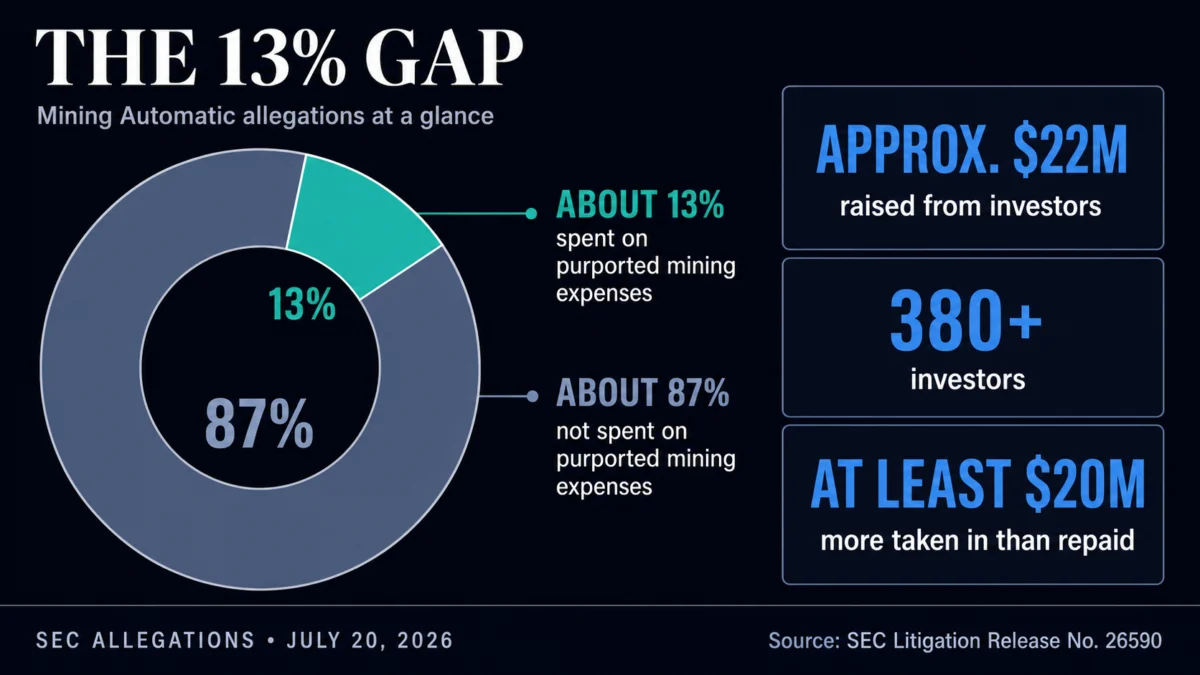
The United States Securities and Exchange Commission (SEC) has unveiled a significant enforcement action against a cryptocurrency mining operation that allegedly defrauded hundreds of investors through a sophisticated marketing campaign and promises of unrealistic financial returns. According to the federal complaint filed on July 20, 2026, Zan Shaikh and his company, Bright Vision Distribution LLC—operating under the trade name Mining Automatic—solicited approximately $22 million from more than 380 investors between June 2023 and May 2025. The core of the SEC’s allegation rests on the staggering discrepancy between the company’s stated purpose and its actual financial conduct: while investors believed their capital was funding high-yield Bitcoin mining hardware and operations, the SEC asserts that only 13 cents of every dollar invested were actually directed toward mining-related activities.
The remaining 87% of the funds were reportedly diverted into a variety of non-mining expenditures, including aggressive marketing campaigns designed to recruit new investors, the personal expenses of Zan Shaikh, and the operational costs of unrelated business ventures. This case highlights the persistent risks within the "cloud mining" and managed mining sectors, where the technical complexity of the underlying industry often provides a veil for fraudulent activity and capital misappropriation.
The Mechanics of the Alleged Scheme
The SEC complaint details a classic "guaranteed return" scheme, a hallmark of financial fraud that has become increasingly prevalent in the digital asset space. From the outset of the operation in mid-2023, Shaikh and Mining Automatic reportedly promised investors fixed monthly returns. These promises were made despite the inherent volatility of the Bitcoin mining industry, where profitability is dictated by fluctuating energy costs, hardware efficiency, and the "hash rate" or difficulty of the network.
According to the SEC, the Mining Automatic operation was never structured to generate the levels of profit necessary to fulfill its obligations to investors. Instead of scaling a legitimate mining infrastructure, the defendants allegedly prioritized the acquisition of new capital to pay out existing obligations—a structure that mirrors a Ponzi scheme. The regulator alleges that Shaikh and Mining Automatic took in at least $20 million more than they ever repaid to their pool of 380-plus investors.
The 13% allocation toward mining operations—amounting to roughly $2.86 million of the $22 million raised—was insufficient to sustain the hardware and electricity costs required to meet the promised benchmarks. The SEC’s investigation found that the vast majority of the capital was funneled into marketing efforts. These efforts were crucial for maintaining the illusion of a growing, successful enterprise and for ensuring a steady stream of new victim capital to cover the shortfall in actual mining revenue.
Chronology of the Investigation and Legal Filings
The timeline of the alleged fraud spans a two-year period, coinciding with a broader recovery in the cryptocurrency markets following the "crypto winter" of 2022.
- June 2023: Zan Shaikh and Bright Vision Distribution LLC (Mining Automatic) begin actively soliciting funds from retail investors, promising monthly payouts linked to Bitcoin mining rewards.
- 2024 – early 2025: The operation expands its marketing reach. The SEC alleges that during this period, the disparity between mining revenue and investor payouts widened significantly, leading to increased reliance on new investor funds.
- May 2025: The solicitation period identified in the SEC complaint concludes, as regulatory scrutiny likely began to intensify behind the scenes.
- July 20, 2026: The SEC officially files partially settled charges against Zan Shaikh and Bright Vision Distribution LLC.
- July 21, 2026: Details of the enforcement action are made public, revealing the extent of the fund misappropriation and the involvement of other federal agencies.
The legal proceedings have moved toward a partial settlement. Shaikh and Mining Automatic have agreed to proposed permanent injunctions, which are currently awaiting court approval. As part of this agreement, Shaikh has consented to an "officer-and-director bar," which effectively prohibits him from serving as an officer or director of any publicly traded company in the future. Furthermore, a conduct-based injunction has been established to prevent further violations of federal securities laws.

FBI Boston Division Broadens the Investigation
While the SEC’s case focuses specifically on the $22 million raised for Mining Automatic between 2023 and 2025, a parallel investigation by the Federal Bureau of Investigation (FBI) suggests the scope of the alleged misconduct may be even broader. The FBI’s Boston Division has launched a dedicated victim-information page, seeking contact from anyone who invested with Zan Shaikh or his associated entities.
The FBI’s questionnaire identifies several other companies allegedly affiliated with Shaikh and his associates, including:
- YT Automatic
- RankOne Ecommerce
- Replic8
The inclusion of "Ecommerce" and "YT" (commonly associated with YouTube automation) suggests that the defendants may have operated multiple schemes across different sectors, using similar "done-for-you" or "automated income" marketing tactics. The FBI indicates that the period of concern for these various entities extends back to 2022, a year earlier than the timeline specified in the SEC’s Mining Automatic complaint.
The FBI has clarified that its outreach is an information-gathering step. While victims may be eligible for restitution or services under federal law, the bureau has not yet provided a timeline for the recovery of funds. The outreach is designed to identify the full scale of the financial damage and to determine if additional charges are warranted regarding the other named entities.
Supporting Data and Financial Discrepancies
The financial data provided by the SEC paints a stark picture of a business model that was fundamentally disconnected from its purported industry. In a legitimate Bitcoin mining operation, capital expenditures (CAPEX) typically account for the majority of initial funding, as companies must purchase ASIC (Application-Specific Integrated Circuit) miners, secure high-voltage electrical infrastructure, and invest in cooling systems.
In the case of Mining Automatic, the allocation of only 13% to these critical areas made success virtually impossible. For context, industry standards for cloud mining or managed mining ventures usually require 60% to 80% of capital to be deployed directly into hardware and energy contracts to remain competitive. By diverting 87% of the $22 million elsewhere, the defendants ensured that the "mining" aspect of the business was little more than a marketing facade.
The $20 million gap between what was raised and what was repaid suggests a total loss of principal for the vast majority of the 380 investors. When marketing expenses and personal withdrawals are factored in, the remaining assets available for "disgorgement"—the legal process of returning ill-gotten gains—may be significantly lower than the total amount lost.
Official Responses and Regulatory Context
The SEC’s Division of Enforcement has characterized the case as a clear violation of the anti-fraud and registration provisions of the federal securities laws. By offering "guaranteed returns" on a managed investment, the SEC argues that Mining Automatic was selling unregistered securities.

"The defendants promised the ‘automatic’ profits of crypto mining while allegedly pocketing the lion’s share of investor funds for themselves," a spokesperson for the regulator noted in a summary of the litigation. "This enforcement action underscores our commitment to holding individuals accountable when they use the buzzwords of emerging technology to mask old-fashioned fraud."
Zan Shaikh and Bright Vision Distribution have not issued a public statement defending their actions, choosing instead to enter into the partial settlement. This settlement allows the court to determine the specific amounts for disgorgement, prejudgment interest, and civil penalties at a later date, following a formal motion by the SEC.
This case arrives during a period of heightened scrutiny by the SEC and the Department of Justice regarding "crypto-adjacent" scams. Regulators have expressed growing concern over the rise of "passive income" schemes that target retail investors through social media platforms, often promising to handle the technical complexities of mining or trading in exchange for upfront capital.
Broader Impact and Implications for Investors
The Mining Automatic case serves as a cautionary tale for the digital asset community. It highlights several "red flags" that are common in fraudulent investment schemes:
- Guaranteed Returns: In any market, but especially in the volatile world of crypto mining, "guaranteed" monthly returns are almost always a sign of fraud.
- Lack of Transparency: While the company used the name "Mining Automatic," investors seemingly had little visibility into the actual hardware being purchased or the locations of the data centers.
- High Marketing Spend: When a company spends more on soliciting new investors than on its core product or service, it often indicates a Ponzi-style structure.
For the 380 investors involved, the road to recovery is fraught with uncertainty. Even if the court orders Shaikh to pay tens of millions in disgorgement and penalties, the actual recovery of those funds depends on the existence of liquid assets. In many such cases, the money has already been spent on lifestyle expenses or lost in other failed business ventures.
The involvement of the FBI’s Boston Division suggests that the legal ramifications for Shaikh could eventually extend into the criminal realm, depending on the findings of the broader investigation into YT Automatic and RankOne Ecommerce. As the SEC moves for monetary relief in the coming months, the focus will shift to identifying any remaining assets that can be liquidated to provide even a partial recovery for the victims of the $22 million scheme.