admin
admin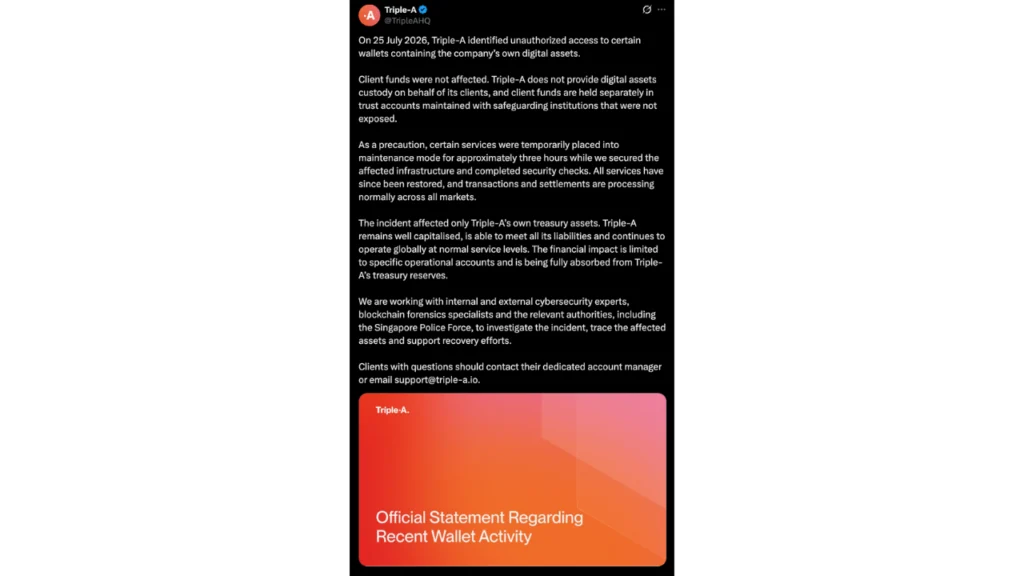
Singapore-based crypto payments firm Triple-A has publicly confirmed that it remains fully capitalized and capable of meeting all its liabilities, despite experiencing unauthorized access to wallets containing company-owned digital assets. The incident, which the firm identified on July 25, 2026, exclusively impacted its treasury wallets, emphatically sparing customer funds due to the company’s robust segregated custody model. While Triple-A has not disclosed the precise financial loss, blockchain security researchers, through diligent on-chain analysis, estimate that approximately $11.8 million in various digital assets was illicitly transferred. This event underscores both the persistent vulnerabilities within the digital asset landscape and the critical importance of stringent asset segregation for crypto enterprises.
Details of the Breach and Immediate Response
The unauthorized access was first detected within Triple A Technologies Pte. Ltd., the company’s Singaporean entity, on the morning of July 25, 2026. The firm promptly initiated its incident response protocols, which included engaging internal cybersecurity teams and external security specialists. According to an official statement released by Triple-A, the breach was meticulously contained to wallets holding its operational digital assets, specifically its treasury reserves. This swift containment ensured that the integrity of other business operations remained uncompromised.
Triple-A confirmed that the financial impact, although significant, was limited to these specific operational accounts. The company has stated unequivocally that it is fully absorbing this loss using its existing treasury reserves, reiterating its "well-capitalized" status and its continued ability to meet all financial obligations. This reassurance is crucial for its enterprise clients and the broader market, especially in an industry often sensitive to security breaches and their financial repercussions. For a brief period of approximately three hours, certain services were placed into maintenance mode as engineers worked to secure the affected infrastructure and verify the scope of the breach. Following this period, normal payment processing and settlement services have fully resumed across all markets served by Triple-A.
The Unaffected Client Assets: A Testament to Segregated Custody
A cornerstone of Triple-A’s immediate messaging and a critical factor in mitigating the broader impact of this incident is its segregated custody model. The company vehemently stressed that no customer funds were compromised during the breach. This protection stems from a fundamental operational principle: Triple-A does not custody client digital assets directly within its operational wallets. Instead, client funds are held separately in safeguarded trust accounts. These accounts are maintained with regulated financial institutions, operating under distinct security frameworks that were entirely isolated from the attack vector targeting Triple-A’s internal treasury.
This model stands as a stark contrast to past high-profile incidents within the cryptocurrency space, where the commingling of customer and operational funds led to catastrophic losses for users when platforms faced insolvency or security breaches. The ability of Triple-A to confidently assert the safety of customer assets reinforces the industry’s push towards clearer segregation practices, often mandated by regulators in mature crypto jurisdictions like Singapore. For a payment provider, the trust in handling client funds is paramount, and Triple-A’s architecture successfully upheld this trust even under duress.

On-Chain Forensics Pinpoint $11.8 Million Loss
While Triple-A opted not to disclose the exact financial value of the stolen assets, the transparency inherent in public blockchains allowed independent blockchain security researchers to quickly ascertain the scale of the theft. On-chain analyst ‘Specter’ was among the first to flag unusual fund movements originating from addresses linked to Triple-A. This initial identification was swiftly followed by a more comprehensive analysis from the renowned blockchain security firm PeckShield, which subsequently estimated the total losses at approximately $11.8 million.
The stolen assets, reportedly diverse in nature, were drained across multiple prominent blockchain networks, including Ethereum, TRON, Polygon, Arbitrum, Solana, and TON. This multi-chain nature of the theft suggests a sophisticated operation designed to maximize the variety of assets stolen and complicate tracing efforts. Researchers observed a common laundering pattern frequently employed in recent crypto exploits: the attackers swiftly swapped stablecoins and other highly liquid digital assets through various decentralized exchanges (DEXs). This step is crucial for obfuscating the origin of funds and converting less liquid or traceable assets into more fungible ones. Subsequently, these proceeds were bridged across different networks, ultimately being consolidated into a single wallet on the Ethereum blockchain, which currently holds an estimated 5,227 ETH. This consolidation is a typical step for attackers aiming to simplify management and potentially prepare for further laundering via mixers or other privacy-enhancing services, although the immediate destination of these consolidated funds remains under close scrutiny. The precision and speed with which these on-chain investigators were able to trace and quantify the stolen funds underscore the invaluable role of blockchain analytics in the post-incident response of digital asset security.
Ongoing Investigation and Collaborative Efforts
Triple-A has mobilized extensive resources for the ongoing investigation into the breach. The company is collaborating closely with its internal cybersecurity teams, leveraging their expertise in digital forensics and incident response. This internal effort is augmented by the engagement of external security specialists, who bring independent perspectives and specialized tools to analyze the attack vector and potential vulnerabilities. Furthermore, leading blockchain forensic experts have been enlisted to meticulously trace the flow of the stolen assets across various chains, aiming to identify potential points of recovery or identify associated entities.
Crucially, the Singapore Police Force has also been brought into the investigation. The involvement of law enforcement signals the serious nature of the incident and the potential for criminal prosecution. The Singapore Police Force, known for its advanced cybercrime units, will likely focus on identifying the perpetrators, leveraging both digital and traditional investigative methods. The challenges in recovering stolen crypto assets are well-documented, often requiring international cooperation, rapid freezing orders, and the ability to navigate the pseudonymous nature of blockchain transactions. As of now, Triple-A has not publicly disclosed the specific attack vector that allowed unauthorized access, the precise number of compromised wallets, or whether any of the stolen funds have been successfully recovered. These details are often withheld during active investigations to avoid compromising ongoing efforts to apprehend the culprits and recover assets.
Broader Implications for Stablecoin Payment Providers and the Industry
This security incident at Triple-A carries significant broader implications, particularly for stablecoin payment providers and the wider digital asset ecosystem. It serves as a stark reminder of the persistent and evolving cyber threats faced by entities operating with digital assets, regardless of their regulatory standing.

1. Reinforcing Segregated Custody as Best Practice: The incident unequivocally highlights the paramount importance of segregating customer assets from operational treasury funds. Triple-A’s robust custody structure, which prevented the compromise of its treasury wallets from cascading into a client-loss event, stands as a practical demonstration of how effective fund segregation can dramatically limit the impact of security incidents. This principle, often enshrined in traditional finance, is increasingly critical in the volatile crypto space. For regulators, this incident could serve as further evidence supporting the mandating of strict asset segregation for all licensed crypto service providers.
2. Scrutiny on Treasury Wallet Security: While licensing and regulation often focus heavily on safeguarding customer funds, this breach raises crucial questions about the security protocols surrounding a company’s own operational assets. Treasury wallets, by their nature, often hold significant capital required for daily operations, liquidity provisioning, and strategic investments. These funds are prime targets for sophisticated attackers. The incident prompts a deeper evaluation of treasury management practices within regulated crypto payment providers, including the implementation of multi-signature schemes, cold storage solutions for larger reserves, granular access controls, and regular security audits of all internal wallet infrastructure.
3. Evolving Threat Landscape: The method of attack, involving draining assets across multiple networks and consolidating them through DEXs and bridges, reflects the increasing sophistication of cybercriminals in the Web3 space. Attackers are adept at exploiting the interoperability of various blockchain ecosystems to launder funds, making tracing and recovery efforts more complex and resource-intensive. This necessitates continuous innovation in security measures, including real-time threat detection, advanced behavioral analytics, and enhanced blockchain forensics capabilities.
4. Due Diligence for Enterprise Customers: For enterprise customers who rely on stablecoin payment infrastructure for their business operations, the Triple-A incident reinforces the need for comprehensive due diligence. Beyond merely evaluating a provider’s regulatory status, businesses must delve into their prospective partners’ wallet security architecture, treasury management policies, incident response plans, and overall reserve strength. Questions regarding insurance coverage for corporate assets, frequency of security audits, and the transparency of past security incidents will become increasingly relevant. The stability and security of the underlying payment rails are critical for businesses adopting crypto payments.
5. Regulatory Frameworks and Operational Resilience: The incident will likely inform ongoing discussions around regulatory frameworks for digital asset service providers. While Singapore has a progressive stance on crypto regulation, events like these underscore that licensing helps establish safeguards around customer funds but does not eliminate all cyber risks targeting a company’s operational assets. Regulators might consider incorporating more prescriptive requirements for internal security postures, risk management frameworks, and incident reporting for all aspects of a crypto firm’s operations, not just client-facing services. This emphasis on operational resilience is vital for maintaining trust and stability within the nascent digital finance sector.
As the investigation progresses, the digital asset industry will be closely observing for further disclosures from Triple-A regarding the precise attack vector, any vulnerabilities exploited, and the effectiveness of their recovery efforts. The lessons learned from this incident will undoubtedly contribute to the ongoing evolution of best practices in cybersecurity and treasury management within the rapidly expanding realm of cryptocurrency payments.