Dwi Wanna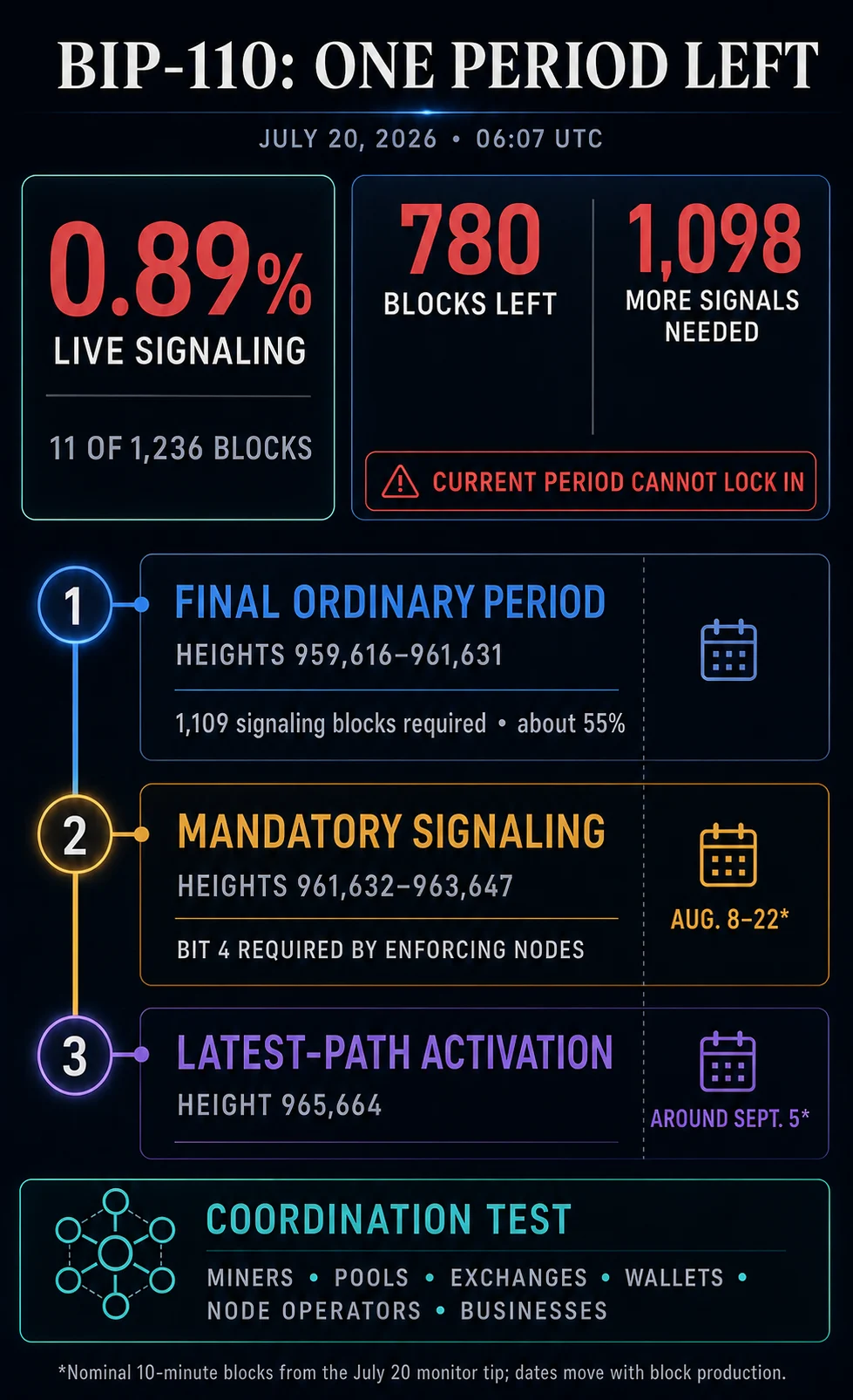
BIP-110 represents one of the most significant and debated technical proposals in recent Bitcoin history. It suggests a one-year soft fork designed to temporarily restrict certain types of arbitrary-data and script uses at the consensus level. Proponents of the measure argue that the proliferation of non-financial data on the blockchain—often associated with inscriptions and complex scripts—threatens to exhaust node resources and increase the costs of maintaining the network’s decentralized nature. However, critics, now joined by one of Bitcoin’s most prominent institutional advocates, warn that the proposal could set a dangerous precedent by invalidating transactions that are currently considered valid under Bitcoin’s established rules.
The Core of the BIP-110 Dispute
At its heart, BIP-110 is a response to the "data bloat" debate that has intensified over the past eighteen months. The proposal seeks to implement a consensus-level restriction for a duration of 52,416 blocks, which equates to approximately one year of network activity. This restriction would target specific uses of the OP_RETURN opcode and other methods used to embed arbitrary data directly into the Bitcoin ledger.
Supporters of the proposal emphasize the importance of protecting the "pruning" capabilities of nodes and ensuring that the cost of running a full node remains within reach of the average user. They argue that if the blockchain becomes a general-purpose data storage layer, the increasing hardware requirements will lead to centralization, as only well-funded entities will be able to verify the chain.
Conversely, the opposition, led by figures like Michael Saylor and various protocol developers, argues that Bitcoin’s strength lies in its neutrality. Saylor’s 110-point case emphasizes that the Bitcoin base layer should remain a neutral platform for permissionless innovation. He has characterized the proposed restrictions as a "cure more dangerous than the condition," suggesting that tampering with consensus rules to exclude fee-paying transactions undermines the fundamental economic incentives that secure the network.
Saylor’s Institutional Intervention
Michael Saylor’s involvement has shifted the gravity of the discussion from a purely technical dispute among developers to a broader conversation about Bitcoin’s economic properties. As the leader of the world’s largest corporate holder of Bitcoin, Saylor’s perspective carries significant weight among institutional investors and exchange operators.
In his detailed critique, Saylor outlined several key concerns:
- Consensus Stability: The risk of invalidating transactions that are currently valid under Bitcoin’s rules.
- Market Neutrality: The importance of an open market where any user can pay a fee to have their transaction included in a block.
- Precedent Setting: The fear that once "arbitrary data" is restricted, further restrictions on other types of transactions could follow, leading to a slippery slope of censorship.
- Chain Split Risks: The technical danger of a "forced signaling" path leading to a permanent fork in the network history.
While Saylor holds no formal authority over the Bitcoin protocol—which is governed by decentralized consensus among miners, node operators, and users—his stance provides a signal to other institutional actors who may be hesitant to support a proposal that introduces consensus-level uncertainty.

Technical Analysis of the Signaling Periods
The activation path for BIP-110 follows a structured timeline that includes several difficulty periods, each consisting of 2,016 blocks. For the proposal to lock in through the "ordinary" path, it requires a 55% signaling threshold, or 1,109 blocks within a single period.
As of July 20, 2026, the monitoring data shows a stark lack of support among mining pools. With only 11 signaling blocks recorded out of 1,236 tracked in the current window, the 55% threshold is now mathematically impossible to achieve. Even if every single remaining block in the current period were to signal support, the total would only reach 791, far short of the 1,109 required.
This failure shifts the focus to the next difficulty period, spanning block heights 959,616 through 961,631. This upcoming window represents the final opportunity for the network to reach a consensus through the standard signaling process. If this period also fails to meet the 55% threshold, the protocol enters a "mandatory signaling" phase.
The Mandatory Signaling and Enforcement Timeline
If the ordinary lock-in fails, the BIP-110 code includes a mechanism that requires enforcing nodes to demand "bit 4" signaling from miners. This phase is scheduled to occur between block heights 961,632 and 963,647. During this window, nodes running the BIP-110 enforcement software will actively reject any blocks that do not include the required signal.
Based on current block production rates, the timeline for these events is estimated as follows:
- Final Ordinary Signaling Period: July 25 – August 7, 2026.
- Mandatory Signaling Window: August 8 – August 22, 2026.
- Forced Lock-in Height: 963,648 (Estimated August 23).
- Latest-Path Activation: 965,664 (Estimated September 5).
The mandatory signaling phase is the point of highest risk for a chain split. If a significant portion of the mining hash rate continues to produce blocks without the bit 4 signal, and a significant portion of node operators (including exchanges and payment processors) begin enforcing the rejection of those blocks, the Bitcoin network will split into two incompatible versions of the blockchain.
Potential for a Chain Split and Economic Consequences
A chain split represents a "worst-case scenario" for Bitcoin’s short-term stability and market value. In such an event, two versions of Bitcoin would exist: one that follows the original rules and allows arbitrary data, and one that enforces the BIP-110 restrictions.
For businesses and exchanges, this creates an operational nightmare. They would be forced to decide which chain to recognize as "Bitcoin." Deposits and withdrawals would become risky, as a transaction on one chain might not exist on the other, or might be subject to "replay attacks" where a transaction is valid on both chains but intended for only one.

Mining pools also face a strategic dilemma. If they signal for BIP-110 without genuine intent to enforce it, they are merely delaying the conflict. If they refuse to signal, they risk having their blocks rejected by enforcing nodes, leading to lost revenue and wasted electricity. The current 0.89% signaling rate suggests that the vast majority of miners are currently choosing a "wait and see" approach, or are outright opposed to the restrictions.
Historical Context: Lessons from the Blocksize War
The current tension surrounding BIP-110 draws frequent comparisons to the "Blocksize War" of 2017, which culminated in the activation of Segregated Witness (SegWit) and the creation of Bitcoin Cash. That conflict was similarly centered on how Bitcoin should scale and what types of data should be prioritized on the blockchain.
However, BIP-110 is unique in that it is a temporary restriction. Proponents argue this "cooling-off period" is necessary to assess the long-term impact of inscriptions on the network. Critics argue that even a temporary restriction is a violation of the social contract that Bitcoin is a permissionless, immutable ledger. The use of a mandatory signaling path (similar to the User Activated Soft Fork or UASF movement of 2017) shows that the proponents are willing to use aggressive technical maneuvers to achieve their goals, even in the absence of overwhelming miner support.
Market Reaction and Broader Implications
Despite the technical uncertainty, the Bitcoin market has remained relatively stable. As of the latest data, Bitcoin is trading at approximately $65,000, with a market capitalization of $1.3 trillion. Bitcoin dominance remains high at 58.69%, indicating that the internal dispute has not yet led to a significant flight to alternative assets.
However, analysts suggest that as the August 8 deadline for mandatory signaling approaches, market volatility could increase. Institutional holders, who have largely entered the space through spot ETFs and corporate balance sheets, generally favor stability and clear consensus. A prolonged dispute or a messy chain split could dampen institutional appetite and lead to a re-evaluation of Bitcoin’s "digital gold" narrative.
The outcome of the BIP-110 fight will likely define the governance of Bitcoin for years to come. If the proposal fails due to lack of support, it will reaffirm the difficulty of changing Bitcoin’s consensus rules without near-unanimous agreement. If it succeeds through forced signaling, it will demonstrate that a dedicated minority of node operators can successfully push through changes, even over the objections of miners and major institutional holders.
Conclusion and Path Forward
As the Bitcoin network approaches block height 959,616, the window for a peaceful, ordinary resolution is closing. The intervention of Michael Saylor has galvanized the opposition, providing a powerful counter-narrative to the "resource protection" arguments of BIP-110 supporters.
The next three weeks will be decisive. Mining pools must decide whether to provide the 55% signaling support to avoid the mandatory signaling phase, or to hold their ground and risk a confrontation with enforcing nodes in August. Wallet developers, exchanges, and node operators are currently in the process of reviewing their readiness plans, as the possibility of a chain split moves from a theoretical risk to a looming technical reality. Regardless of the outcome, the BIP-110 debate has once again highlighted the complex and often contentious nature of decentralized governance in the world’s largest cryptocurrency.