admin
admin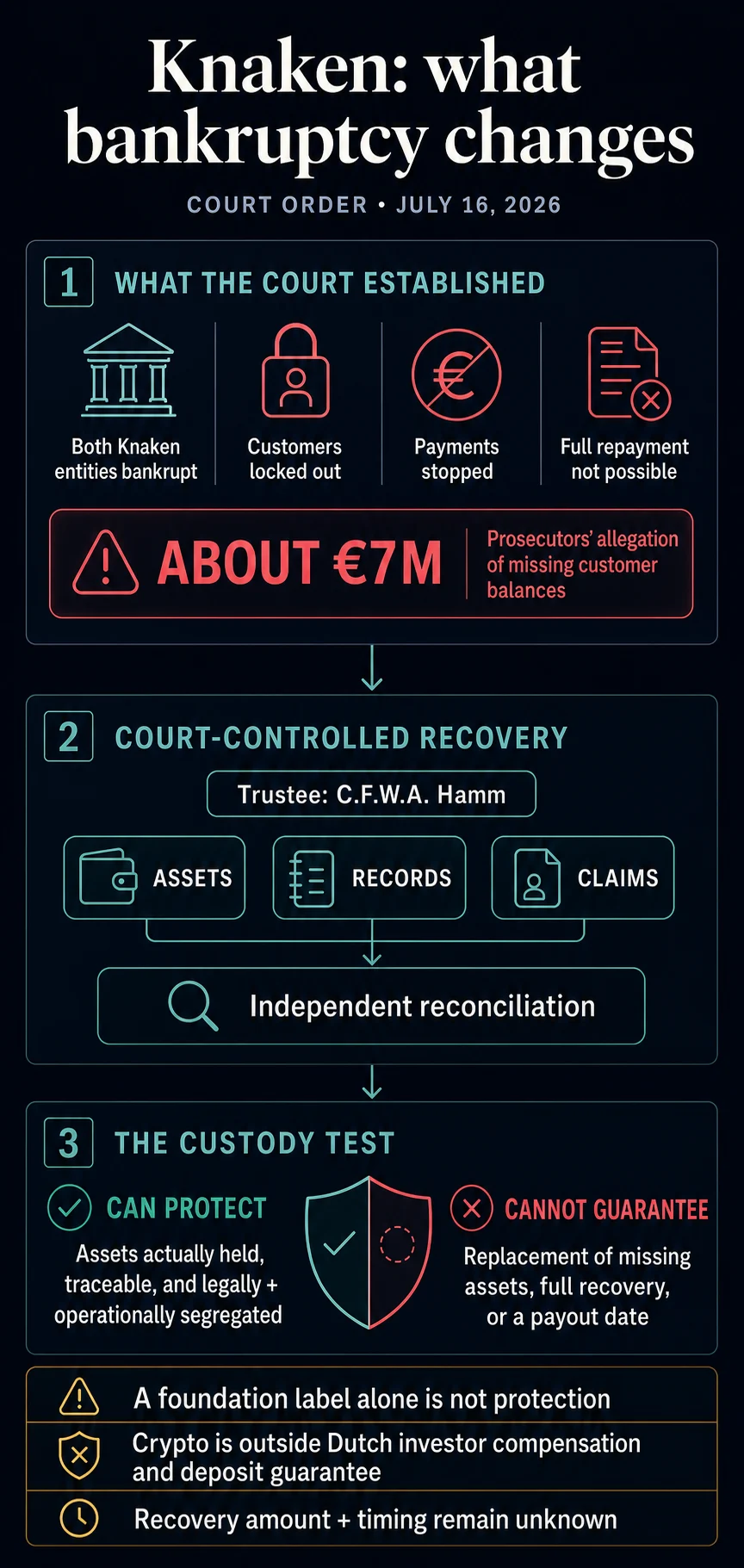
The Dutch cryptocurrency exchange Knaken, operating through its entity Knaken Cryptohandel B.V., and its affiliated payments foundation, Stichting Knaken Payments, have been declared bankrupt by the Rotterdam District Court. The pivotal decision, rendered on July 16, 2026, followed compelling evidence presented by the court that the exchange was demonstrably incapable of fully repaying its customer base. This development marks a significant blow to users who found themselves locked out of their accounts, with payment services grinding to a halt, and a substantial, undisclosed coverage deficit emerging as the core of the crisis.
The Dutch Public Prosecution Service (OM) brought the gravity of the situation to light, informing the court that approximately €7 million in customer balances had vanished. This revelation was instrumental in the court’s decision to place both Knaken Cryptohandel B.V. and Stichting Knaken Payments under court-controlled bankruptcy, stripping management of their authority and placing the wind-down process under the stewardship of an appointed trustee, C.F.W.A. Hamm. The court’s intervention effectively supplanted Knaken’s own proposed payout plan, opting instead for a stringent, externally managed liquidation process.
A Rejection of Knaken’s Defense and the Ascent of Court Control
Knaken’s management had attempted to argue against the necessity of bankruptcy proceedings, asserting that measures such as criminal asset seizures, the service shutdown, and their existing custody structure were sufficient to safeguard customer interests. They proposed an independent verification process followed by a self-administered distribution protocol. However, the court found these arguments insufficient and rejected this proposed path, opting instead for the appointment of an impartial external trustee to oversee the liquidation.
The initiation of the public-interest petition by the Dutch Public Prosecution Service followed an unusual trajectory. Prosecutors intervened directly after customers were left in an untenable position, unable to access their funds or ascertain their financial standing due to blocked accounts and a lack of transparent disclosure. The inability of customers to file meaningful bankruptcy petitions themselves necessitated the court’s direct intervention, providing a formal process that operates independently of the exchange’s internal records and its proposed, ultimately rejected, payout system.
Under Dutch law, a court-appointed bankruptcy trustee operates as a representative of the collective body of creditors, under the supervision of a designated judge. Their mandate is extensive, encompassing the meticulous inventory of all assets and claims, a thorough examination of company records to identify potential irregularities, the protection and subsequent liquidation of the estate, and the formulation of distribution proposals that adhere strictly to established claim priorities, as detailed in Dutch judiciary guidance and the overarching Bankruptcy Act.
For Knaken, this broad mandate translates into the complex task of reconciling platform ledgers with the contents of digital wallets, access controls, bank accounts, and other property held by both the operating company and the affiliated foundation. The trustee’s role is to definitively establish which entity is liable to each customer and to determine whether assets purported to be customer property were, in reality, held independently of the exchange’s own corporate estate. While the appointment of a trustee provides a crucial layer of independent verification, it does not inherently resolve the existing deficit nor pre-determine the percentage of recovery for customers.
The Shadow of Criminal Investigation and Custody Concerns
Adding another layer of complexity to the situation, the Fiscal Intelligence and Investigation Service (FIOD), the Dutch financial crime unit, had been conducting a parallel investigation into possible criminal conduct. Searches were carried out on June 29, 2026, according to statements from the Public Prosecution Service. During these searches, investigators seized digital data carriers and company assets. As of June 30, 2026, no arrests had been made in connection with these investigations. It is important to note that the civil petition for bankruptcy and the criminal investigation are being handled by separate teams. Neither the investigation nor the asset seizures constitute a finding of guilt. The legal treatment of seized property and its coordination with the bankruptcy estates remain open questions to be clarified through these distinct but interconnected legal processes.
The Critical Role of Custody in Customer Recovery
The bankruptcy of Stichting Knaken Payments places the exchange’s custody structure at the forefront of customer recovery efforts. While the establishment of a separate foundation is intended to create a legal separation between the operating company and client property, its effectiveness hinges entirely on whether sufficient assets were held, accurately recorded, and were indeed available for return at the time of the platform’s collapse.
The Dutch Authority for the Financial Markets (AFM) has previously highlighted that Dutch law does not provide for an automatic statutory segregation regime for custodied crypto assets, unlike the robust protections afforded to securities held by traditional financial institutions. Consequently, crypto providers in the Netherlands often opt for the creation of a separate entity, typically a foundation, to establish a legal firewall between their operations and client assets.
However, effective protection is contingent upon a multitude of factors. The provider must not only hold client crypto and funds but also maintain scrupulously accurate position records. Crucially, separate client and proprietary wallets must be utilized, alongside appropriate recovery-key controls. The foundation’s activities must be strictly confined to the safeguarding of client custody interests, and a functional and accessible return procedure must be in place.

To date, neither the court nor the prosecution has provided definitive details regarding the nature or location of any remaining Knaken assets. The extent to which the platform’s internal ledgers align with the foundation’s records, or whether customer balances were truly segregated both legally and operationally, remains unclear. With both entities now in bankruptcy, the trustee’s immediate priority is to establish these fundamental facts before any account entry can be definitively linked to identifiable property or a recognized claim.
Adding to the regulatory scrutiny, prosecutors indicated that Knaken had not secured the necessary authorization from the AFM. The Markets in Crypto-Assets Regulation (MiCA), the European Union’s comprehensive framework for crypto-asset markets, now serves as the benchmark for the safeguards expected of an authorized custody provider.
MiCA Article 70 mandates that authorized providers holding client crypto assets or the means to access them must rigorously safeguard client ownership rights, particularly in scenarios involving insolvency. Subject to specific institutional exceptions, eligible client funds are generally required to be deposited in a separately identifiable account at a credit institution or central bank by the following business day.
Furthermore, MiCA Article 75 imposes stringent requirements on custody providers. These include maintaining detailed per-client position records, adhering to a defined custody policy, and implementing robust return procedures. Critically, client holdings must be maintained in a state of legal and operational separation from the provider’s own holdings. This ensures that properly custodied crypto assets remain beyond the reach of the provider’s creditors in the event of insolvency. The regulation’s official text emphasizes preventive custody controls rather than mechanisms designed to replace assets that have already disappeared.
In the lead-up to the full implementation of MiCA, the European Securities and Markets Authority (ESMA) issued a public statement in June 2026, advising unauthorized providers to cease onboarding new clients, restrict remaining activities to an orderly exit, and diligently safeguard client interests. They were also required to provide clear explanations regarding the handling of customer assets.
The operational risks associated with this transition have been observed elsewhere in the market. Recent reports have detailed instances, such as AscendEX’s withdrawal warnings following its own MiCA compliance challenges, where some customer withdrawals might not be processed. Knaken’s situation, however, is distinct and legally more advanced due to the court’s formal finding of a coverage deficit and the subsequent imposition of court-controlled bankruptcy.
In the Netherlands, De Nederlandsche Bank (DNB) has clarified that crypto-assets and crypto service providers fall outside the scope of the Dutch investor compensation scheme. Similarly, its deposit-guarantee guidance explicitly excludes cryptocurrencies like Bitcoin. Any potential treatment of fiat currency held by Knaken in bank accounts would be entirely dependent on the established ownership and structure of those accounts, which, as of now, have not been definitively determined.
The Path Forward: Reconciling Balances with Reality
The immediate and most critical indicator for affected customers will be the production of a reconciled inventory. This inventory must meticulously detail all controllable or recoverable crypto assets, fiat currency, and any other property, cross-referenced against the official records of both Knaken Cryptohandel B.V. and Stichting Knaken Payments. A customer’s displayed balance on the platform serves as evidence of the exchange’s acknowledged liability, but actual recovery is contingent upon the successful identification and legal linkage of corresponding tangible property.
It is plausible that the foundation may have held some assets on behalf of customers, while the operating company might bear other forms of liability. The bankruptcy process must meticulously determine whether identifiable client property exists outside the general pool of creditors’ claims. It must also ascertain whether any shortfalls translate into claims against either of the bankrupt estates and, crucially, how these accepted claims will be prioritized under the framework of Dutch insolvency law.
The assets and information seized by investigators may hold significant relevance to the bankruptcy estate. However, the court’s announcement does not specify the nature of these seizures, their ownership, or their eventual legal treatment. Effective coordination between the bankruptcy trustee and criminal authorities will be paramount in determining the availability of evidence and assets for the bankruptcy proceedings, without, however, transforming the insolvency case into a judgment on criminal liability.
Only after these intricate questions are thoroughly addressed can the trustee formulate a defensible estimate of the potential recovery for customers and the timeline for any distributions. For users who have been locked out of their accounts, the imposition of court control offers an independent mechanism to distinguish between a simple account balance and actual, traceable property that can be legally returned. This process replaces Knaken’s defunct proposed payout scheme with a rigorously supervised accounting and a structured collective claims procedure. The outcome will ultimately depend on the trustee’s ability to untangle the complex web of assets and liabilities and to navigate the legal intricacies of Dutch bankruptcy law.