admin
admin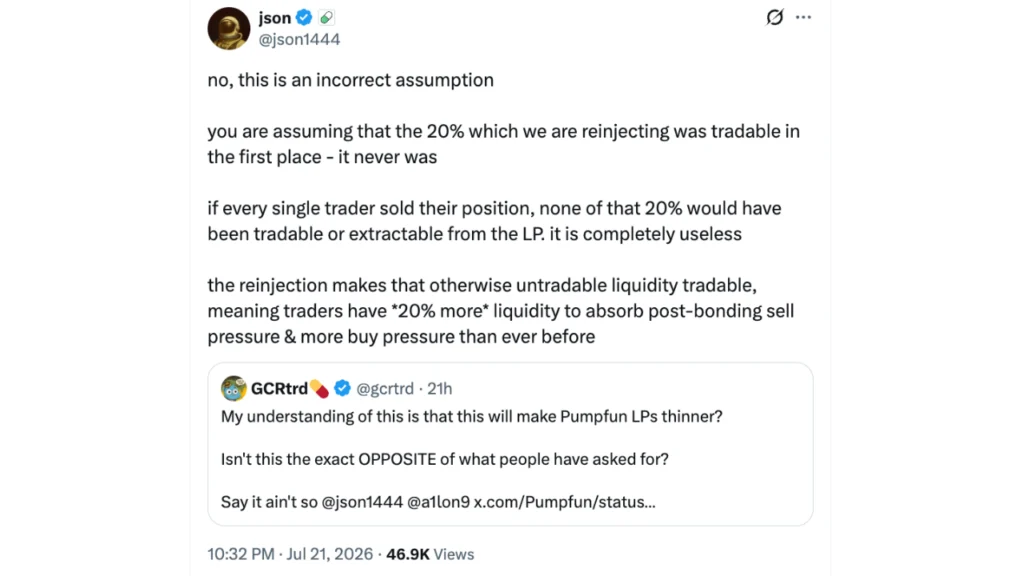
Pump.fun, a prominent Solana-based platform for launching memecoins, has introduced a groundbreaking new mechanism dubbed "BOOST mode." Rolled out as the default launch protocol for eligible tokens on July 21, this innovative feature is designed to automatically convert previously inaccessible "dead liquidity" into token buybacks and subsequent burns. The strategic move aims to fortify the post-migration stability and capital efficiency of newly launched memecoins, a sector often characterized by extreme volatility and rapid value fluctuations. This initiative represents a significant evolution in the token launch paradigm, directly addressing a critical issue that has historically seen vast sums of capital become permanently locked and unproductive within the decentralized finance (DeFi) ecosystem.
Understanding the Challenge: The Enigma of Dead Liquidity
The core impetus behind BOOST mode stems from a persistent problem identified within Pump.fun’s previous token migration model: the accumulation of "dead liquidity." Under the platform’s traditional system, after a memecoin successfully completed its initial bonding curve phase and migrated to a decentralized exchange (DEX) like PumpSwap, a portion of the liquidity provided – estimated by Pump.fun to be approximately 20% of the migration liquidity – would become permanently locked within the newly created liquidity pool. While the fundamental purpose of liquidity pools is to facilitate seamless trading by ensuring assets are available for exchange, this specific fraction of capital, whether in SOL or USDC, became irrecoverable. It could not be withdrawn by any participant, nor could it be redeployed, even if every single token holder decided to sell their entire position.
Pump.fun’s internal analysis reveals the sheer scale of this inefficiency, estimating that over $100 million worth of liquidity annually becomes permanently stranded across all migrated tokens on its platform. This capital, though technically present within liquidity pools, effectively sits idle, contributing nothing further to market activity, capital generation, or ecosystem growth. In a high-speed, capital-intensive environment like the memecoin market, such a substantial amount of immobilized funds represents a significant opportunity cost and a drag on overall market efficiency. The existence of this dead liquidity has long been a quiet challenge for launchpads, impacting both the perceived value of liquidity pools and the overall capital optimization within the nascent memecoin sector.
BOOST Mode: A Paradigm Shift in Post-Migration Economics
BOOST mode directly tackles the problem of dead liquidity by re-engineering the post-migration process. Instead of allowing these dormant funds to remain perpetually locked, the new mechanism diverts them into an active market strategy. For every eligible token migration, the protocol now automatically redirects a specific amount of this previously trapped capital. Specifically, approximately 17.6 SOL for tokens trading against SOL pairs, or around $2,516 for USDC pairs, is repurposed.

This redirected capital is not simply dumped into the market in a single, potentially disruptive transaction. Instead, Pump.fun employs a Time-Weighted Average Price (TWAP) strategy. This sophisticated execution method spreads the buy orders over the first five minutes immediately following the token’s migration. By distributing purchases across a short time window, the TWAP strategy helps to minimize the market impact of these orders, preventing sudden price spikes or manipulation that a single large buy order might cause.
The tokens acquired through these automated purchases are then immediately and permanently burned. This dual-action process—buying back tokens and then removing them from circulation—achieves several critical objectives simultaneously. Firstly, the buy orders create temporary buying pressure, offering crucial price support during the often-volatile initial minutes post-migration when early investors might be taking profits. Secondly, the subsequent burning of these tokens permanently reduces the circulating supply, which, in economic theory, can contribute to increased scarcity and potential long-term value appreciation, assuming consistent demand. Crucially, this entire process is achieved without introducing any new liquidity from external sources or requiring additional funding, purely by recycling capital that was previously considered lost.
A Chronology of Implementation and Eligibility
The official rollout of BOOST mode commenced on July 21, at which point it became the default migration mechanism for all new, eligible tokens launched on Pump.fun. The platform emphasizes that this integration is seamless for both creators and traders. Token creators do not need to manually activate the feature; it is automatically applied to their projects upon successful migration. Similarly, traders continue to interact with the same bonding curve and PumpSwap infrastructure, experiencing no change in their user journey.
It is important to note the specific eligibility criteria for BOOST mode. The mechanism is exclusively applied to tokens launched after the July 21 activation time. Projects that completed their migration prior to this date, therefore, are not retroactively subject to BOOST mode. Additionally, tokens launched through Pump.fun’s "Mayhem" system, an alternative launch pathway, are also excluded from this new mechanism, indicating a focused application to the platform’s primary bonding curve launch model. This phased rollout ensures a clear demarcation between the old and new systems, allowing for focused data collection on the performance of BOOST-enabled tokens.
Official Perspectives and the Vision for Capital Efficiency
Alon, the founder of Pump.fun, has been vocal about the transformative potential of BOOST mode. He highlighted that the new system enhances liquidity efficiency by approximately 20% while maintaining the platform’s established and user-friendly trading experience. Alon articulated a vision where the recycling of this "dead liquidity" could gradually channel hundreds of millions of dollars back into newly launched memecoins, diverting capital from being permanently locked into becoming an active force in market dynamics. This perspective underscores a commitment to optimizing the underlying mechanics of memecoin launches, moving beyond mere speculative hype to foster more robust foundational economics.

Json, Pump.fun’s Head of Content, further clarified the common misconceptions surrounding "dead liquidity." He emphasized that these locked assets were never genuinely usable trading liquidity because they could not be accessed, withdrawn, or reallocated under any circumstances. Therefore, BOOST mode does not "remove" active liquidity from the market but rather "transforms" previously inaccessible capital into tangible buy orders. This transformation, followed by the permanent burning of acquired tokens, fundamentally alters the nature of these dormant funds, giving them a purpose and an impact they previously lacked. This distinction is crucial for understanding the true value proposition of BOOST mode, reframing it as an efficiency gain rather than a direct liquidity reduction.
Community Reception and Market Debates
The introduction of BOOST mode has ignited a lively debate across the broader crypto community, eliciting a spectrum of reactions from enthusiastic support to cautious skepticism. Proponents of the feature laud it as a sophisticated and efficient approach to capital utilization. They view the automated buybacks and burns as a much-needed structural improvement that could lend greater stability to the notoriously volatile post-migration phase of memecoin launches. The argument is that any mechanism that can reduce capital waste and provide even temporary buying pressure is a net positive for the ecosystem.
However, critics have raised pertinent questions regarding the potential magnitude of BOOST mode’s impact. Some traders contend that redirecting approximately 17.6 SOL (or $2,516 USDC) into buybacks might not be substantial enough to meaningfully influence the price trajectory of tokens that have already achieved market capitalizations of $30,000 or more during their bonding curve phase. They suggest that while the principle is sound, the quantum of capital recycled might be too small to counteract significant selling pressure from early investors or market-wide downturns.
Another point of contention among some observers is the idea that, even if permanently locked, the "dead liquidity" still contributed to the reported size of liquidity pools, which could influence investor perception. Pump.fun executives, including Json, have actively challenged this assessment, reiterating that assets that cannot be accessed or traded are not, by definition, "usable" liquidity. The platform argues that its approach does not diminish actual trading liquidity but rather reallocates and repurposes otherwise inert capital into active market demand. This philosophical divergence highlights differing interpretations of what constitutes "effective" liquidity in the context of decentralized exchanges.
Broader Market Implications and Strategic Positioning
BOOST mode represents one of Pump.fun’s most significant infrastructure updates in recent memory, focusing squarely on enhancing capital efficiency within its ecosystem. By concentrating on how existing capital is utilized rather than introducing new incentives or external liquidity, the protocol sets itself apart. This strategic pivot could have several profound implications for the memecoin launch landscape.

Firstly, it could bolster Pump.fun’s competitive edge. In a crowded market of launchpads, offering a mechanism that demonstrably improves post-launch token economics and reduces capital waste could attract more creators and investors. If BOOST mode proves effective in mitigating the sharp sell-offs often witnessed immediately after migration – a period of heightened volatility when many early investors tend to take profits – it could position Pump.fun as a more reliable and structurally sound platform for memecoin innovation.
Secondly, the initiative could inspire similar mechanisms across the broader Solana ecosystem and potentially other blockchain networks. As the DeFi space matures, there’s a growing emphasis on sustainability, capital efficiency, and robust token economics. Pump.fun’s experiment with recycling dead liquidity offers a novel template that other platforms might seek to emulate or adapt, potentially leading to a more sophisticated approach to token launches beyond just initial fundraising.
Thirdly, from an investor’s perspective, a more stable post-migration environment, even if marginally, could foster greater confidence. Reducing the immediate post-launch crash potential could make memecoin investments on Pump.fun appear less risky, at least in the critical initial minutes. This isn’t to say memecoins will lose their inherent volatility, but rather that a foundational structural improvement could smooth out some of the most abrupt and predictable downturns.
Future Outlook and the PUMP Token’s Response
The ultimate success and impact of BOOST mode will hinge on its real-world performance over the coming weeks and months. While automatic buybacks and token burns offer theoretical benefits, the question remains whether the five-minute buying program is sufficient to counter sustained selling pressure. Market participants will be closely observing whether BOOST-enabled tokens exhibit demonstrably different price action and stability compared to their predecessors.
Following the announcement and activation of BOOST mode, PUMP, Pump.fun’s native token, traded largely unchanged. This muted reaction suggests that investors are adopting a wait-and-see approach, preferring to evaluate tangible data and observe the consistent performance of newly launched memecoins before fully pricing in the potential benefits of the new mechanism. The market’s cautious optimism reflects the inherent skepticism often found in the crypto space, where innovative features need to prove their efficacy over time.
In conclusion, BOOST mode represents an ambitious experiment in post-migration token economics. By transforming previously unusable capital into active market demand and permanent supply reduction, Pump.fun is attempting to inject a new layer of structural integrity into the often-chaotic world of memecoin launches. If successful, it could not only redefine capital efficiency within its own ecosystem but also set a new standard for how decentralized launchpads manage and optimize liquidity in the volatile yet vibrant realm of digital assets. The crypto community eagerly awaits the empirical data that will determine whether BOOST mode can consistently deliver on its promise to strengthen newly migrated tokens and recycle hundreds of millions in stranded capital.