Dwi Wanna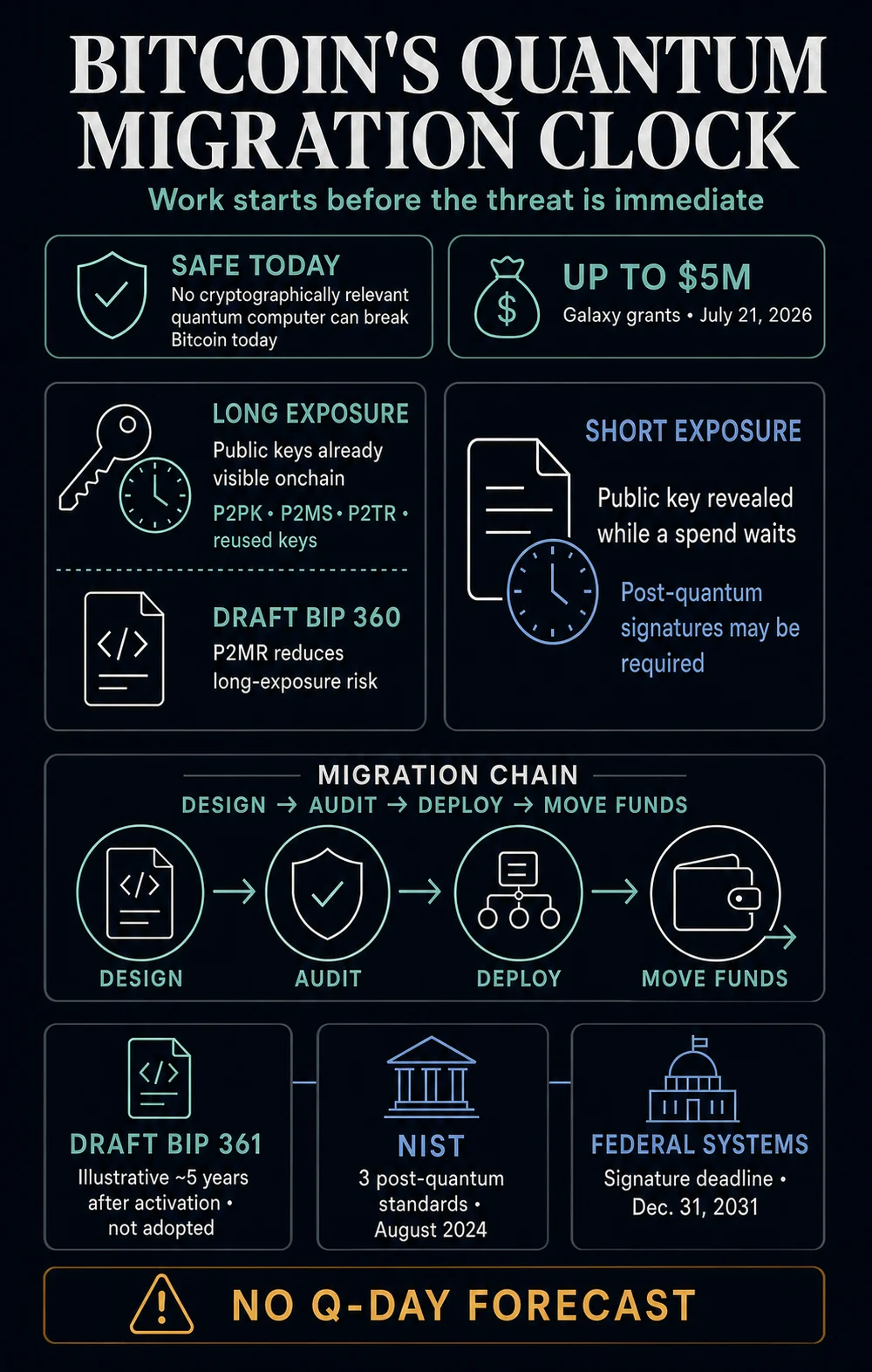
Galaxy Digital, a leading diversified financial services and investment management firm in the digital asset sector, officially pledged up to $5 million on July 21, 2026, to fortify Bitcoin’s infrastructure against the burgeoning threat of quantum computing. This strategic initiative, designed to accelerate the development of quantum-resistant protocols, marks one of the most significant private sector investments in the long-term cryptographic security of the Bitcoin network. The program is structured to provide financial backing to developers as they reach critical technical milestones, while simultaneously funding a new Quantum Advisory Council and specialized research workstreams.
While current quantum computers lack the processing power to compromise Bitcoin’s existing signature security, the initiative reflects a growing consensus among cryptographers and institutional stakeholders that the window for a proactive defense is narrowing. The transition to post-quantum cryptography (PQC) is not merely a software update; it is a fundamental architectural shift that requires years of coordination across a decentralized ecosystem of developers, miners, node operators, and financial institutions.
The Nature of the Quantum Threat to Elliptic Curve Cryptography
The core of the security concern lies in the vulnerability of the Elliptic Curve Digital Signature Algorithm (ECDSA), which Bitcoin currently utilizes to generate public keys from private keys and to verify transactions. Under classical computing paradigms, reversing this process—deriving a private key from a public key—is computationally infeasible. However, the advent of sufficiently powerful quantum computers utilizing Shor’s algorithm could theoretically solve the discrete logarithm problem in a fraction of the time required by classical hardware.
According to the technical frameworks identified by the initiative, Bitcoin faces two primary "exposure windows." The first involves "long-term exposure," where public keys are already visible on the blockchain. This includes legacy Pay-to-Public-Key (P2PK) outputs, bare multisignature scripts, and certain Taproot outputs. An attacker with a quantum computer could use Shor’s algorithm to recover these private keys over an extended period, allowing them to drain funds from dormant or long-term storage addresses.
The second, more urgent threat is the "short-term exposure" window. This occurs during the interval when a transaction is broadcast to the network but has not yet been confirmed in a block. During this time, the transaction sits in the mempool (memory pool), revealing the public key to any observer. A quantum attacker with sufficient speed could intercept the public key, compute the private key, and broadcast a competing transaction with a higher fee to redirect the funds before the original transaction is processed. Defending against this "mempool attack" requires not only quantum-resistant addresses but also high-speed post-quantum signature schemes that can be verified quickly by the network.
Technical Roadmaps and the Role of BIP 360 and BIP 361
The Galaxy-funded initiative aims to streamline the review and implementation of several critical proposals currently circulating within the Bitcoin developer community. Central to these efforts is BIP 360, a draft Bitcoin Improvement Proposal that introduces a new output type known as Pay-to-Merkle-Root (P2MR).

BIP 360 proposes a soft fork to implement P2MR, which intentionally omits the "key path" found in Taproot (BIP 341). By removing the immediate disclosure of a public key, P2MR limits the long-term exposure of the output. This provides a "buffer zone" for users, allowing them to secure their funds in a format that remains hidden until the moment of spending. While P2MR addresses the first exposure window, it is viewed as a foundational step rather than a complete solution, as it does not yet integrate the post-quantum signatures required to close the mempool exposure window.
Supplementing this is BIP 361, an informational proposal that outlines the operational scale of a network-wide migration. BIP 361 sketches a hypothetical five-year, two-phase transition plan. The first phase focuses on the adoption of new quantum-resistant address formats, while the second phase involves the eventual deprecation of vulnerable legacy signature schemes. However, BIP 361 remains dependent on the selection of a finalized post-quantum signature scheme—a choice that involves balancing security, signature size, and computational overhead.
The Global Context: NIST Standards and Federal Mandates
The push for Bitcoin’s quantum readiness does not exist in a vacuum. It mirrors a broader global shift toward post-quantum security standards led by government and regulatory bodies. In August 2024, the National Institute of Standards and Technology (NIST) finalized its first three post-quantum encryption standards, including ML-KEM (a key encapsulation mechanism) and ML-DSA (a digital signature algorithm). NIST has urged all digital infrastructure providers to begin integration immediately, citing the "harvest now, decrypt later" strategy employed by sophisticated state actors.
Furthermore, Executive Order 14412, titled "Securing the Nation Against Advanced Cryptographic Attacks," issued in June 2026, mandated that specified federal systems transition to post-quantum signatures by December 31, 2031. This federal timeline has served as a benchmark for the private sector, signaling that the era of classical cryptography is entering its final decade.
Galaxy Digital’s initiative aligns Bitcoin’s development trajectory with these international standards. By funding formal security audits and the integration of NIST-approved signature schemes, the program seeks to ensure that Bitcoin remains compatible with the future global financial architecture.
Institutional and Decentralized Coordination Challenges
The $5 million pledge targets several critical links in the transition chain, including the development of institutional migration tools. For large-scale custodians, exchanges, and Bitcoin ETFs, the migration process is exceptionally complex. These entities manage billions of dollars in assets across thousands of multi-signature wallets and "cold storage" solutions. A migration error or a failure to upgrade in time could result in catastrophic capital loss or permanent asset lock-ups.
Unlike centralized banking systems, Bitcoin cannot be upgraded by a single executive decree. The decentralized nature of the network means that any move toward quantum resistance requires a broad consensus.

- Developers must design and test the code for new soft forks.
- Miners must signal their readiness to support the new rules.
- Node operators must update their software to validate new transaction types.
- Wallet providers must create user-friendly interfaces for migrating funds.
- Users must take the manual step of moving their Bitcoin from old, vulnerable addresses to new, quantum-secure ones.
Galaxy’s funding is intended to provide the "grease" for this complex machinery, supporting the research and tools that make coordination easier. However, as Galaxy noted in its announcement, funding alone cannot dictate the final design or the timeline of adoption; that remains in the hands of the global community.
Chronology of Quantum Readiness Milestones
To understand the current state of play, it is necessary to look at the timeline of cryptographic evolution that led to the July 2026 announcement:
- August 2024: NIST releases the first finalized post-quantum standards, providing a blueprint for secure digital signatures.
- January 2025: Initial drafts of BIP 360 and BIP 361 are published, sparking debate over P2MR and the feasibility of a five-year migration.
- June 2026: The White House issues Executive Order 14412, setting a 2031 deadline for federal quantum migration and increasing the sense of urgency in the private sector.
- July 21, 2026: Galaxy Digital pledges $5 million to the Bitcoin Quantum Readiness Initiative, establishing a formal funding mechanism for PQC research.
- Late 2026 (Projected): The Quantum Advisory Council is expected to release its first set of recommendations regarding the integration of ML-DSA into the Bitcoin protocol.
Implications for the Bitcoin Ecosystem
The implications of this initiative extend far beyond technical specifications. Successfully navigating the quantum transition is essential for Bitcoin’s narrative as a "store of value." If the network is perceived as vulnerable to future technological breakthroughs, its status as "digital gold" could be undermined, leading to capital flight toward assets with more agile cryptographic foundations.
Conversely, a successful, well-coordinated migration would demonstrate the resilience of Bitcoin’s decentralized governance model. It would prove that the network can evolve to meet existential threats without compromising its core principles of security and decentralization.
The $5 million commitment by Galaxy Digital serves as a catalyst for this evolution. By supporting the "Quantum Advisory Council," Galaxy is fostering a venue where cryptographers and developers can collaborate on the rigorous testing required for such a high-stakes upgrade. The initiative also highlights the role of institutional "stewardship" in the cryptocurrency space, where major market participants take financial responsibility for the health of the underlying protocol.
In the coming years, the focus will shift from theoretical research to the practicalities of implementation. The Bitcoin network will likely see a series of soft forks aimed at introducing new signature schemes and address types. For the average holder, this will eventually mean a "migration event"—a period during which they will be encouraged to move their funds to newer, more secure wallet formats.
As quantum hardware continues to advance, the work funded today will determine whether Bitcoin remains a secure global reserve asset or becomes a relic of the pre-quantum era. The race to migrate is now officially underway, backed by the financial and intellectual resources necessary to ensure that Bitcoin’s cryptographic foundations remain unshakeable for decades to come.