Dwi Wanna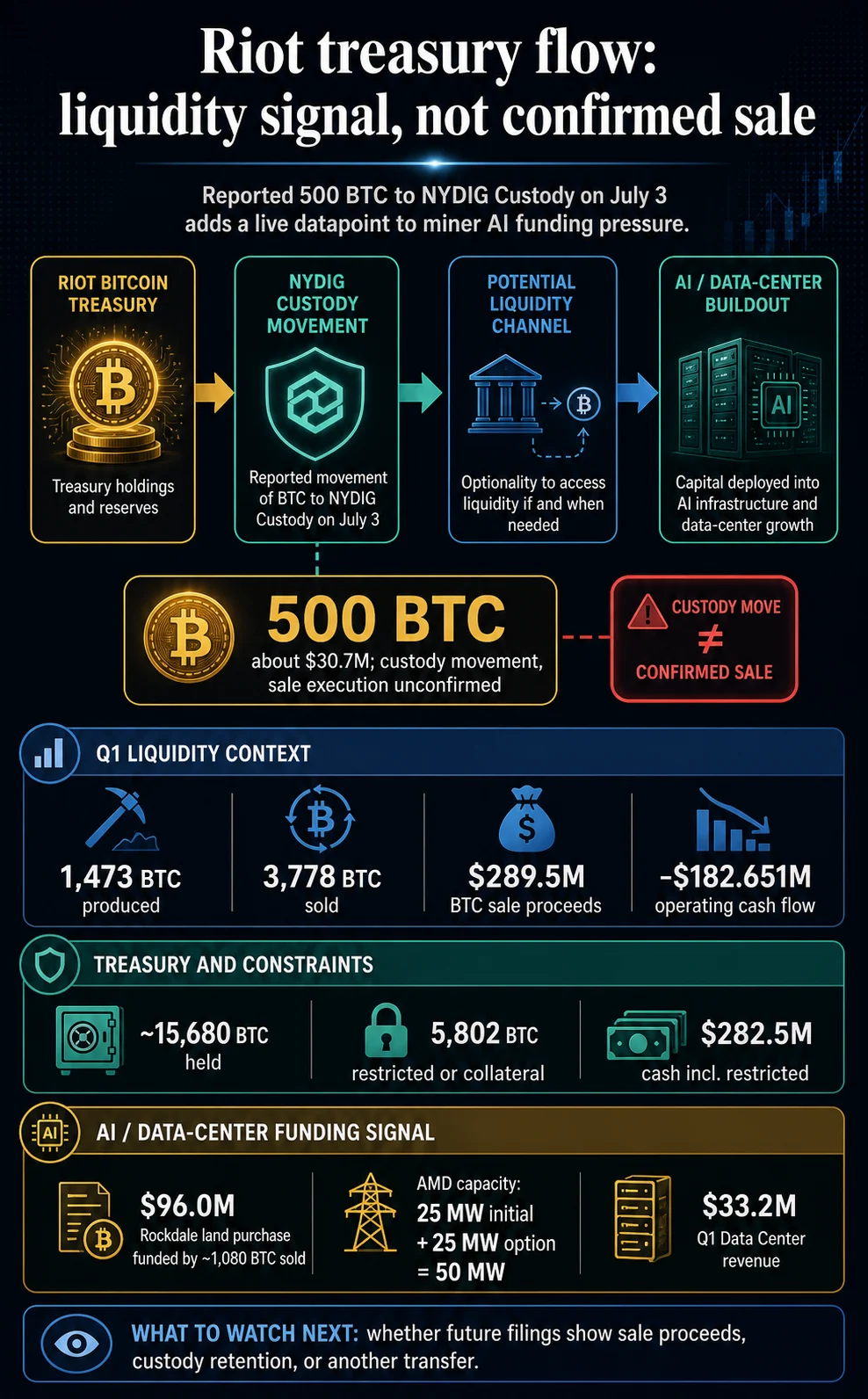
The recent movement of 500 Bitcoin from a Riot Platforms-associated wallet to NYDIG Custody has emerged as a pivotal signal for market analysts tracking the evolution of public mining companies. This transaction, occurring on July 3 and valued at approximately $30.7 million based on prevailing market prices, represents more than a routine administrative adjustment; it serves as a live indicator of how the industry’s largest players are mobilizing their digital asset treasuries to fund the capital-intensive transition into artificial intelligence (AI) and high-performance computing (HPC) data centers. While the on-chain data, first reported by PANews, confirms the transfer to a known custody provider, it does not yet reflect an executed sale. However, when viewed through the lens of Riot’s recent financial disclosures and strategic pivot, the movement suggests a deliberate step in a broader capital-allocation strategy designed to support massive infrastructure build-outs in a post-halving economic environment.
Deciphering the Liquidity Signal and Wallet Dynamics
In the highly scrutinized world of public Bitcoin miners, the distinction between "wallet maintenance" and "liquidity mobilization" is critical for investors. For Riot Platforms, the 500 BTC transfer to NYDIG arrives at a time when the company has already established a precedent for aggressive treasury management. In the first quarter of 2024, Riot’s financial activity revealed a significant departure from the traditional "HODL" (hold on for dear life) strategy that characterized the previous bull cycle. The company reported the production of 1,473 BTC during the quarter but simultaneously sold 3,778 BTC—more than 2.5 times its quarterly output. These sales generated $289.5 million in net proceeds at an average price of approximately $76,626 per coin.
The mobilization of an additional 500 BTC to a third-party custodian like NYDIG suggests that Riot is maintaining a high state of readiness to liquidate assets. Analysts suggest that by moving coins to a professional custody and execution partner, the company reduces the latency between a management decision to sell and the actual realization of cash. This is particularly relevant given Riot’s reported negative operating cash flow of $182.65 million for the first quarter. Without the nearly $290 million in Bitcoin sale proceeds, the company’s cash position would have faced significant depletion. Consequently, the latest 500 BTC movement acts as a "live liquidity marker," signaling that the treasury remains an active component of the company’s operational funding stack rather than a dormant reserve.
The Chronology of Riot’s Strategic Pivot
To understand the weight of a single 500 BTC transfer, one must examine the timeline of Riot’s transformation from a pure-play Bitcoin miner into a diversified digital infrastructure provider.
- January 2024: The Rockdale Acquisition. Riot announced the "fee simple" acquisition of 200 acres of land at its Rockdale site for $96 million. Crucially, the company disclosed that this entire purchase was funded by the sale of approximately 1,080 BTC. This event established the blueprint for "treasury-to-infrastructure" conversion.
- March 2024: The AMD Partnership. Riot signed a data-center lease and services agreement with AMD. The initial agreement covered 25 megawatts (MW) of critical IT load capacity at the Rockdale facility, specifically designed for high-density computing needs.
- April 2024: The Bitcoin Halving and Capacity Expansion. As the Bitcoin network underwent its quadrennial halving, reducing block rewards by 50%, Riot’s strategic focus shifted toward non-mining revenue. AMD exercised an option to double its contracted capacity to 50 MW. During this period, Riot reported its first quarter of significant data-center revenue, totaling $33.2 million, primarily driven by tenant fit-out services.
- May–June 2024: Infrastructure Acceleration. Following the halving, the cost to mine a single Bitcoin effectively doubled for most operators. Riot intensified its efforts to monetize its power-heavy assets, focusing on the build-out of the Corsicana facility, which is slated to reach 1 gigawatt (GW) of capacity.
- July 3, 2024: The 500 BTC Transfer. The reported movement of $30.7 million in Bitcoin to NYDIG serves as the latest data point in this timeline, suggesting that the capital requirements for the next phase of expansion are imminent.
Financial Context: The Cost of Building for the AI Era
The transition to AI and HPC infrastructure is an order of magnitude more expensive than traditional Bitcoin mining setups. While a standard Bitcoin mining warehouse requires basic ventilation and power distribution, AI-ready data centers require advanced liquid cooling systems, redundant power supplies, and high-tier fiber connectivity to support GPU clusters such as NVIDIA’s H100 or Blackwell chips.
Riot’s Q1 balance sheet highlights the necessity of active treasury management to meet these costs. At the end of the period, the company held approximately 15,680 BTC. However, a closer look at the filing reveals that 5,802 BTC—nearly 37% of the total treasury—was classified as restricted or held as collateral. This indicates that a significant portion of Riot’s "wealth" is already encumbered by financing agreements or operational guarantees.
Furthermore, the company ended the quarter with $282.5 million in cash, which includes restricted cash. Given that large-scale data center build-outs can cost upwards of $10 million to $15 million per megawatt, Riot’s ambitious 1 GW target at Corsicana represents a multi-billion dollar capital expenditure program. The 500 BTC transfer, therefore, represents a tactical drop in the bucket for a company facing massive long-term capital requirements, yet it serves as a crucial indicator of the "pay-as-you-go" model public miners are adopting to avoid dilutive equity raises in a volatile stock market.
Broader Industry Implications and Market Reaction
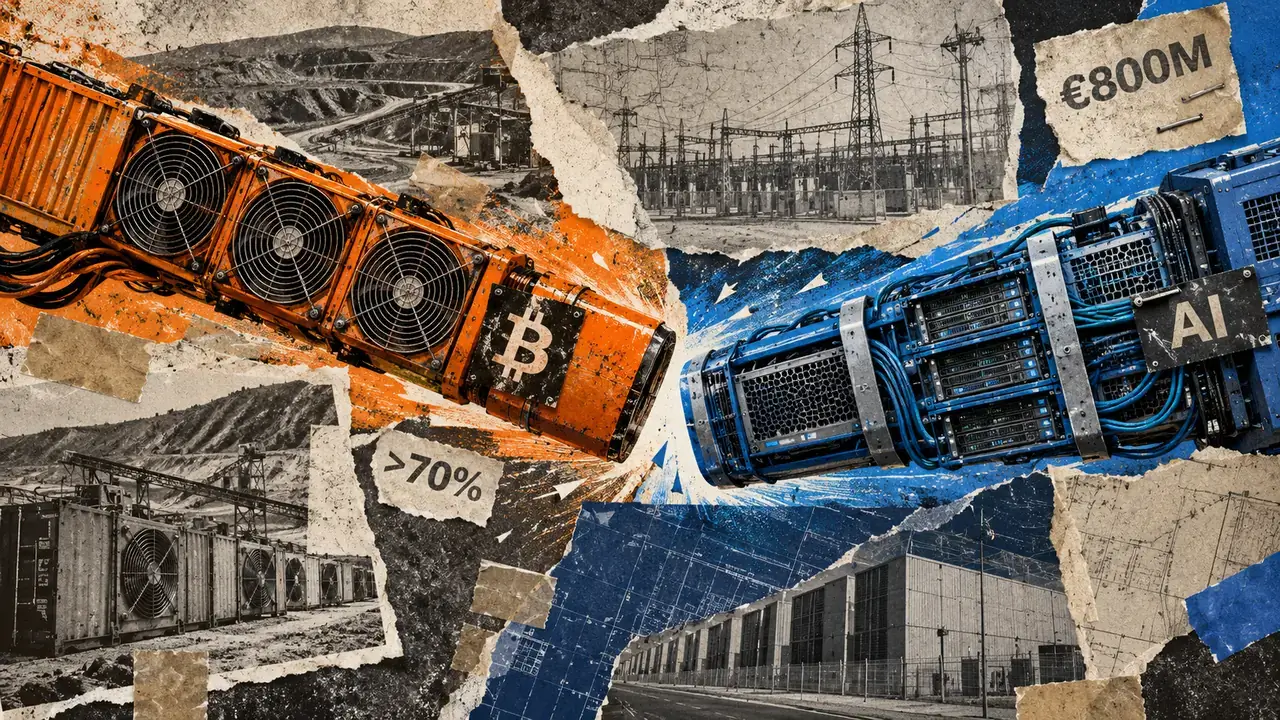
Riot is not alone in this pivot. The broader Bitcoin mining sector is currently undergoing a "Great Bifurcation." On one side are miners doubling down on hash rate efficiency to survive the halving; on the other are companies like Core Scientific, Bitdigital, and Terawulf, which are aggressively retooling their power capacity to host AI workloads.
The market has generally reacted favorably to miners who successfully pivot. Core Scientific’s recent multi-billion dollar deal with CoreWeave served as a catalyst for the entire sector, demonstrating that the value of a miner’s "grid-ready power" may eventually exceed the value of its "Bitcoin produced." For Riot, the challenge is maintaining its identity as a leading Bitcoin producer while convincing Wall Street it can capture the high-margin revenue associated with AI hosting.
Industry analysts suggest that the 500 BTC movement to NYDIG may be viewed by the market as a sign of operational agility. "When a miner moves coins to an exchange or a custodian known for execution, they are signaling to the market that they are price-sensitive but liquidity-ready," noted one digital asset strategist. "The question for Riot is no longer if they will sell their Bitcoin, but how efficiently they can convert that Bitcoin into the next generation of computing power."
Analysis of Risks and Capital Allocation Strategy
The strategy of using Bitcoin treasuries to fund infrastructure is not without risks. By selling BTC to fund data center construction, Riot is essentially trading a high-upside, liquid asset for a long-term, illiquid physical asset. If the price of Bitcoin were to surge significantly after a sale, the "opportunity cost" of that infrastructure could become astronomical. Conversely, if the AI boom cools or demand for third-party hosting fluctuates, Riot could find itself with expensive facilities and a depleted Bitcoin reserve.
However, Riot’s management appears to be prioritizing the diversification of revenue streams to mitigate the inherent volatility of mining. The company’s Q1 10-Q filing explicitly describes its evolution into a "diversified data-center and digital-infrastructure company." This terminology is a deliberate signal to institutional investors who may be wary of the "boom-bust" cycle of Bitcoin but are eager for exposure to the infrastructure underlying the AI revolution.
The 500 BTC transfer also highlights the role of specialized firms like NYDIG. As miners become more sophisticated financial entities, they require institutional-grade partners to manage their "capital stack." NYDIG provides the bridge between the on-chain world of Bitcoin and the off-chain world of corporate finance, offering services that include lending, execution, and custody that allow companies like Riot to use their BTC as a versatile financial tool rather than just a speculative asset.
Conclusion: The New Rhythm of the Mining Sector
The 500 BTC movement from Riot Platforms to NYDIG Custody marks a transition in the narrative of public Bitcoin mining. The era of "blind HODLing" is being replaced by a sophisticated era of "Active Capital Allocation." For Riot, every Satoshi in its treasury is now a potential brick in a data center, a foot of fiber optic cable, or a cooling fan for a GPU cluster.
Investors should expect a steady rhythm of such transfers in the coming months. As Riot pushes toward its expansion goals at Rockdale and Corsicana, the cadence of these treasury movements will likely increase. The market will no longer view these transfers as "sell-offs" in the traditional sense, but as the necessary fuel for an infrastructure machine that is being rebuilt for the AI age.
For the broader Bitcoin market, the impact of a 500 BTC transfer is relatively minor in terms of daily spot volume. However, the cumulative effect of public miners mobilizing thousands of coins to fund their transformation could create a consistent source of secondary market supply. The "conditional conclusion," as analysts suggest, is that Bitcoin treasuries have officially become a core part of the funding stack for the next generation of digital infrastructure. Riot’s next set of financial disclosures—its Q2 production updates and subsequent 10-Q filings—will be the ultimate arbiter of whether this 500 BTC was the start of a new liquidation trend or a tactical repositioning of assets. Regardless of the immediate outcome, the signal is clear: the business of mining Bitcoin is increasingly becoming the business of building the future of global computing.