admin

In a significant strategic reorientation, Ethereum co-founder Vitalik Buterin has advocated for Ether (ETH) to be primarily recognized and valued as a robust store of value (SoV), a departure from its earlier narrative centered on fee burning. This shift comes as the broader cryptocurrency landscape grapples with a complex confluence of developments, including uncertain regulatory futures following a Democrat sweep in the U.S. elections, the aftermath of a monumental $6.34 billion hack on Binance, and an accelerated timeline for Ethereum’s transition to quantum resistance. Concurrently, the decentralized finance (DeFi) sector is witnessing a bold defiance of traditional authority, as THORChain reinstated services despite an explicit FBI warning regarding illicit funds.
Ethereum’s Evolving Value Proposition: From "Ultrasound Money" to Digital SoV
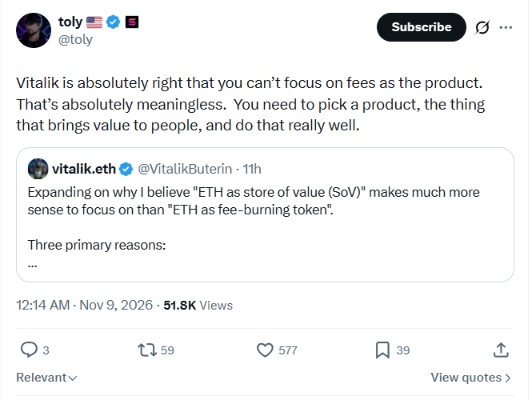
Vitalik Buterin, the visionary behind Ethereum, recently articulated a refined perspective on ETH’s fundamental value, proposing its primary role as a store of value. This argument, presented in a comprehensive public thread, posits that the prior emphasis on ETH as a "fee-burning token" was less robust than initially perceived. Buterin warned that optimizing for fee burning could inadvertently compromise Ethereum’s crucial tenets of "decentralization and capture resistance," core attributes that define its integrity and long-term viability.
Instead, Buterin argues that Ethereum’s inherent value should stem from the stability and resilience provided by its unwavering commitment to "decentralization and CROPS." He clarified CROPS as an acronym encompassing Censorship and Capture Resistance, Open Source principles, Privacy, and Security. These pillars, he believes, will become increasingly paramount and highly valued in an "era of AI disruption," where centralized systems may face unprecedented challenges to their trustworthiness and autonomy.
This pivot marks a notable evolution from the "ultrasound money" narrative that gained traction following the 2021 implementation of Ethereum Improvement Proposal (EIP-1559). This upgrade introduced a mechanism to burn a portion of transaction fees, which, during periods of high network activity and exorbitant gas fees, temporarily flipped Ethereum into a deflationary asset. Proponents, including prominent crypto podcasters like Bankless, enthusiastically championed ETH as "ultrasound money," suggesting its scarcity would rival or even surpass Bitcoin’s.
However, subsequent design choices and market dynamics have led to a sustained decline in median transaction fees. Data reveals a stark reduction, with median transaction fees plummeting from 35 cents to a mere 3.5 cents between January and October of the current year, even as the number of daily transactions significantly increased by over 50%. This trend has rendered the "ultrasound money" narrative, largely predicated on high fee revenue fueling deflation, increasingly unsustainable.

The proposed shift has inevitably drawn criticism from segments of the Bitcoin community, who staunchly uphold Bitcoin’s unchallenged status as a store of value. Dan Held, founder of Held Media, sharply derided Buterin’s comments as "ETH trying to pivot to Bitcoin’s SoV narrative after all of its previous narratives collapsed. Again." Held further questioned the viability of a protocol with "constantly changing monetary policy (just like fiat)" being considered "sound money."
Yet, Ethereum proponents counter these criticisms by highlighting the network’s consistent monetary policy since "The Merge" in 2022, which transitioned Ethereum to a Proof-of-Stake consensus mechanism. They emphasize that each subsequent monetary policy adjustment has consistently aimed to reduce, rather than increase, ETH issuance, contributing to a more predictable and potentially deflationary supply schedule over time. Ethereum "maxis" have largely welcomed Buterin’s clear narrative direction, seeing it as a natural progression for the protocol. Gabriel Shapiro, an attorney at MetaLeX, described it as a "nature is healing moment," expressing his conviction that "on fundamentals ETH can be a much better SoV than both ZEC and BTC." Even Solana co-founder Anatoly Yakovenko acknowledged Buterin was "absolutely right that can’t focus on fees as the product," albeit with a subtle jab at Ethereum’s overall "product" offering.
U.S. Regulatory Landscape Shifts: Democrat Sweep and Crypto’s Uncertain Path
The recent U.S. elections have ushered in a new political dynamic, with Democrats securing control of both the Senate and the House of Representatives. Despite a substantial investment of $176 million by crypto super Political Action Committees (PACs) across 100 electoral races—including a reported $64 million spent unsuccessfully attempting to prevent Sherrod Brown’s Senate re-election—the immediate impact of this financial muscle on election outcomes appeared minimal. However, the true influence of these PACs remains a subject of debate.
Stand With Crypto, a prominent advocacy group, offers a more optimistic assessment, suggesting that a majority of legislators in both chambers are now "pro-crypto." Their analysis indicates that 50 out of 100 senators are designated "pro-crypto," with only 33 identified as "anti-crypto." In the House, 241 representatives reportedly support the industry, while only 106 are actively opposed. This data presents a nuanced picture, implying a broader base of support for digital assets within Congress, even under unified Democratic leadership.
Nevertheless, the impending legislative environment is expected to bring heightened scrutiny for the crypto sector. Key "anti-crypto" figures are poised to assume powerful committee positions. Senator Sherrod Brown, known for his critical stance on digital assets, is anticipated to join the influential Senate Agriculture Committee, which oversees commodities, including some cryptocurrencies. More significantly, Senator Elizabeth Warren, a vocal critic of the industry, is tipped to chair the Senate Banking Committee, a pivotal body for financial regulation.
Kyle Bligen, Executive Director at the Decentralization Research Center, underscored this shift, stating, "The next Congress will bring a fundamentally different environment for crypto in Washington, and the industry should expect significantly more scrutiny." This sentiment suggests that while direct legislative bans may be unlikely given the reported pro-crypto majorities, a more rigorous regulatory framework is almost certainly on the horizon.
Democrats are reportedly considering expanding proposals from Representative Maxine Waters, Chair of the House Financial Services Committee, into a broader market structure bill. This could lead to comprehensive legislation addressing various aspects of the crypto market, including stablecoins, exchanges, and investor protections. There also remains an outside possibility that the CLARITY Act, a bipartisan bill aimed at providing regulatory clarity for digital assets, could be resurrected. However, its passage would likely hinge on incorporating much stronger ethics provisions, particularly those targeting alleged corruption related to President Donald Trump’s family.
Hadley Stern, founder of Fidelity Digital, highlighted a specific "governance problem" that has fueled calls for stricter ethics. "A sitting president’s family launching memecoins and a stablecoin is a real governance problem," Stern told Magazine, adding, "If I’d done that at Fidelity, I’d have been walked out the same afternoon." This concern gained tangible market relevance as the "TRUMP" memecoin experienced a significant downturn, losing a third of its value this week and becoming the biggest loser among the top 100 cryptocurrencies. The broader market reacted to the election results, with AI-related stocks crashing and Bitcoin falling below $76,000, where it has since remained, reflecting investor apprehension.
Binance Rocked by $6.34 Billion Hack Stemming from Elaborate Social Engineering
Binance, the world’s largest cryptocurrency exchange, has revealed the intricate details behind a staggering $6.34 billion hack, one of the largest in cryptocurrency history. The breach was not a singular event but a sophisticated, months-long campaign orchestrated by North Korean state-sponsored hackers, reportedly the notorious Lazarus Group.
The chronology of the attack highlights a multi-stage infiltration. The initial breach occurred in June when a Binance employee unwittingly downloaded a tampered Homebrew installation. The employee was attempting to install an AI coding tool, a common vector for supply chain attacks where malicious code is injected into legitimate software. While Binance’s security systems quickly detected and flagged this incident, the attackers had already managed to exfiltrate critical information concerning employees involved in the exchange’s sensitive wallet infrastructure.
Building on this initial reconnaissance, the hackers escalated their efforts in September. Posing as recruiters, they targeted another software engineer with a meticulously crafted social engineering scheme. The engineer was tricked into downloading a malicious file disguised as a coding assignment, a tactic designed to exploit the professional curiosity and diligence of developers. This allowed the attackers to gain a deeper foothold within Binance’s internal systems.
The decisive phase of the attack unfolded on October 20. Utilizing the compromised computer and leveraging an internal AI tool, the attackers successfully accessed the systems of two additional engineers. This lateral movement within the network enabled them to deploy sophisticated malware that ultimately granted them access to Binance’s internal wallet-signing service. This critical service is responsible for authorizing transactions and controlling the movement of funds, allowing the hackers to steal billions of dollars in cryptocurrencies.

Binance co-CEO Richard Teng confirmed the complexity of the attack in a post on X, stating, "This wasn’t one mistake or one breach – it was a months-long campaign." The incident underscores the persistent threat posed by advanced persistent threat (APT) groups like the Lazarus Group, known for their sophisticated social engineering techniques and their focus on high-value targets within the cryptocurrency sector to fund North Korea’s illicit programs.
In the wake of this monumental hack, Grayscale, a prominent digital asset manager, offered a perspective that, while acknowledging the immediate blow to confidence, pointed towards long-term improvements. Grayscale’s head of research, Zach Pandl, suggested the hack could be a "temporary setback" for crypto markets but would ultimately "lead to stronger security practices across exchanges." Pandl further emphasized "the importance of institutional custody, such as offered by US-based crypto [exchange-traded products]," which typically boast offline storage, multi-signature wallets, SOC attestations, and comprehensive insurance policies, offering a stark contrast to the vulnerabilities exposed by the Binance hack.
Adding to Binance’s challenges, the exchange’s French arm recently announced the closure of all user accounts by December 31. This move follows Binance’s failure to secure Markets in Crypto-Assets (MiCA) regulatory authorization from a European Union member state before a July 1 deadline. Accounts retaining a balance after November 29 will incur monthly maintenance fees, a minimum of 10 USDC or 0.025% of the balance, highlighting the growing regulatory pressure faced by global exchanges.
Ethereum’s Race to Quantum Resistance Accelerates to 2028
In a significant update for the long-term security and viability of the Ethereum network, Justin Drake, a researcher at the Ethereum Foundation, has announced an accelerated timeline for achieving post-quantum and post-AI resistance. Speaking at Devcon 8 in Mumbai, Drake outlined an ambitious target of December 2028, a full year earlier than the foundation’s previously established deadline of December 2029.
"Our hope is that by December 2028 we’ll be able to wrap up the full post-quantum and post-AI transition," Drake stated, indicating a compressed development roadmap that requires developers to deliver three additional network upgrades within the next 24 months. This accelerated schedule underscores the growing urgency within the blockchain community to address the existential threat posed by advancements in quantum computing.
Quantum computers, once fully realized, could potentially break current cryptographic algorithms, including those that secure blockchain networks like Ethereum and Bitcoin. Algorithms such as Shor’s algorithm threaten public-key cryptography, while Grover’s algorithm could weaken symmetric-key cryptography. A successful quantum attack could compromise the security of user funds, transaction integrity, and the very immutability of blockchain ledgers. The "post-AI transition" refers to anticipating and mitigating potential security threats arising from advanced artificial intelligence.

While the Ethereum Foundation’s September roadmap had initially set December 2029 as the deadline, the new target reflects a proactive approach to future-proofing the network. However, the path to these upgrades is not without its challenges. The current roadmap is at a standstill, with core developers delaying the "Glamsterdam" upgrade indefinitely. This delay stems from unresolved security concerns tied to eight critical smart contract invariants, highlighting the meticulous and cautious approach required when implementing fundamental changes to a network securing billions of dollars in value. The successful implementation of quantum-resistant cryptography is crucial not only for Ethereum but for the entire blockchain ecosystem, ensuring its resilience against future technological advancements.
THORChain Defies FBI Warning, Reinstates Trading Despite Illicit Funds
In a stark demonstration of decentralized protocol governance, THORChain, a permissionless cross-chain decentralized exchange (DEX), has restarted trading on most of its supported networks, explicitly ignoring a warning from the U.S. Federal Bureau of Investigation (FBI) not to process funds linked to the recent Binance hack. The protocol restored functionality on November 4, enabling swaps across Bitcoin, Ethereum, Bitcoin Cash, Dogecoin, Litecoin, Tron, and Zcash, with Avalanche, Base, and XRP already operational.
The news triggered a positive market reaction for THORChain’s native RUNE token, which rallied 15% within 24 hours of the announcement. This defiance of law enforcement directives highlights a core tenet of truly decentralized systems: their operation is not subject to centralized control or external pressure.
Chainalysis, a blockchain analytics firm, reported that THORChain had already processed over $46 million from the Binance hack within the first 72 hours of the illicit funds being moved. The protocol reportedly generated $200,000 in fees from these transactions, as noted by the Wall Street Journal. Trading had been automatically halted prior to the FBI warning due to an unrelated Ethereum block reorganization event, which momentarily paused activity across the network.
JPThor, a co-founder of THORChain, explicitly leveraged the FBI’s intervention as evidence of the protocol’s decentralized nature. "The fact that the FBI did in fact call out the protocol – and nobody could do anything – means in fact the protocol is decentralised," he stated. "Nobody in their right mind in a western country would flagrantly ignore a direction like that." This statement underscores the philosophical tension between the ideals of permissionless decentralization and the demands of traditional financial regulation and law enforcement. The incident is likely to intensify the debate surrounding the regulatory oversight of DeFi protocols and the challenges in combating illicit financial activity within truly decentralized environments.
Market Overview: Winners, Losers, and Lingering Apprehension

The turbulent week concluded with significant market movements. Bitcoin (BTC) experienced a 4.5% decline, trading at $74,302, while Ethereum (ETH) fell 6.3% to $2,117. XRP also saw a 5% drop, settling at $1.11. The total cryptocurrency market capitalization, according to CoinMarketCap, stood at $2.49 trillion, reflecting a broader market correction influenced by the U.S. election outcomes, the Binance hack, and general macroeconomic uncertainty.
Among the top 100 cryptocurrencies, Pieverse (PIEVERSE) emerged as the top altcoin winner, boasting an impressive 39.2% gain. Injective (INJ) followed with an 11.1% increase, and Tether Gold (XAUt) registered a 4.2% gain. Conversely, the week’s biggest altcoin losers included OFFICIAL TRUMP, which plummeted by 32.8% amidst election fallout and governance concerns. Worldcoin (WLD) was down 20.8%, and Ethena (ENA) saw a 19% decline, indicating specific project-related pressures or broader market sentiment shifts.
Top Prediction and FUD of the Week
Prediction: Grayscale’s head of research, Zach Pandl, suggested that the $6.3 billion Binance hack, while a "temporary setback," would ultimately compel crypto exchanges to adopt "stronger security practices" and underscore the critical importance of institutional custody solutions. These solutions, often offered by US-based crypto exchange-traded products, typically feature robust security measures such as offline storage, multi-signature wallets, SOC attestations, and comprehensive insurance policies, providing a higher standard of asset protection.
FUD (Fear, Uncertainty, Doubt) Incidents:
- Binance France Closure: Binance France announced the impending closure of all user accounts by December 31, with monthly maintenance fees to be levied on remaining balances from November 29. This development follows Binance’s failure to obtain MiCA regulatory authorization in the EU, forcing service restrictions in several European markets.
- Suspicious Prediction Market Activity: A report by The New York Times highlighted suspicious betting patterns on prediction markets shortly before the release of two recent New York Times/Siena political polls. Vanderbilt University researchers noted a Polymarket user placed nearly $200,000 on Oct. 31, correctly predicting Nebraska Senator Pete Ricketts’ re-election an hour before the poll was released. The user reportedly won over $77,000, raising questions about potential insider information and market integrity.
- Gnosis Pay Breach: Crypto-linked Visa debit card provider Gnosis Pay disclosed a security breach on Friday, exposing customers’ payment card details, home addresses, and cryptocurrency wallet addresses. The company detected unauthorized access to its legacy consumer card system on November 3 and initiated containment within two hours, assuring that customer funds and its separate enterprise platform were unaffected.
Magazine Features of the Week
This week’s deeper dives from industry publications explored critical topics: an analysis of what the Democratic U.S. midterm sweep means for the CLARITY Act and the future of crypto regulation; a guide for Bitcoin holders on utilizing their newly received eCash from a recent fork; strategies for Australian Bitcoiners to navigate the impending 2027 Capital Gains Tax increase; and an investigation into whether decentralized phone networks possess the capacity to power the rapidly evolving AI revolution.