admin
admin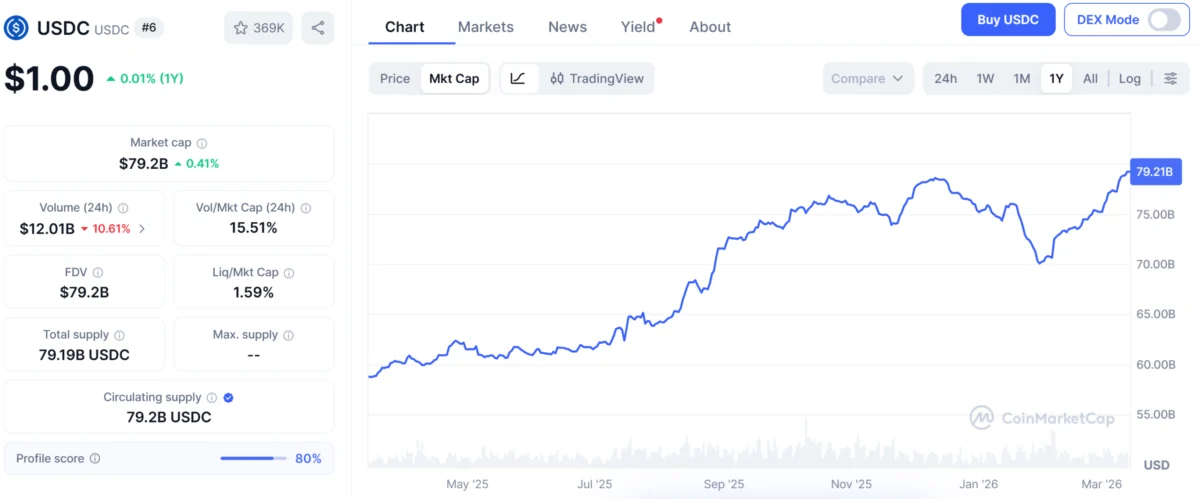
Today’s crypto landscape is marked by significant developments across core blockchain infrastructure, regulatory initiatives, and stablecoin market dynamics. Ethereum co-founder Vitalik Buterin has unveiled a proposal aimed at streamlining the network’s node software, a move poised to enhance decentralization and accessibility. Concurrently, the legislative path for the U.S. CLARITY Act, designed to provide much-needed regulatory clarity for digital assets, appears increasingly constrained, with an executive from Galaxy Digital warning of an extremely narrow window for passage this year. Meanwhile, the market capitalization of the USDC stablecoin is rapidly nearing an unprecedented $80 billion, a surge that one analyst attributes to significant capital flight from the United Arab Emirates amidst turbulence in Dubai’s real estate sector. These disparate yet interconnected events underscore the ongoing evolution, challenges, and growing influence of the digital asset ecosystem on a global scale.
Ethereum’s Decentralization Drive: Vitalik Buterin’s Node Simplification Proposal
In a pivotal move for the Ethereum network’s long-term health and decentralization, co-founder Vitalik Buterin has put forth a proposal designed to simplify the operational requirements for running an Ethereum node. On Saturday, Buterin initiated a "pull request" – a standard mechanism in open-source software development for proposing changes to a codebase – outlining a strategy to merge the distinct backend programs currently required for node operation. This proposed update seeks to unify the software responsible for interacting with Ethereum’s Beacon Chain, which manages the network’s consensus mechanism and staking, with the protocol’s execution layer, which processes transactions and smart contract operations, into a single, cohesive code structure. The primary objective of this consolidation is to significantly simplify the node setup process, thereby lowering the technical barrier to entry for prospective validators.
Currently, individuals or entities wishing to run an Ethereum node, often referred to as validators, must operate two separate software clients in tandem. One client handles the execution layer, processing transactions and maintaining the state of the Ethereum Virtual Machine (EVM), while the other manages the consensus layer, participating in the Proof-of-Stake (PoS) mechanism to validate blocks and secure the network. Each of these clients necessitates its own setup, configuration, and continuous synchronization with the network. This dual-client requirement, while a necessary architectural evolution following Ethereum’s monumental "Merge" from Proof-of-Work to Proof-of-Stake in September 2022, has inherently increased the technical complexity. This complexity often deters ordinary users and smaller participants from running their own infrastructure, inadvertently fostering a reliance on third-party service providers for validation services. Such reliance, while offering convenience, raises legitimate concerns about network centralization, as a smaller number of large entities could potentially exert undue influence over the network’s operations and governance.

The issue of technical complexity and hardware requirements for running nodes is not unique to Ethereum; it’s a common criticism leveled against many smart contract blockchains. These challenges can lead to a concentration of validation power among well-resourced entities, potentially undermining the core ethos of decentralization that underpins blockchain technology. Buterin’s proposal directly addresses these concerns, aiming to make it easier for a broader spectrum of users to become active participants in securing and validating the network. By integrating the execution and consensus clients into a unified structure, the process of setting up and maintaining a node could become considerably less daunting, potentially expanding the pool of independent validators.
This initiative is a continuation of Ethereum’s ongoing commitment to enhancing its robustness and censorship resistance. Post-Merge, the network’s architecture was designed with modularity in mind, allowing for specialized clients to handle different functions. While beneficial for development and upgrades, it introduced operational hurdles. Buterin’s latest proposal, if adopted, represents a significant step towards optimizing this architecture for user accessibility without compromising the network’s security or efficiency. It reflects a proactive approach to addressing centralization concerns that have historically plagued large-scale blockchain networks, ensuring that Ethereum remains a truly decentralized and permissionless platform as it continues to scale and evolve. The move could foster greater individual participation, reduce dependence on centralized staking pools, and ultimately strengthen the network’s resilience against various forms of attack or manipulation, reinforcing its foundational principles of distributed trust and autonomy.
US Crypto Regulatory Landscape: The CLARITY Act’s Tight Window
The United States Congress is currently navigating a critical period for digital asset regulation, with the proposed CLARITY Act facing a rapidly closing window for passage this year. Alex Thorn, Head of Firmwide Research at Galaxy Digital, a prominent financial services and investment management firm in the digital asset sector, issued a stark warning on Saturday via an X post: "If CLARITY doesn’t pass committee by the end of April, odds of passage in 2026 become extremely low." Thorn further emphasized the urgency, stating, "This needs to hit the Senate floor by early May… floor time is running out, and odds diminish every day that passes." This assessment underscores the precarious legislative environment for crypto-specific bills in Washington.
The CLARITY Act, formally known as the "Clarity for Digital Assets Act," is a bipartisan legislative effort aimed at providing much-needed regulatory certainty for the burgeoning crypto industry in the U.S. Its core objective is to establish clear definitions and jurisdictional boundaries for digital assets, specifically addressing whether a particular crypto asset should be classified as a security, commodity, or another category. This distinction is crucial, as it determines which federal agency—primarily the Securities and Exchange Commission (SEC) or the Commodity Futures Trading Commission (CFTC)—has oversight. The current lack of a comprehensive regulatory framework has led to an environment often described as "regulation by enforcement," where crypto companies operate under a cloud of uncertainty, facing potential legal action without clear guidelines. This ambiguity has been a significant impediment to innovation and institutional adoption within the U.S. market.

Thorn’s urgency is rooted in the practical realities of the legislative calendar, particularly in an election year. Congressional floor time is a finite and highly competitive resource. Bills must pass through various committee stages before they can even be considered for a full vote by the Senate or House. The Senate Majority Leader, John Thune, recently indicated that the chamber would not prioritize digital asset market structure legislation before April, signaling that other legislative initiatives, such as the "SAVE America Act" which focuses on voter registration requirements, would take precedence. This prioritization directly impacts the CLARITY Act’s trajectory, pushing it further down a shrinking queue of legislative items.
If the CLARITY Act fails to advance within the stipulated timeframe, the implications for the U.S. crypto industry could be significant. Continued regulatory uncertainty would likely perpetuate the current challenges, potentially stifling domestic innovation and driving crypto businesses to more accommodating jurisdictions. It could also mean a prolonged period of legal battles and enforcement actions, consuming resources that could otherwise be directed towards product development and job creation. Conversely, the passage of the CLARITY Act would be a landmark achievement, providing a foundation for clearer rules of engagement, fostering greater institutional participation, and potentially positioning the U.S. as a leader in responsible crypto innovation. Industry stakeholders have long advocated for such clarity, believing it to be essential for the maturation and mainstream integration of digital assets. The coming weeks will be critical in determining whether the U.S. can establish a coherent regulatory framework or if it will continue to grapple with the complexities of an evolving digital economy without a clear legislative compass.
USDC’s Ascendance: Stablecoin Market Cap Nears Record $80 Billion Amid Geopolitical Shifts
The market capitalization of USD Coin (USDC), the second-largest stablecoin by market cap, is rapidly approaching an unprecedented high near $80 billion, signaling a significant surge in demand, particularly from the Middle East. This remarkable growth trajectory is drawing attention, with one analyst directly linking the spike to what he describes as "capital flight" originating from the United Arab Emirates (UAE).
According to data compiled from CoinMarketCap, USDC’s circulating supply has recently swelled to approximately $79.2 billion. This figure marks a new all-time high for the dollar-pegged stablecoin, surpassing its previous peak of just under $79 billion recorded in December of the previous year. The expansion has been notably swift in recent weeks; the stablecoin’s market cap stood at slightly over $70 billion at the beginning of February and had already climbed to $75 billion earlier in the current month. This sustained upward trend underscores a robust and accelerating demand for USDC across global markets.

USDC is a stablecoin issued by Circle, a regulated financial technology company, and is designed to maintain a stable value pegged 1:1 with the U.S. dollar. Its value is backed by a combination of cash and short-duration U.S. Treasury bonds, held in segregated accounts and regularly audited to ensure transparency and solvency. This structure, coupled with its regulatory compliance and transparency, makes USDC an attractive option for users seeking a stable digital asset that can facilitate cross-border transactions, provide a hedge against local currency volatility, or serve as a safe haven during periods of economic or political uncertainty.
Rami Al-Hashimi, a self-proclaimed Dubai-based analyst, offered a specific explanation for this recent surge. In a Friday post on X (formerly Twitter), Al-Hashimi asserted that the increase reflects growing demand from investors in the UAE seeking to move funds out of traditional markets. He claimed that over-the-counter (OTC) desks in Dubai have been struggling to meet the intense demand for the stablecoin, indicating a substantial influx of capital seeking refuge or mobility via digital assets. This phenomenon, commonly referred to as capital flight, occurs when assets or money rapidly flow out of a country due to an event of economic or political instability, or the perception of such instability.
The context for this alleged capital flight in the UAE, specifically Dubai, appears to be linked to recent turmoil in its real estate market. While details on the precise nature of this turmoil are evolving, reports have indicated shifts in market dynamics, potentially driven by factors such as oversupply, changes in foreign investment regulations, or broader economic uncertainties. In such an environment, individuals and businesses may seek to diversify their holdings or move liquidity to more stable and accessible assets. Stablecoins like USDC offer a compelling solution due to their digital nature, global accessibility, and perceived stability relative to traditional assets during periods of localized economic stress.
The implications of USDC’s rapid market cap expansion are multifaceted. For Circle, the issuer, it signifies increased market dominance and potentially higher revenue from reserve management. For the broader stablecoin ecosystem, it highlights the growing utility of these digital assets as crucial bridges between traditional finance and the crypto world, particularly in facilitating global financial flows. More broadly, it underscores the increasing role of cryptocurrencies in global economic dynamics, serving not just as speculative investments but as practical tools for wealth preservation and transfer, especially in regions experiencing economic flux or geopolitical shifts. As global financial systems continue to grapple with various pressures, the demand for transparent, stable, and easily transferable digital assets like USDC is likely to remain a significant trend, shaping the future of international finance.