admin

The nascent US spot Bitcoin (BTC) and Ether (ETH) exchange-traded funds (ETFs) experienced a significant downturn on Thursday, recording approximately $530 million in net outflows, as cryptocurrency markets globally faced a sharp sell-off. This substantial reversal marked a notable shift in investor sentiment, following a brief period of optimism and inflows earlier in the week. The outflows underscore the continued volatility inherent in digital assets, even as they become increasingly integrated into mainstream financial products.
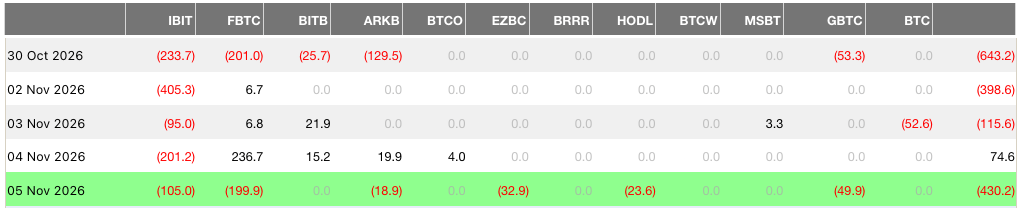
According to data compiled by SoSoValue, Bitcoin ETFs bore the brunt of the withdrawals, accounting for $430 million in net outflows. Ether funds, which have seen a surge in interest and activity since their recent approvals, also registered considerable losses, with around $100 million exiting the market. This collective exodus represents one of the largest single-day net outflows since the inception of these investment vehicles, highlighting a broader re-evaluation of risk across the financial landscape.
A Week of Swings: From Election Rally to Market Retreat
The dramatic outflows on Thursday followed a fleeting moment of bullish sentiment. Just the day before, on Wednesday, combined inflows into Bitcoin and Ether ETFs totaled $128 million. This positive momentum was largely attributed to a brief rally in cryptocurrency markets, which saw Bitcoin briefly climb above the $80,000 mark. The surge coincided with the perceived positive market reaction to the Democratic Party’s victories in the US midterm elections, which some analysts interpreted as signaling a period of potential policy stability or investor-friendly legislative outcomes. Historically, election cycles can introduce uncertainty, and clear outcomes often bring temporary relief or directional conviction to markets.
However, the optimism proved short-lived. Thursday witnessed a comprehensive market retreat, with Bitcoin falling back below $76,000. This crypto downturn mirrored a severe correction in traditional equity markets. The tech-heavy Nasdaq Composite index plunged a staggering 5.5% on Thursday, marking its biggest single-day decline since April 2025, as reported by Reuters. This strong correlation between cryptocurrency performance and major equity indices, particularly those dominated by growth and technology stocks, highlights how digital assets are increasingly seen as risk-on investments, susceptible to the same macroeconomic pressures and investor sentiment shifts that affect traditional markets. Factors contributing to the broader market decline likely included renewed concerns about inflation, potential shifts in monetary policy, and profit-taking after recent rallies in tech stocks.
Fidelity and BlackRock Lead the Outflow Tide
The details of the outflows reveal a concentrated movement of capital, particularly from some of the largest and most prominent ETF issuers. Fidelity’s Wise Origin Bitcoin Fund (FBTC), a significant player in the spot Bitcoin ETF space, experienced the largest single withdrawal on Thursday, with approximately $200 million in outflows. This figure stands in stark contrast to the previous day’s performance, when FBTC had attracted around $237 million in inflows, according to data from Farside Investors. Such a rapid pivot in investor behavior within a 24-hour period underscores the highly reactive nature of institutional capital to market signals.

BlackRock’s iShares Bitcoin Trust (IBIT), another behemoth in the ETF market, also recorded substantial net outflows, with $105 million withdrawn. More significantly, the latest withdrawals extended IBIT’s outflow streak to five consecutive sessions. Since October 30, more than $1 billion has been pulled from BlackRock’s Bitcoin ETF. This sustained period of outflows from a fund managed by one of the world’s largest asset managers is particularly noteworthy. While initial weeks and months post-launch saw IBIT consistently attract billions, this extended period of net outflows suggests a more fundamental shift in sentiment or portfolio reallocation by its institutional and retail holders. The cumulative impact of these movements has pushed Bitcoin ETFs’ year-to-date net outflows to approximately $510 million following Thursday’s market close, indicating that the initial euphoria and significant capital influx witnessed immediately after their launch may be stabilizing or even reversing course.
Broader Market Context: Interconnectedness of Crypto and Traditional Finance
The sharp decline in cryptocurrency markets, particularly Bitcoin, on Thursday cannot be viewed in isolation. It occurred against a backdrop of significant turbulence in traditional financial markets, most notably the severe plunge of the Nasdaq Composite. This interconnectedness is a defining feature of the current market cycle, where cryptocurrencies, once considered uncorrelated assets, now often move in tandem with broader risk-on/risk-off sentiment in equities. When investors perceive increased risk in the global economy or anticipate tighter monetary policy, they tend to reduce exposure to speculative assets, a category that often includes cryptocurrencies and high-growth technology stocks.
The US midterm elections, which briefly spurred optimism on Wednesday, illustrate the complexity of market reactions. While Democratic victories initially seemed to stabilize markets, the subsequent sharp downturn suggests that underlying economic concerns or sector-specific weaknesses quickly overshadowed any political relief rally. Investors are constantly weighing a myriad of factors, including inflation rates, interest rate trajectories set by central banks like the Federal Reserve, corporate earnings reports, and geopolitical developments. A significant single-day drop in a major index like the Nasdaq, often driven by concerns over future economic growth or corporate profitability, inevitably sends ripples through assets perceived as more volatile, such as Bitcoin and Ether.
Expert Analysis: Navigating the Short-Term Bottom and Long-Term Vulnerabilities
In the wake of Thursday’s market sell-off, analysts offered varied perspectives on the immediate outlook for cryptocurrencies and broader markets. Crypto analyst Michaël van de Poppe, a prominent voice in the digital asset space, suggested on X (formerly Twitter) that Bitcoin could find a near-term bottom on Friday. He linked this potential rebound directly to the severity of the Nasdaq’s decline, stating, "I expect Nasdaq to bottom tomorrow. The same for Bitcoin, potentially after sweeping $75,000." This analysis points to a technical concept where a price temporarily falls below a significant support level (like $75,000) to "sweep" or clear out stop-loss orders before potentially reversing direction. Such short-term technical indicators are closely watched by traders seeking entry points during periods of high volatility.
Adding a broader economic perspective, Dean Lyulkin, CEO of Cardiff and founder of the investment publication The Dean’s List, provided crucial context by comparing the current market environment to the period leading up to the 2008 global financial crisis. Lyulkin emphasized critical differences, stating, "The global financial crisis wasn’t caused by Democrats taking Congress." He pointed out that prior to 2008, the Federal Reserve had already engaged in substantial interest rate hikes, and the housing market was showing significant signs of weakening well in advance of the crisis. This historical context suggests that while political events can influence market sentiment, major economic downturns typically stem from deeper, systemic issues.
Lyulkin acknowledged certain vulnerabilities in the current economy, specifically mentioning commercial real estate, private credit, and potentially excessive artificial intelligence (AI) spending. The commercial real estate sector, for instance, faces challenges from evolving work patterns (remote work), rising interest rates affecting refinancing, and potential vacancies. Private credit, an increasingly popular form of lending outside traditional banks, could pose risks due to less regulatory oversight and potential exposure to companies struggling in a tighter economic climate. Speculation around AI companies, with soaring valuations, also raises concerns about potential bubbles. However, Lyulkin concluded on a more reassuring note, arguing that both household balance sheets and the banking system are considerably stronger today compared to the pre-2008 era, suggesting a greater resilience against potential shocks. This nuanced view provides a balanced outlook, recognizing areas of concern while also highlighting fundamental strengths that could prevent a systemic collapse.
Implications for Institutional Adoption and Future Trends
The substantial outflows from spot Bitcoin and Ether ETFs, particularly the sustained withdrawals from major funds like BlackRock’s IBIT, raise important questions about the trajectory of institutional adoption of cryptocurrencies. While the initial approval and launch of these ETFs were hailed as landmark events that would usher in a new era of mainstream crypto investment, the recent performance suggests that the path to full integration is not linear. Institutional investors, renowned for their cautious approach and risk management, are likely to react swiftly to broader market downturns or shifting economic outlooks by rebalancing portfolios and reducing exposure to riskier assets.
The year-to-date net outflow for Bitcoin ETFs, now around $510 million, indicates that while these products provide easier access to crypto, they also expose investors to its inherent volatility. This period of re-evaluation might be a natural part of market maturation, as the initial speculative fervor gives way to more measured investment strategies. Future inflows and outflows will likely be dictated by a complex interplay of factors: global macroeconomic conditions (inflation, interest rates, economic growth), regulatory clarity, technological advancements within the crypto space, and major events like Bitcoin’s upcoming halving cycle, which historically has influenced price action.
Moreover, the performance of Ether ETFs, which also saw significant outflows, underscores the broader market sentiment towards altcoins and the second-largest cryptocurrency. While Ether’s fundamentals and its role in the decentralized finance (DeFi) ecosystem remain strong, its price movements are often correlated with Bitcoin and broader market trends. The sustained interest in ETH ETFs since their approval suggests a growing appetite for diversification within digital asset portfolios, but also a similar sensitivity to market corrections.
Conclusion: A Volatile Path to Mainstream Integration
Thursday’s massive $530 million outflow from US spot Bitcoin and Ether ETFs serves as a stark reminder of the volatile and dynamic nature of cryptocurrency markets. While these investment vehicles have successfully bridged the gap between traditional finance and digital assets, they have also exposed institutional and retail investors alike to the sharp price swings characteristic of the crypto world. The rapid transition from Wednesday’s election-driven rally to Thursday’s comprehensive market sell-off, heavily influenced by a significant drop in the Nasdaq, highlights the increasing interconnectedness of crypto with broader economic trends and investor sentiment.
As analysts weigh the potential for a short-term bottom against persistent underlying vulnerabilities in the global economy, the focus remains on how these newly established ETFs will perform under sustained market pressure. The journey toward mainstream institutional adoption of cryptocurrencies is clearly not without its challenges, characterized by periods of rapid growth interspersed with sharp corrections. Investors and market participants will continue to monitor these flows closely, as they offer a tangible barometer of institutional appetite and confidence in the evolving digital asset landscape. The long-term trajectory will depend on a delicate balance of macroeconomic stability, regulatory advancements, and the continued maturation of the underlying blockchain technologies.