admin
admin
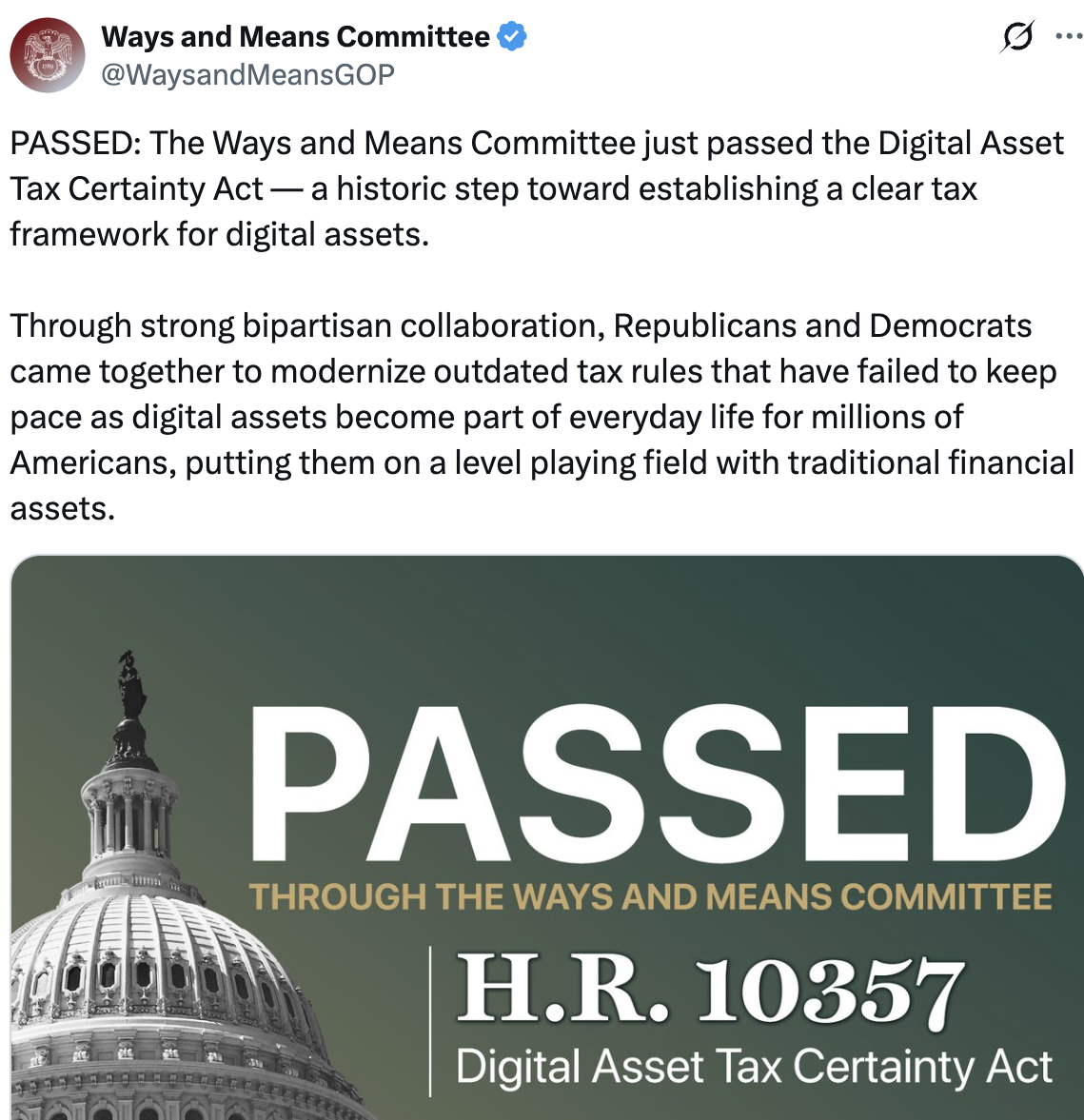
The United States House Ways and Means Committee has achieved a significant milestone in the ongoing effort to define the regulatory landscape for digital assets, passing the Digital Asset Tax Certainty Act with robust bipartisan support on Wednesday. This legislative advancement, approved by a commanding 38-5 vote, aims to provide much-needed clarity on the federal tax treatment of various digital asset activities, ranging from stablecoins to mining and lending. The move signals a focused, albeit fragmented, approach by U.S. lawmakers to address the burgeoning cryptocurrency sector, coming just one day after a broader market structure bill, the CLARITY Act, failed to advance in the Senate, underscoring the complex and often contentious path toward comprehensive digital asset legislation.
The Digital Asset Tax Certainty Act, now poised for consideration by the full House of Representatives, addresses several key areas that have historically posed challenges for investors and businesses in the crypto space. Among its most impactful provisions, the bill proposes special tax treatment for qualifying dollar-pegged stablecoins, recognizing their unique role as a bridge between traditional finance and the digital economy. It also seeks to clarify the tax implications of certain crypto lending agreements, an area rife with ambiguity under existing tax codes. Furthermore, the legislation extends "wash-sale" rules to widely traded digital assets, aligning them more closely with traditional securities markets and preventing certain tax-loss harvesting strategies. New rules for income derived from mining and staking activities are also introduced, aiming to provide a clearer framework for participants in these fundamental blockchain operations.
A particularly noteworthy provision in the bill is the creation of a de minimis exemption for certain crypto transaction fees. This exemption would allow taxpayers to avoid recognizing minor gains or losses when digital assets are used to pay qualifying network or transaction fees of $10 or less. This seemingly small detail carries significant practical implications, as it could dramatically reduce the compliance burden for everyday crypto users who engage in frequent, low-value transactions, each of which currently requires careful tracking for tax purposes. Without such an exemption, a user paying a $0.50 transaction fee with Bitcoin, for example, would theoretically need to calculate the capital gain or loss on that $0.50 worth of Bitcoin at the moment of the transaction, a task that has proven onerous and a barrier to mainstream adoption. The passage of this act by such a wide margin from the influential Ways and Means Committee underscores a growing legislative consensus on the necessity of simplifying crypto tax obligations.
Background and the Need for Tax Clarity
The rapid evolution of digital assets over the past decade has outpaced traditional regulatory frameworks, leaving both innovators and investors navigating a complex and often uncertain legal environment. The Internal Revenue Service (IRS) first issued guidance on virtual currency in 2014, classifying it as property for federal tax purposes. This foundational ruling, later supplemented by Revenue Ruling 2019-24, established that general tax principles applicable to property transactions apply to virtual currency. However, these pronouncements left many specific scenarios unaddressed, leading to widespread confusion.

For instance, the tax treatment of staking rewards – where individuals lock up cryptocurrencies to support network operations and earn new tokens – has been a subject of intense debate. Is the reward income when received, or only when sold? Similarly, the tax implications of decentralized finance (DeFi) lending protocols, where users lend digital assets to earn interest, have been murky. The application of "wash-sale" rules, which prevent investors from selling a security at a loss and repurchasing a substantially identical security within 30 days to claim a tax deduction, has also been a point of contention for digital assets, which lack the explicit regulatory definition of "securities" in many contexts.
The sheer volume of digital asset transactions, many of which are micro-transactions for network fees or small purchases, has exacerbated the compliance challenge. Tax software solutions have emerged to help users track their crypto activity, but the underlying ambiguity in tax law has remained a significant hurdle. Industry advocacy groups and individual taxpayers have consistently called for legislative action to provide clear, actionable guidance, citing the potential for innovation to be stifled and for honest taxpayers to inadvertently fall afoul of complex rules. The Digital Asset Tax Certainty Act is a direct response to these calls, aiming to inject predictability into an area historically marked by uncertainty.
Senate’s CLARITY Act Fails to Advance: A Broader Regulatory Setback
The positive momentum from the House Ways and Means Committee was, however, overshadowed by a significant setback in the Senate just hours prior. The CLARITY Act, a far more comprehensive piece of legislation designed to establish a federal regulatory framework for digital assets and delineate the respective roles of the Securities and Exchange Commission (SEC) and the Commodity Futures Trading Commission (CFTC), failed to advance. The cloture motion, which would have brought the bill to a full debate on the Senate floor, garnered only 49 votes, falling short of the 60 votes required for passage. The final tally of 49-50 against advancing the bill highlighted deep divisions within the Senate regarding the future of crypto regulation.
Senator Cynthia Lummis (R-WY), a prominent advocate for digital asset legislation and a lead sponsor of the CLARITY Act, expressed her profound disappointment following the vote. Lummis, who chairs the Senate Banking Subcommittee on Digital Assets, pointed fingers at her Democratic colleagues, accusing them of moving the goalposts. "For over a year, they presented demands and the second we met them, they made new demands and moved the goal posts," Lummis stated in a post on X (formerly Twitter). She further alleged that Democrats had voted against key provisions aimed at enhancing consumer protections and restricting personal crypto investments by politicians, suggesting that partisan politics rather than substantive concerns ultimately derailed the bipartisan effort.
The CLARITY Act, much like its predecessor, the Lummis-Gillibrand Responsible Financial Innovation Act, sought to address the fundamental question of how digital assets should be classified – as securities, commodities, or a new asset class – and which federal agency should have primary jurisdiction over different segments of the market. Its failure means that the ambiguity surrounding the SEC’s and CFTC’s authority over various crypto assets persists, perpetuating the "regulation by enforcement" approach that has drawn criticism from the industry. This approach sees regulators primarily defining their jurisdiction and applying existing laws through legal actions against companies, rather than through clear, prospective rulemaking.
Implications of the CLARITY Act’s Failure and Agency Responses
The inability of the Senate to pass comprehensive market structure legislation has significant implications for the digital asset industry in the United States. Without a clear federal framework, the industry will continue to grapple with uncertainty regarding which assets fall under the SEC’s purview as securities and which are considered commodities subject to CFTC oversight. This lack of clarity can stifle innovation, deter investment, and potentially push crypto businesses to operate in jurisdictions with more defined regulatory environments.
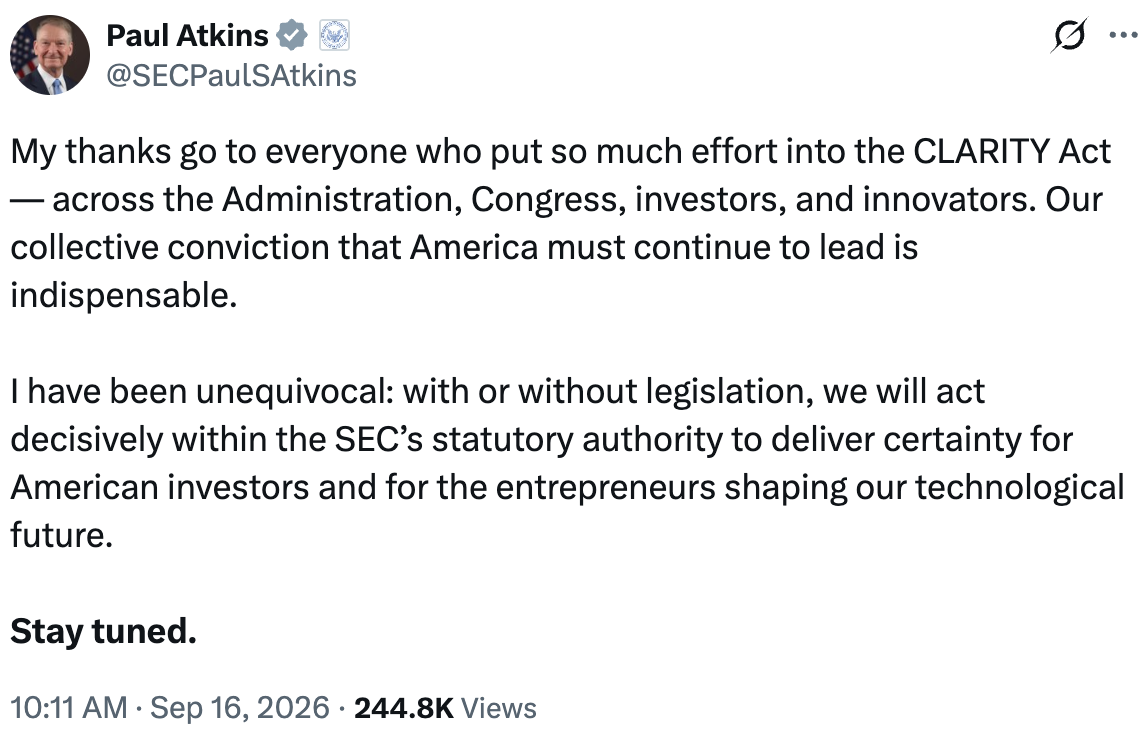
In the immediate aftermath of the CLARITY Act’s failure, both the SEC and CFTC signaled their intent to continue their regulatory efforts under their existing statutory authorities. SEC Chair Paul Atkins, known for his firm stance on investor protection within traditional markets, reiterated the agency’s commitment. "With or without legislation, we will act decisively within the SEC’s statutory authority to deliver certainty for American investors and for the entrepreneurs shaping our technological future," Atkins declared in a post on X, adding a concise "Stay tuned" – a phrase often interpreted by the crypto community as a harbinger of potential enforcement actions. This statement underscores the SEC’s view that many digital assets already qualify as securities and fall under its existing jurisdiction, irrespective of new legislation.
Echoing Atkins’ sentiment, CFTC Chair Michael Selig also confirmed his agency’s readiness to proceed with rulemaking under its current authority. "The CFTC is locked in and ready to ship its rules for the new frontier of finance," Selig stated in a Wednesday post on X. He emphasized that Americans "deserve regulatory clarity, legal certainty, and consumer protections in crypto asset markets," suggesting that the CFTC views its role as critical in bringing order to the digital asset space, particularly for assets classified as commodities. The CFTC has historically taken a more principles-based approach to regulating derivatives markets, and its increased focus on spot crypto markets, especially for assets like Bitcoin and Ethereum (which it generally considers commodities), signifies a proactive stance.
The coordinated statements from the heads of both primary federal financial regulators highlight a shared commitment to addressing the risks and opportunities presented by digital assets, even in the absence of a unified legislative mandate. However, this approach also carries the risk of fragmented and potentially conflicting regulations, as each agency interprets and applies its existing authority to a novel asset class. The industry has long called for a "whole-of-government" approach to avoid regulatory arbitrage and ensure consistent application of rules. The failure of the CLARITY Act makes such a coordinated strategy more challenging to achieve through legislative means, placing a greater burden on inter-agency cooperation.
Broader Impact and Future Outlook
The contrasting outcomes in the House and Senate on digital asset legislation reveal a complex and evolving political landscape. The bipartisan success of the Digital Asset Tax Certainty Act in the House Ways and Means Committee indicates that there is common ground for addressing specific, practical issues within the crypto sphere, particularly when it comes to simplifying tax compliance for a growing number of American investors. The focus on stablecoins, mining, staking, and de minimis exemptions demonstrates a recognition of the operational realities of the digital asset market.
However, the Senate’s inability to advance the CLARITY Act signifies that the broader, more contentious issues of market structure, jurisdictional clarity, and comprehensive regulatory oversight remain unresolved. This legislative stalemate leaves the burden of establishing rules on federal agencies, which will likely continue to pursue their agendas through existing enforcement powers and targeted rulemaking. This "patchwork" approach may offer some clarity in specific areas, but it is unlikely to provide the overarching certainty that the digital asset industry and many policymakers believe is necessary for the sector to thrive responsibly within the U.S.
The immediate future for digital assets in the U.S. appears to be a dual track: incremental legislative progress on specific, less controversial issues like taxation, coupled with continued, and potentially aggressive, enforcement and rulemaking by federal agencies operating under their current mandates. This scenario could lead to a dynamic environment where clarity emerges gradually in some areas, while significant legal and operational risks persist in others. For investors and businesses, careful monitoring of both legislative developments and agency actions will remain paramount as the U.S. continues its fitful journey toward integrating digital assets into its financial and legal frameworks. The demand for a comprehensive federal framework remains strong, and it is likely that future legislative attempts will continue, fueled by the industry’s growth and the increasing participation of American citizens in the digital economy.