admin
admin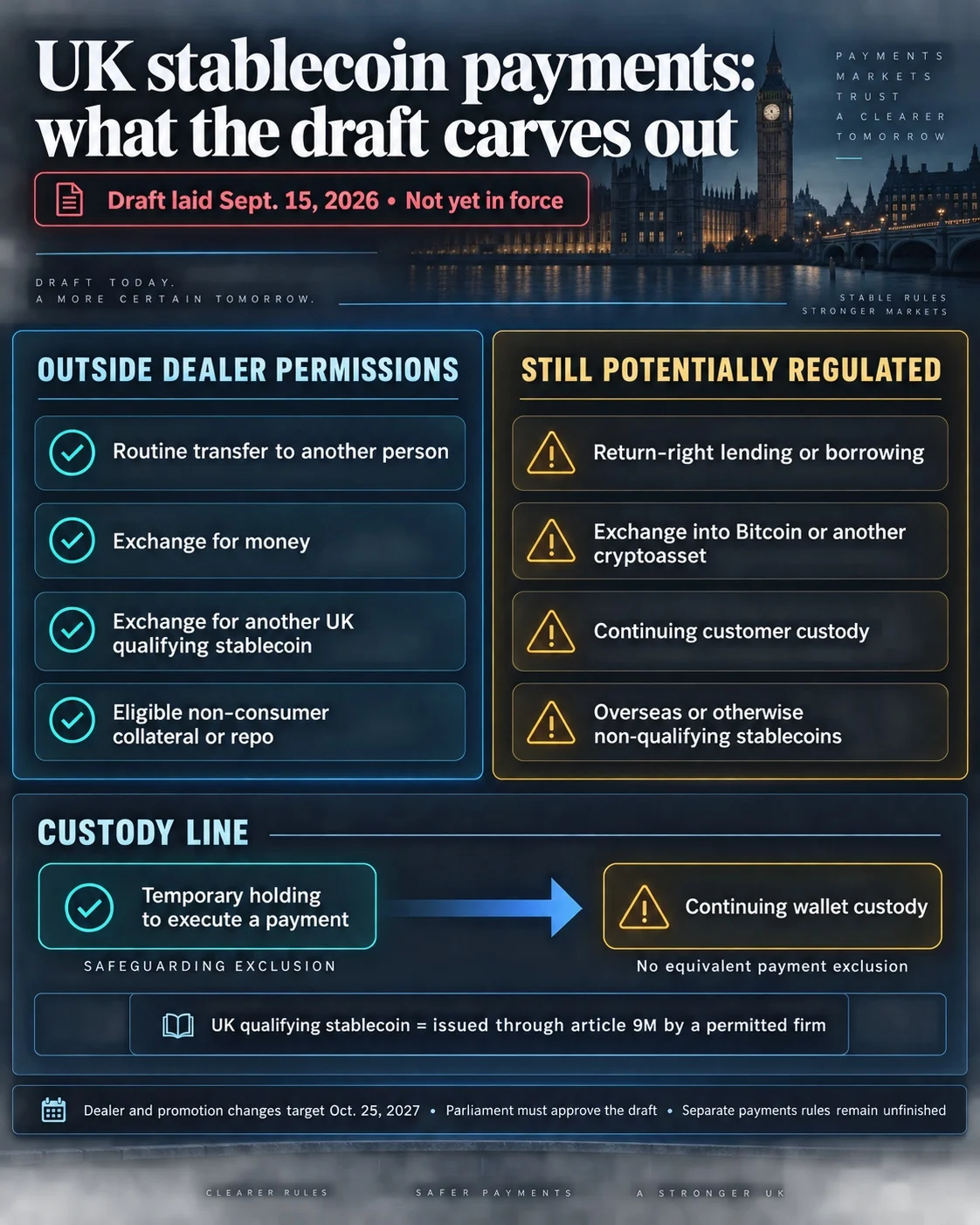
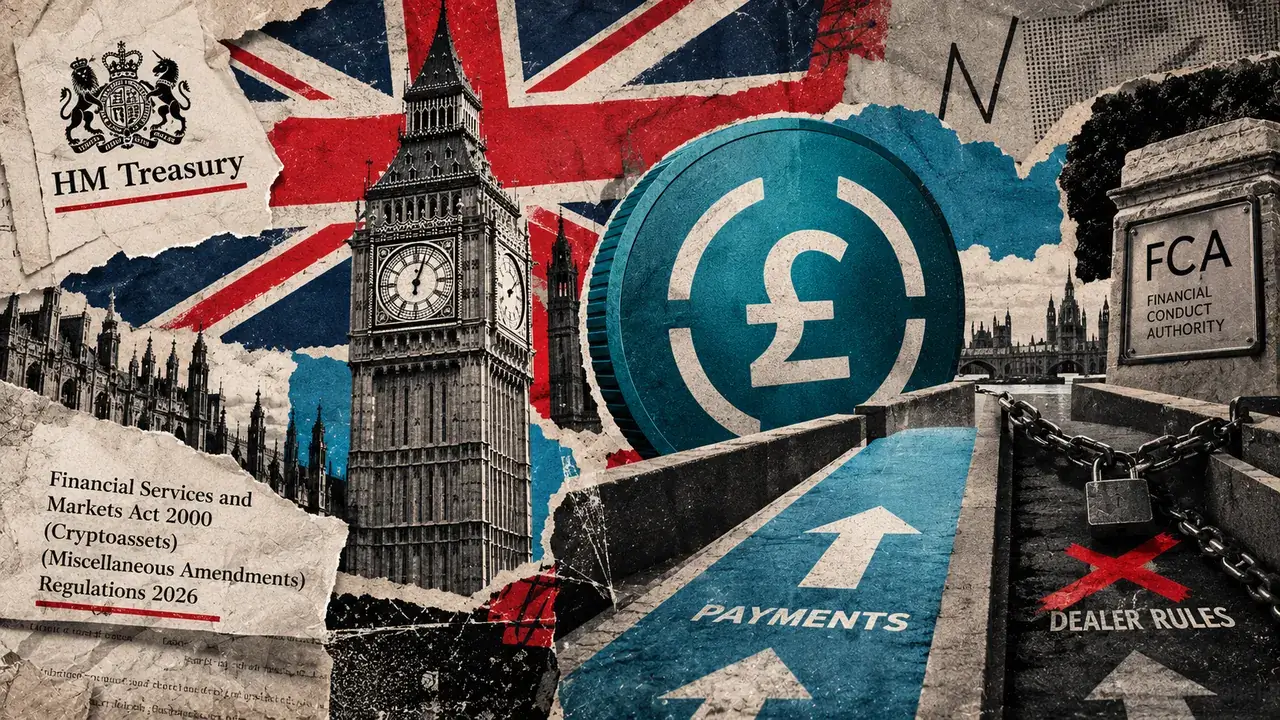
HM Treasury has finalized draft regulations that carve out significant exemptions for certain stablecoin payment activities within the United Kingdom’s upcoming crypto regulatory framework. The Financial Services and Markets Act 2000 (Cryptoassets) (Miscellaneous Amendments) Regulations 2026, laid before Parliament on September 15, aim to streamline the use of qualifying stablecoins for routine transactions while maintaining a stricter stance on crypto lending and other complex financial activities.
This strategic move by the UK government signals a nuanced approach to digital asset regulation, distinguishing between simple payment mechanisms and more intricate financial instruments. The amendments, while not yet in force, are slated to take effect alongside the new regime for crypto firms, anticipated by the Financial Conduct Authority (FCA) to commence on October 25, 2027.
Key Exemptions for Stablecoin Payments
The core of the new regulations introduces a significant carve-out for "qualifying transfers" of UK qualifying stablecoins. These transfers will be removed from the stringent rules governing dealing as principal, dealing as agent, and arranging deals. This means that the simple act of sending a UK qualifying stablecoin to another person, or exchanging it for fiat currency or another UK qualifying stablecoin, could fall outside the dealer perimeter. This exemption is designed to facilitate frictionless payments and cash-like exchanges using regulated stablecoins.
However, the scope of this exemption is carefully defined and is not a blanket endorsement of all stablecoin activity. To qualify, a stablecoin must be issued through a regulated "article 9M activity" by a firm possessing the requisite regulatory permissions. This criterion deliberately excludes overseas-issued tokens or those that merely track sterling without meeting the specific UK issuance requirements. The intention is to ensure that only stablecoins operating under a defined regulatory umbrella benefit from these payment-friendly provisions.
Defining the Boundaries: When Payments Become Regulated Activity
The regulatory landscape shifts significantly when stablecoin transactions begin to resemble traditional financial services like lending or trading. The draft instrument explicitly states that if a transaction involves a "right or obligation to return the stablecoin later," it will not benefit from the basic exclusion. This means that ordinary lending or borrowing activities, even when conducted with qualifying stablecoins, may still be subject to regulation if they meet the underlying activity tests for financial services.
Similarly, swapping a qualifying stablecoin for another type of cryptoasset, such as Bitcoin or Ether, will remain outside the payment carve-out. These transactions are likely to be viewed as cryptoasset exchanges, a category that is subject to its own set of regulatory requirements. The UK’s approach appears to be to foster innovation in payment systems while ensuring that more complex financial intermediation involving digital assets is brought under robust oversight.
Wholesale Arrangements and Collateral
The finalized text also introduces a separate, wholesale-focused exception for certain title-transfer collateral and repurchase (repo) arrangements involving qualifying stablecoins. This exception can be applied when the original holder of the stablecoin is neither a consumer nor falls into a category specifically defined by the FCA. This provision acknowledges the role of stablecoins in institutional finance and wholesale markets, providing clarity for businesses engaging in these types of transactions.
Custody Relief for Temporary Holdings
A notable addition in the draft regulations concerns the temporary holding of UK qualifying stablecoins. A new safeguarding provision will exclude the temporary holding of such stablecoins when it is directly connected with the execution of a payment. This distinction is crucial. It means that firms facilitating payments will not necessarily need full safeguarding permissions solely for the brief period a stablecoin is held during a transaction settlement.
This is a significant evolution from HM Treasury’s April proposal, which had indicated that payment firms would still require safeguarding permission. The previous proposal had also suggested limiting the temporary settlement exclusion to holdings ancillary to other crypto activities. The final draft, however, draws a clearer line between the transient holding of assets for payment execution and the longer-term custody of customer assets, such as maintaining a digital wallet. Continuing custody, which involves ongoing safekeeping of customer assets, does not receive an equivalent payment exception and will likely remain within the scope of safeguarding regulations.
Financial Promotion Rules Align with Transactional Exemptions
The financial promotion rules, which govern how cryptoassets can be marketed, are designed to broadly align with the exemptions for transfers, exchanges, collateral, and repo arrangements. While the coverage is not identical, the principle is to ensure that marketing activities do not inadvertently circumvent the transactional regulations. As with the transactional rules, arrangements that require the stablecoin to be returned will not benefit from the basic financial promotion exemption. This suggests a consistent regulatory intent to distinguish between promotional activities for simple payments and those for more complex, returnable arrangements.
Timeline and Broader Regulatory Context
The amendments to the dealing, arranging, and financial promotion rules are drafted to come into effect on October 25, 2027, coinciding with the FCA’s anticipated launch of its new regime for crypto firms. Amendments made through regulation 4 of the instrument will take effect after the instrument itself is made and approved by Parliament.
This development occurs against a backdrop of broader regulatory efforts in the UK to modernize its payments landscape. HM Treasury’s separate payments reform initiatives are still underway and will define the longer-term rules for stablecoins utilized in payment systems. This suggests a phased approach to stablecoin regulation, with an initial focus on establishing a clear framework for payments and gradually addressing other use cases.
Background and Evolution of UK’s Crypto Regulation
The UK has been progressively developing its approach to cryptocurrency regulation. Initially, the focus was on anti-money laundering (AML) and counter-terrorist financing (CTF) regulations, bringing crypto exchanges and wallet providers under the purview of the FCA. The introduction of the Financial Services and Markets Act 2000 (Regulated Activities) (Amendment) Order 2023 brought certain cryptoassets, including stablecoins, within the scope of financial promotion rules and regulated activities.
The April 2024 policy statement by HM Treasury outlined its intention to bring cryptoassets within the regulatory perimeter, emphasizing a risk-based approach. The focus was on activities that mirrored traditional financial services, such as operating exchanges, arranging deals, and providing custody. The distinction between security tokens, e-money tokens (stablecoins), and other cryptoassets was a key element of this evolving framework.

The draft instrument laid before Parliament on September 15 represents the latest iteration of these efforts, reflecting feedback and further policy refinement. The inclusion of specific exemptions for stablecoin payments indicates a deliberate effort to foster the adoption of digital currencies for everyday transactions, while simultaneously ensuring that the UK remains a hub for responsible innovation in the digital asset space.
Potential Impact and Analysis
The distinction between payment activities and other forms of stablecoin utilization is a critical development for the UK’s digital asset ecosystem. By creating a clearer path for stablecoin payments, HM Treasury is potentially encouraging greater adoption of these instruments for remittances, e-commerce, and other transactional purposes. This could lead to increased competition within the payments sector and potentially lower transaction costs for consumers and businesses.
The careful delineation of what constitutes a "qualifying transfer" underscores the importance of regulatory compliance for stablecoin issuers. Only those that adhere to the stringent issuance requirements will be able to leverage the payment exemptions. This is likely to drive a consolidation in the stablecoin market, favoring issuers that are willing and able to meet regulatory expectations.
The continued regulation of crypto lending and swapping activities highlights the UK’s cautious approach to activities that carry higher risks. By keeping these under stricter oversight, the government aims to protect investors and maintain financial stability. The fact that return-right lending remains potentially regulated, even with qualifying stablecoins, suggests a concern about the inherent risks of credit creation and maturity transformation within the crypto space.
The relief provided for temporary custody during payment execution is a pragmatic adjustment, acknowledging the operational realities of payment processing. It avoids placing an undue regulatory burden on firms simply facilitating the flow of funds. However, the continued requirement for safeguarding permissions for longer-term custody reinforces the FCA’s commitment to protecting customer assets.
Industry Reactions and Future Outlook
While specific industry reactions to the finalized draft regulations are still emerging, the general sentiment from FinTech and crypto associations has often been one of cautious optimism. The UK’s commitment to establishing a comprehensive regulatory framework is generally welcomed, as it provides clarity and certainty for businesses.
However, the nuances of the regulations, particularly the precise definitions of "qualifying transfers" and the boundaries of regulated activities, will require careful interpretation by legal and compliance teams within the industry. The industry will likely be keen to understand the specific criteria the FCA will use to assess whether a transaction falls outside the payment carve-out, especially in edge cases involving complex payment structures.
The ultimate success of these regulations will depend on their clarity in implementation and their ability to strike a balance between fostering innovation and mitigating risks. As the UK continues to refine its approach to digital assets, these amendments represent a significant step towards integrating stablecoins into the mainstream financial system, albeit with carefully defined parameters. The ongoing payments reform will further shape the long-term landscape, promising a more comprehensive regulatory environment for stablecoins in the years to come. The UK’s measured approach, differentiating between payment utility and financial intermediation, positions it as a potentially significant player in the global digital asset economy.