admin
admin
The surge in adoption reflects a broader shift in the global perception of digital assets, which are increasingly viewed not merely as speculative instruments but as legitimate components of a modern financial portfolio. As the market matures, the influx of both retail and institutional capital has created a feedback loop of legitimacy and accessibility, driving ownership rates to unprecedented heights despite the inherent volatility of the asset class.
The 2021 Growth Trajectory: A Year of Tripling Adoption
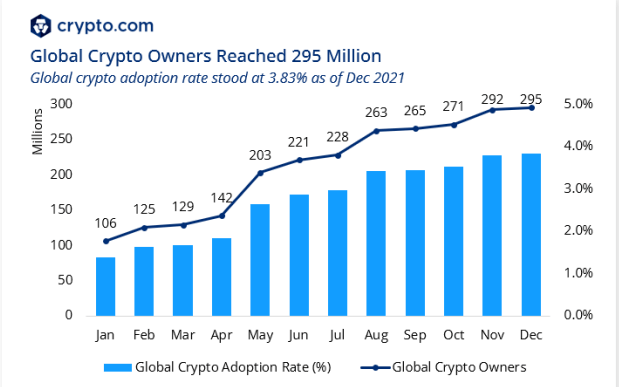
To understand the momentum heading into 2022, it is essential to examine the extraordinary growth witnessed over the previous year. In January 2021, the global crypto-using population stood at a relatively modest 106 million. By the close of the year on December 29, that figure had ballooned to 295 million. This represents a nearly 178% increase in just twelve months. If the market maintains even a fraction of this growth rate, the threshold of one billion users—representing roughly one-eighth of the world’s population—becomes a mathematically plausible reality.
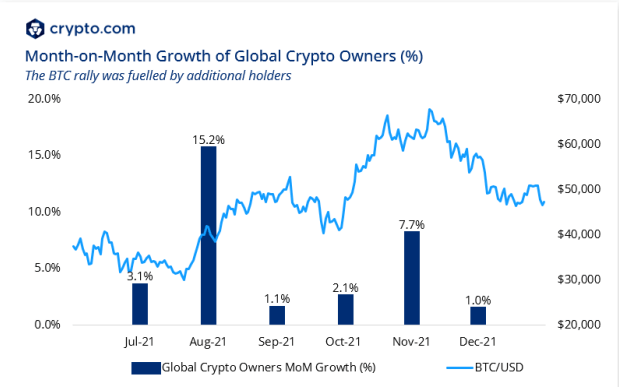
The growth was not uniform throughout the year but was punctuated by specific periods of intense market activity. The most significant month-on-month increase occurred in August 2021, when the user base expanded by 15.2%. This surge preceded a major market rally, culminating in Bitcoin reaching its all-time high of approximately $69,000 in November. While growth rates moderated in September and October—registering increases of 1.1% and 2.1% respectively—the underlying trend remained firmly upward.

Institutional Catalysts and Legislative Milestones
While retail investors have historically been the primary engine of cryptocurrency adoption, 2021 marked a definitive turning point for institutional involvement. The year was defined by a series of high-profile endorsements and legislative breakthroughs that provided the "social proof" necessary for more conservative segments of the population to enter the market.
Perhaps the most significant milestone was El Salvador’s decision to adopt Bitcoin as legal tender. The implementation of the Bitcoin Law in September 2021 served as a global case study for the practical utility of decentralized currency at a sovereign level. Despite domestic and international criticism, the move signaled to the world that Bitcoin had evolved into a tool for national financial strategy.
Simultaneously, the corporate world saw massive entries from major financial institutions and tech companies. Entities such as Tesla, MicroStrategy, and Square (now Block) added Bitcoin to their balance sheets, while payment giants like PayPal and Visa integrated crypto services into their global networks. These developments removed many of the technical barriers to entry for average consumers, allowing them to engage with digital assets through familiar interfaces.
Bitcoin Dominance and the "Gateway" Effect
The Crypto.com report highlights a significant disparity in the types of assets held by the global user base. As of early 2022, Bitcoin remains the undisputed leader in terms of adoption. Approximately 176 million people, or nearly 60% of all crypto users, hold Bitcoin in their portfolios. In contrast, Ethereum ownership stands at roughly 23 million users. However, there is a notable overlap, with 23% of the total user base holding both of the market’s leading assets.
Bitcoin’s dominance in user count is attributed to its status as the "gateway" cryptocurrency. For many new entrants, Bitcoin represents a digital version of gold—a store of value that is easier to understand than the complex smart-contract ecosystems of its competitors. Its brand recognition far exceeds that of any other digital asset, aided by extensive coverage in mainstream financial media.
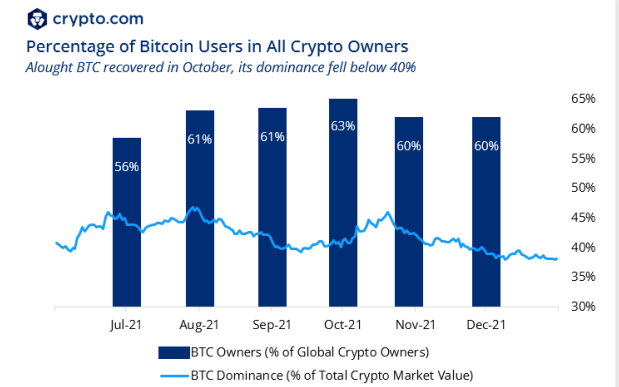
The data reveals that Bitcoin’s market share of users fluctuated in tandem with its price action. In July 2021, 56% of crypto users owned Bitcoin. This figure climbed to 63% by October as the market anticipated a new all-time high. Following the subsequent market drawdown in late November and December, Bitcoin’s share of the user base settled back to 60%. Despite a decline in Bitcoin’s market capitalization dominance—which fell below 40% toward the end of the year—the number of individual owners continues to grow, suggesting that while investors are diversifying their holdings, they are not necessarily abandoning their Bitcoin positions.
The Ethereum Paradox: Stagnation Amidst Innovation
One of the more surprising findings in the report is the relatively stagnant growth of Ethereum users in the latter half of 2021. While Bitcoin users grew by 37.5% between July and December, Ethereum ownership increased by only 1.4%. This is a stark contrast to the first half of the year, where Ethereum adoption surged by 64%.
Several factors likely contributed to this slowdown. First, the Ethereum network has been plagued by high transaction costs, commonly referred to as "gas fees." During periods of high network congestion, the cost to execute a simple swap on a decentralized exchange (DEX) could reach hundreds of dollars, effectively pricing out smaller retail investors.
Second, the rise of "Ethereum Killers"—alternative Layer-1 blockchains like Solana, Avalanche, and Terra—as well as Layer-2 scaling solutions, has fragmented the market. Many users who would have previously onboarded directly onto Ethereum are now opting for EVM-compatible chains that offer faster transactions and lower fees. The report suggests that the total value locked (TVL) in these alternative ecosystems has drawn away both capital and users from the main Ethereum chain.
Furthermore, the complexity of Ethereum’s decentralized finance (DeFi) and non-fungible token (NFT) ecosystems can be daunting for newcomers. While Bitcoin functions as a straightforward digital asset, Ethereum requires a deeper understanding of wallet management and protocol interaction, which may serve as a barrier to mass adoption among less tech-savvy demographics.
Methodology and the "Invisible" Market
It is important to note the methodology used by Crypto.com to arrive at these figures. The data is largely aggregated from 24 of the world’s largest centralized exchanges (CEXs). While the researchers use sophisticated on-chain analysis to cross-check addresses and eliminate double-counting, this approach inherently misses a significant portion of the market.
Users who exclusively utilize decentralized exchanges, self-custody wallets, or private peer-to-peer networks are difficult to track with precision. This suggests that the actual number of global crypto users may already be higher than the reported 295 million. Furthermore, the growth of Ethereum and other smart-contract platforms is often concentrated in the DeFi space; therefore, the low ownership growth reported for Ethereum may be partially due to users moving their assets off centralized exchanges and into private wallets to interact with decentralized applications (dApps).
Broader Implications for the Global Economy
The prospect of reaching one billion users carries profound implications for the global financial architecture. As the user base grows, the pressure on regulators to provide clear frameworks increases. Governments in major economies, including the United States, the European Union, and India, are currently debating the degree to which they should integrate or restrict digital assets. Mass adoption makes outright bans increasingly difficult to enforce and politically unpopular.
From an infrastructure perspective, reaching one billion users will necessitate a massive scaling of existing technology. Current blockchain networks must evolve to handle the transaction volume of a global population. This explains the urgency behind Ethereum’s transition to Proof of Stake and the continued development of the Bitcoin Lightning Network, which aims to make Bitcoin a viable medium for daily micro-transactions.
Finally, the shift toward a billion users signals a demographic change in wealth management. Younger generations, who are often skeptical of traditional banking systems, are leading the charge into digital assets. As a massive intergenerational transfer of wealth occurs over the next decade, the preference for digital-native assets is expected to solidify, potentially making cryptocurrency a standard pillar of global finance.
Conclusion: A Milestone Within Reach
The journey from 100 million to nearly 300 million users in a single year demonstrates that the cryptocurrency industry has reached an "escape velocity" of sorts. While market volatility and regulatory hurdles remain, the momentum of adoption appears resilient. The forecast of one billion users by the end of 2022 is more than just a bullish prediction; it is a reflection of a world that is rapidly digitizing its concept of value. Whether Bitcoin maintains its 60% share of that billion-strong crowd or gives way to a more diverse "altcoin" landscape, the fundamental trend is clear: the era of the digital asset is no longer a future possibility, but a present reality.