admin

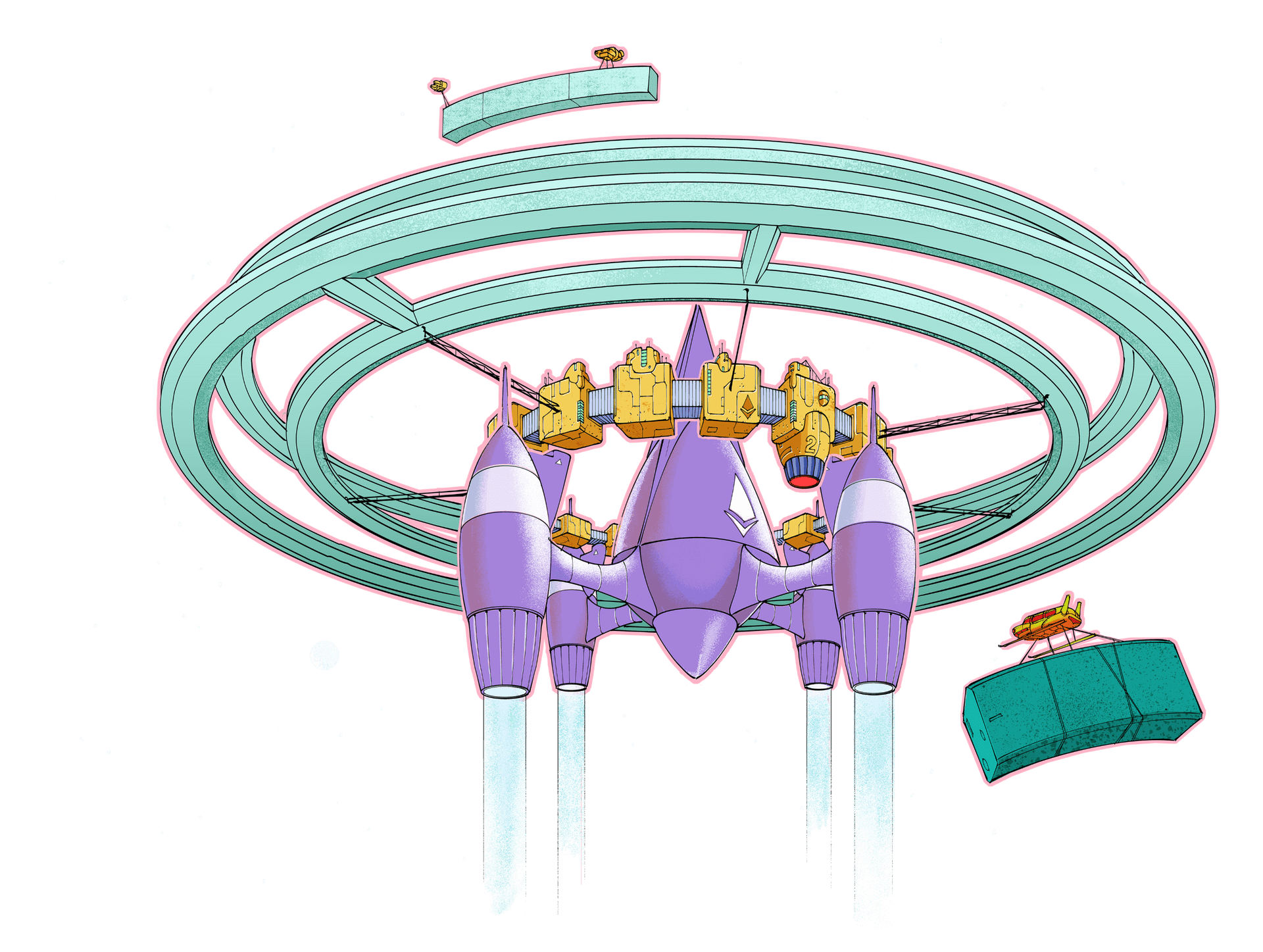
The Ethereum blockchain, the world’s second-largest decentralized network by market capitalization, is currently approaching one of the most significant technical milestones in the history of distributed ledger technology. Often likened to "changing the engine of an airplane mid-flight," the transition from a Proof-of-Work (PoW) consensus mechanism to a Proof-of-Stake (PoS) system—commonly known as "The Merge"—is a multi-year engineering feat designed to enhance the network’s sustainability and security. However, as the developer community and global stakeholders prepare for this transition, a critical vulnerability has emerged in the form of client diversity. The reliance of a supermajority of the network on a single software implementation poses a systemic risk that could, under specific circumstances, lead to catastrophic failure or a permanent chain split.

The Architecture of the Transition: Understanding The Merge
The Merge represents the formal joining of Ethereum’s existing execution layer (the Mainnet used today) with its new consensus layer, the Beacon Chain. Since its inception in December 2020, the Beacon Chain has operated as a parallel registry for validators, utilizing Proof-of-Stake while the Mainnet continued to process transactions via Proof-of-Work miners. Upon the activation of The Merge, the Proof-of-Work component will be permanently decommissioned, and the responsibility for block production and validation will shift entirely to PoS validators.
Under this new architecture, the duties of a node are bifurcated into two distinct roles. The first is the Execution Client, which manages the Ethereum Virtual Machine (EVM), processes transactions, and maintains the state of smart contracts. The second is the Consensus Client, which handles the Proof-of-Stake logic, communicates with other nodes to agree on the state of the network, and validates the blocks produced by the execution layer. For the network to remain secure and decentralized, it is essential that these clients are developed by independent teams using different programming languages. This "multi-client" philosophy is a cornerstone of Ethereum’s design, intended to ensure that a bug in one software implementation does not bring down the entire global network.
The Philosophy of Client Diversity vs. The Bitcoin Model
Ethereum’s approach to network software differs fundamentally from that of Bitcoin. The Bitcoin protocol is characterized by its relative simplicity and the dominance of a single primary client, Bitcoin Core. Because the Bitcoin protocol changes infrequently and possesses a limited scope of functionality, the risk of a catastrophic software bug is managed through extreme conservatism in code updates.
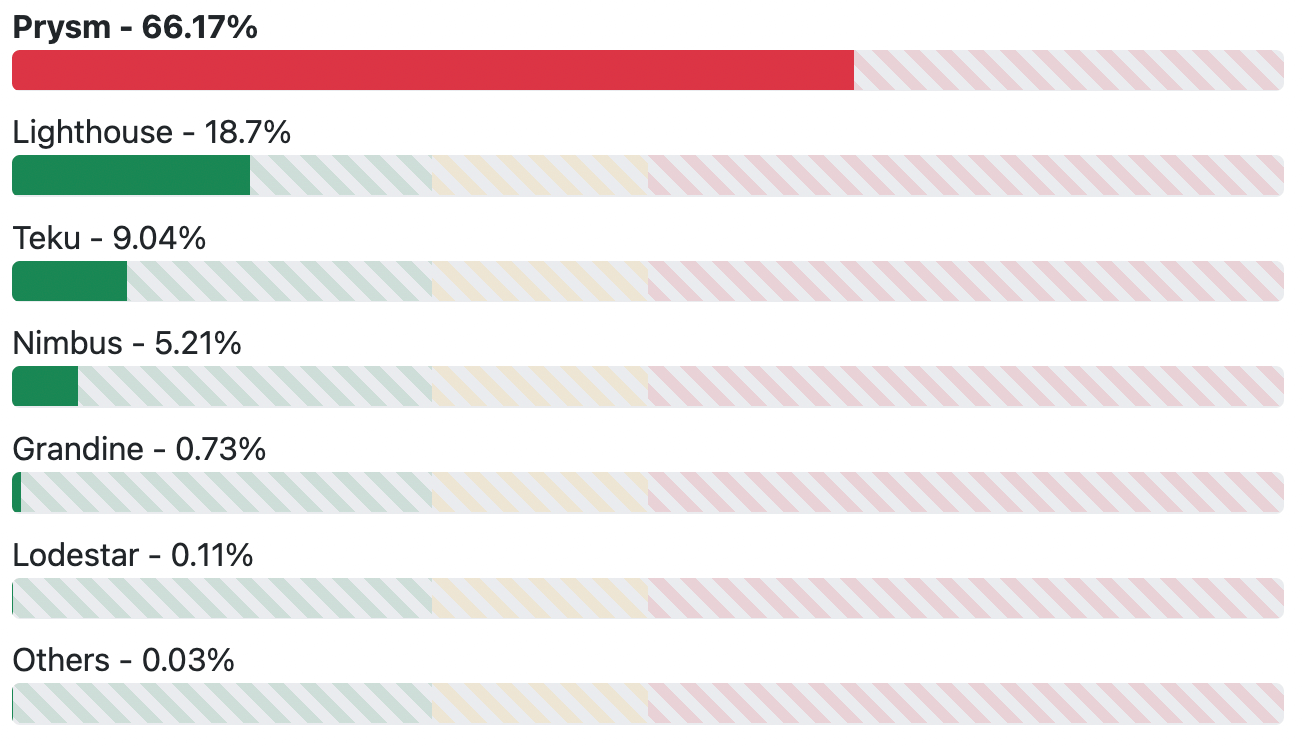
In contrast, Ethereum is a Turing-complete "world computer" with a significantly higher degree of complexity. This complexity increases the surface area for potential vulnerabilities. To mitigate this risk, the Ethereum Foundation and the core developer community have encouraged the development of multiple client versions, including Prysm, Lighthouse, Teku, Nimbus, and others. The theoretical goal is a balanced distribution where no single client controls more than 33% of the network. If a bug occurs in a minority client, the rest of the network can continue to function while the issue is patched. However, the current reality of the network suggests that this defensive strategy is being undermined by market concentration.
The Supermajority Risk: A "Game Over" Scenario
The security of the Proof-of-Stake consensus mechanism relies on specific mathematical thresholds. These thresholds determine how the network reacts to technical failures or malicious attacks.
- The 33% Threshold: If a client with less than one-third of the total staked Ether (ETH) experiences a bug that causes it to go offline or produce invalid blocks, the network continues to finalize transactions without interruption. The affected validators may face minor "inactivity leaks" (small penalties), but the system remains stable.
- The 50% Threshold: If a bug affects a client used by more than half of the network, the blockchain can no longer reach "finality"—the point at which a transaction is considered irreversible. While the network may continue to produce blocks, users would face significant uncertainty, and automatic mechanisms would eventually begin to penalize the malfunctioning nodes to restore balance.
- The 66% Supermajority Threshold: This is the "critical zone." If a single client implementation is used by more than 66% (two-thirds) of validators, a bug in that client could cause the network to finalize an incorrect or "buggy" version of the blockchain. In this scenario, the non-buggy minority clients would be unable to stop the finalization of the incorrect chain. The result would be a permanent split where the only options are to follow the corrupted chain or initiate a contentious hard fork to create a new, corrected version of Ethereum. This has been described by developers as a "game over" scenario for the network’s immediate stability.
Current Market Distribution and the Dominance of Prysm
As of the current monitoring period, the Prysm client, developed by Prysmatic Labs, maintains a dominant position in the Ethereum ecosystem. Data indicates that approximately two-thirds of the network’s staking power is concentrated within Prysm. While Prysm is widely regarded as a high-quality, stable, and well-documented client, its sheer dominance creates a single point of failure.
Marius van der Wijden, an Ethereum core developer, attributes Prysm’s success to several factors, primarily its "first-mover advantage." Prysm was the first client to offer a functional prototype for the Beacon Chain, allowing it to build robust tooling, a user-friendly web interface, and comprehensive documentation long before its competitors. Additionally, Prysm is written in Golang (Go), a programming language that strikes a balance between high performance and readability, making it attractive to developers who were already familiar with Geth (Go-Ethereum), the dominant client of the Proof-of-Work era.
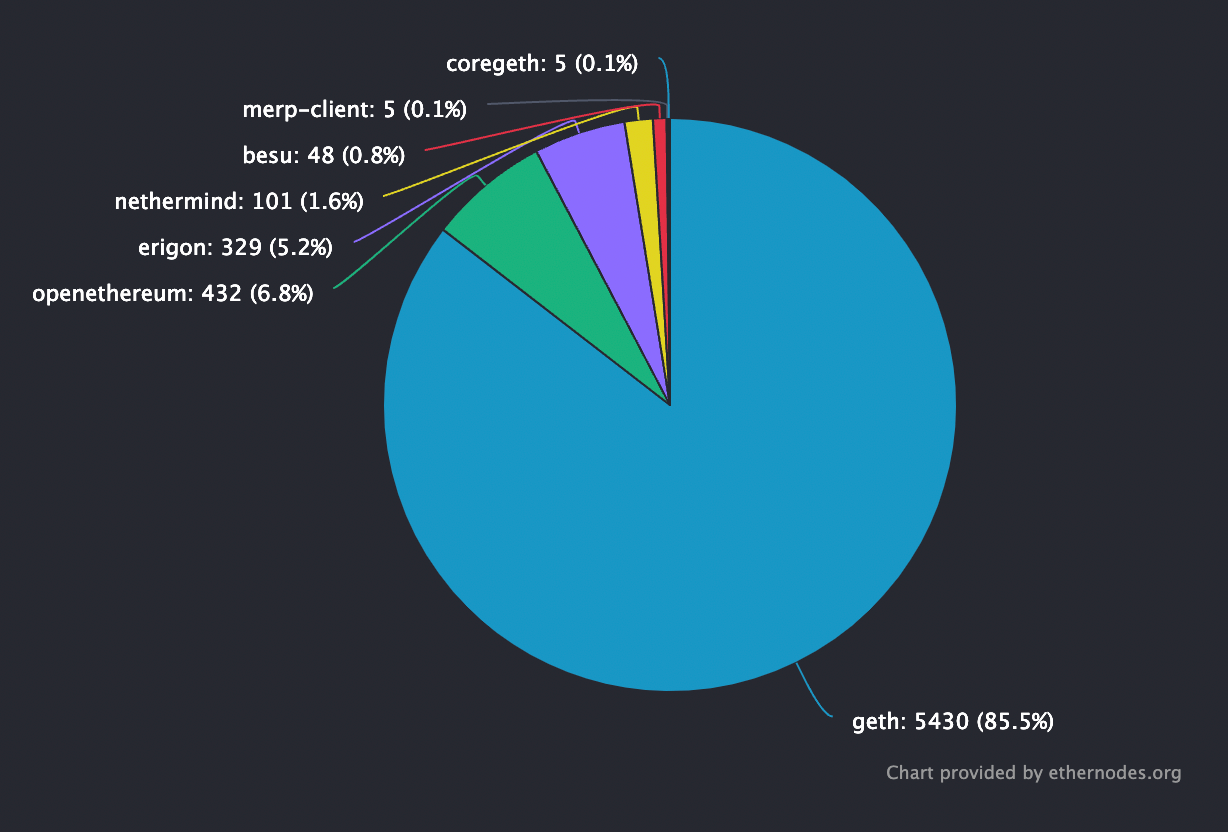
While Geth currently holds an 85% market share on the execution layer, developers note that this is less concerning post-Merge because execution clients do not dictate consensus in the same way. The consensus layer is where the ultimate authority regarding the "truth" of the blockchain resides.
The Role of Institutional Stakers and Exchanges
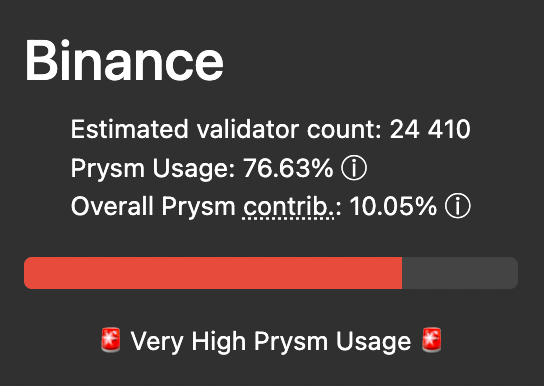
The concentration of client usage is not merely a result of individual hobbyist choices; it is largely driven by major institutional players. Centralized exchanges and staking-as-a-service providers, such as Coinbase, Kraken, and Binance, manage tens of thousands of validator nodes on behalf of their customers.
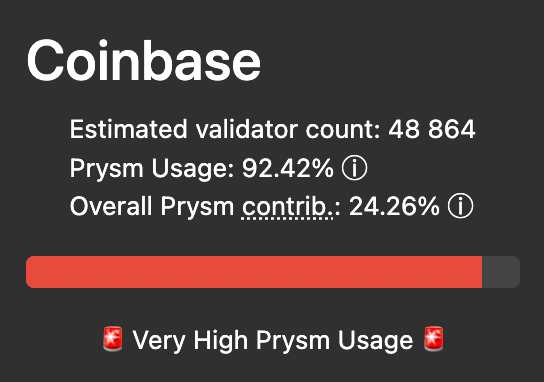
Coinbase, for instance, operates over 48,000 validators, representing roughly 17.5% of the total network. Reports suggest that over 92% of Coinbase’s validators run on Prysm. When questioned about this concentration, Coinbase pointed to the maturity of Prysm’s security features, specifically its support for "remote signers." This feature allows validators to store private keys in isolated, secure environments rather than on the validator server itself, which is a prerequisite for institutional-grade security.
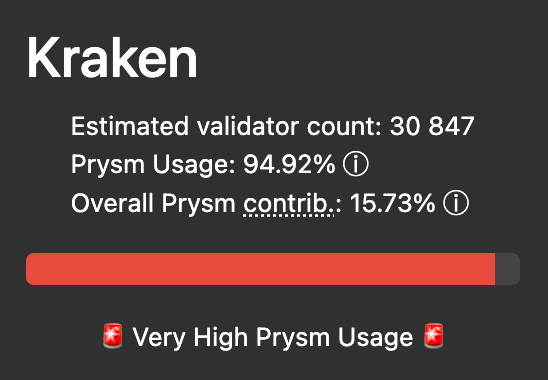
Similarly, Kraken, which manages approximately 11% of the network’s validators, has shown a 94.9% reliance on Prysm. Brian Hoffman, Senior Product Manager at Kraken, acknowledged that the choice was based on Prysm’s stability during the early stages of the Beacon Chain. However, in response to growing concerns from the Ethereum Foundation, Kraken has begun a migration process to incorporate Teku, another consensus client, to improve its internal diversity.
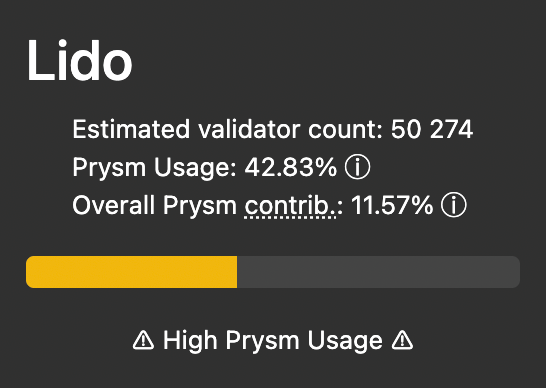
Lido, the largest decentralized liquid staking protocol, also contributes to the issue, though to a lesser extent, with a Prysm usage rate of approximately 42.8%. In contrast, smaller, more decentralized projects like Rocket Pool have led the way in diversity, with only about 10% of their nodes running Prysm.
Technical Mitigation and the Path to Client Parity
The process of switching clients is not inherently difficult for individual node operators. Developers suggest that a validator can switch from Prysm to Lighthouse or Teku in a matter of minutes, provided they follow strict protocols to avoid "double-signing," which can lead to "slashing" (the permanent loss of a portion of staked ETH).
For large-scale institutions, however, the transition is more complex. These organizations have built extensive monitoring, reporting, and failover infrastructure specifically around the Prysm API. Migrating to a new client requires updating these internal systems and conducting rigorous testing to ensure that the change does not lead to downtime or financial loss for their clients.
Despite these hurdles, the Ethereum Foundation is actively facilitating discussions with major exchanges to incentivize a shift. There is a growing "social consensus" among developers that if a supermajority client fails, the network will not bail out the affected validators. This serves as a powerful financial incentive for stakers to diversify; if they remain on a majority client that bugs out, they risk losing their entire stake, whereas those on minority clients would remain safe.
Implications for the Future of Ethereum
As The Merge approaches, the Ethereum community faces a paradox: the network is becoming more technologically advanced and energy-efficient, yet it remains vulnerable to the risks of centralization through software monoculture. The developer community remains confident in the safety of the transition, citing the rigorous "fuzzing" and testing protocols that run continuously to identify discrepancies between different client implementations.
Marius van der Wijden remains optimistic about the timeline, stating that while the distribution is not ideal, the chances of a catastrophic consensus failure are statistically low. He emphasized that the Ethereum ecosystem has the resilience to push out rapid updates and resolve forks if an issue arises.
The long-term success of Ethereum post-Merge will likely depend on whether the ecosystem can move toward a "33-33-33" distribution among at least three major clients. Achieving this would solidify Ethereum’s status as the most robust and decentralized smart contract platform in existence. For now, the focus remains on the "airplane engine" swap, with the hope that the diversity of the crew and the redundancy of the systems will ensure a smooth flight into the Proof-of-Stake era.