admin

The Ethereum network, currently the world’s second-largest blockchain by market capitalization and the primary layer for hundreds of billions of dollars in decentralized finance (DeFi) assets, is approaching its most significant technical milestone since its inception in 2015. Scheduled for the middle of this year, the transition from a Proof-of-Work (PoW) consensus mechanism to a Proof-of-Stake (PoS) system represents a fundamental shift in how the network secures itself and validates transactions. This transition, widely known as "The Merge," has been likened by industry experts to the feat of replacing an airplane’s engine while it remains in full flight. Because Ethereum serves as the foundational infrastructure for a global ecosystem of stablecoins, non-fungible tokens (NFTs), and smart contracts, the network cannot afford even a momentary cessation of block production or a compromise in data integrity.

Unlike the Bitcoin network, which relies almost exclusively on a single implementation of its protocol (Bitcoin Core), the Ethereum community has long championed a philosophy of software multi-culture. Under the guidance of the Ethereum Foundation (EF) and leading developers, the ecosystem has cultivated multiple independent versions of client software designed to implement the PoS protocol. These clients, which are developed by distinct teams using different programming languages, are intended to provide a safeguard against systemic failure. However, as the date for The Merge draws closer, a growing concentration of staking power within a single client implementation—Prysm—has raised alarms regarding the network’s long-term resilience and its vulnerability to a "supermajority" failure.
The Architecture of the Merge: A Tale of Two Layers
The Merge is not a simple software update but a complex integration of two independent chains. Since December 2020, the Beacon Chain has been running in parallel to the Ethereum Mainnet, serving as a "consensus layer" that does not yet process transactions but manages the registry of validators. The upcoming transition will involve merging the current Ethereum state (the execution layer) with the Beacon Chain.
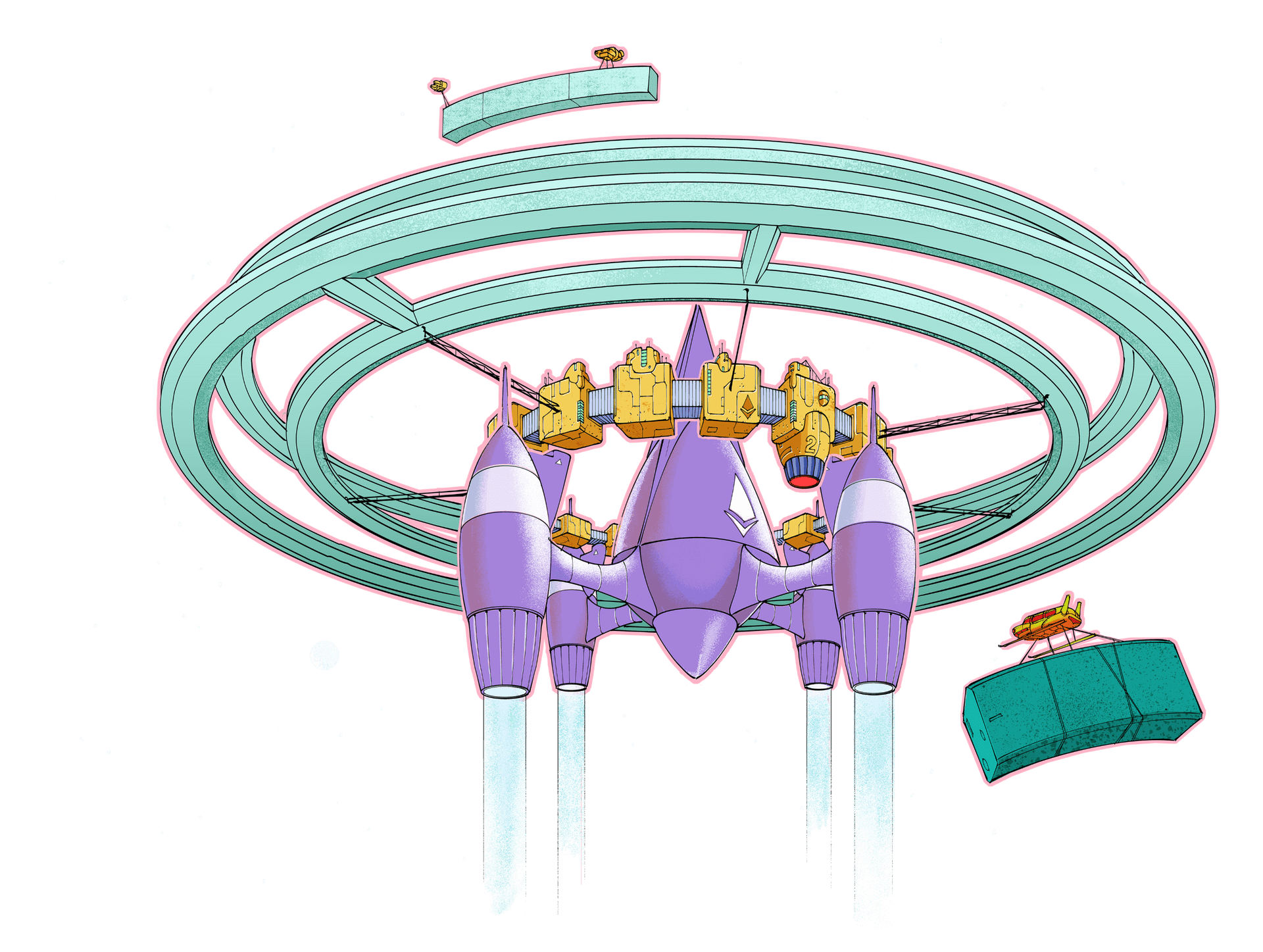
Post-merge, the duties of a node will be bifurcated into two distinct roles. The execution client will manage the Ethereum Virtual Machine (EVM), handle transaction execution, and interact with smart contracts. Meanwhile, the consensus client will handle the validation of those transactions and the achievement of network-wide agreement. This separation of duties is designed to enhance robustness by isolating different logical layers of the protocol. Most existing execution clients, such as Geth (Go-Ethereum), require only minor modifications to communicate with consensus clients, allowing the network to reuse the battle-tested EVM code that has secured Ethereum for years.
The Mathematical Risks of Client Concentration
The primary motivation for maintaining multiple client implementations is to ensure that a bug, vulnerability, or logic error in one software package does not result in a total network collapse. If the distribution of clients is sufficiently diversified, a flaw in one implementation will only affect a minority of nodes, allowing the rest of the network to continue operating while the issue is remediated. However, the current distribution of consensus clients is heavily skewed, creating specific mathematical thresholds of risk:
The 33% Threshold: Preventing Finality
If a single client controls more than one-third (33.3%) of the total staked Ether (ETH), a bug in that client could prevent the network from reaching "finality"—the point at which a block is considered permanently part of the blockchain. While the network would continue to produce blocks, users would face uncertainty as transactions could theoretically be reverted.
The 50% Threshold: Chain Splits
If a client controls more than 50% of the stake, a bug could lead to a temporary split in the chain. While automated mechanisms are in place to eventually reconcile the state, the network would experience significant disturbances, and users would likely see delays in exchange deposits and withdrawals.
The 66% Threshold: The "Game Over" Scenario
The most critical risk occurs if a single client implementation controls more than two-thirds (66.6%) of the network’s staking power. In this "supermajority" scenario, if the dominant client contains a bug that causes it to validate an incorrect block, that block would be finalized by the network. Because the buggy client has the power to reach consensus on its own, the "wrong" version of the chain becomes the official version. In this event, non-buggy clients are faced with a catastrophic choice: follow the buggy chain and accept the corrupted data, or permanently split the network into two separate blockchains.
Analyzing the Dominance of Prysm
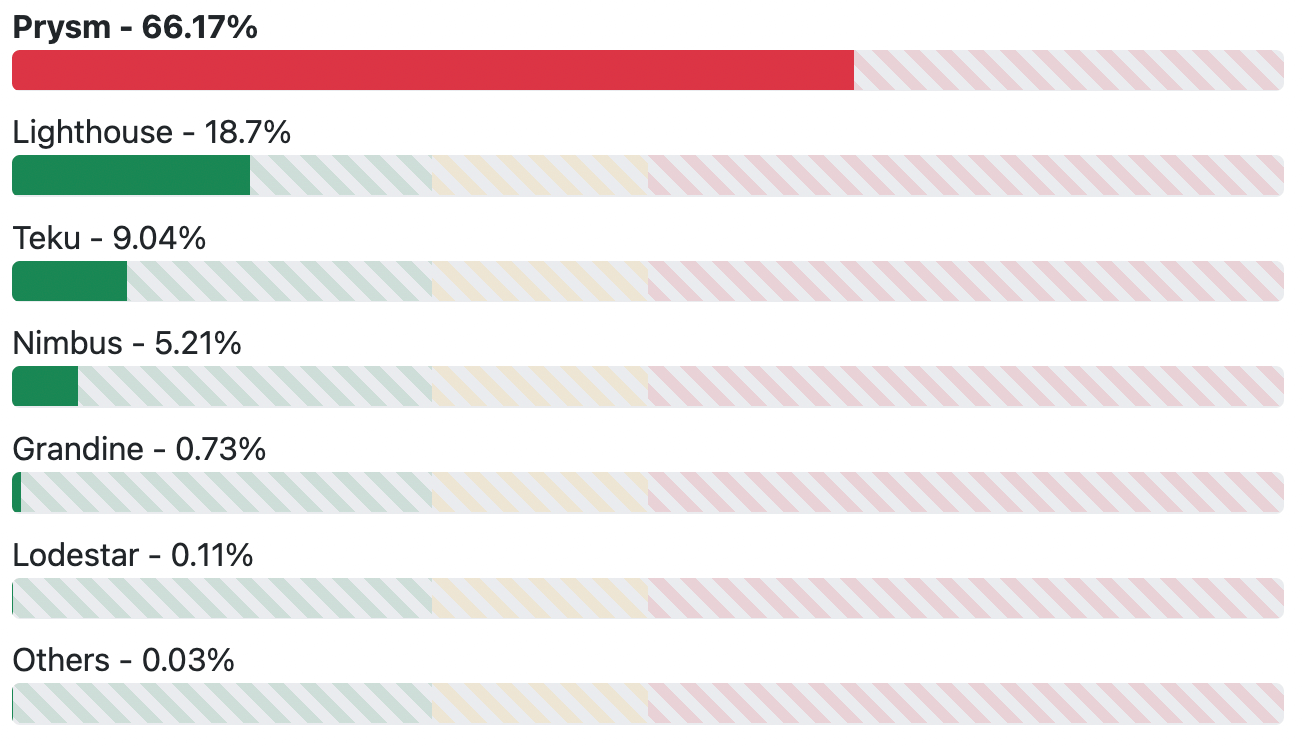
As of current reporting, approximately 66% of the network’s staking power is running the Prysm client, developed by Prysmatic Labs. While Prysm is a highly regarded and stable piece of software, its near-supermajority status creates a single point of failure for the entire Ethereum ecosystem. If a consensus-breaking bug were to be discovered in Prysm today, the results could be existential for the network.
Marius van der Wijden, a prominent Ethereum core developer working on Geth, suggests that Prysm’s dominance is largely a result of first-mover advantage. "Prysm was the first prototype implementation of a beacon client," van der Wijden noted. This early start allowed the team to optimize performance and develop superior tooling, such as a comprehensive Web UI and extensive documentation, which made it the default choice for early adopters.
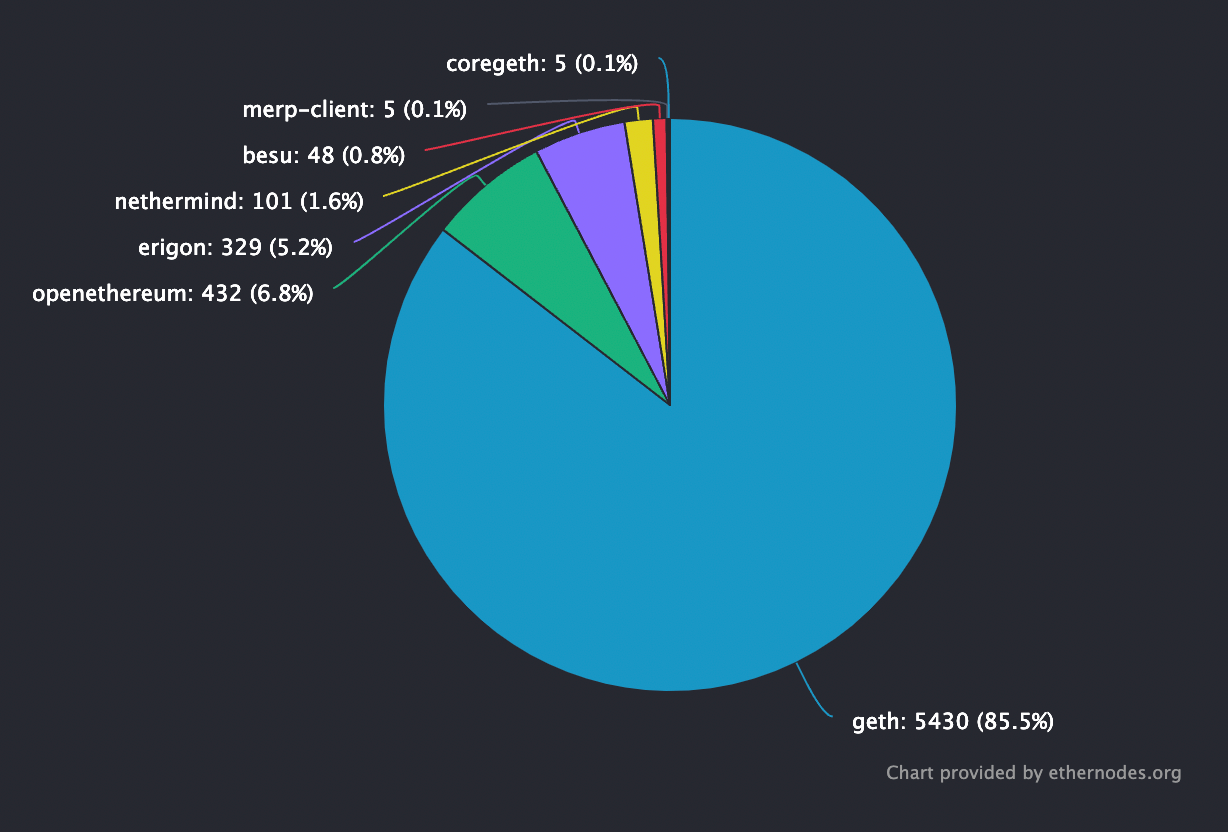
Furthermore, Prysm is written in Golang, the same language as Geth. Since Geth dominates the execution layer with an 85% market share, developers and node operators already familiar with Golang found Prysm to be the most accessible and auditable option. While other clients like Lighthouse (Rust), Teku (Java), and Nimbus (Nim) offer high performance and security, they have struggled to overcome the momentum established by Prysmatic Labs.
The Role of Institutional Stakers and Exchanges
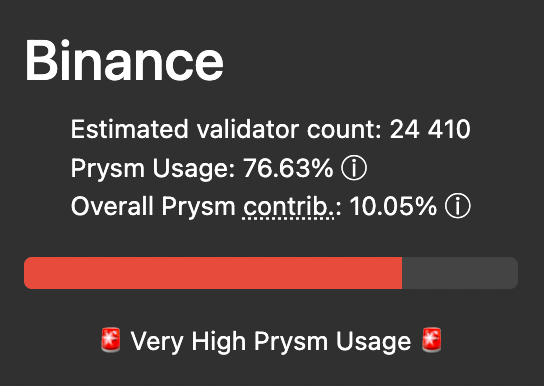
The concentration of client usage is not merely a result of individual hobbyists choosing the most popular software; it is driven by large-scale institutional staking services and centralized exchanges. Major entities such as Coinbase, Kraken, and Binance control a significant portion of the total ETH staked on the Beacon Chain.
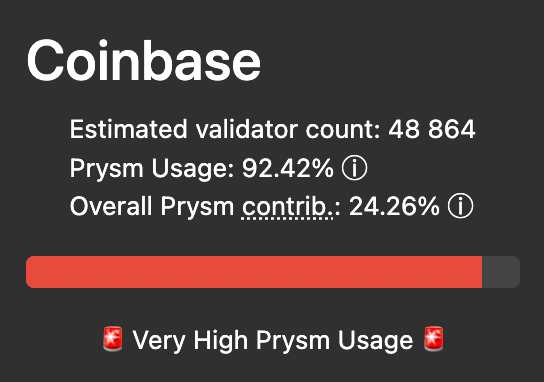
Coinbase alone accounts for approximately 17.5% of all validator nodes. Data indicates that over 92% of Coinbase’s validators run the Prysm client. In response to inquiries regarding this concentration, Coinbase Cloud pointed to security considerations as the primary driver. Early in the Beacon Chain’s life, Prysm was the only client that offered robust support for "remote signers." This feature allows validators to store their private keys in isolated, secure environments rather than on the validator server itself, a requirement for institutional-grade security.
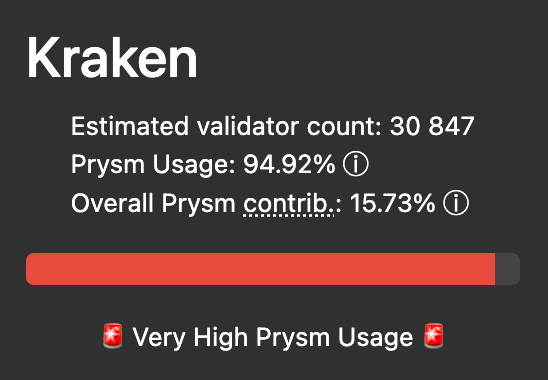
Kraken, which manages roughly 11% of the network’s validators, has shown a similar reliance on Prysm, with a 94.9% usage rate. However, Brian Hoffman, Senior Product Manager at Kraken, indicated that the exchange is actively working with the Ethereum Foundation to diversify its infrastructure. Kraken has begun rolling out new validators using the Teku client and is in the process of migrating existing nodes to reduce the risk of a supermajority failure.
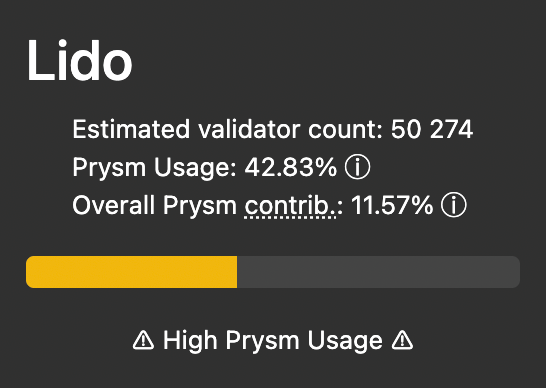
Lido, the largest decentralized staking pool, represents about 18% of the network. While its Prysm usage is lower than that of centralized exchanges at 42.8%, it still contributes significantly to the overall dominance of the client. In contrast, Rocket Pool, a decentralized staking protocol, has emerged as a leader in diversity, with only 10.6% of its nodes running Prysm.
The Road Ahead: Is The Merge Safe?
Despite the risks associated with client concentration, Ethereum’s core developers remain confident in proceeding with The Merge. The community has established a "no-bailout" policy: if a staker chooses to run a majority client and that client fails, the network will not intervene to save their funds. This creates a powerful economic incentive for large stakers to diversify their software to avoid "slashing"—a protocol-level penalty that destroys a portion of a validator’s stake in the event of a consensus failure.
Marius van der Wijden emphasizes that the chances of a catastrophic failure are minimized by rigorous testing and "fuzzing" infrastructure, which constantly searches for discrepancies between different client implementations. "We have great testing and fuzzing infrastructure that runs permanently to find differences between clients," van der Wijden stated. "Even if a consensus failure occurs, we will be able to push out new releases and resolve forks quickly."
The transition to Proof of Stake is a multi-year journey that does not end with The Merge. Future upgrades, such as the "Surge" (aimed at increasing scalability through sharding) and the "Verge" (implementing Verkle trees to simplify node requirements), will further refine the network. However, the immediate challenge remains the social and technical coordination required to decentralize the software that powers the consensus layer.
As the Ethereum community moves toward a more sustainable and energy-efficient future, the diversity of its clients will remain the ultimate metric of its decentralization. While the dominance of Prysm and Geth presents a hurdle, the proactive steps being taken by exchanges and the steadfast commitment of core developers suggest that the "engine swap" of the world’s most active blockchain is being handled with the necessary caution to ensure a safe landing. The success of The Merge will ultimately depend not just on the code itself, but on the willingness of the network’s most powerful participants to prioritize collective security over individual convenience.