admin
admin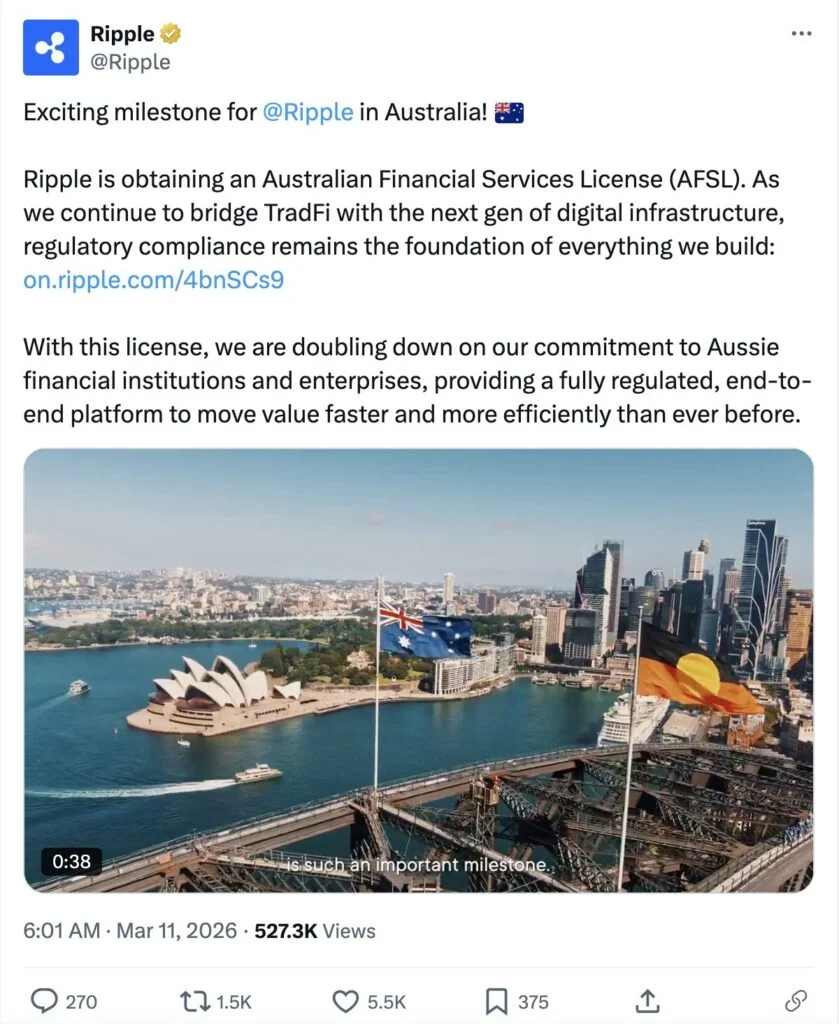
Ripple, a leading enterprise blockchain and crypto solutions provider, is taking a significant step to solidify its global regulatory standing and expand its operational reach with the announced acquisition of BC Payments Australia. This strategic move is designed to secure an Australian Financial Services License (AFSL), a crucial regulatory approval that will enable Ripple to operate more comprehensively within one of the Asia-Pacific region’s most dynamic and evolving financial markets. The acquisition, unveiled on March 11, signals Ripple’s unwavering commitment to building a globally compliant and robust payments infrastructure powered by blockchain technology, further bridging the gap between digital assets and traditional financial systems for enhanced cross-border transactions.
The planned acquisition of BC Payments Australia Pty Ltd, a company with ties to the European Banking Circle Group, is slated to conclude on April 1, pending final regulatory approvals and customary closing conditions. This deal is pivotal as it grants Ripple access to BC Payments’ existing AFSL, which is essential for any entity intending to offer financial services legally within Australia. By obtaining this license, Ripple will gain the institutional credibility and operational permissions necessary to directly manage and expand the capabilities of its Ripple Payments platform across the Australian financial ecosystem. This includes the end-to-end management of financial transactions, encompassing customer onboarding, stringent compliance checks, facilitating funding and foreign exchange, managing liquidity, and executing final payouts – a comprehensive suite of services that underscores Ripple’s ambition to be a full-service payments provider.
A Deep Dive into Ripple’s Global Compliance Strategy
This latest acquisition is not an isolated event but rather a consistent thread in Ripple’s meticulously woven tapestry of global regulatory compliance. The company has long championed the integration of blockchain technology within existing financial frameworks, recognizing that regulatory clarity and adherence are paramount for mainstream institutional adoption. Ripple’s President, Monica Long, succinctly captured this philosophy in a social media post, stating, "Licensing wins keep stacking. Compliance is how we scale." This mantra reflects a strategic imperative to navigate the complex and often fragmented global regulatory landscape for digital assets.

Ripple currently boasts an impressive portfolio of over 75 licenses and regulatory registrations spanning major financial markets worldwide, including North America, Europe, the Middle East, and Asia. Over the past year alone, the company has secured critical payment licenses in key financial hubs such as Singapore, the United Arab Emirates, and the United Kingdom. These approvals are not merely bureaucratic checkboxes; they are foundational elements that allow Ripple to provide regulated financial services, fostering trust and stability among its institutional partners in a sector often plagued by regulatory uncertainties. Furthermore, Ripple recently received conditional approval for a national trust banking charter in the United States, a development that could potentially allow it to operate as a fully regulated financial institution within the U.S., significantly broadening its service offerings and market reach. These successive regulatory victories highlight Ripple’s proactive approach, setting it apart in a rapidly evolving digital finance sector where regulatory frameworks for cryptocurrencies are still taking shape globally.
Australia: A Strategic Gateway in the Asia-Pacific Market
Australia’s role in Ripple’s long-term expansion plans cannot be overstated. Fiona Murray, Ripple’s Managing Director for the Asia-Pacific region, articulated this importance, emphasizing, "Australia is a key market for Ripple, and securing an AFSL strengthens our ability to scale Ripple Payments across the region." The Asia-Pacific region, characterized by its diverse economies, burgeoning digital adoption, and significant cross-border trade volumes, presents an immense opportunity for blockchain-powered payment solutions. Australia, with its sophisticated financial market and increasingly forward-thinking regulatory environment, serves as a crucial gateway to this expansive region.
The timing of Ripple’s move into Australia is particularly strategic, aligning with the country’s active efforts to establish clearer and more comprehensive regulations for the digital asset industry. Australia has rapidly emerged as a significant market for cryptocurrency adoption, attracting both retail investors and a growing number of institutional players. Recognizing this burgeoning sector, Australian lawmakers introduced a Digital Asset Framework bill last year, aiming to create a robust regulatory structure for cryptocurrency companies operating within the nation. This landmark legislation successfully passed through the lower house of parliament earlier in 2026 and is currently undergoing review in the Senate, signaling a clear legislative intent to provide regulatory certainty.
Concurrently, the Australian Securities and Investments Commission (ASIC) has proposed new regulatory guidelines that could mandate crypto platforms offering financial services to obtain an AFSL. While ASIC has stated it will not enforce these licensing requirements for crypto companies until June 30, 2026, Ripple’s proactive decision to secure an AFSL well ahead of this potential enforcement deadline underscores its commitment to compliance and its strategic foresight. This preemptive action not only ensures operational continuity but also positions Ripple as a trusted and compliant partner in the Australian financial landscape. The competitive landscape further affirms Australia’s growing importance, with other major cryptocurrency exchanges, such as Coinbase, reportedly also seeking to obtain an AFSL as part of their broader expansion strategies in the country. This collective movement by industry leaders highlights Australia’s increasing allure as a regulated and mature market for digital assets.

Enhancing the Ripple Payments Ecosystem
The integration of an AFSL will significantly enhance the capabilities of the Ripple Payments platform. This infrastructure is designed to seamlessly integrate traditional banking rails with cutting-edge blockchain technology and digital assets. The primary objective is to enable faster, cheaper, and more transparent cross-border transactions, addressing long-standing inefficiencies in the global payments system. For banks, fintech companies, and various enterprises, this system promises to substantially reduce the costs and time historically associated with moving money internationally. By managing the entire transaction lifecycle, from initial customer onboarding and rigorous compliance checks to facilitating foreign exchange and ensuring efficient liquidity management, Ripple aims to provide a frictionless payment experience.
Beyond regulatory licensing, Ripple’s global expansion strategy is also characterized by strategic acquisitions aimed at strengthening its underlying financial infrastructure and institutional services. A notable recent acquisition was that of Hidden Road, a non-bank prime brokerage firm. Rebranded as Ripple Prime, this platform has allowed Ripple to become the first crypto-native company to operate a multi-asset prime brokerage, offering comprehensive services across a wide spectrum of financial products, including digital assets, derivatives, foreign exchange, swaps, and fixed-income instruments. This acquisition significantly expanded Ripple’s capacity to serve sophisticated institutional clients such as hedge funds, asset managers, and other financial institutions.
Further cementing its position as a holistic financial infrastructure provider, Ripple also acquired GTreasury, a corporate treasury management platform. GTreasury specializes in helping businesses efficiently manage liquidity, payments, and financial risk. Together, these acquisitions underscore Ripple’s ambitious evolution from merely a blockchain technology company to a comprehensive financial infrastructure provider, capable of offering a broad range of services that cater to the complex needs of modern global finance.
Expanding the Utility of XRP and RLUSD

Ripple’s strategic regulatory expansion directly supports the growth and utility of its digital asset ecosystem. Central to this ecosystem is XRP, the native cryptocurrency designed to facilitate liquidity in cross-border payments. XRP enables near-instant settlement between different fiat currencies, dramatically reducing the reliance on pre-funded nostro/vostro accounts in international transfers, thereby unlocking trapped capital and improving efficiency. The XRP Ledger (XRPL), the underlying blockchain network, is engineered for speed and cost-effectiveness, processing transactions rapidly and at minimal expense.
In addition to XRP, Ripple has introduced its own stablecoin, RLUSD, which is pegged to the U.S. dollar and designed to support enterprise payments and financial settlements using digital dollars. The combination of XRP, the XRPL, and RLUSD, bolstered by regulated financial services like those enabled by the AFSL, empowers Ripple to construct a payment infrastructure capable of handling both traditional fiat transactions and digital asset transfers seamlessly and compliantly. With the AFSL in place, Ripple is well-positioned to accelerate the adoption of these technologies within Australia, offering compliant digital asset payment services to banks, fintech firms, and enterprises. This proactive integration of blockchain-based financial infrastructure across the Asia-Pacific region has the potential to set new standards for efficiency and transparency in cross-border payments.
Market Reaction and Outlook
The announcement of Ripple’s acquisition of BC Payments Australia has naturally garnered attention from cryptocurrency traders and investors, often viewing such regulatory milestones as positive indicators for long-term growth and stability. Following the news, XRP displayed a modest but positive upward momentum in the market. The token was observed trading around $1.39, with its 24-hour price range fluctuating between $1.38 and $1.44. More significantly, trading activity for XRP saw a notable increase, with overall volume rising by approximately 37% over the past 24 hours. This spike in trading volume suggests heightened investor interest and confidence following Ripple’s latest regulatory achievement.
Further reinforcing this sentiment, derivatives market data, as reported by CoinGlass, indicated a climb in XRP futures open interest to approximately $2.40 billion. Rising open interest is typically interpreted as a sign of increasing market engagement, as traders open new positions in anticipation of potential price movements, often signaling growing conviction in the asset’s future trajectory. While the immediate price impact of such regulatory developments might appear modest, market analysts widely regard regulatory progress and expanding institutional adoption as crucial long-term catalysts for sustained cryptocurrency growth and mainstream integration.

Looking ahead, Ripple’s planned acquisition of BC Payments Australia represents far more than just an expansion into a new geographical market; it is another deliberate and strategic step in the company’s overarching vision to construct a globally regulated, blockchain-powered payments network. By securing an Australian Financial Services License, Ripple lays down a critical regulatory foundation, enabling it to significantly scale its payment services in one of the Asia-Pacific region’s most economically vital and technologically advanced financial markets. This move is emblematic of a broader, maturation trend within the cryptocurrency industry, where leading companies are increasingly prioritizing robust compliance and regulatory alignment as indispensable requirements for international scaling and long-term viability. As Ripple continues to accumulate licenses, forge strategic partnerships, and enhance its financial infrastructure through targeted acquisitions, the company is poised to play an increasingly influential role in shaping the future of cross-border payments. For the XRP ecosystem, these ongoing developments are expected to further solidify adoption, reinforce its utility, and cement Ripple’s position as a pivotal innovator in the evolving global digital finance landscape.