Dwi Wanna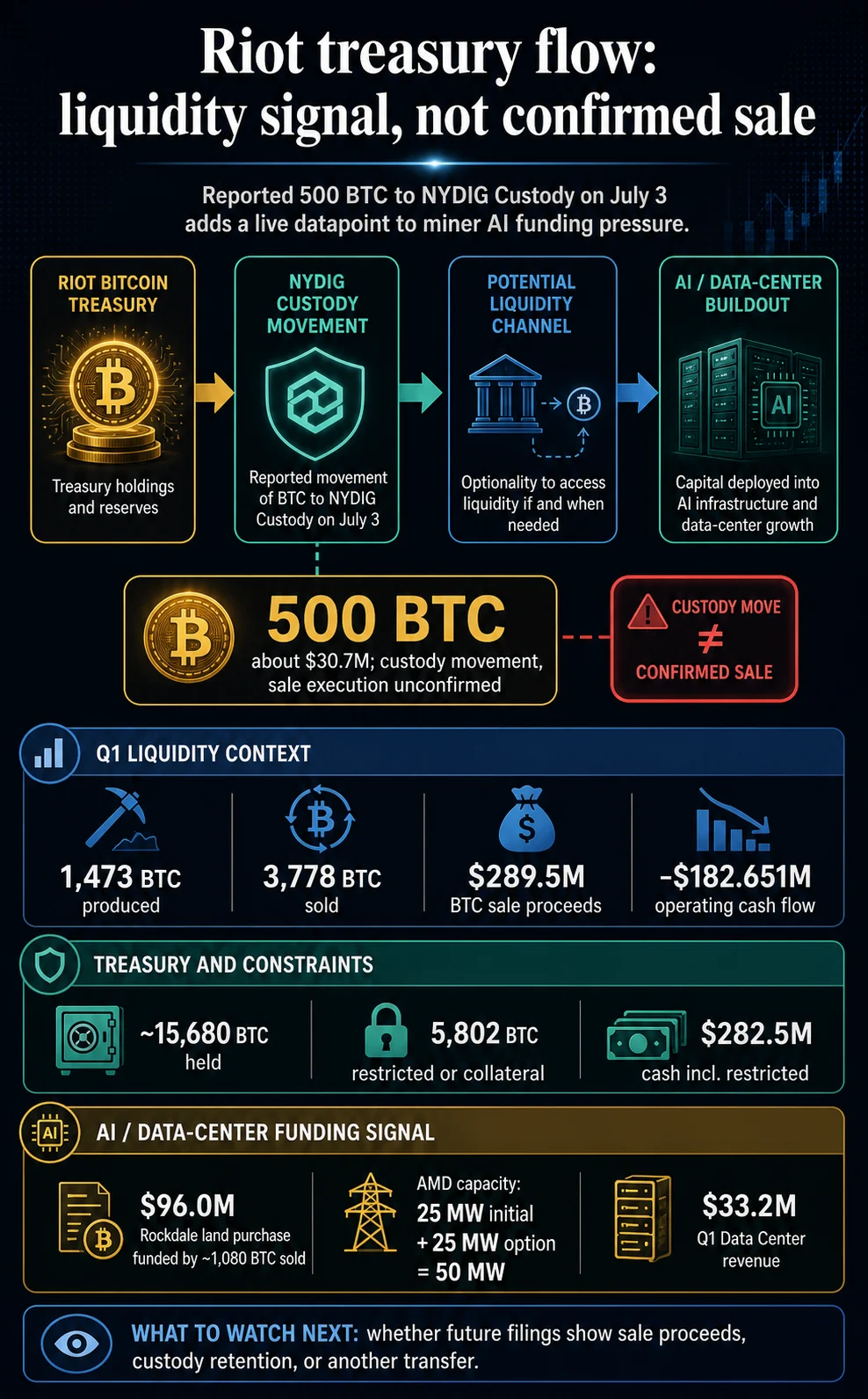
The movement of 500 Bitcoin by Riot Platforms to NYDIG custody on July 3 has emerged as a significant indicator of how publicly traded mining firms are managing their digital asset treasuries in an era of escalating infrastructure costs. Valued at approximately $30.7 million at the time of the transfer, the transaction was first identified through on-chain monitoring data and subsequently reported by PANews. While the available blockchain records confirm a shift in custody, they do not explicitly show an executed sale or the receipt of fiat proceeds. However, within the broader context of Riot’s recent financial disclosures and strategic pivot toward artificial intelligence (AI) and high-performance computing (HPC), this movement serves as a vital signal for market participants regarding the company’s capital allocation strategy.
The distinction between a routine wallet maintenance procedure and a strategic liquidity move is critical for investors. Riot Platforms has recently disclosed a series of financial maneuvers, including substantial Bitcoin sales, the classification of restricted collateral, and a trend of negative operating cash flow. When combined with the company’s aggressive expansion into the data-center sector, a custody transfer of this magnitude suggests a deliberate preparation for liquidity rather than simple administrative shuffling. As the costs associated with power procurement and the development of AI-ready infrastructure continue to climb, Riot’s treasury is increasingly being utilized as a flexible funding mechanism rather than a dormant reserve.
Financial Context: The Divergence Between Production and Sales
To understand why a 500 BTC transfer carries such weight in the current market, one must examine Riot’s financial performance during the first quarter. According to the company’s Q1 production and operations update, Riot produced 1,473 BTC through its mining operations. During the same period, however, the company liquidated 3,778 BTC, generating approximately $289.5 million in net proceeds. This resulted in an average net price of $76,626 per coin, a figure that highlights the company’s ability to capitalize on price strength to bolster its balance sheet.
The data reveals a stark reality: Riot sold more than 2.5 times the amount of Bitcoin it successfully mined during the quarter. Despite this aggressive liquidation, the company maintained a substantial treasury, ending the period with approximately 15,679 to 15,680 BTC. A significant portion of this treasury, specifically 5,802 BTC, was categorized as restricted or held as collateral in Riot’s Q1 financial materials. This suggests that a large percentage of the company’s "HODL" position is already spoken for, either pledged against debt or restricted by contractual obligations, making any movement of the remaining "free" Bitcoin a point of intense interest for analysts.
Riot’s Q1 10-Q filing with the Securities and Exchange Commission (SEC) provides further clarity on the necessity of these sales. The company reported a negative operating cash flow of $182.651 million for the three months ending March 31. The $289.484 million in proceeds from Bitcoin sales served as the primary offset to this cash burn, allowing the company to maintain a cash-on-hand position of $282.5 million, including restricted cash. In this environment, the 500 BTC movement to NYDIG acts as a live liquidity marker, suggesting that the company may be preparing for another round of capital deployment to fund its ongoing operations or capital expenditures.
The Strategic Evolution Toward Digital Infrastructure
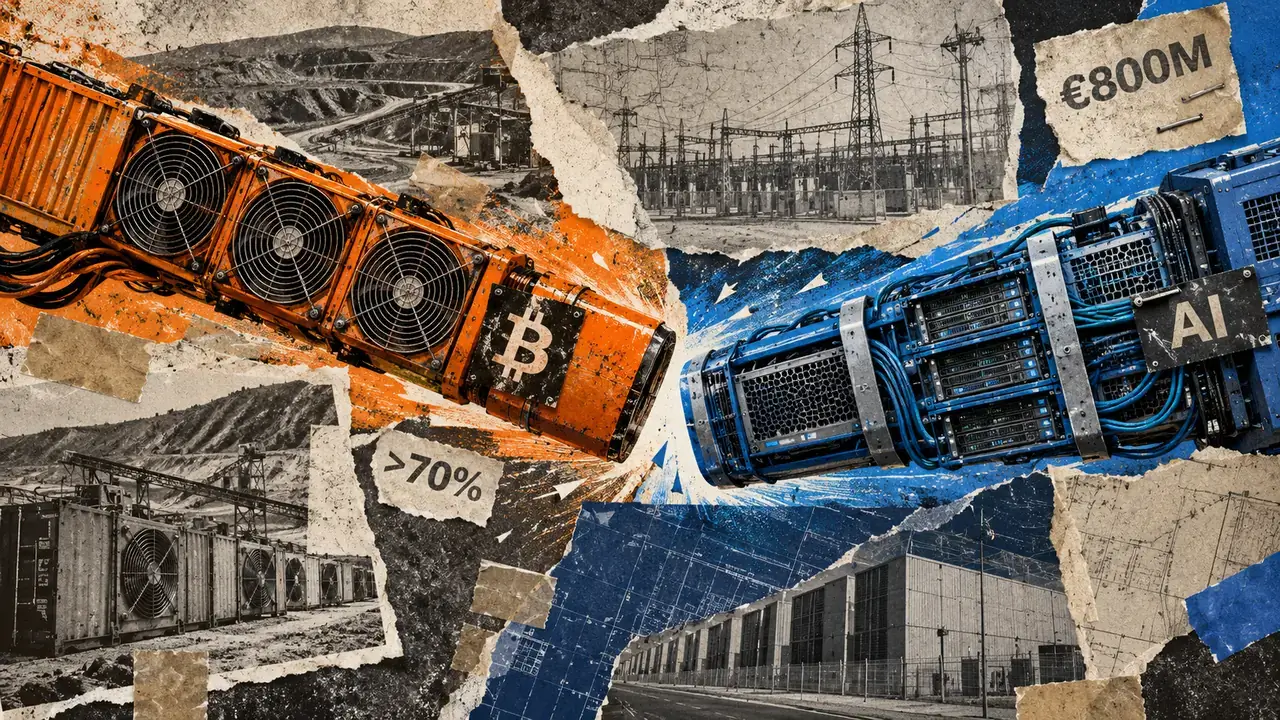
Riot Platforms is currently undergoing a fundamental transformation, repositioning itself from a pure-play Bitcoin miner into a diversified digital infrastructure enterprise. This strategic evolution is driven by the burgeoning demand for data center capacity suitable for AI and high-performance computing. In its recent filings, Riot explicitly describes its mission as developing large-scale data centers that can serve a variety of power-intensive purposes beyond the scope of cryptocurrency mining.
A primary example of this shift is the January acquisition of the Rockdale site. Riot completed a $96 million fee-simple acquisition of 200 acres in Rockdale, Texas, a move funded entirely by the sale of approximately 1,080 BTC from its balance sheet. This transaction established a direct precedent for the monetization of Bitcoin to acquire tangible physical assets and infrastructure. The Rockdale site is not merely intended for more mining rigs; it is the cornerstone of Riot’s expansion into the broader data center market.
Following the acquisition, Riot announced a landmark data-center lease and services agreement with AMD. Initially covering 25 megawatts (MW) of critical IT load capacity, the agreement included options for rapid expansion. By April, AMD had exercised an option for an additional 25 MW, bringing the total contracted capacity to 50 MW. This partnership bore immediate financial fruit, as Riot reported its first quarter of data-center revenue, totaling $33.2 million. While much of this revenue was derived from tenant fit-out services, it marks the beginning of a diversified revenue stream that is less dependent on the volatility of Bitcoin’s price and the network’s mining difficulty.
Chronology of Recent Key Events and Market Signals
The timeline of Riot’s recent activities illustrates a consistent pattern of treasury management in support of expansion:
- January: Riot acquires 200 acres at the Rockdale site for $96 million, funded by the sale of 1,080 BTC. The company announces an initial 25 MW agreement with AMD.
- March 31: Riot concludes Q1 with 15,680 BTC in treasury, but records a $182.6 million deficit in operating cash flow.
- April: AMD exercises its option to double its contracted capacity at Riot’s facilities to 50 MW. Riot reports its first significant data-center revenue.
- May/June: Market focus shifts to the "halving" aftermath, placing increased pressure on miner margins and highlighting the value of contracted power capacity.
- July 3: On-chain data reveals the transfer of 500 BTC to NYDIG custody, signaling a potential move toward further liquidation or collateralization.
This chronology suggests that Riot is not selling Bitcoin out of desperation, but rather as part of a calculated transition. The high cost of building out Tier 3 or Tier 4 data centers—those capable of hosting high-end GPU clusters for AI training—requires massive upfront capital. By leveraging its Bitcoin treasury, Riot is effectively "recycling" its digital gains into physical infrastructure that commands a valuation premium in the current equity market.
Broader Implications for the Bitcoin Mining Sector
Riot’s behavior is emblematic of a broader trend within the Bitcoin mining industry. Following the most recent halving event, which slashed block rewards by 50%, miners have been forced to seek alternative revenue streams or significantly lower their cost of production. Companies like Core Scientific and Terawulf have also made headlines by pivoting toward HPC and AI hosting, often securing long-term contracts that provide the stable cash flow that mining lacks.
For the Bitcoin market, the repeated movement of coins from miner treasuries to exchanges or prime brokers like NYDIG creates a shift in sentiment. Historically, miners were viewed as the ultimate "bulls," hoarding as much supply as possible. In the current era, they are increasingly viewed as active participants in the supply side of the market. While a 500 BTC transfer is relatively small compared to Bitcoin’s daily global trading volume, a consistent cadence of such transfers from multiple public miners could create a persistent "overhead" of supply.
Furthermore, the "AI pivot" changes how analysts value mining stocks. Traditionally valued on a multiple of their Bitcoin production or the size of their BTC treasury, these companies are now being appraised based on their total power capacity and the quality of their data center build-outs. Riot’s decision to move 500 BTC is a reminder that in the race for AI dominance, power is the ultimate currency, and Bitcoin is the tool used to secure it.
Conclusion: Treasury as Infrastructure Funding
The market’s reaction to the NYDIG transfer will likely remain speculative until Riot’s next quarterly disclosure or an interim 8-K filing. However, the available data points toward a clear conclusion: Bitcoin treasuries are no longer just a "store of value" for public miners; they are a vital component of the funding stack for industrial-scale infrastructure projects.
The 500 BTC movement serves as a live datapoint in a much larger story about capital allocation. As Riot continues to build out its Rockdale facility and fulfill its obligations to partners like AMD, the company’s Bitcoin holdings will likely continue to fluctuate. If transfers to custody providers like NYDIG become a steady rhythm, it will confirm that the market should treat miner treasuries as active liquidity pools. For investors, the focus remains on whether the revenue generated by the new AI infrastructure can eventually offset the depletion of the Bitcoin treasury, creating a sustainable, diversified business model for the post-halving era.