admin
admin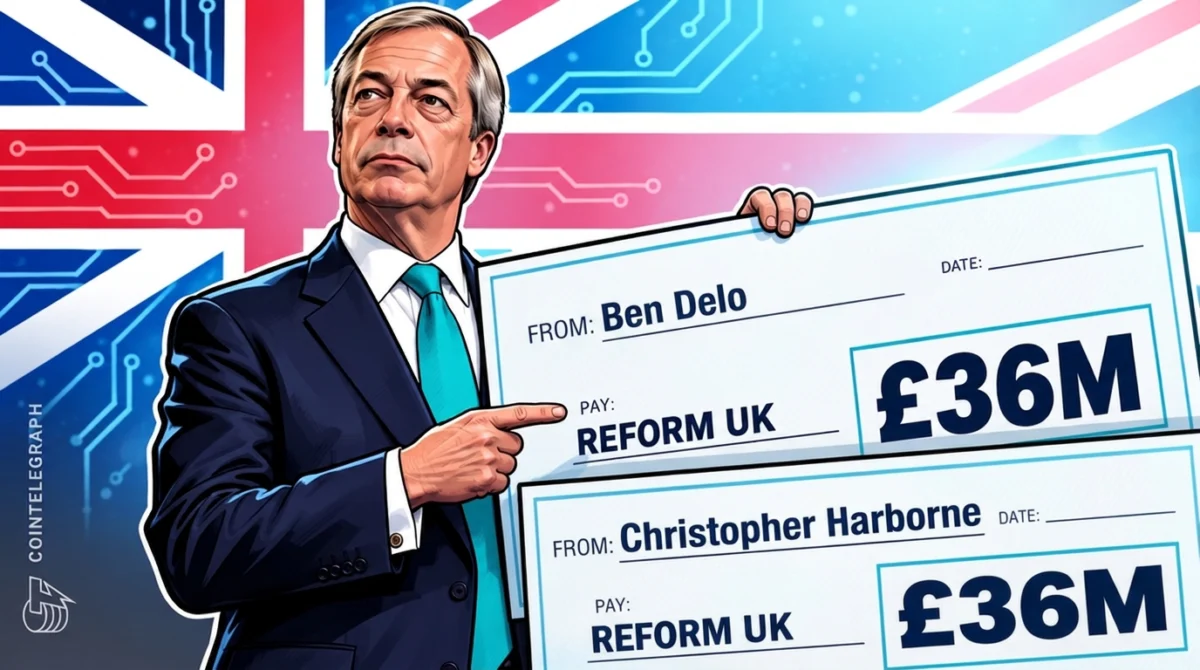
Reform UK, the populist political party led by Nigel Farage, has received an unprecedented £72 million ($97 million) in combined donations from two prominent cryptocurrency billionaires, marking the largest political contributions ever made to a British political party. The colossal sum materialized after Christopher Harborne matched a record-setting donation from Ben Delo, significantly altering the financial landscape of British politics ahead of the anticipated 2029 general election.
The latest infusion of capital saw Christopher Harborne announce his £36 million contribution on Saturday, September 12, 2026, directly following Ben Delo’s identical announcement just a day prior. This combined total of £72 million instantly dwarfs previous donation records and provides Reform UK with a formidable war chest. Harborne, a long-time donor to the party, had previously contributed £9 million in August 2025, underscoring his sustained financial backing for Farage’s political ventures.
The Donors’ Motivations: A "Fair Fight" and No Quid Pro Quo
In an article penned for The Telegraph, Christopher Harborne articulated his motivation, stating that Ben Delo’s initial pledge had inspired him to match the sum. Harborne explicitly denied seeking any personal gain or policy concessions in return for his substantial investment. "No peerage, no policy change, just a party that is ready for government," he asserted, aiming to preempt criticism regarding the influence of such large donations. This statement echoes a long-standing debate in British politics concerning the potential for wealthy donors to exert undue influence on policy or to receive honours in exchange for financial support.
Ben Delo, co-founder of the BitMEX cryptocurrency exchange, similarly framed his contribution as an effort to ensure a "fair fight" at the polls. Delo clarified in The Telegraph that his £36 million donation was intended to cover £1 million per month until the general election scheduled for 2029. However, to circumvent any potential legal or administrative hurdles that could block or delay the funding, Delo opted to make the entire payment upfront. This proactive measure highlights a perceived urgency from the donors to empower Reform UK without delay, despite the multi-year timeframe for its intended use.
Nigel Farage, a veteran figure in British Eurosceptic and populist politics, warmly welcomed both donations. He asserted that the substantial funding would finally enable Reform UK to contest the next general election on "a level playing field." For years, smaller parties, particularly those challenging the established Conservative and Labour dominance, have struggled with financial disparities, often citing the inability to compete with the vast resources available to the two main parties. Farage’s statement suggests a belief that this new funding will allow Reform UK to mount a truly national, competitive campaign, investing in advertising, grassroots organization, and candidate support on an unprecedented scale for the party.
Chronology of Crypto-Linked Donations and Political Scrutiny
The influx of crypto-derived wealth into Reform UK’s coffers has not occurred in a vacuum but against a backdrop of increasing scrutiny and controversy surrounding Nigel Farage and digital asset donations. The timeline of events leading up to this record-breaking announcement reveals a pattern of both significant financial support and intense political pushback:
- August 2025: Christopher Harborne makes a £9 million donation to Reform UK, signaling an early and substantial commitment to the party.
- March 2025: Ben Delo, along with his BitMEX co-founders Arthur Hayes and Samuel Reed, receives a controversial presidential pardon from then-US President Donald Trump. This pardon followed their guilty pleas in 2022 to federal charges in the US related to violations of the Bank Secrecy Act, for which Delo had agreed to pay a $10 million fine but avoided prison time. The pardon reignited debates about executive clemency and its potential implications.
- March 2026: Amid growing concerns about the source and nature of cryptocurrency donations, Labour MPs reportedly begin considering a moratorium on such contributions, pending further legislation. This move was a direct response to a series of "gifts" and donations linked to the crypto industry received by Farage.
- July 2026: Farage finds himself under intense investigation after Cointelegraph reported on millions of dollars’ worth of donations and gifts he received from two figures tied to the crypto industry: Christopher Harborne and George Cottrell. Farage vehemently denied any wrongdoing. In response to the escalating "crypto scandal," Farage resigned his position as a Member of Parliament, triggering a controversial by-election. He subsequently won the by-election with 63% of the vote, defeating satirical candidate Count Binface, demonstrating his continued electoral appeal despite the controversy.
- September 11, 2026: Ben Delo announces his £36 million donation to Reform UK.
- September 12, 2026: Christopher Harborne announces his matching £36 million donation, bringing the total to £72 million.
This sequence of events illustrates a concerted effort by figures with substantial crypto wealth to support Farage’s political vehicle, coinciding with a period of heightened public and political debate about the regulatory oversight of digital assets and their role in campaign finance.
Regulatory Pushback and the Debate over Crypto Donations
The sheer scale of these donations has amplified calls from various quarters for a robust re-evaluation of UK political finance laws, particularly concerning cryptocurrency. Labour MPs, who had initiated discussions in March 2026 regarding a temporary moratorium on crypto donations, are now reportedly considering making this ban permanent. This legislative consideration is a direct consequence of the "Nigel Farage scandal" and the perceived lack of transparency or accountability associated with digital asset contributions.
Critics argue that cryptocurrency donations pose unique challenges for oversight compared to traditional fiat currency donations. The decentralized and sometimes pseudonymous nature of certain crypto transactions, even when funnelled through regulated exchanges, can complicate efforts to trace the ultimate source of funds, verify their legitimacy, and ensure compliance with anti-money laundering (AML) regulations. While the donors in this instance are publicly known figures, the broader principle of how crypto donations are handled within the existing regulatory framework remains a contentious issue.
The current legal framework for political donations in the UK, primarily governed by the Political Parties, Elections and Referendums Act 2000 (PPERA), focuses on transparency, prohibiting donations from impermissible sources (e.g., foreign entities without a UK presence), and setting limits on anonymous donations. However, the rapid evolution of digital assets has presented new challenges that pre-digital legislation may not adequately address. Labour’s proposed permanent ban reflects a desire to close potential loopholes and prevent what some perceive as an opaque pathway for undue influence.
Broader Implications: Reshaping the Electoral Landscape
The £72 million war chest fundamentally transforms Reform UK’s capabilities and could have profound implications for the UK’s political landscape. Historically, Reform UK, and its predecessor the Brexit Party, have operated with comparatively limited budgets, relying heavily on Farage’s public profile and social media reach. This level of funding allows the party to:
- Mount a National Campaign: The party can now afford extensive advertising campaigns across traditional media (TV, radio, print) and digital platforms, reaching a much broader electorate. It can also fund a significant ground operation, employing more staff, organizing events, and distributing literature nationwide.
- Attract and Support Candidates: With substantial financial backing, Reform UK can provide greater support to its candidates, potentially attracting a wider pool of talent and ensuring they are well-resourced to campaign effectively in their constituencies.
- Influence Policy Debate: Increased visibility and campaigning power can enable Reform UK to push its policy agenda more forcefully, potentially shifting the focus of national debates on issues such as immigration, Brexit, and government spending, which are central to its platform.
- Challenge Established Parties: The funding could enable Reform UK to seriously challenge the electoral dominance of the Conservative and Labour parties. While winning a significant number of seats remains a considerable challenge under the UK’s first-past-the-post system, a well-funded Reform UK could act as a potent disruptor, splitting votes and potentially leading to more hung parliaments or coalition governments.
However, such substantial funding also brings its own set of challenges and scrutiny. The "level playing field" argument put forth by Farage may be countered by those who argue that such a vast sum, particularly from a narrow base of donors, creates its own form of imbalance, potentially giving disproportionate influence to specific financial interests.
Transparency, Influence, and the Future of Political Finance
The record donations to Reform UK reignite perennial debates about transparency, influence, and accountability in political funding. While both donors have publicly stated their motivations and denied seeking personal gain, the sheer scale of the contributions inevitably raises questions about the potential for "soft power" or future access to political figures.
For Reform UK, the challenge will be to manage this new financial power responsibly and transparently, particularly given the ongoing investigations and the public’s heightened sensitivity to political finance scandals. The party will need to meticulously comply with all electoral commission regulations and demonstrate that the funds are being used ethically and effectively for campaigning purposes.
Beyond Reform UK, this event serves as a critical inflection point for the broader discussion on political donations in the digital age. As wealth continues to accumulate in novel sectors like cryptocurrency, lawmakers face the urgent task of updating regulatory frameworks to ensure that political funding remains fair, transparent, and resistant to undue influence. The calls for a permanent ban on crypto donations, or at least a more robust regulatory framework for them, are likely to intensify, potentially leading to significant reforms in how British political parties are funded in the years to come. The £72 million question is not just how Reform UK will spend its new riches, but how the UK political system will adapt to the rising tide of digital wealth in its democratic processes.