admin
admin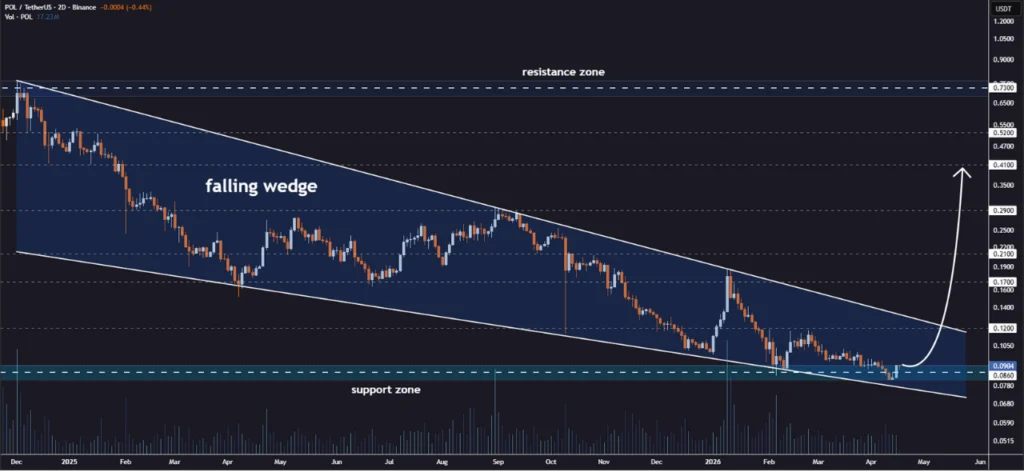
As of April 18, 2026, Polygon (POL) is navigating a precarious market landscape, trading around $0.09 following a modest rebound of approximately 6.4% over the past week. This slight recovery arrives at a pivotal moment for the Layer 2 scaling solution. Beneath the surface of compressed price action, Polygon’s foundational elements are exhibiting significant strengthening, spearheaded by the successful rollout of sPOL (liquid staking) and the consistent advancement of its ambitious AggLayer initiative. Despite these internal developments, POL’s price remains confined within a protracted bearish structure, creating a high-stakes scenario. The cryptocurrency market is now bracing for a confluence of external forces, notably the anticipated markup of the CLARITY Act in late April and a critical Federal Open Market Committee (FOMC) decision days later. The outcome of these events over the next two weeks is widely expected to dictate whether POL can finally break free into a bullish expansion phase or revert to its historical lows.
A Confluence of Catalysts: Late April’s Defining Moment
The trajectory of POL in the immediate future is not merely a function of its internal ecosystem; rather, it is poised to be shaped by a rare convergence of regulatory developments, macroeconomic liquidity shifts, and Polygon’s own technological advancements. This intricate interplay of factors sets the stage for what many analysts believe will be a defining period for the asset and potentially the broader Layer 2 sector.
The Regulatory Crucible: The CLARITY Act’s Defining Role
The Digital Asset Market CLARITY Act has emerged as a landmark legislative effort, holding the potential to significantly reshape the regulatory landscape for the U.S. crypto market. Initiated in late 2024 and refined through early 2026, the Act aims to provide much-needed legal certainty for digital assets, categorizing them and establishing frameworks for their issuance and trading. A markup from the Senate Banking Committee, signaling progress towards a vote, is tentatively expected as early as late April 2026. However, the legislative process is inherently fraught with complexities, and delays remain a tangible risk, fueled by intense lobbying from various stakeholders.
At the heart of the ongoing debate is a highly contentious issue: whether stablecoins should be permitted to generate yield on idle balances. Traditional financial institutions, particularly large commercial banks, have vociferously argued against this provision, citing concerns about systemic risk, consumer protection, and the potential erosion of their own deposit bases. They advocate for a conservative approach, emphasizing the stability and liquidity of stablecoins while cautioning against features that could transform them into shadow banking instruments. Conversely, the cryptocurrency industry, including DeFi protocols and stablecoin issuers, contends that allowing yield generation is crucial for innovation, capital efficiency, and for stablecoins to fulfill their potential as foundational building blocks for a robust digital economy. They highlight the demand for yield in a low-interest-rate environment (historically speaking) and argue that appropriate regulatory safeguards, rather than outright bans, can mitigate risks.

For Polygon, the implications of the CLARITY Act are direct and profound. As a network increasingly positioning itself as a foundational layer for payments, decentralized finance (DeFi), and real-world asset (RWA) tokenization, regulatory clarity is paramount. A favorable outcome, or even significant progress on the bill, would likely unlock a wave of institutional participation that has been largely sidelined by legal ambiguities. This would not only act as a powerful tailwind for POL but would also validate the entire Layer 2 narrative, signaling a mature and regulated environment conducive to mainstream adoption. "Clear regulatory guidelines are the bedrock upon which institutional capital can confidently enter the digital asset space," stated a spokesperson for the Blockchain Association, an industry advocacy group. "The CLARITY Act, if passed effectively, could be the catalyst for the next wave of innovation and adoption in DeFi, areas where Polygon is a clear leader." Conversely, another delay or an unfavorable outcome could reinforce market uncertainty, suppress momentum, and prolong the ‘crypto winter’ sentiment, particularly at a critical technical juncture for POL.
Macroeconomic Headwinds and Tailwinds: The FOMC’s Shadow
Beyond regulatory shifts, macroeconomic conditions continue to exert their silent, yet powerful, influence on all risk assets, including cryptocurrencies. As of early 2026, global markets are still grappling with the lingering effects of inflationary pressures that peaked in prior years, with inflation metrics hovering slightly above central bank targets in key economies. Employment data, while robust in some sectors, shows signs of deceleration in others, painting a complex picture for policymakers.
Against this backdrop, the Federal Open Market Committee (FOMC) decision, slated for April 29, 2026, is under intense scrutiny. Market participants are overwhelmingly leaning toward a "hawkish pause," implying that the Fed is likely to hold interest rates unchanged, but with a strong rhetoric signaling readiness to resume tightening if inflationary pressures persist. Data from Polymarket, a decentralized prediction market, indicates a 98% probability of the Fed holding rates unchanged at this meeting, reflecting broad market consensus. This leaves two primary outcomes that could significantly diverge from current expectations:
- A Surprise Rate Hike: Should inflation data unexpectedly surge in the coming weeks, or if the Fed adopts a more aggressive stance to anchor inflation expectations, a surprise rate hike could occur. This scenario would likely trigger a significant risk-off event across all asset classes, including cryptocurrencies, leading to sharp declines as liquidity tightens and borrowing costs rise.
- A Dovish Pivot/Rate Cut: While less probable given current inflationary concerns, a sudden deterioration in economic growth indicators or a rapid decline in inflation could prompt the Fed to signal a more dovish stance or even contemplate a rate cut. This would inject substantial liquidity into the market, likely fueling a strong rally in risk assets, including mid-cap altcoins like POL.
For Polygon, which occupies a prominent position within the mid-cap altcoin category, liquidity conditions are as crucial as its fundamental developments. A hawkish pause, while priced in, could still lead to muted performance if accompanied by cautious forward guidance. A more restrictive monetary policy environment typically favors larger, more established assets, leaving smaller, more volatile assets vulnerable to capital outflows. Conversely, an influx of liquidity, often stimulated by easing monetary policy, tends to cascade down the market cap hierarchy, benefiting altcoins disproportionately.
Polygon’s Internal Momentum: Building a Stronger Foundation
While macro and regulatory narratives dominate headlines, Polygon’s internal development teams are quietly but consistently building a stronger, more resilient foundation for the network. These efforts, though not immediate price catalysts, are crucial for the platform’s long-term viability and intrinsic value.

A significant recent milestone was the mid-April launch of sPOL (liquid staking). This innovation unlocked approximately $330 million in previously illiquid capital, allowing POL holders to stake their tokens to secure the network while simultaneously retaining access to their capital through a liquid staking derivative. This changes the economic equation for POL in several critical ways:
- Enhanced Capital Efficiency: Stakers no longer have to choose between earning staking rewards and participating in DeFi. They can now utilize their sPOL tokens in other decentralized applications, boosting overall network activity and liquidity.
- Increased Network Security: By making staking more attractive and flexible, sPOL encourages broader participation in network validation, thereby strengthening Polygon’s proof-of-stake consensus mechanism and overall security.
- New DeFi Opportunities: The introduction of sPOL creates new primitives for the Polygon DeFi ecosystem, fostering innovative applications and potentially attracting more users and capital to the network.
Simultaneously, the broader AggLayer vision continues to take concrete shape. The AggLayer is Polygon’s ambitious plan to unify fragmented liquidity across various Layer 2 chains, particularly those built using Polygon’s ZK-rollup technology. By enabling seamless, atomic cross-chain transactions without the need for cumbersome bridges, the AggLayer aims to create a truly interconnected and scalable blockchain ecosystem. This vision, combined with the "Gigagas" roadmap targeting over 100,000 transactions per second (TPS), positions Polygon as a leading scalable settlement layer, particularly for high-throughput applications like payments and the burgeoning market of tokenized real-world assets. "The AggLayer represents a paradigm shift in how Layer 2s interact," commented a lead architect at Polygon Labs. "It’s about creating a unified user experience and unlocking unprecedented liquidity, which is essential for mainstream adoption of Web3 technologies."
These internal developments are not designed to be short-term catalysts for immediate price pumps. Instead, they represent fundamental improvements to Polygon’s architecture, security, and utility, strengthening the case for a delayed but potentially powerful repricing as the market gradually recognizes their long-term value and competitive advantage.
Technical Outlook: A Market Poised for Resolution
From a purely structural standpoint, POL is currently trading within a multi-month falling wedge pattern. This classical chart pattern, characterized by converging trendlines where both resistance and support are declining, is typically associated with trend exhaustion and often precedes a bullish reversal. Since late 2024, POL has consistently made lower highs and lower lows, but the amplitude of these movements has been decreasing, indicating a tightening range—a common precursor to an explosive price expansion or contraction.
What truly matters now is not merely the existence of the pattern, but where it ultimately resolves. Key price levels have emerged as critical junctures for POL:
- $0.086: This level represents immediate support, derived from previous consolidation phases and acting as the lower bound of the current trading range. A sustained breakdown below this point would signal a clear continuation of the bearish trend.
- $0.12: Identified as the initial "trigger" level. A decisive break above $0.12, preferably on significant volume, would confirm a potential breakout from the falling wedge, signaling a shift in market sentiment. This level also aligns with a key resistance point from early 2026.
- $0.21: This acts as the primary "test" level. It represents a confluence of historical resistance, a significant volume node, and potentially the 200-day moving average (if applicable by 2026). Clearing $0.21 would suggest strong underlying buying pressure and open the path to higher targets.
- $0.30: This is the ambitious "stretch target." It aligns with a major resistance zone from late 2025 and would require substantial momentum and sustained capital inflow to reach.
The image provided, depicting "$POL approaching key supply for potential rejection," visually underscores the current technical dilemma. Price is hovering near a critical resistance zone, where sellers have historically entered the market. The resolution of this compression, whether upward or downward, will largely be influenced by the external catalysts discussed.

Two Paths Forward: Breakout or Breakdown Scenarios
With POL’s price compressed and a series of high-impact catalysts on the horizon, the market appears poised for a binary outcome.
Bull Case: Expansion Toward $0.30+
In the bullish scenario, a perfect storm of positive factors aligns, propelling POL into a significant upward trajectory. This would likely involve:
- Favorable Regulatory Progress: The CLARITY Act markup proceeds smoothly, indicating a clear path to regulatory certainty for stablecoins and the broader crypto market, significantly de-risking institutional participation.
- Dovish Macro Shift: The FOMC decision, or subsequent economic data, signals an easing of monetary policy or a stronger-than-expected economic outlook, injecting liquidity into risk assets.
- Strong L2 Narrative Rotation: Renewed interest and capital flow specifically into Layer 2 solutions, driven by their scalability and efficiency, with Polygon emerging as a top beneficiary due to sPOL and AggLayer.
Should these conditions materialize, the price structure would likely unfold in distinct stages:
- Initial Breakout: A decisive push above $0.12, fueled by short covering and initial institutional buying, breaking the long-term falling wedge.
- Momentum Building: Subsequent rallies targeting $0.17, followed by a crucial test of $0.21. Clearing $0.21 would signify a fundamental shift in market structure.
- Extended Rally: If $0.21 is firmly established as support, the path opens up for an extended rally towards $0.29 and potentially $0.41, drawing in further speculative and institutional capital.
This bullish path demands a near-perfect alignment across technical, macroeconomic, and regulatory factors, coupled with sustained volume inflows and a strong narrative rotation into the L2 sector.
Bear Case: Continuation Toward $0.06-$0.08

Conversely, the bearish scenario is more straightforward and arguably more consistent with the prevailing long-term bearish structure. This outcome would be triggered by:
- Regulatory Delays or Negative Outcome: The CLARITY Act markup is delayed indefinitely, or a restrictive version is proposed, reinforcing uncertainty and stifling institutional interest.
- Hawkish Macro Stance: The FOMC adopts a more hawkish tone, or key inflation data disappoints, leading to a tightening of global liquidity and a general risk-off sentiment in markets.
- Weak Market Demand: Despite internal advancements, Polygon fails to attract significant new capital or user adoption, and existing supply pressures outweigh demand.
A breakdown below the critical $0.086 support level would likely trigger a cascade of negative events:
- Stop-Loss Hunting: Automated selling from traders whose stop-losses are triggered below $0.086.
- Increased Selling Pressure: Further capitulation from long-term holders losing conviction, leading to downward momentum.
- Price Reversion: A retest of previous lows in the $0.06-$0.08 range, establishing a new consolidation floor.
A structural headwind also persists for POL: its approximate 2% annual emission rate. This constant introduction of new tokens into circulation creates continuous sell pressure. Without robust and sustained demand catalysts, this supply dynamic can effectively cap upside potential and weigh heavily on the price. In such an environment, even positive developments like sPOL, which unlocked previously illiquid capital, risk being interpreted not as demand drivers but as simply increasing the circulating supply, potentially exacerbating selling pressure if not met with commensurate buying.
Can POL Realistically Break $0.30 Before the Vote?
The question of whether POL can realistically reach $0.30 before the CLARITY Act vote hinges on distinguishing between possibility and probability. While technically possible, achieving such a rapid ascent in a short timeframe (less than two weeks) presents a formidable challenge.
To reach $0.30, POL would need to gain over 230% from its current price of $0.09. This would necessitate an extraordinary combination of factors:
- Near-Perfect Alignment of Catalysts: Every external factor—regulatory, macroeconomic, and market sentiment—would need to align perfectly in POL’s favor.
- Extreme Market Conviction: A sudden, overwhelming surge of buying pressure, potentially fueled by institutional inflows and a broad narrative shift, driving aggressive short covering.
- Unprecedented Volume Inflow: Trading volumes would need to surge to levels not seen in months, indicating widespread participation and strong conviction.
Such a confluence of events is exceedingly rare. More realistically, the market is likely to test the immediate resistance levels at $0.12 and $0.17 first. The $0.21 mark would then act as the true inflection point, requiring significant strength to overcome. Only after decisively clearing and consolidating above these intermediate levels does $0.30 enter the realm of a credible near-term target. The image depicting "Polygon 24H price chart (Source: CoinMarketCap)" further emphasizes the current tight trading range, underscoring the magnitude of the required movement for a rapid ascent to $0.30.

Conclusion: A Defining Fortnight for Polygon’s Trajectory
Polygon (POL) is undeniably approaching a decisive moment where technical compression converges with powerful macroeconomic and regulatory catalysts. The setup is clear: the asset is trading within a tightening range, signaling an imminent resolution, while external forces gather, ready to exert their influence.
The next two weeks are poised to be a defining period, offering two distinct paths. On one hand, a favorable outcome from the CLARITY Act and a supportive macroeconomic environment could catalyze a breakout from its long-term bearish structure, potentially pushing POL towards significant resistance levels. On the other hand, regulatory delays, a hawkish FOMC, or a general risk-off sentiment could see POL continue its downward trajectory, retesting prior lows.
While the long-term thesis for Polygon continues to strengthen, driven by its relentless pursuit of scalability, capital efficiency through sPOL, and ecosystem growth via the AggLayer, the short-term price trajectory remains heavily dependent on forces beyond the network itself. Whether POL manages to break $0.30 before the CLARITY Act vote will be less a function of its technological prowess and more a testament to the precise timing of policy decisions, global liquidity dynamics, and the collective conviction of the market. Investors and enthusiasts alike will be watching closely as these critical events unfold, shaping Polygon’s immediate future.