admin
admin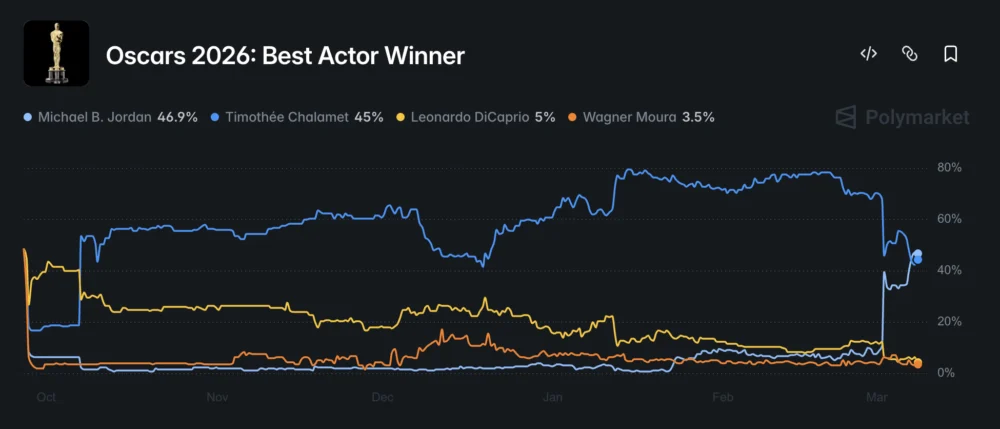
Actor Michael B. Jordan has dramatically shifted the landscape of the 2026 Academy Awards "Best Actor" race, seizing the top spot on the prominent prediction market platform Polymarket. His odds of securing the coveted Oscar have soared by more than 400% since March 1, overtaking Timothée Chalamet, who previously held the lead. This significant movement on Polymarket, a platform increasingly recognized for its real-time market-driven forecasts, underscores the growing influence of pre-Oscar buzz and critical precursor awards. The surge in Jordan’s favor comes at a pivotal time, not just for the actor, but also for Polymarket itself, as the platform navigates a complex and often contentious regulatory environment in the United States, even as it targets a substantial US app rollout later this year.
The Best Actor Race Heats Up: Jordan’s Ascendancy
As of the latest Polymarket figures, Michael B. Jordan now holds approximately a 47% chance of winning the Best Actor award at the 98th Academy Awards, scheduled to air on March 15, 2026. This places him marginally ahead of Timothée Chalamet, who stands at a close second with 45%. The market also shows Leonardo DiCaprio with 5% odds, Wagner Moura at 4%, and Ethan Hawke trailing with 1%. This tight race at the top reflects a dynamic and responsive market, where new information can rapidly alter perceptions and financial bets. Chalamet had maintained a comfortable lead until just Saturday, highlighting the volatility and immediate impact of recent developments.
Jordan’s dramatic rise can be directly attributed to his recent triumph at the Actor Awards, where he clinched the Best Actor prize. This esteemed ceremony, formerly known as the Screen Actors Guild Awards (SAG Awards), is widely regarded as one of the most reliable indicators of future Oscar success due to its electorate comprising fellow actors – the largest branch of the Academy. His win was for his compelling dual role as twin brothers Smoke and Stack Moore in the 2025 vampire horror film "Sinners." The film, lauded for its genre-bending narrative and Jordan’s intense portrayal of two distinct, yet interconnected, characters, appears to have resonated deeply with the acting community. Critics have praised his performance in "Sinners" as a career-defining moment, showcasing a versatility and dramatic depth previously unexplored to this extent. Playing twin brothers, each with unique psychological and physical attributes within the horror genre, presents a formidable challenge that often garners significant awards attention.
In contrast, Timothée Chalamet’s nomination stems from his role in "Marty Supreme," a fictional drama film centered around a competitive table tennis player. While Chalamet is known for his nuanced and often acclaimed performances in indie and mainstream cinema, the nature of his role in "Marty Supreme" might be perceived differently by voters compared to Jordan’s more physically and emotionally demanding dual portrayal in a genre film. The Academy has historically shown a preference for transformative roles, especially those that push actors out of their comfort zones or involve significant character complexity.
The "Actor Awards" Advantage: A Precursor’s Power
The Actor Awards, with its extensive voting body of working actors, holds immense sway in the awards season. A win here is often seen as a direct endorsement from peers, signaling a performance that resonates deeply within the industry. Historically, there’s a strong correlation between SAG/Actor Awards wins for individual performances and subsequent Oscar victories. For instance, in many past cycles, the recipient of the SAG Award for Outstanding Performance by a Male Actor in a Leading Role has gone on to win the Academy Award. This correlation is not accidental; the significant overlap in voters between the Actor Awards and the Academy’s acting branch means that a performance recognized by one group is highly likely to be recognized by the other. Jordan’s victory therefore serves as a potent endorsement, shifting the narrative and solidifying his status as a frontrunner in the crucial weeks leading up to the Academy Awards. This recent win provides tangible evidence of industry recognition, transforming speculative predictions into data-backed forecasts on platforms like Polymarket.

Polymarket: A New Barometer for Awards Season
Polymarket’s role in this narrative extends beyond merely reflecting the shifting odds; it actively aggregates real-time sentiment and financial commitment from thousands of participants. The platform allows users to bet on the outcome of future events, with market prices reflecting the collective probability assigned by traders. With over $5.6 million in trading volume for the 2026 Best Actor prediction market alone at the time of publication, the liquidity and engagement signal a robust and information-rich market. High trading volume typically indicates greater confidence in the market’s efficiency, as more participants contribute their collective wisdom, making the prices a more accurate reflection of underlying probabilities than traditional polls or expert opinions.
Prediction markets offer a unique advantage over conventional polling methods. Instead of relying on stated preferences, they capture incentivized beliefs, as traders put their money where their predictions are. This mechanism often leads to more accurate forecasts, as participants are motivated to seek out and act upon relevant information. For the Oscars, this means that every piece of news – from precursor awards like the Actor Awards to critical reviews and industry buzz – is rapidly assimilated into the market prices, providing a dynamic and continuously updated probability assessment.
Beyond the Frontrunners: The Broader Field
While the spotlight is firmly on Jordan and Chalamet, the presence of seasoned veterans like Leonardo DiCaprio (5%) and rising international stars like Wagner Moura (4%), alongside established talents such as Ethan Hawke (1%), indicates a strong overall field for the 2026 Best Actor category. DiCaprio, a perennial Oscar contender, likely commands respect for a yet-to-be-specified role, while Moura, known for his powerful performances, could be a dark horse if his nominated film gains significant traction. Ethan Hawke, a consistent performer with a respected body of work, often garners nominations for his nuanced character studies. Their lower odds, however, underscore the current dominance of Jordan and Chalamet in the immediate aftermath of the Actor Awards. The market’s allocation of probabilities reflects not just individual performance quality but also the broader narrative momentum, campaigning efforts, and perceived "narrative arc" of each actor’s journey toward the Oscar.
Polymarket’s Ambitions and Regulatory Hurdles
The story of Michael B. Jordan’s Oscar odds is intertwined with a larger, more complex narrative surrounding Polymarket itself: its ambitious plans for expansion and the significant regulatory headwinds it faces in the United States. While the platform thrives on international participation, its full potential in the massive US market remains largely untapped due to ongoing legal and regulatory battles.
Polymarket initiated a cautious re-entry into the US market in December 2025, opening its application process for a select group of waitlisted users. The company has articulated plans for a full rollout of a US-regulated platform later in 2026, a move that could exponentially increase its user base and trading volume. However, this expansion is contingent upon navigating a fragmented and often hostile regulatory landscape. Prediction market platforms, which allow users to bet on the outcomes of real-world events, are frequently scrutinized by state-level regulators in the United States, who often argue that these platforms fall under their purview as a form of gambling. This clashes with the industry’s assertion that prediction markets are sophisticated financial instruments akin to futures contracts, designed for information aggregation, and thus should be regulated at the federal level by bodies like the Commodity Futures Trading Commission (CFTC).
A Battle for Jurisdiction: Federal vs. State Oversight
The core of Polymarket’s regulatory challenge crystallized in February 2026 when the company filed a landmark lawsuit against the Commonwealth of Massachusetts. In its legal challenge, Polymarket contends that the state’s gambling regulator lacks the authority to oversee prediction markets, arguing instead that this jurisdiction rests exclusively with the federal CFTC. This lawsuit is not merely a defensive maneuver; it aims to establish a crucial legal precedent that could shape the future of prediction markets across the entire United States. If Polymarket prevails, it could streamline the regulatory framework, potentially paving the way for easier, more consistent nationwide operation under federal guidelines. Conversely, a loss could empower states to assert their authority, leading to a patchwork of disparate and potentially restrictive regulations that would complicate national expansion.

The legal arguments are nuanced. Polymarket’s position is often rooted in the argument that its markets provide a unique form of information discovery, allowing participants to price the probability of future events, which has applications beyond mere entertainment. They often cite academic research supporting the efficiency of prediction markets in forecasting outcomes ranging from elections to public health events. State regulators, on the other hand, typically emphasize consumer protection, anti-money laundering concerns, and the classification of these activities as a form of unregulated gambling, which could lead to significant social and financial risks for participants.
The Nevada Precedent and Complexities
Adding another layer of complexity to Polymarket’s regulatory woes, both Polymarket and Kalshi, another prominent prediction market platform, are facing increased scrutiny in the state of Nevada. This intensified oversight follows a federal judge’s recent rejection of arguments that the Commodity Exchange Act (CEA) and the CFTC inherently prevent state regulators from exercising oversight over prediction markets. This ruling in Nevada creates a precedent that potentially weakens the argument for exclusive federal jurisdiction, suggesting that states may indeed have a legitimate claim to regulate these platforms. The Nevada decision introduces significant uncertainty, as it implies that even if the CFTC were to assert federal oversight, states might still retain the ability to impose their own rules, particularly if they classify prediction markets as a form of gambling. This could lead to a fragmented regulatory landscape, where platforms would need to comply with different sets of rules in different states, creating substantial operational and compliance burdens.
The High Stakes of Innovation: Valuation and Future Growth
Despite these considerable regulatory hurdles, the perceived market potential of prediction platforms remains incredibly high. Polymarket and Kalshi are reportedly exploring new fundraising rounds that could value each company at an astonishing $20 billion, roughly double their most recent valuations. The Wall Street Journal reported on Friday, citing individuals familiar with the matter, that both platforms have engaged in preliminary discussions with potential investors regarding raising fresh capital at these elevated valuations.
These staggering figures underscore the immense belief among investors in the long-term viability and disruptive potential of prediction markets. The ability to accurately forecast events, aggregate distributed information, and create liquid markets for virtually any future outcome is seen as a powerful tool with applications spanning finance, politics, sports, and entertainment. Should Polymarket successfully navigate its regulatory challenges and achieve a full, compliant US rollout, its market capitalization could indeed skyrocket. The $20 billion valuation target reflects not just current performance but the anticipated growth fueled by regulatory clarity and broader market acceptance. However, the report also cautioned that these negotiations are still in their early stages and may not ultimately result in deals or secure the targeted valuation, especially given the ongoing regulatory uncertainties. The outcome of the lawsuits and the clarity of the regulatory framework will undoubtedly play a critical role in determining whether these ambitious valuations can be realized.
The Future of Prediction Markets
The journey of Michael B. Jordan’s Oscar odds on Polymarket serves as a microcosm of the broader dynamics at play within the prediction market industry. It highlights the platforms’ growing accuracy and influence in forecasting complex real-world events, from awards shows to elections and economic indicators. At the same time, it underscores the profound challenges these innovative platforms face in establishing their legitimacy and operational scope within existing legal and financial frameworks. The outcomes of the various lawsuits and regulatory dialogues will not only determine the future trajectory of companies like Polymarket and Kalshi but will also set critical precedents for how new, decentralized, and data-driven financial instruments are integrated into regulated markets worldwide. The stakes are high, not just for the actors vying for an Oscar, but for the very infrastructure that seeks to predict their success.