admin
admin
On the surface, modern banking feels instant, a seamless dance of digital transactions where a tap of a card pays for coffee and a click buys a stock, yet beneath this veneer of immediate gratification lies a complex, often archaic system grappling with inefficiencies rooted in its very architecture. For decades, the global financial ecosystem has operated on a fragmented model of independent, private ledgers maintained by individual institutions. Every payment, every settlement, every trade necessitates a intricate web of coordination among banks, clearinghouses, custodians, and other entities, each needing to independently verify and record the same event to establish ownership and transfer of value. This constant "comparing of notebooks"—a process known as reconciliation—is not merely an administrative burden; it is the fundamental reason why international wire transfers can languish for days, why operational risks are endemic across multi-day processes, and why back-office complexity siphons billions of dollars from the industry annually.
The Historical Trajectory of Financial Inefficiency
The origins of this systemic complexity can be traced back to the pre-digital era, when financial institutions meticulously maintained physical ledgers, later transitioning to centralized, proprietary digital databases. As global trade and finance expanded exponentially in the latter half of the 20th century, these siloed systems, while efficient for individual institutions, struggled to interoperate seamlessly. The rise of messaging standards like SWIFT (Society for Worldwide Interbank Financial Telecommunication) in the 1970s provided a crucial communication layer, enabling banks to send structured messages about transactions. However, these messages merely instruct other banks to update their own ledgers; they do not create a shared, immutable record. This fundamental design choice, born of necessity and technological limitations, has persisted, leading to an environment where discrepancies are frequent, manual interventions are common, and the true state of a transaction often requires laborious cross-verification. Industry estimates suggest that reconciliation processes alone cost major financial institutions anywhere from $5 to $10 billion globally each year, encompassing staffing, software, and the hidden costs of delayed settlements and capital inefficiency.
Blockchain’s Emergence as a Coordination Layer
The advent of blockchain technology, initially popularized by cryptocurrencies, introduced a paradigm-shifting concept: a distributed digital ledger that records transactions in a tamper-resistant, verifiable manner across a network of participants. For the banking sector, this technology is increasingly being explored not as a replacement for existing infrastructure, but as a critical execution and coordination layer designed to work in conjunction with it. Instead of Bank A sending a message to Bank B to update its database, both institutions can reference a single, shared, and immutable ledger state. This shift promises to fundamentally address the long-standing infrastructure constraints that have plagued banking, especially in areas where customer-facing experiences have modernized rapidly but the underlying "plumbing" still relies on batch processing and message-based coordination.
This shift delivers four foundational benefits that are compelling banks to invest in blockchain solutions:
- Shared State and Single Source of Truth: Eliminates the need for multiple, independent ledgers, providing all participants with a consistent, real-time view of transactions and asset ownership.
- Tamper-Resistance and Immutability: Cryptographic security ensures that once a transaction is recorded, it cannot be altered, significantly enhancing trust and auditability.
- Automation via Smart Contracts: Programmable agreements that automatically execute predefined actions when specific conditions are met, reducing manual intervention and increasing efficiency.
- Enhanced Transparency with Privacy Controls: While providing a transparent record of activity, advanced cryptographic techniques can ensure that sensitive data remains private, visible only to authorized parties.
Transforming Core Banking Operations: Key Benefits in Detail
The practical applications of blockchain’s unique properties translate into tangible advantages for financial institutions:
-
Faster Transactions and Settlement: In traditional markets, settling a trade can take upwards of a day (T+1) or even longer for complex cross-border transactions, tying up significant capital and increasing counterparty exposure. Blockchain-based settlement, especially when combined with atomic Delivery-versus-Payment (DvP) and Payment-versus-Payment (PvP) workflows, can drastically shorten this cycle, often to near-instantaneous finality. This "atomic settlement" — where the exchange of assets and payment occurs simultaneously — materially reduces settlement risk, frees up liquidity, and significantly lowers the operational burden associated with multi-day post-trade processes. Estimates suggest that reducing settlement times could unlock trillions in capital currently trapped in the financial system.
-
Greater Security and Operational Resilience: Blockchain systems leverage sophisticated cryptography and decentralized consensus mechanisms to protect transaction integrity across multi-party networks. This inherent security model strengthens resilience in workflows where data consistency is paramount, reducing reliance on centralized reconciliation points and mitigating risks associated with manual controls that are prone to delays, errors, and single points of failure. The distributed nature of the ledger also means there is no single point of attack or failure, enhancing system robustness.
-
Cost Reduction Through Automation: The manual effort involved in financial processes such as reconciliation, exception handling, corporate actions, and compliance checks represents a substantial operational cost. Smart contracts enable rules-based automation across these areas. By encoding "if-this-then-that" logic directly into execution workflows, banks can achieve higher straight-through processing rates, minimize human intervention, and dramatically lower administrative costs. Analysis by consulting firms indicates that blockchain automation could reduce operational costs in capital markets by 15-20% in certain areas.
-
Improved Transparency, Trust, and Compliance: A shared, transparent ledger provides a single, verifiable view of transactions and asset states across all authorized participants. When combined with privacy-preserving identity and compliance controls (such as zero-knowledge proofs), blockchains can significantly improve auditability and streamline regulatory reporting without exposing sensitive proprietary data. This fosters greater trust among institutions, regulators, and clients, creating a more robust and accountable financial ecosystem. Regulators, initially cautious, are increasingly recognizing the potential for enhanced oversight and risk management that blockchain offers.
Pioneering Blockchain Use Cases in Banking
Financial institutions are actively piloting and deploying blockchain solutions across various critical banking functions:
-
Payments and Money Transfers: Cross-border payments are notoriously inefficient, plagued by fragmented messaging systems, multiple intermediaries, and delayed finality, all contributing to high costs and reconciliation overhead. Blockchain-enabled workflows aim to revolutionize these transfers by improving coordination and settlement efficiency. The maturation of stablecoins, tokenized deposits, and central bank digital currencies (CBDCs) alongside traditional payment rails is paving the way for programmable payments. Institutions are exploring how existing messaging standards, such as ISO 20022, can be connected to blockchain environments to support real-time, transparent, and lower-cost international transfers without disrupting core payment infrastructure. This could reduce average cross-border payment costs, which can currently range from 1% to 5% or more, by a significant margin.
-
Clearing and Settlement: This area represents one of the most operationally complex segments of finance, demanding precise data synchronization across a multitude of custodians, clearinghouses, broker-dealers, and asset servicers. The current reliance on message-based confirmation and post-trade reconciliation across siloed systems is ripe for disruption. Blockchain can serve as a common coordination layer for post-trade activity, drastically reducing reconciliation overhead and providing consistent, verified access to records. As assets become tokenized, standardized reference data and coordinated workflows across both traditional and blockchain environments become increasingly critical to achieving faster, lower-risk settlement, potentially cutting settlement times from T+2 or T+1 to T+0 or even near-instantaneous.
-
Trade Finance: Historically, trade finance has been characterized by its document-heavy, coordination-intensive nature, involving numerous parties like banks, logistics providers, insurers, and customs authorities. Disconnected systems and manual documentation introduce significant delays, disputes, and elevated fraud risk throughout the trade lifecycle. Blockchain-based workflows can synchronize key trade events — such as shipment status, document issuance, and ownership transfers — across participants in near real-time. By maintaining a shared, tamper-resistant record, institutions can reduce paperwork, accelerate settlement, improve trust, and mitigate fraud, all while preserving existing operational roles and responsibilities. The global trade finance gap, estimated at $1.7 trillion, could be significantly narrowed by these efficiencies.
-
Identity Verification and Compliance (KYC/AML): Identity and compliance are foundational to banking but remain costly and repetitive due to duplicated verification processes across institutions. Customers are often required to resubmit sensitive documentation multiple times, while banks independently perform similar Know Your Customer (KYC) and Anti-Money Laundering (AML) checks. Blockchain-based identity solutions, particularly those leveraging verifiable credentials, enable individuals and institutions to prove specific attributes (e.g., KYC status, eligibility) without repeatedly sharing underlying personal data. This approach reduces duplication in compliance workflows, supports jurisdiction-specific regulatory requirements, and strengthens privacy protections, potentially cutting KYC costs by 10-20%.
Real-World Advancements: Chainlink’s Role in Institutional Blockchain Adoption
Leading banks and market infrastructures are moving beyond pilot programs, actively integrating blockchain platforms that directly connect with their existing systems, standards, and regulatory frameworks. These initiatives underscore a pragmatic approach to blockchain adoption, prioritizing incremental deployment, standards-based integration, and controlled automation while preserving existing infrastructure and regulatory controls. Chainlink, as a decentralized oracle network, has emerged as a crucial enabler in many of these pioneering efforts, powering critical data feeds, interoperability solutions, compliance frameworks, and privacy-preserving mechanisms.
-
SWIFT Connectivity and Cross-Chain Settlement: A landmark collaboration between Chainlink and SWIFT has demonstrated the ability for financial institutions to connect to multiple public and private blockchain networks using existing SWIFT infrastructure and messaging standards. Leveraging Chainlink’s Cross-Chain Interoperability Protocol (CCIP), these initiatives illustrate how tokenized asset settlement workflows can be coordinated alongside traditional payment rails, crucially without requiring banks to overhaul their core messaging systems. Under the Monetary Authority of Singapore’s Project Guardian, SWIFT, UBS Asset Management, and Chainlink successfully demonstrated the issuance and settlement of tokenized assets using existing fiat payment infrastructure, marking a significant step towards practical institutional adoption. A SWIFT spokesperson noted that "interoperability is key to unlocking the full potential of tokenized assets, and our collaboration with Chainlink is a testament to our commitment to bridging traditional finance with emerging blockchain capabilities."
-
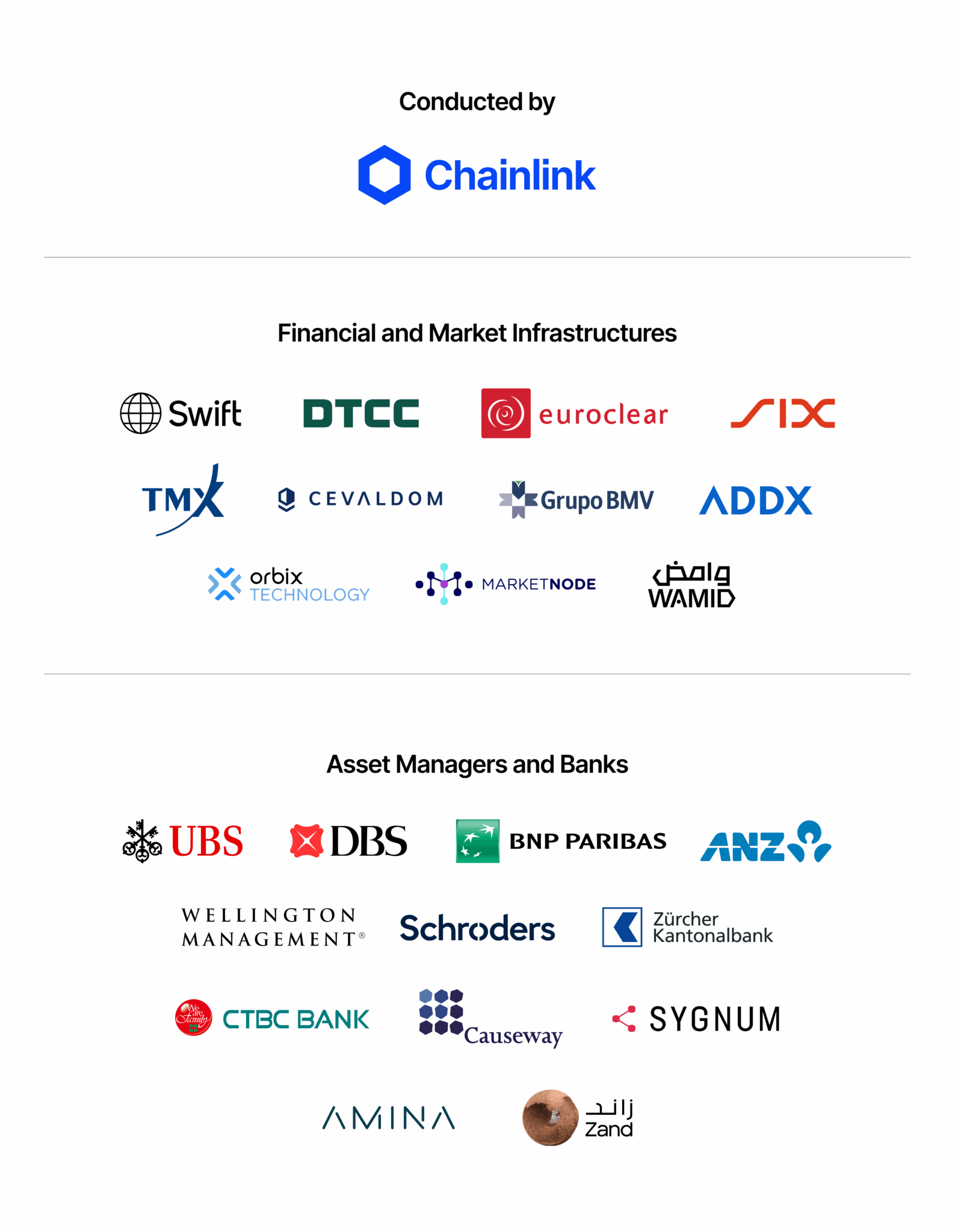
Standardizing Corporate Actions Across Global Markets: Corporate actions processing (e.g., dividends, mergers, stock splits) has long been a notorious source of complexity and cost in financial markets. Chainlink has powered a global industry initiative involving 24 financial institutions and market infrastructures, including SWIFT, DTCC, Euroclear, UBS, DBS Bank, ANZ, BNP Paribas, Wellington Management, and Schroders, to address this problem. By combining oracle networks and blockchains with structured data extraction and validation, this work transforms fragmented, manual corporate actions workflows into standardized, near-real-time processes. The result is a significant reduction in operational cost, lower error rates, and considerably less reconciliation overhead across jurisdictions, addressing an estimated $5-8 billion annual industry challenge.
-
Tokenized Fund and Digital Asset Settlement: Chainlink has been instrumental in multiple major institutional initiatives involving tokenized assets and stablecoins. Collaborative efforts with Kinexys by J.P. Morgan, Ondo Finance, and other market participants have showcased atomic Delivery-versus-Payment (DvP) settlement workflows that coordinate asset and payment legs, reducing settlement risk and operational complexity. These demonstrations highlight how tokenized assets can settle with greater certainty and efficiency when execution and coordination occur within a shared, programmable environment. A representative from J.P. Morgan emphasized, "The ability to achieve atomic settlement for tokenized assets is a game-changer for capital efficiency and risk management."
-
Cross-Border Compliance and Identity Workflows: In Asia, Chainlink has facilitated compliant cross-chain settlement under initiatives such as the Hong Kong Monetary Authority’s e-HKD+ program. Institutions including ANZ Bank, China AMC, and Fidelity International have leveraged Chainlink infrastructure to verify investor eligibility, enforce jurisdiction-specific controls, and execute tokenized asset transactions across borders. These workflows demonstrate how blockchain-based settlement can meet stringent regulatory requirements while preserving privacy and supporting complex cross-jurisdictional operations.
-
Integration With Institutional Messaging and Transfer Agency Systems: The Chainlink Runtime Environment (CRE) enables financial institutions to initiate on-chain fund workflows directly from existing enterprise infrastructure, including ISO 20022 messages transmitted via SWIFT. In collaboration with UBS Tokenize, Chainlink demonstrated how subscription and redemption requests for tokenized funds could be orchestrated on-chain through standardized transfer agency workflows without replacing core banking systems or operational processes. This pragmatic approach underscores the industry’s commitment to integration over wholesale replacement.
Challenges and Future Considerations
Despite the demonstrable progress, the widespread adoption of blockchain in banking faces several significant challenges:
- Regulatory Clarity: The evolving regulatory landscape around digital assets, tokenization, and blockchain-based financial services remains a key hurdle. Institutions require clear guidelines on compliance, legal enforceability, and data privacy across diverse jurisdictions.
- Scalability and Performance: Enterprise-grade blockchain solutions must demonstrate the ability to handle the enormous transaction volumes and low-latency requirements of global financial markets, which can involve millions of transactions per second.
- Interoperability: The financial industry operates with a multitude of legacy systems and emerging blockchain networks. Seamless interoperability between these disparate systems, both on-chain and off-chain, is crucial for widespread adoption.
- Integration Complexity: Integrating new blockchain layers with deeply embedded, mission-critical legacy systems is a complex and resource-intensive undertaking, requiring careful planning and execution.
- Talent Gap: A shortage of skilled professionals with expertise in both traditional finance and blockchain technology can slow down development and implementation.
These realities explain why most institutional initiatives focus on standards-based integration, incremental deployment, and controlled automation, rather than radical overhaul. The journey is one of evolution, not revolution.
Chainlink’s Enduring Role in Banking’s Digital Transformation
The modernization of banking through blockchain adoption demands more than just token issuance; it necessitates trusted data, secure cross-network coordination, and seamless integration with existing institutional workflows. The Chainlink platform provides the critical middleware layer that allows banks to operationalize blockchain-based processes in production environments by enabling:
- Secure Off-Chain Data and Computation: Bridging real-world data, events, and complex computations onto blockchain networks reliably.
- Robust Cross-Chain Interoperability: Facilitating secure communication and value transfer between disparate blockchain networks and traditional systems.
- Enterprise-Grade Scalability and Confidentiality: Providing solutions that meet the high-throughput, low-latency, and privacy requirements of financial institutions.
- Seamless Integration with Legacy Infrastructure: Allowing blockchain solutions to connect with existing enterprise systems, standards, and regulatory frameworks.
This approach empowers banks to modernize and integrate blockchain workflows that add tangible value, all while maintaining the reliability, security, and stringent controls required by global capital markets. By enabling standards-based connectivity between legacy systems and emerging blockchain environments, Chainlink is uniquely positioned to help financial institutions innovate across both traditional and on-chain finance, charting a course towards a more efficient, secure, and interconnected global financial system. The ongoing convergence of traditional finance with distributed ledger technology is not a distant future but a present reality, promising a fundamental reshaping of how value is exchanged, managed, and secured worldwide.