admin
admin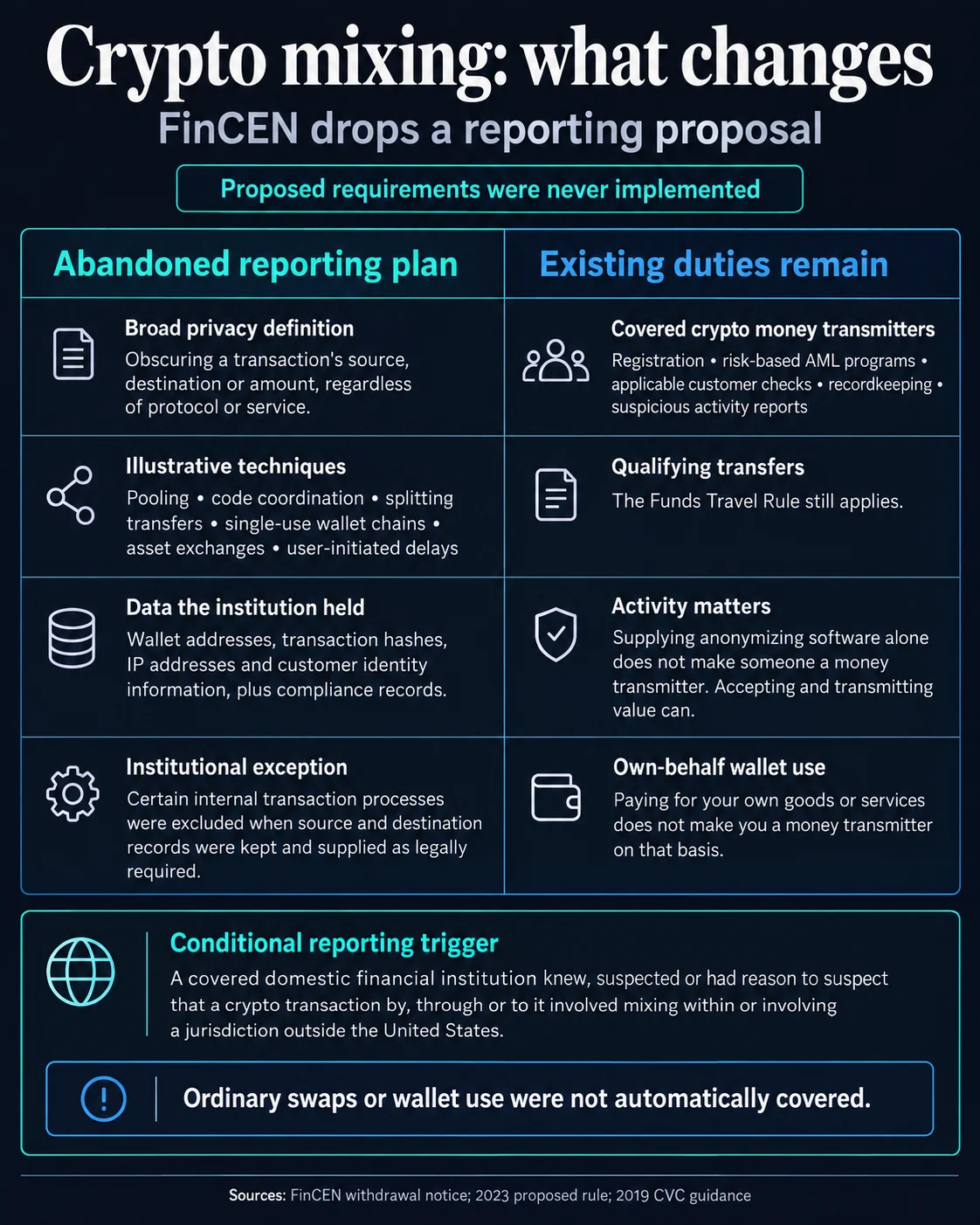
The U.S. Treasury Department’s Financial Crimes Enforcement Network (FinCEN) has officially withdrawn a controversial proposed rule that would have significantly expanded reporting requirements for cryptocurrency mixing activities. The decision, announced on October 5th, marks a notable shift after considerable industry pushback and concerns raised by financial institutions regarding the proposal’s broad scope and potential impact on legitimate digital asset innovation. This withdrawal affects both FinCEN’s 2023 designation of international crypto mixing as a primary money laundering concern and the accompanying proposed recordkeeping and reporting obligations.
The withdrawn proposal, initially outlined with a scheduled Federal Register publication date of October 6th, aimed to capture a wide array of transactions that obscure the origin, destination, or amount of cryptocurrency transfers. FinCEN had cited a desire to combat illicit finance and money laundering as the driving force behind these proposed measures. However, the agency has now acknowledged that the extensive definition could inadvertently stifle legitimate economic activity and impose an undue reporting burden on financial institutions, leading to its subsequent retraction.
A Timeline of Proposed Regulation and Industry Response
The genesis of this withdrawn proposal can be traced back to FinCEN’s ongoing efforts to regulate the rapidly evolving digital asset landscape. In late 2023, the agency issued a notice of proposed rulemaking that sought to classify certain cryptocurrency mixing techniques as transactions of primary money laundering concern. This classification itself was a significant step, but it was the proposed reporting and recordkeeping requirements that drew the most intense scrutiny.
The definition of "mixing" under the proposed rule was notably expansive. It was intended to apply regardless of the specific protocol or service utilized. Examples provided by FinCEN included common operational practices such as pooling funds from multiple users, coordinating transactions through sophisticated coding, splitting large transfers into smaller amounts, routing funds through a series of temporary digital wallets, exchanging one cryptocurrency for another, and implementing user-initiated delays to obfuscate transaction flows.
The obligation to report would have been triggered when a covered domestic financial institution knew, suspected, or had reason to suspect that a crypto transaction processed through its systems involved mixing, particularly if such mixing occurred within or involved a jurisdiction outside the United States. This "foreign nexus" was a critical component of the proposed rule, intended to focus regulatory attention on cross-border illicit financial activities.
However, the proposal immediately ignited a firestorm of criticism from various stakeholders within the cryptocurrency industry. Concerns were raised that the broad definition of mixing could ensnared legitimate privacy-enhancing technologies and everyday transactional practices that are not inherently malicious. Critics argued that the rule, as written, could criminalize the use of widely adopted software and services designed to improve user privacy and security in digital transactions.

Furthermore, financial institutions themselves voiced significant concerns about the operational and compliance burdens associated with such a sweeping reporting requirement. The technical challenges of accurately identifying and reporting on every instance of "mixing" as defined by FinCEN, especially within complex blockchain ecosystems, were deemed substantial. The cost of implementing new surveillance systems, training personnel, and managing the sheer volume of potential reports was a major point of contention.
Key Provisions of the Withdrawn Proposal and Their Implications
The proposed definition of mixing was designed to encompass a broad spectrum of activities. Beyond dedicated mixing services, it aimed to capture instances where individuals or entities employed various methods to obscure transaction details. These methods, as outlined by FinCEN, included:
- Fund Pooling: Consolidating funds from multiple sources before redistribution, making it difficult to trace individual contributions.
- Coordinated Transactions: Using pre-arranged sequences of transactions, often managed by code, to disguise the flow of assets.
- Transaction Splitting: Breaking down larger amounts into smaller, less conspicuous transfers to avoid detection thresholds.
- Multi-Wallet Routing: Funneling funds through a series of single-use digital wallets to create a convoluted transaction history.
- Cross-Asset Exchange: Converting one cryptocurrency to another as part of a strategy to obscure the original asset’s provenance.
- Transaction Delays: Introducing artificial delays between transaction steps to disrupt the chronological flow and hinder analysis.
The proposed obligation was intended to apply when a covered domestic financial institution had a reasonable suspicion of mixing involving a foreign jurisdiction. This conditional trigger was a key element, distinguishing it from a blanket reporting mandate. However, the expansive nature of the mixing definition meant that even transactions with legitimate privacy-preserving intentions could potentially fall under its purview.
It is important to note that the proposal also included certain exclusions. For instance, it aimed to exempt internal processes used by traditional financial entities like banks, broker-dealers, and money services businesses to execute transactions, provided these institutions maintained comprehensive records of source and destination information and made them available upon legal request. This distinction aimed to preserve the operational integrity of established financial systems while still targeting potential illicit activity.
For individual users of digital wallets, the privacy exposure would have primarily stemmed from the reports submitted by financial institutions. These reports could have included sensitive data such as wallet addresses, transaction hashes, IP addresses associated with transactions, and customer identity information held by the institution. The burden of documenting compliance with these new reporting requirements would have fallen squarely on the shoulders of the financial institutions.
Existing Compliance Framework Remains Intact
Despite the withdrawal of this specific mixing proposal, FinCEN emphasized that existing regulatory obligations for cryptocurrency-related businesses remain in full effect. Covered crypto money transmitters are still subject to a comprehensive framework that includes registration requirements, the implementation of risk-based anti-money laundering (AML) and know-your-customer (KYC) programs, customer due diligence, stringent recordkeeping, and the mandatory reporting of suspicious activities.

FinCEN’s existing guidance, particularly its 2019 guidance on virtual currency, continues to be the operative framework. This guidance clearly distinguishes between entities that act as money transmitters – those that accept and retransmit virtual currency on behalf of others – and those that merely supply software or tools that facilitate privacy. The act of supplying an anonymizing tool, in isolation, does not constitute money transmission. However, operating a business that facilitates such transmissions can trigger regulatory obligations.
The guidance also clarifies that an individual user of an unhosted wallet making a personal purchase for goods or services is generally not considered a money transmitter based solely on that activity. This distinction is crucial for preserving the utility of self-custody digital assets for everyday transactions.
Furthermore, the withdrawal notice also addresses a separate, previously proposed rule concerning unhosted wallets. This proposal, initially published in December 2020, aimed to impose reporting requirements on certain transactions involving unhosted wallets. While that proposal had already been marked for withdrawal in the Spring 2024 regulatory agenda, FinCEN’s latest announcement confirms that no further action will be taken on this matter.
Future Outlook and Ongoing Vigilance
FinCEN reiterated its commitment to monitoring the use of cryptocurrency mixing for illicit purposes, including money laundering and terrorist financing. The agency stated that it may take further regulatory steps in the future if deemed necessary. The current withdrawal does not signal an end to regulatory scrutiny of digital asset privacy techniques. Instead, it reflects a recalibration of FinCEN’s approach, prioritizing a more targeted and less burdensome regulatory framework.
The agency’s stance underscores the ongoing tension between fostering innovation in the digital asset space and ensuring robust safeguards against financial crime. The decision to withdraw the broad mixing proposal, while maintaining existing AML/KYC obligations, suggests a preference for refining existing tools and potentially pursuing more narrowly tailored regulations in the future.
The implications of this withdrawal are significant for the cryptocurrency industry. It provides a degree of clarity and relief for businesses that were concerned about the compliance challenges and potential legal ambiguities of the proposed rule. The continued emphasis on existing AML and SAR (Suspicious Activity Report) obligations means that financial institutions must remain vigilant in their efforts to detect and report illicit financial activity, regardless of the specific methods employed. The "Travel Rule," which requires the transmission of certain information alongside cryptocurrency transfers, also remains a key component of the regulatory landscape.
In essence, FinCEN’s decision to withdraw the crypto mixing proposal highlights a pragmatic approach to regulation in a rapidly evolving technological domain. While the intent to combat financial crime remains paramount, the agency appears to be acknowledging the need for regulations that are both effective and proportionate, avoiding undue burdens that could stifle innovation or hinder legitimate use cases of digital assets. The industry will undoubtedly continue to monitor FinCEN’s future actions and engage in dialogue to shape a regulatory environment that balances security with technological advancement.