admin
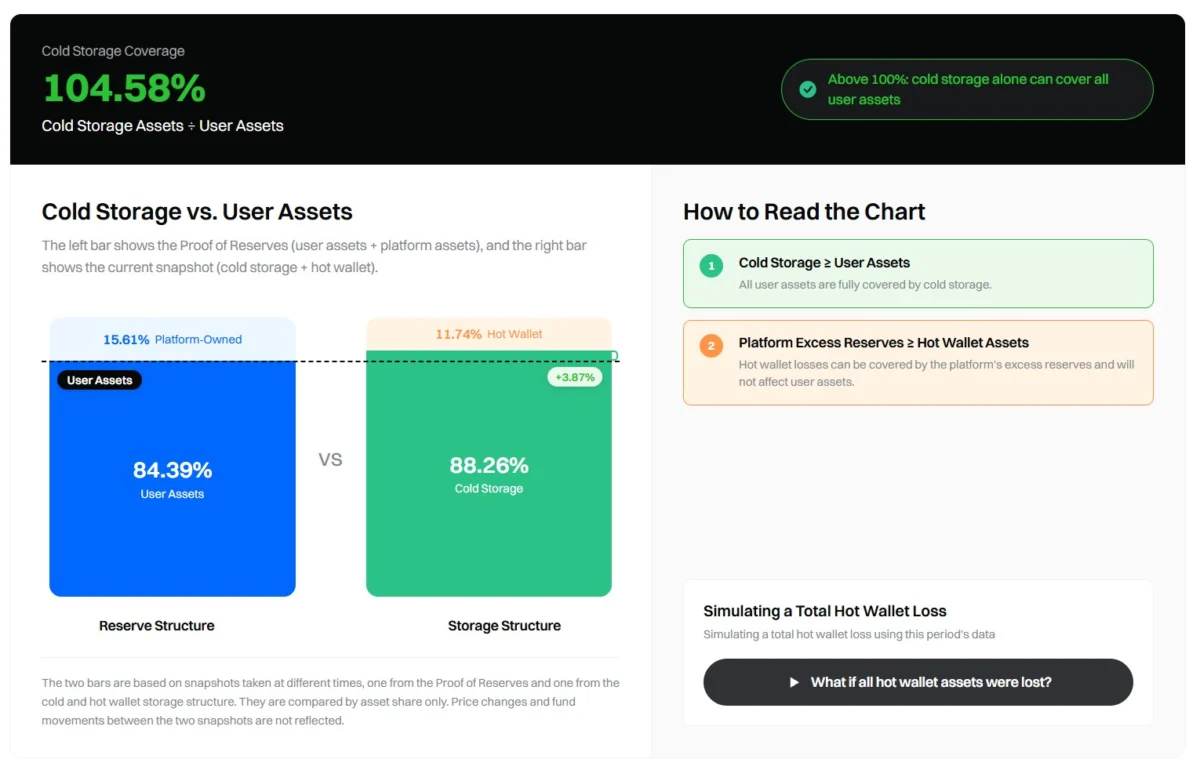
The cryptocurrency industry entered the first week of November with an intensified focus on a previously opaque metric: the percentage of customer digital assets safeguarded in cold storage. This critical measure, denoting funds held in offline wallets disconnected from the internet, came to the forefront following a significant hot wallet attack on Binance on October 29. According to blockchain analytics firm TRM Labs, thieves managed to siphon approximately $6.36 billion, with the vast majority of the theft occurring within a mere 20-minute window, sending shockwaves through the digital asset ecosystem. This unprecedented breach underscored the inherent vulnerabilities of online storage solutions and prompted a swift, albeit varied, response from exchanges globally to reassure their user bases.
The Anatomy of a High-Impact Exploit: Binance’s Hot Wallet Breach
The October 29 incident targeting Binance’s hot wallets represented one of the largest single security breaches in the history of cryptocurrency, triggering immediate alarm across the sector. Hot wallets, by their nature, are kept online to facilitate rapid transactions and withdrawals, offering convenience at the cost of increased exposure to cyber threats. The speed and scale of the Binance exploit highlighted the sophisticated tactics employed by digital asset thieves and the constant arms race between exchange security teams and malicious actors. While Binance CEO Richard Teng quickly moved to reassure the public, stating that the "vast majority" of user assets remained secure in cold wallets and that "no user bears the loss," the incident nevertheless served as a stark reminder of the ever-present risks. The sheer magnitude of the reported loss—$6.36 billion—cast a long shadow, compelling competitors and regulatory bodies alike to demand greater transparency regarding asset custody.
Market Reaction: A Volatile Week for Bitcoin
The market’s immediate reaction to the Binance attack was palpable. On live Bitcoin-to-USD charts, the hours following the theft saw Bitcoin’s price slide below $78,000, representing an approximate 4% drop within 24 hours from its pre-hack levels. This initial downturn reflected investor anxiety and a knee-jerk flight to safety, as traders digested the implications of such a significant security breach on a leading exchange. However, the market demonstrated a degree of resilience, with Bitcoin recovering most of its losses within a week. By November 5, the price had rebounded to $80,564, marking a 5.4% increase on that specific day as markets stabilized and initial fears subsided.
This recovery, however, was short-lived. A broader market sell-off on November 6 saw Bitcoin’s price tumble again to $75,620, registering about a 6% decline in 24 hours. This subsequent dip, as market commentators noted, was largely decoupled from the Binance hack itself. Instead, it was attributed to a wider "risk-off" sentiment permeating global financial markets, particularly a sell-off in AI and tech stocks, coupled with increasing discussions around tougher U.S. regulatory oversight for the crypto sector. The correlation between traditional tech equities and cryptocurrencies often leads to synchronized market movements during periods of macroeconomic uncertainty. On this day, approximately $1.25 billion in leveraged crypto positions were liquidated, further exacerbating the downturn. The Crypto Fear & Greed Index, a sentiment gauge, plummeted to 28 ("Fear") on November 6, down from 50 ("Neutral") just a day prior, reflecting the pervasive unease.
| Date (UTC) | BTC to USD | What was happening |
|---|---|---|
| October 29, ~23:50 | Below $78,000 | Hours after the hot-wallet theft on Binance, triggering initial market panic and a roughly 4.1% drop in Bitcoin’s value within 24 hours. |
| November 1, 10:18 | About $78,064 | Binance began to restart withdrawals in phases, signaling a return to operational normalcy and helping to temper some market anxieties. |
| November 5 | $80,564 | A significant rebound, with Bitcoin’s price increasing by 5.4% on the day, as markets regained composure and the initial shock of the hack began to dissipate, suggesting the market viewed it as an isolated incident rather than a systemic flaw. |
| November 6, 04:00 | $75,620 | A broader market sell-off, with Bitcoin dropping approximately 6% in 24 hours. This decline was primarily driven by macroeconomic factors, including a tech stock rout and concerns over increased U.S. regulatory scrutiny, rather than direct fallout from the Binance exploit. |
Note: Prices from CoinGecko data as reported by market outlets. Bitcoin’s price is highly volatile and changes by the second.
The Imperative of Transparency: Cold-Storage Ratios
In the wake of the Binance incident, the concept of a "cold-storage ratio" rapidly gained prominence. This ratio represents the percentage of an exchange’s customer crypto assets that are securely held in offline wallets, fundamentally disconnected from the internet. The remaining assets reside in "hot wallets," which are online and facilitate swift transactions but are also the primary targets for cybercriminals. The October attack unequivocally demonstrated the critical importance of robust cold storage practices.
Richard Teng’s statement, emphasizing that the "vast majority" of user assets were in cold wallets and that users would not incur losses, was a crucial communication. However, the sheer scale of the theft, even if covered by exchange reserves, propelled the industry towards greater numerical transparency. Regulators, already wary of the nascent crypto market’s risks, found renewed impetus to push for stringent security standards. South Korea, for instance, has long mandated that exchanges maintain at least 80% of customer digital assets in cold storage, with its Financial Supervisory Service (FSS) actively collecting and reviewing these figures. This pre-existing regulatory framework in South Korea served as a benchmark and an indicator of a potential global trend.
Exchanges Step Up: Disclosures and Innovations

The post-hack environment spurred several major global and Korean exchanges to publicly disclose their cold-storage ratios. These disclosures varied, reflecting different operational models and security philosophies, but all aimed to instill confidence in their users. Figures ranged from just above South Korea’s minimum requirement to over 99%, showcasing a spectrum of approaches to asset custody.
| Exchange (as described in disclosures) | Cold storage share | Date of figure |
|---|---|---|
| Large US-listed exchange | More than 99% of customer assets | Blog post, November 4. This high percentage signifies a strong commitment to offline storage, minimizing exposure to online threats. |
| South Korea’s largest exchange | 99.17% | End of September (FSS data). Reflects adherence to strict domestic regulatory requirements and a high standard of asset protection. |
| Second-largest Korean exchange | 94.76% | End of September (FSS data). Also demonstrating strong compliance with South Korean regulations and a robust approach to cold storage. |
| Global exchange (security page) | More than 95% of client crypto | Updated September 18. Indicates a proactive approach to security transparency even before the recent major incident. |
| Global exchange launching a “Proof of Security” report | 88.26% of total assets | November 5. This disclosure was accompanied by an innovative framework, aiming to provide deeper insights into asset management beyond a simple percentage. |
| Three smaller Korean exchanges | 85%, 82.79% and 80.54% | End of September (FSS data). These figures highlight the regulatory floor in South Korea, demonstrating that even smaller exchanges are held to a minimum standard for cold storage. |
Figures as reported by each exchange or by South Korea’s FSS. Exchanges are described by type rather than name for generalized context.
Beyond mere percentage disclosures, one exchange, Gate.io, introduced an innovative framework called "Proof of Security (PoSEC)" on November 5. While standard Proof-of-Reserves (PoR) reports confirm that an exchange holds sufficient assets to cover customer balances, PoSEC takes this a step further. It includes a stress test, detailing how assets are distributed between hot and cold wallets and, crucially, demonstrating whether cold storage alone could fully repay customers even if every hot wallet were completely drained. Gate.io’s PoSEC report indicated a remarkable 104.58%, meaning its cold reserves would still cover all customer assets in such a catastrophic "worst-case" scenario. This framework, while still undergoing third-party audit review, signifies a potential new standard for transparency, providing users with "visibility into asset storage structures and their ability to cover potential losses under extreme scenarios." By initial calculations, these figures imply total platform assets of approximately 118% of customer balances (104.58% ÷ 88.26% ≈ 1.18), indicating a substantial buffer.
Quantifying Risk: Cold Storage in Dollar Terms
While a cold-storage ratio provides a crucial percentage, its real-world impact on potential losses is inherently tied to the fluctuating value of the underlying cryptocurrency. The dollar exposure is a function of both the hot-wallet share and the prevailing Bitcoin price at any given moment. To illustrate this, consider a hypothetical exchange holding 50,000 BTC for its customers. Using the Bitcoin price of $75,620 per coin from November 6 (04:00 UTC), the total value of these holdings would be approximately $3.78 billion.
The following table demonstrates how different hot-wallet shares translate into significant dollar values exposed to online risks:
| Hot-wallet share | BTC online | Dollar value on November 6 |
|---|---|---|
| 0.83% (99.17% cold) | 415 BTC | About $31.4 million |
| 1% (99% cold) | 500 BTC | About $37.8 million |
| 5% (95% cold) | 2,500 BTC | About $189 million |
| 11.74% (88.26% cold) | 5,870 BTC | About $444 million |
| 20% (Korea’s 80% minimum) | 10,000 BTC | About $756 million |
Calculation: BTC online × $75,620.19.
This analysis underscores that even a seemingly small hot-wallet percentage can represent hundreds of millions of dollars in potential exposure, especially for exchanges managing substantial customer assets. Furthermore, the volatility of Bitcoin itself significantly impacts the dollar value of stolen or exposed funds. For example, the 18,270 BTC that blockchain trackers estimate are still controlled by the Binance attacker were worth about $1.47 billion at Bitcoin’s price of $80,564 on November 5. Just one morning later, at $75,620, their value had dropped to approximately $1.38 billion—a swing of roughly $90 million without a single coin changing hands, illustrating the dynamic nature of financial risk in the crypto space.
Broader Implications: Confidence, Regulation, and User Empowerment
While a higher cold-storage ratio does not directly dictate Bitcoin’s market price, which is influenced by trading across the entire global market, it profoundly impacts investor confidence. The quick recovery of Bitcoin’s price to $80,564 by November 5 suggested that the market largely compartmentalized the Binance theft as a company-specific issue rather than an inherent flaw in Bitcoin’s underlying technology. A robust cold-storage strategy demonstrably limits an exchange’s potential losses in an attack, thereby fostering long-term trust and stability.
The response to the Binance hack also highlighted the increasing sophistication in fund recovery efforts. Blockchain analytics firms like Elliptic estimated that approximately $2.85 billion of the stolen funds were frozen or seized, with a remarkable 94% of this amount consisting of stablecoins whose issuers possess the capability to block addresses. This demonstrates a growing capacity within the industry to mitigate the impact of thefts, particularly when assets are traceable and centrally controlled.
However, cold storage, while highly secure, is not entirely immune to vulnerabilities. Regulators, such as Hong Kong’s Securities and Futures Commission, issued warnings in August 2025 (a forward-looking statement in the source text, implying future or hypothetical regulatory guidance) that weaknesses in wallet systems can affect both hot and cold setups. This underscores that while a high cold-storage ratio is a strong indicator of security, it is not an absolute guarantee. Comprehensive security protocols, multi-signature requirements, and rigorous audit processes remain essential.

For individual investors, understanding these dynamics is crucial. The same logic applied to exchanges can be applied to personal asset management. Bitcoin held in a hardware wallet or other offline storage solution controlled by the user is entirely insulated from an exchange’s hot wallet risks.
Empowering Users: A Practical Guide to Assessing Exchange Security
For users wishing to independently assess an exchange’s cold storage alongside Bitcoin’s price, a straightforward five-step routine can be followed:
- Locate Disclosure: Find the exchange’s official cold storage disclosure. This is typically found on their security page, in a blog post, or within regulatory filings.
- Note the Percentage: Identify the stated cold storage percentage (e.g., 99%).
- Find Total Assets (if available): Some exchanges provide an estimated total amount of customer assets held.
- Check Current Bitcoin Price: Use a reliable source like CoinGecko or a live exchange chart to get the current BTC to USD rate.
- Calculate Exposure: Multiply the total customer Bitcoin by the "hot wallet" percentage (100% minus the cold storage percentage) to estimate the amount of BTC online. Then, multiply this by the current Bitcoin price to get the approximate dollar value of assets held in hot wallets.
This simple exercise empowers users to make more informed decisions about where and how they store their digital assets, enhancing their personal security posture in a dynamic and sometimes perilous market.
Frequently Asked Questions (FAQs)
Why don’t exchanges keep 100% of crypto in cold storage?
Exchanges need a portion of customer assets readily accessible in hot wallets to process withdrawals and facilitate trading promptly. Moving funds from cold storage typically involves manual approvals, multiple signatories, and secure protocols, which can take several hours. Most large exchanges maintain a small hot-wallet buffer to cover normal daily transaction volumes and periodically replenish it from their larger cold storage reserves.
What is a proof-of-reserves report?
A Proof-of-Reserves (PoR) report is an audited statement or cryptographic verification demonstrating that an exchange holds sufficient on-chain assets to match or exceed the total balances deposited by its customers. Many modern PoR systems incorporate cryptographic methods, such as Merkle trees, allowing individual users to verify their own balance is included in the audit without revealing other users’ sensitive information. The specific date of the snapshot for the report is critical, as customer balances and asset values change daily.
Is cold storage the same as a hardware wallet?
They are closely related concepts. A hardware wallet is a specific type of cold storage device commonly used by individuals to keep their private keys offline. Exchanges, however, typically employ more complex and larger-scale cold storage setups. These often involve multiple hardware devices, multi-signature requirements, physically secure facilities, and sophisticated operational procedures, but the fundamental principle remains the same: private keys are kept offline, making them significantly harder for attackers to compromise.
What is a multisig wallet?
A multisig, or multi-signature, wallet requires approval from multiple private keys before a transaction can be executed. For instance, a 3-of-5 multisig wallet would need any three out of five designated key holders to sign off before funds can be moved. Exchanges frequently utilize multisig setups for their cold storage, adding an extra layer of security. This prevents a single point of failure, such as a stolen laptop or compromised password, from leading to the unauthorized draining of funds. The trade-off for this enhanced security is often slower transaction processing, as each withdrawal requires multiple individuals to provide their cryptographic signatures.
Why does the Bitcoin price differ slightly between websites?
Bitcoin prices can vary slightly across different websites or exchanges due to several factors. Each platform pulls price data from various trading venues and updates its quotes at different intervals. Some display the last traded price on their specific platform, while others present an aggregated average across multiple markets. These differences can amount to a few dollars at any given second. For consistent calculations, such as those in this article, it is crucial to note the time of the quote and use the same source for all price data.