

 admin
admin
The crypto industry’s substantial financial contributions predominantly favoring US Republicans are creating a significant political chasm, potentially alienating Democrats whose bipartisan support is deemed essential for passing critical federal crypto legislation. This stark warning came from former New York Governor Andrew Cuomo during a panel discussion at the Token2049 conference on Tuesday, where he shared the stage with OKX CEO Star Xu. Cuomo highlighted the industry’s strategic misstep, asserting that its heavy investment in the Republican Party, while intended to push legislation like the CLARITY Act, inherently risks alienating the Democratic contingent necessary for successful legislative action.
The Partisan Divide in Crypto Lobbying
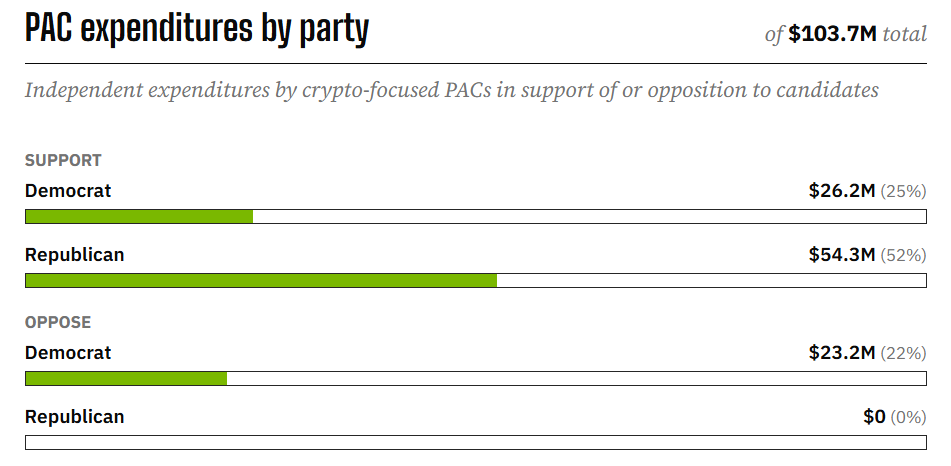
Cuomo’s observations are underscored by recent data from Tech Influence Watch, a political action committee (PAC) tracker. As of Thursday, crypto-focused PACs have channeled a staggering $54.3 million towards supporting Republican candidates in the ongoing 2026 election cycle. In stark contrast, Democratic candidates have received only $26.2 million from these same groups. Further exacerbating the imbalance, an additional $23.2 million has been explicitly spent opposing Democrats, illustrating a clear and pronounced partisan tilt in the industry’s political expenditures. This significant disparity in financial backing paints a picture of an industry heavily betting on one side of the political aisle, a strategy Cuomo contends is counterproductive to its long-term legislative goals. "When you invest heavily in the Republican Party, by definition, you’re going to alienate Democrats," Cuomo stated unequivocally, emphasizing the practical implications of such an imbalanced approach.
The CLARITY Act, a central piece of proposed legislation aimed at providing regulatory clarity for digital assets, represents a significant aspiration for the crypto sector. However, its path to enactment is fraught with political complexities, particularly given the current congressional dynamics. As of Thursday, the Kalshi prediction market indicated a 61% probability of Democrats securing control of both chambers of Congress, a scenario that would profoundly impact the legislative landscape. In such an event, Cuomo posited two potential outcomes: a Democratic-controlled Congress might either seek to roll back existing crypto initiatives spearheaded by agencies or, alternatively, engage with a potential Trump administration to advance the full CLARITY Act. Regardless of the specific path, the need for bipartisan cooperation remains paramount. "You need Democrats to pass the bill. You need Republicans. You have to be more balanced," Cuomo advised, stressing the imperative for a more nuanced and inclusive political engagement strategy.
Token2049: A Global Stage for Policy Discussions
The remarks were delivered at Token2049, one of the crypto industry’s most prominent global conferences, held this year in a major financial hub. The event serves as a crucial platform for industry leaders, policymakers, and innovators to discuss the future of digital assets, blockchain technology, and regulatory frameworks. Cuomo’s presence on a panel with OKX CEO Star Xu highlights the industry’s growing recognition of the need for robust engagement with political figures, especially those with significant experience in governance and public policy. The discussions at such events often revolve around fostering innovation, ensuring consumer protection, and establishing clear regulatory guardrails that can propel the industry forward. Cuomo’s intervention underscores that while technological advancements are central to the conference’s theme, the political realities of achieving regulatory certainty are equally, if not more, critical.

Challenging the Narrative: Democrats and Crypto
Cuomo actively challenged the prevailing perception within the crypto community that Democrats are inherently anti-crypto. He argued that such a generalization is not only inaccurate but also strategically detrimental. "There’s a sense that Democrats are anti-crypto," he acknowledged, before presenting a compelling counter-argument. "As a matter of fact, I could argue that the crypto technology is exactly suited to the Democratic Party. It’s empowering people who otherwise wouldn’t have access to financial products, and the Democratic Party has been working to do that all its life."
This perspective aligns with historical Democratic Party platforms emphasizing financial inclusion, consumer protection, and leveling the economic playing field. Concepts such as decentralized finance (DeFi) and accessible digital payment systems could, theoretically, resonate with Democratic ideals of empowering underserved communities and providing alternatives to traditional, often exclusionary, financial institutions. By reframing crypto as a tool for economic empowerment rather than merely a speculative asset class, Cuomo suggested a potential avenue for the industry to bridge the partisan divide and find common ground with Democratic lawmakers.
Legislative History and Bipartisan Hurdles
Despite the industry’s predominantly Republican funding strategy, the legislative journey of crypto bills has, at times, demonstrated pockets of bipartisan support, albeit with significant hurdles. For instance, in July 2025, the CLARITY Act managed to pass the House of Representatives with substantial backing, including 78 House Democrats joining 216 Republicans. However, a significant bloc of 134 Democrats voted against it, signaling deep divisions within the party. Similarly, the GENIUS Act, another piece of crypto legislation, saw 18 Democratic senators support its passage in the Senate in June 2025. These instances suggest that while Republican support has been more unified, a segment of the Democratic Party is indeed open to specific crypto legislation.
However, the path to comprehensive regulatory clarity remains rocky. A critical moment arrived in September during a procedural vote on the CLARITY Act in the Senate, where all Senate Democrats, along with four Republicans, voted against advancing the bill. While this vote was a setback, many of the concerns raised at the time were reportedly tied to potential conflicts of interest involving former President Trump’s crypto business ventures, rather than an outright rejection of the technology or the bill’s core tenets. This nuance is crucial, as it suggests that specific ethical or political concerns can complicate bipartisan efforts, even when underlying policy goals might align.
In a subsequent move to clarify their position and reaffirm their commitment, seven Democratic senators issued a joint statement. This statement underscored their continued dedication to passing the CLARITY Act, indicating that the September procedural vote was not a definitive end to their support for comprehensive crypto regulation but rather a reflection of specific concerns that needed to be addressed. This complex interplay of support, opposition, and specific reservations highlights the intricate dance of legislative politics in Washington.
The Role of Political Action Committees (PACs)
Crypto-focused PACs, such as Fairshake, have emerged as powerful players in the political landscape, channeling significant funds to shape election outcomes and influence policy debates. These PACs argue that their involvement is essential to ensure that lawmakers understand the nuances of digital assets and create a regulatory environment conducive to innovation. On Monday, Fairshake announced its endorsement of 32 House candidates for November’s midterm elections, a slate that included 19 Republicans and 13 Democrats. While this particular endorsement list shows a more balanced approach than the overall spending trends, it still reflects the ongoing challenge of building robust, across-the-aisle support. The strategic allocation of funds by these PACs is a calculated effort to cultivate a cadre of "crypto-friendly" legislators who can champion the industry’s interests. However, as Cuomo points out, if this strategy results in a perceived bias towards one party, it risks alienating the very lawmakers whose votes are needed for legislative success.
Broader Implications and the Need for a Balanced Approach
The current political strategy employed by the crypto industry carries significant implications for the future of digital asset regulation in the United States. A highly partisan approach risks creating legislative gridlock, where bills pass one chamber of Congress only to die in the other, or face veto threats. This stalemate prolongs regulatory uncertainty, which in turn stifles innovation, discourages investment, and potentially pushes crypto businesses to more favorable jurisdictions abroad. The lack of a clear regulatory framework also leaves consumers vulnerable to scams and market manipulation, issues that a comprehensive federal law aims to address.
From a global competitiveness perspective, the United States risks falling behind other nations that are actively developing clear and robust regulatory frameworks for digital assets. Countries in Europe, Asia, and the Middle East are vying to become hubs for crypto innovation, and a prolonged period of regulatory ambiguity in the U.S. could lead to a brain drain and capital flight from the American market.
Cuomo’s message is a call for a strategic recalibration within the crypto industry’s lobbying efforts. To successfully navigate the complex legislative process, the industry must move beyond a perceived partisan preference and actively cultivate relationships and understanding across the political spectrum. This would involve not only balancing financial contributions but also engaging in sustained educational efforts to demonstrate how crypto technology can serve diverse policy objectives, from financial inclusion to national security.
The path to comprehensive crypto legislation in the U.S. is not merely a technical or economic challenge; it is fundamentally a political one. The ability of the crypto industry to adapt its political strategy, embracing a more bipartisan and inclusive approach, will be a crucial determinant of whether it achieves the regulatory clarity it so desperately seeks. Without such a shift, the industry risks remaining caught in a perpetual cycle of political infighting, leaving its future in the U.S. uncertain and its potential unfulfilled. The urgency of this issue is amplified by the upcoming election cycles, where the composition of Congress and the White House could either pave the way for progress or deepen the existing divides.







