admin
admin
The cryptocurrency industry, a domain perpetually on the cutting edge of technological innovation and simultaneously a magnet for sophisticated cyber threats, is currently facing a critical dilemma: the highly uneven distribution of access to powerful new artificial intelligence models designed to fortify code against attacks. While a select few major players have successfully integrated these frontier AI capabilities into their security protocols, the vast majority remain on the outside looking in, creating a burgeoning security divide that could have profound implications for an ecosystem where exploits can cost billions of dollars and erode public trust. This disparity comes at a time when AI-assisted hacking attempts are not merely theoretical threats but have already led to service disruptions and significant financial losses, amplifying the urgency for equitable access to advanced defensive technologies.
The Escalating Stakes: Crypto’s Unique Security Challenges
The digital assets landscape, with a global market capitalization that frequently exceeds $2 trillion, presents an irresistible target for malicious actors. Decentralized finance (DeFi) protocols alone often hold tens of billions in Total Value Locked (TVL), making them prime targets for a diverse array of sophisticated attacks, including flash loan exploits, re-entrancy attacks, and complex phishing schemes. The immutable nature of blockchain transactions means that once an exploit occurs, funds are often irretrievable, intensifying the need for proactive and robust security measures that can prevent breaches rather than merely respond to them. Traditional cybersecurity methods, while essential, are increasingly struggling to keep pace with the evolving sophistication of attackers, particularly as these adversaries begin to leverage the immense power of artificial intelligence themselves. This confluence of high stakes, rapid technological evolution, and increasingly AI-empowered threats underscores why access to cutting-edge AI security tools is not merely an advantage, but rapidly becoming an existential necessity for many crypto entities.
The Promise of Frontier AI: A New Shield Against Cyber Threats
At the heart of this access disparity are advanced AI models, often referred to as "frontier" models, such as Anthropic’s "Mythos" and OpenAI’s "GPT-5.5-Cyber." These models possess capabilities far beyond their publicly available counterparts, which are typically designed for general-purpose tasks and often come with built-in safeguards to prevent misuse (e.g., restricting prompts related to hacking or exploit generation). In contrast, specialized frontier models are engineered for highly sensitive tasks, including deep code analysis, automated vulnerability identification, exploit generation, and even the simulation of attack vectors, all without the restrictive guardrails present in public versions. For cybersecurity professionals, this unrestricted capability represents an unprecedented tool for proactively identifying and patching vulnerabilities in complex codebases like smart contracts and blockchain protocols. They can simulate countless attack scenarios, analyze vast amounts of code for subtle flaws, and even generate potential fixes, dramatically accelerating the defense cycle. However, this same immense power also carries the inherent risk of being weaponized if it falls into the wrong hands, a primary reason for the developers’ cautious and highly controlled approach to distribution.
A Tale of Two Tiers: Who Has Access and Who Doesn’t

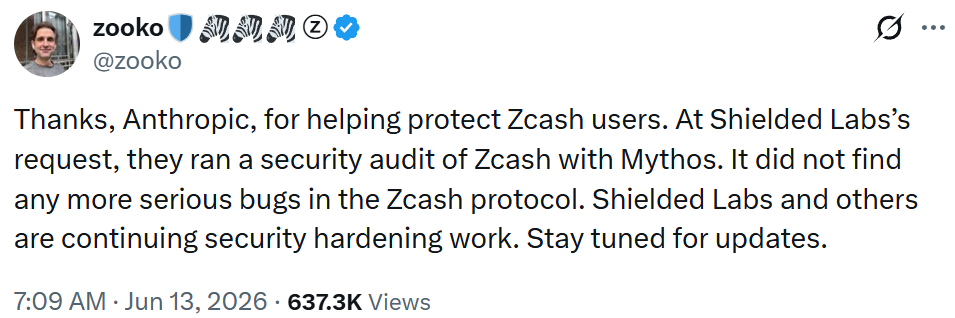
The stark reality of this access gap is evident across the industry’s major players. In June, leading US crypto exchange Coinbase announced a significant breakthrough: it had secured access to Anthropic’s restricted Mythos model. This was followed by an affirmation from Zooko Wilcox, founder of Zcash, who publicly stated that Anthropic utilized Mythos to conduct an audit of the Zcash protocol at the behest of Shielded Labs. These instances represent significant milestones, demonstrating the tangible potential of such AI to enhance the integrity and resilience of critical blockchain infrastructure by identifying subtle bugs that human auditors might miss.
However, these remain isolated successes, highlighting a widening chasm. Binance, the world’s largest cryptocurrency exchange by daily trading volume, holding a staggering $137.8 billion in assets according to DefiLlama, has openly admitted its struggles to gain entry to this exclusive club. Jimmy Su, Binance’s chief security officer, conveyed to Cointelegraph the extent of their ongoing efforts: "That’s one advanced frontier model that hasn’t been made available to crypto just yet. We have been trying to make inroads there. We also talked to other crypto exchanges and our own investors to try to make some progress. But we haven’t gotten the most frontier AI model, like Mythos." This candid statement from such a dominant industry player underscores the systemic nature of the challenge and the perceived difficulty in accessing these pivotal tools, even for entities with immense financial resources and security needs.
The sentiment of being locked out is echoed by other major entities across the crypto landscape. Crypto custodian Fireblocks, responsible for securing trillions of dollars in assets annually for institutions, indicated in April its active pursuit of Mythos access, at the time relying solely on Anthropic’s publicly available models for penetration testing, as reported by The Information. These public models, while useful, lack the targeted cyber capabilities of their restricted counterparts. Similarly, Hayden Adams, the founder of the prominent decentralized exchange Uniswap, voiced palpable frustration in June regarding the restrictive safeguards of Fable 5, Anthropic’s public model. He criticized how these safeguards hampered its utility for cybersecurity-related prompts, effectively making it less effective for critical defensive work. The Ethereum Foundation, a pivotal organization in the blockchain space that coordinates development for the second-largest cryptocurrency, disclosed in July that it employs "coordinated AI agents" to detect bugs across its systems. However, it notably refrained from specifying which AI models were in use, leaving open the critical question of whether they, too, possess access to these coveted frontier tools, or if they are developing their own solutions. Cointelegraph’s attempts to confirm access with Ethereum Foundation, Fireblocks, and Uniswap were ongoing, reflecting the industry’s opacity around this sensitive issue.
The Developers’ Rationale: Balancing Power with Responsibility
The developers of these advanced AI models, Anthropic and OpenAI, articulate a clear rationale for their highly controlled rollout, centered on safety, ethical considerations, and preventing misuse. Anthropic, for instance, clarifies that Mythos 5 shares the same foundational model as its publicly available Fable 5 but operates without the safeguards that typically restrict sensitive cybersecurity applications. This distinction is crucial: Fable 5 might be an excellent conversational AI, but Mythos 5 is a precision instrument for cyber warfare, capable of generating code, identifying vulnerabilities, and simulating complex attack scenarios, without the ethical "stopgaps" built into consumer-facing models.
OpenAI employs a similar multi-tiered access system. "Verified defenders" can utilize GPT-5.5 with "Trusted Access for Cyber," providing a degree of enhanced capability. However, a more permissive variant, GPT-5.5-Cyber, is strictly reserved for a smaller cohort engaged in authorized penetration testing and high-stakes security research. This tiered approach allows developers to test the models’ capabilities in controlled environments with trusted partners, gather feedback, and iterate on safety protocols before potentially broader distribution.
Crypto security executives, while acknowledging the immediate benefits of these tools, largely concur with the necessity of initial restrictions. Binance’s Jimmy Su articulated this perspective clearly, stating that a cautious rollout is a "responsible approach" because newly released models could potentially empower attackers more rapidly than defenders. "If it enhances the attacker much faster than the defender, then it actually is harming the ecosystem," Su explained, suggesting that a limited testing period could significantly mitigate the "blast radius" of any unforeseen vulnerabilities or misuse. This conservative stance reflects a broader industry concern about the dual-use nature of powerful AI and the potential for unintended consequences if such tools are released prematurely or without adequate safeguards. The ethical imperative to prevent powerful AI from becoming a weapon in the hands of malicious actors heavily influences these developers’ distribution strategies.
However, this consensus on initial restriction is not absolute, nor is it seen as a permanent solution. Executives interviewed by Cointelegraph emphasized that the justification for gating access diminishes significantly as publicly available AI models rapidly approach similar capabilities. Su himself noted that "as other more powerful models are being released, the pressure will be on Anthropic to make it more widely available." The critical question then shifts to whether legitimate defenders can deploy these frontier models as effectively as potential attackers once they become broadly accessible. This points to an evolving arms race, where delayed access for defenders could prove catastrophic.
Michael Coates, the Chief Information Security Officer of the Solana Foundation, who joined in July, echoed the need for safeguards but stressed the urgency for legitimate defenders to gain faster routes to these tools. "I fully understand guardrails for advanced models, but we need to streamline the verification programs, the acceptance programs, to give these models to legitimate defenders," Coates urged. His concern is rooted in the belief that "we need to make sure that the best models we can get are in the hands of defenders because attackers will have something capable enough." This highlights the "defender’s dilemma": if attackers are already leveraging or will soon leverage powerful AI, withholding similar tools from defenders places them at a severe disadvantage.
Sean Cheetham of Blockchain Capital further supported the eventual opening up of these restrictions, positing that broader availability could ultimately favor defenders. He reasoned that the sheer number of legitimate security researchers and white-hat hackers vastly outweighs the relatively small groups of sophisticated attackers. "If good people can multiply their defense scale… you’re much better off just opening it up and allowing them to defend themselves," Cheetham contended, highlighting a potential network effect where collective defense capabilities, amplified by AI, could outpace individual malicious exploits.
A Chronology of Rising AI-Assisted Threats
The debate over access is not merely theoretical; it is underpinned by an increasingly alarming trend of AI-assisted hacking attempts targeting the crypto space. The past few months have witnessed a noticeable uptick in these sophisticated attacks, forcing protocols to adapt or, in some cases, temporarily halt operations, underscoring the immediate and escalating nature of the threat.
On a recent Monday, Bitcoin swap service Boltz announced its decision to temporarily pause its non-custodial bridge following a "steady rise in AI-assisted exploits" over the preceding months. The company’s candid assessment underscored the formidable challenge: "The pattern is clear: attackers now iterate faster than a team our size can find and patch." This incident serves as a stark warning, demonstrating how even well-intentioned and secure protocols can be overwhelmed when facing adversaries augmented by rapid AI iteration. A human security team, no matter how skilled, struggles to match the speed at which an AI can analyze code, generate attack vectors, and test them, effectively creating an asymmetric battlefield.
Just the week before, Bitcoin hardware wallet manufacturer Coinkite reported a critical vulnerability in its Coldcard devices. The flaw lay in its wallet seed generation, which proved to be less random than anticipated, leading to exploits. Disturbingly, Coinkite speculated that the attacker had likely employed AI to meticulously review previous versions of the firmware to pinpoint and exploit this subtle flaw. This incident is particularly poignant as the company itself had utilized "one of the best available AI models" to review its code mere weeks prior, illustrating the relentless pace of the AI cybersecurity arms race. This suggests that even a proactive defense strategy using AI might not be enough if the attacker possesses a more advanced or strategically deployed AI, or if the defender’s AI is constrained by safeguards.
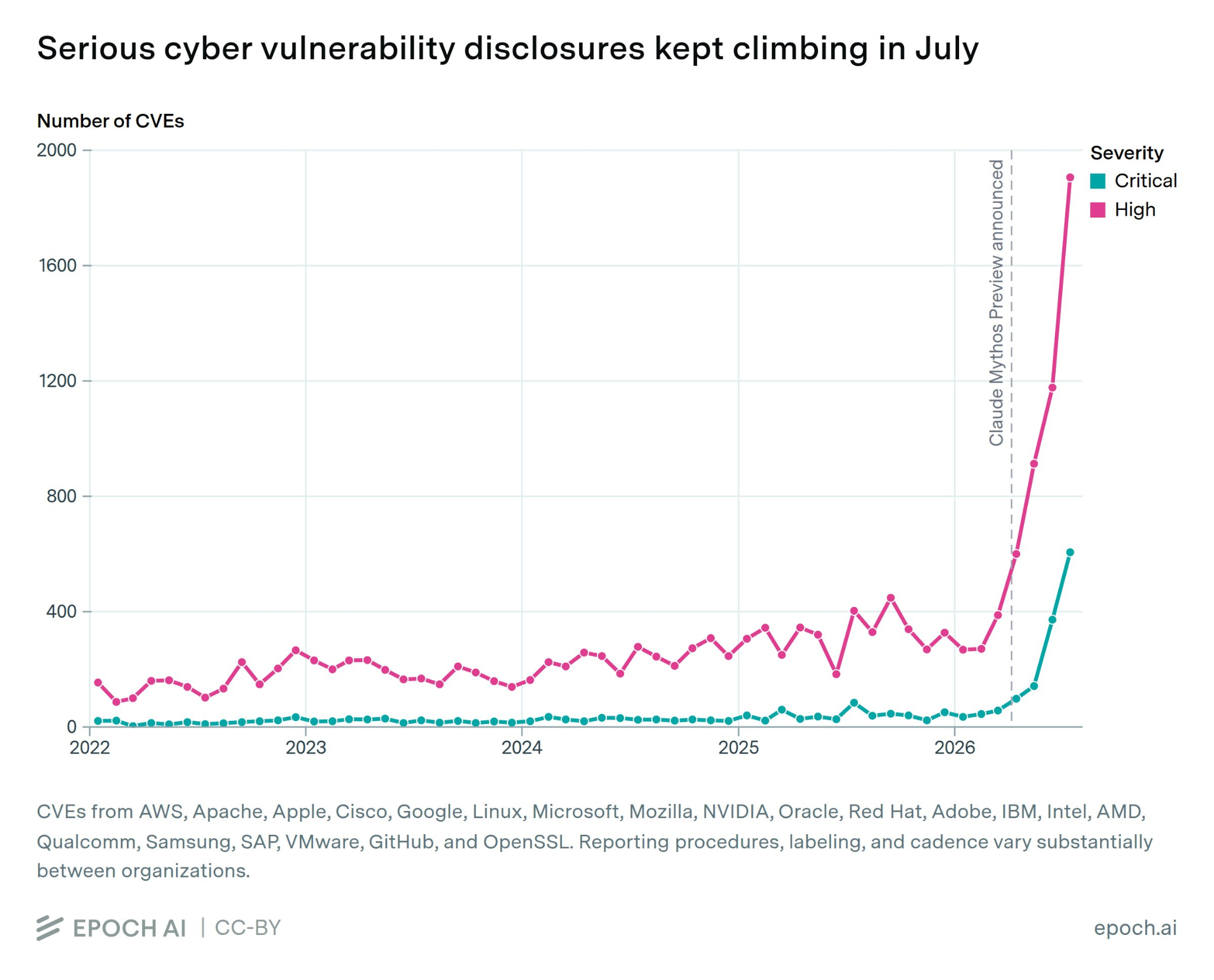
The timing of these events also coincides with observations of increased vulnerabilities. Data from Epoch AI Research indicates a climb in critical-severity CVEs (Common Vulnerabilities and Exposures) following the preview launch of Claude Mythos. While correlation does not always imply causation, this data suggests a potential acceleration in the discovery or exploitation of vulnerabilities in the wake of advanced AI model releases, further complicating the risk assessment for both AI developers and potential users. It highlights a period of heightened vulnerability exposure, possibly due to both legitimate security researchers and malicious actors leveraging new AI capabilities.
Project Glasswing and Crypto-Adjacent Access
While many core crypto firms await access, some crypto-adjacent companies have successfully navigated the stringent access requirements, offering a glimpse into Anthropic’s strategic rollout. FIS, a prominent global financial technology provider that partnered with Circle in July last year to enable banking clients to offer USDC payments, joined Anthropic’s "Project Glasswing" last month. Project Glasswing is Anthropic’s exclusive, gated program designed to provide vetted cyber defenders and organizations deemed critical software infrastructure with early access to its restricted Mythos models. This inclusion of traditional finance infrastructure providers highlights the perceived importance of these AI models beyond the immediate crypto ecosystem, particularly where digital assets intersect with conventional banking systems, which are themselves critical infrastructure.
Similarly, HackerOne, a leading platform for bug-bounty and security testing services that counts major crypto exchanges among its clientele, also announced its participation in Project Glasswing. However, HackerOne clarified that its testing capabilities with Mythos are presently confined to its own internal infrastructure, not yet extended to its client programs. This distinction underscores the cautious and phased rollout approach adopted by Anthropic, even for trusted cybersecurity partners. These instances suggest a strategic prioritization by AI developers, focusing first on entities that provide foundational infrastructure or generalized security services, potentially before broadening access to specific, highly decentralized crypto protocols. This approach aims to maximize the defensive impact while minimizing