admin
admin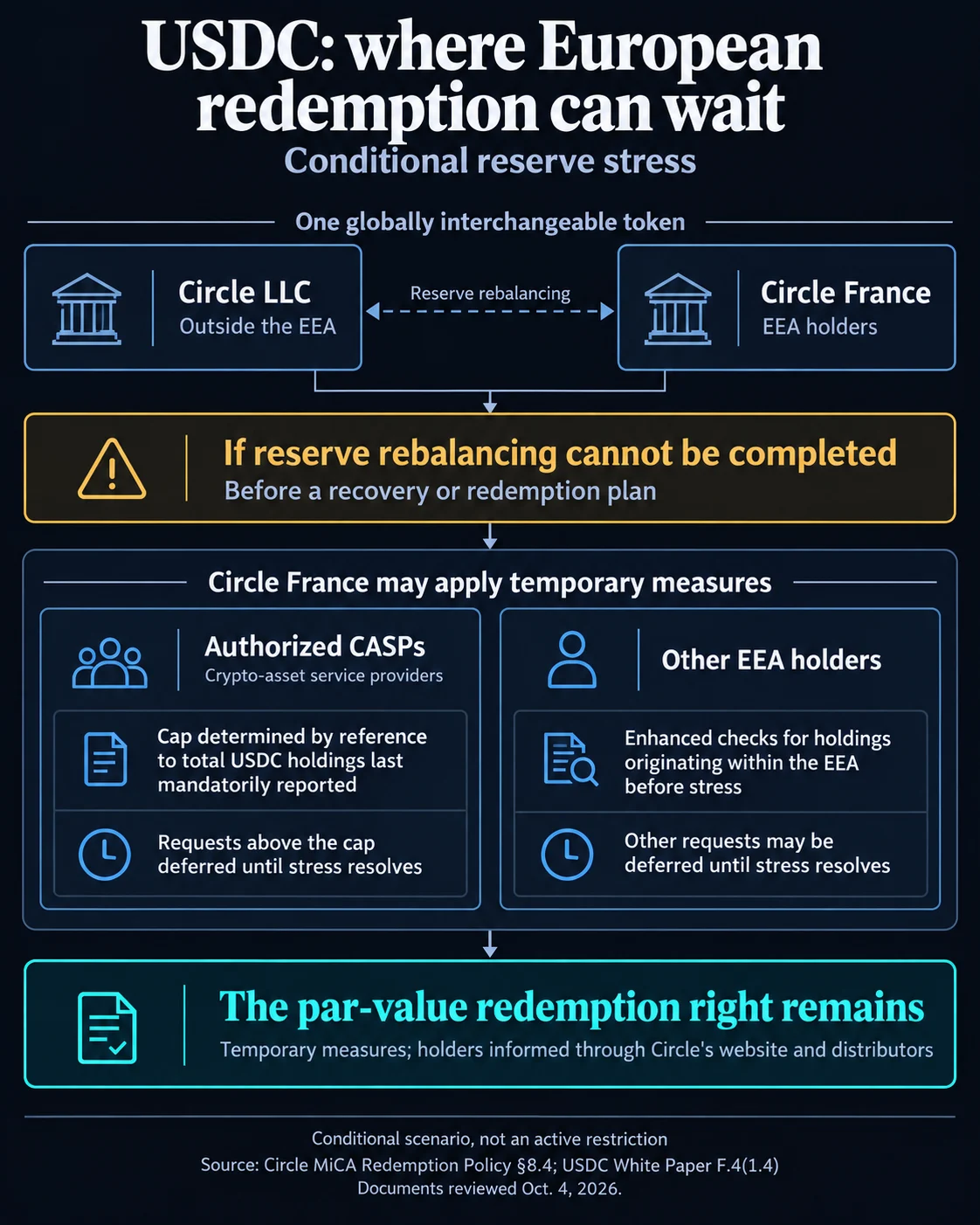
European holders of USD Coin (USDC), a prominent stablecoin, could encounter temporary delays in accessing their dollar-denominated funds from Circle, the issuer, if reserve rebalancing between its European and U.S. entities falters. While their fundamental claim to a dollar remains intact, Circle’s current European redemption policy allows for such postponements during periods of failed reserve rebalancing, exposing a critical cash-access boundary within a digital asset designed for global interchangeability. This intricate mechanism is particularly relevant as Circle actively lobbies European regulators to maintain its cross-border co-issuance model.
Circle’s proactive engagement with the European Commission, evidenced by its October 1 response to the Markets in Crypto-Assets (MiCA) review consultation, underscores the importance of this structure. The company argues that preserving the co-issuance framework is crucial for keeping global stablecoin liquidity within Europe’s regulatory perimeter. However, the existing terms of this policy implicitly highlight the potential consequences when the reserve transfers that underpin this structure encounter impediments.
The implemented controls differentiate between authorized crypto service providers and other European Economic Area (EEA) holders. Authorized providers might face redemption caps, potentially tied to their previously reported holdings. Conversely, other EEA holders could undergo checks to verify that their holdings were established within the EEA prior to any identified stress event. These provisions are characterized as contingency measures. As of October 4, public documents reviewed did not indicate an active reserve-transfer failure or an imposed restriction on redemptions due to reserve stress. Nevertheless, these policies qualify the assumptions European users can make regarding immediate access to issuer cash during periods of market duress.
Under Circle’s MiCA redemption policy, Circle Internet Financial Europe SAS, operating as Circle France, is designated to handle redemptions for USDC holders established within the EEA. Holders based outside the EEA exercise their redemption rights directly with Circle Internet Financial, LLC, under a separate agreement. The policy asserts that this allocation preserves the right to redemption at par, as stipulated by Article 49 of MiCA. However, for an individual holder, the value of their claim and the timeline for receiving the actual payment are distinct considerations.
Circle’s current EEA Mint terms explicitly delineate this timing distinction. While a customer can submit a redemption request at any time, the execution of that request is contingent upon a range of factors, including legal, regulatory, compliance, prudential, liquidity, and operational conditions. The redemption policy itself is dated September 15, 2026, and the USDC white paper indicates an amendment on the same date, suggesting a structured and evolving approach to these terms.
Two Mechanisms for Redemption Deferral
Section 8.4 of the redemption policy defines a "Stress Event" as a period during which USDC reserves cannot be effectively rebalanced between Circle France and Circle LLC, preceding the activation of a Recovery Plan or Redemption Plan. During such a defined Stress Event, Circle reserves the right to adjust the processing and prioritization of redemption requests, which may include deferring their execution beyond the standard policy timelines.
Complementing this, Section F.4(1.4) of the USDC white paper outlines specific holder-based measures that can be implemented during such stressful periods. These measures are designed to manage the flow of redemptions and preserve the integrity of the reserve system. Circle characterizes these adjustments as temporary and non-discriminatory, emphasizing that they are implemented to maintain the par-value redemption of USDC. The policy stipulates that holders will be informed of such situations through Circle’s website and by distributing partners. Should the reserve rebalancing not be restored, the redemption process would then be managed under the established recovery or redemption arrangements.
These operational controls can therefore impact both intermediaries seeking direct access to issuer cash and individual EEA holders attempting to redeem their holdings. The ability to receive USDC during a stress period would not, in isolation, guarantee that a non-provider’s newly acquired holdings meet the pre-stress EEA origin condition.

The Secondary Market and Intermediary Roles
In scenarios where direct issuer redemption is delayed, a secondary market sale could potentially offer an immediate exit route, provided a willing buyer or intermediary is prepared to facilitate the transaction. The conditional nature of cash flow implies that another party would need to supply the requisite cash before Circle could ultimately settle the redemption. Such a buyer could acquire the tokens outright using their own liquidity, without necessarily involving a loan facility.
An exchange that commits to providing funds to users before Circle does would be reliant on its own internal cash management strategies and available liquidity. The token’s persistent claim to par value does not automatically translate into immediate funding for such an exchange. An intermediary choosing to advance cash would inherently assume the timing gap until they could redeem the tokens themselves or otherwise dispose of them.
The reviewed documentation does not identify any specific intermediary commitments to provide unrestricted, immediate cash-outs under this reserve-stress scenario, nor does it detail any available stress-market bid prices or associated financing costs. Consequently, any secondary market sale would ultimately depend on the availability of a willing buyer and the terms they are prepared to offer.
Circle’s transparency disclosures, accessible via its website, focus on reserve backing and monthly third-party assurance of these reserves, addressing a different aspect of the stablecoin’s integrity. The white paper details a French minimum reserve requirement equivalent to the value of EEA-held USDC and outlines an inter-issuer rebalancing procedure. This requirement is designed to accommodate fluctuations in token distribution. Notably, the white paper explicitly acknowledges the risk that Circle LLC might be unable to rebalance reserves when holdings and redemption requests disproportionately shift towards the EEA.
The Reserve-Transfer Test: A Cornerstone of Circle’s Policy Advocacy
Circle’s October 1 submission to the European Commission advocates for the preservation of its multi-issuance model and the formalization of safeguards, including dynamic rebalancing between global and EU-specific reserves. The company’s central argument is that restricting this structure would inevitably drive stablecoin usage towards offshore providers, thus circumventing the protections afforded by MiCA.
However, Europe’s systemic risk watchdog has articulated a differing perspective. In its October 25, 2025, recommendation concerning third-country multi-issuer stablecoins, the European Systemic Risk Board (ESRB) urged the Commission to interpret the existing MiCA framework as not permitting such schemes. Should the Commission adopt a contrary view, the ESRB recommended the establishment of a dedicated regulatory framework incorporating robust safeguards.
The ESRB’s recommendation, adopted on September 25, 2025, also called for a thorough assessment of barriers to reserve mobility. It further emphasized the need to obtain concrete evidence demonstrating that supporting institutions possess the capacity to promptly liquidate assets, facilitate cross-border fund transfers, and maintain consistent access to payment systems.
The operational terms outlined by Circle vividly illustrate why these practical considerations are of paramount importance to USDC holders. The effectiveness of rebalancing as a safeguard is intrinsically linked to the unimpeded movement of cash to the issuer tasked with fulfilling redemption requests. When such transfers are obstructed, temporary restrictions can shift the burden of waiting onto service providers and other EEA holders, even as the fundamental right to redemption at par remains theoretically intact.
Therefore, the critical practical tests revolve around the readiness of reserve transfers, the stipulated treatment of holder redemption requests, and any concrete undertaking by intermediaries to provide actual cash-outs. Circle’s advocacy for its policy framework hinges on the premise of maintaining accessible global liquidity within Europe. However, its current redemption terms serve as a clear acknowledgment that European access to this liquidity could indeed experience slowdowns under specific circumstances. The potential for delays, while not an indication of insolvency, highlights a crucial operational vulnerability within the stablecoin ecosystem that regulators are closely examining.